Wednesday, August 30, 2023

CNN Hires Former NYT Exec Mark Thompson As CEO, Chairman


CNN Hires Former NYT Exec Mark Thompson As CEO, Chairman

CNN has found a replacement for the ousted Chris Licht for its most senior executive: Mark Thompson, president and CEO of The New York Times.

Thompson, who will be chairman/CEO of CNN Worldwide, will start October 9. He will be editor in chief, and “ultimately responsible for all CNN content,” according to the company. 

Thompson will head up all CNN's strategy, operations and business units, as well as worldwide CNN-branded networks, channels and programming across broadcast, and streaming.

Previously, Thompson was director-general -- CEO and editor-in-chief -- of the BBC from 2004 to 2012. One of Thompson's major efforts came with the development of the BBC iPlayer, the world's first streaming service from a major broadcaster.

Licht departed CNN in June after a short year-long stint due to major editorial and operational issues.

Before his hiring a year ago, Warner Bros Discovery dismantled its major streaming effort CNN+ in April 2022.

CNN+ was touted to be a major effort to improve the news operation in expanding into the next generation of streaming/connected TV platforms.

CNN, a long-established major news group, has seen lower viewership, with rising competition from Fox News Channel and MSNBC.

One of Licht's major goals was to expand CNN's appeal to a wider audience. Among other things, under his reign, CNN produced a live town hall event in May 2023 with former President Donald Trump, which drew widespread criticism.

Will Max Be the Next Netflix - Or Maybe Just 'John from Cincinnati'?


COMMENTARY

Will Max Be the Next Netflix - Or Maybe Just 'John from Cincinnati'?

Years ago, I had my mom watch a new TV crime procedural show on NBC. I did tell her it might be a bit unusual.

First, there were standard scenes of cops in a precinct complaining, examining a crime scene. And then out of the blue, a detective started to sing, complete with a musical accompaniment -- like a filmed Broadway musical, but with lyrics pertaining to the storyline. 

My mom's reaction was immediate -- and dismissive. “What! No, no, no! This isn't right.” In other words, a “musical cop TV show” is just plain wrong.

I refer, of course, to NBC's “Cop Rock,” where tangentially one of my favorite songwriters lent a helping hand to the show's overall musical effort -- Randy Newman, who wrote its theme song.

Although many pointed the finger at the show's creator Steven Bochco, I cheered this way out-of-the-box attempt to break up a traditional TV formula effort.

Failure is part of any creative process. Big dramatic failures are even better.

All of this brings us to Warner Bros. Discovery's Max -- the premium streamer which up until this May was called HBO Max. Then reviews came in: Rolling Stone recently said the Max relaunch was the 34th-worst decision in the history of television.

In essence, blame was put on the name -- as well as the process. 

For many, dismissing the premium brand name "HBO" in favor of a plain Jane nondescript adjective seems like a major letdown -- a diminution of the “quality” of content for this streaming platform. 

Mixing what some might say are low-rent unscripted TV series from Discovery+ with stellar TV production values of a “Game of Thrones,” “Barry” or “Insecure” might seem to cheapen a highly regarded TV enterprise.

Hey, no one is immune from the process. Trouble is not all are entirely visible.

Many can point the finger at Quibi, for example -- that recent short-lived, short-form video platform. But what about other media brand alterations? Can we celebrate some of them as in the typical refrain: “It's So Bad, It's Good"?

Companies have, in fact, re-branded cable TV networks -- highlighting a "change of direction." But maybe something more: ABC Family has been the former Freeform. Spike TV changed to the current Paramount Network.

For sure, even HBO has had programming clunkers: “John From Cincinnati” started up right after the series final episode of the hugely popular series “The Sopranos.” “John From Cincinnati” didn't last. The New Yorker called the show "stunningly dull."

Big streaming networks and platforms need lots of material to spike up day-in, day-out too comfortable and safe viewing habits. They always want to bring in new subscribers or lure back those who have left. New and returning series episodes are the way to do it.

Even then, no one wants to be dull and predictable. How about re-formulating an unscripted cooking competition show?

Bursting into "Food, Glorious Food," written for the Broadway musical “Oliver,” might be a good start.

Wednesday, August 23, 2023

Why Retail Media Could Overtake Search


COMMENTARY

Why Retail Media Could Overtake Search

LiveIntent reports that more than 80% of marketers plan to increase investment in retail media. This may be because 96% of marketers now realize that first-party data is vital to successful advertising strategies, as Google continues to roll out changes to third-party cookies on Chrome.

That’s according to a study from email-based marketing and advertising-technology company LiveIntent.

The data is in the company’s third set of findings from its four-part research project on retail media network (RMN) adoption in digital advertising.

The report -- The 2023 Retail Media Playbook: Unlocking Adoption, Mastering Best Practices, Overcoming Challenges & Driving Performance -- surveyed more than 200 U.S. marketers to examine their experiences and views on the expanding retail media landscape.

The overwhelming catalyst for interest in retail media from advertisers is the anxiety around the loss of cookies and other forms of personalized ad targeting on the open web and mobile.

Given Google’s announcement several months ago, 73% of advertisers said that the coming deprecation of third-party cookies was the biggest driver of interest in retail media networks.

Insider Intelligence analysts believe retail media like Walmart and Amazon are boosting search ad spend.

As performance-driven advertisers push closer to the point of sale, companies like Amazon benefit,” the analyst firm wrote in a blog post.

Behind retail media’s search success resides a forecast that U.S. retail media search ad revenues will grow at a rate of 18.7% this year, nearly four times faster than the rest of search advertising, 5.0%, according to the forecast.

Amazon is estimated to account for $23.95 billion of the total $29.69 billion U.S. retail media search ad spend market this year, per our forecast.

Retail media will make up 26.9% of U.S. search ad spend this year, but Amazon will account for 21.7% of that spend.

Walmart and Instacart also contribute to retail media’s share of search ad spend, though their share is smaller.

Trust in retail media is key. In fact, U.S. advertisers will spend nearly $30 billion on retail media search ads this year, and by 2027, that figure will be more than double.

As Target's Sales Fall, It Promises A Happier Pride -- Whatever That Means


As Target's Sales Fall, It Promises A Happier Pride -- Whatever That Means

With core customers buffeted by multiple economic pressures, Target reported a 5.4% drop in comparable quarterly sales -- its first decline in six years. The company  also said some of the sales decline stemmed from angry conservative customers, who boycotted the company because of its Pride merchandise collection.

Second-quarter revenue decreased 4.9% to $24.8 billion, with digital sales sinking 10.5%. Net earnings, however, soared to $835 million, a 357% increase from last year’s $183 million, thanks to a much-leaner inventory position and the retailer’s agility in rapidly responding to shifting trends.

On a conference call webcast for investors, executives at the Minneapolis-based mass retailer painted a picture of shoppers who are making tough choices. Increasingly, they skip discretionary purchases, like clothing and home items, for purchases in high-frequency categories, including food, beverage and packaged goods.

“In addition, consumers are choosing to increase spending on services like leisure travel, entertainment, and food away from home, putting near-term pressure on discretionary products,” said Brian Cornell, Target’s chairman and chief executive officer, on the call.

“The rollback of government efforts to support consumers during the pandemic, including stimulus payments, enhanced child care tax credits, and the suspension of student loan payments, presents an ongoing headwind that consumers continue to manage.”

The backlash against Target’s Pride merchandise also bit into sales. The company has offered Pride merchandise for 10 years, and it has long promoted itself as an LGBTQ-friendly employer.

“After the launch of the assortment this year, members of our team began experiencing threats and aggressive actions that affected their sense of safety and well-being while at work,” Cornell said. “I want to make it clear, we denounce violence and hate of all kinds. And the safety of our team and our guests is our top priority. So, to protect the team in the face of these threatening circumstances, we quickly made changes.”

But the company is not backing away from Pride -- at least, not exactly. “Pride is one of many heritage moments that are important to our guests and our team, and we'll continue to support these moments in the future,” Cornell said.

Still, things will change. Customers say Target is their “happy place, somewhere they can go to escape and recharge,” Cornell added. Future celebrations will “navigate an ever-changing operating and social environment.”

Over on X, conservatives who had urged the boycott were taking a victory lap with plenty of “Go woke, go broke” posts.

“It’s impossible to say with any specificity how and whether Target’s Pride challenges led to recent market cycles,” says Bob Witeck, founder of Witeck Communications, which specializes in the LGBTQ market, in an email to Marketing Daily. “It’s painfully clear that the brand was aggressively singled out with in-store assaults and threats of violence against associates as well as online harassment. None or very little of this might have erupted without instigation and harmful intent.”

Cornell’s remarks are vague enough to draw a line under Target’s damned-if-you-do predicament. It’s hard to imagine any interpretation of Pride that will make conservatives think of Target as a happy place. And it’s equally difficult to envision how LGBTQ employees and shoppers will feel like smiling at the company’s decision to tone Pride down.

Witeck thinks if any brand can thread that needle, it might be Target. “Target’s legacy, policies and practices are still beyond reproach as a fair-minded and LGBTQ-friendly retailer and employer,” he says. He anticipates the company will find a “path forward to remain a successful retailer that welcomes all.”

Sports, Family, Pets See Video Ad Spend Growth In Mixed Q2


Sports, Family, Pets See Video Ad Spend Growth in Mixed Q2

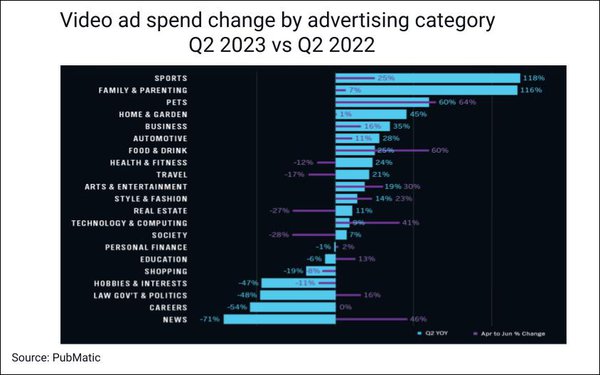
The sports, family/parenting and pets categories showed the greatest growth in programmatic video advertising ad spend amid a mixed second quarter this year, according to data from the PubMatic advertising platform.

“Similar to the retail industry, some advertising sectors experience seasonality, while others tend to flow with macroeconomic conditions — and some are at the whims of both,” notes PubMatic.

Looking at the overall picture, increased impressions volume drove 9% year-over-year growth in ad spend in programmatic connected TV and online video, but lower CPMs drove total video revenue across mobile, desktop and CTV devices for the platform down 4% YoY.

Impressions volume growth resulted in a 30% YoY increase in CTV ad revenue despite some decline in CPMs. Online video impressions across mobile and desktop also increased, but experienced double-digit percentage CPM declines that pushed revenues down more than 10% YoY.

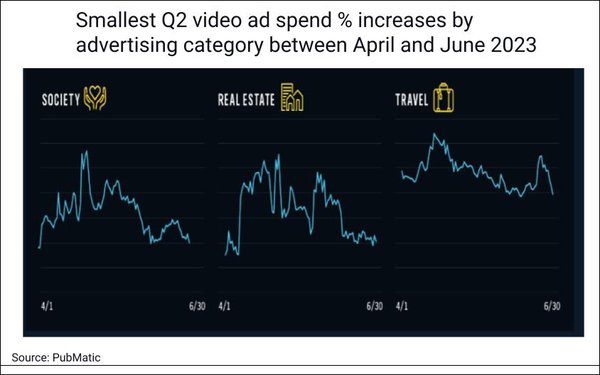
Q2 video ad spend in the sports category more than doubled over Q2 2022 (up 118%), and sports spend also grew 17% YoY across all digital formats. But the category’s video growth rate between April and June of this year was a more modest 25%. Overall category spending rose between April and May, but fell in June. 

The family and parenting category saw Q2’s second-largest growth in YoY video ad spend, at 116%. Its video growth between April and June was just 7%, however. 

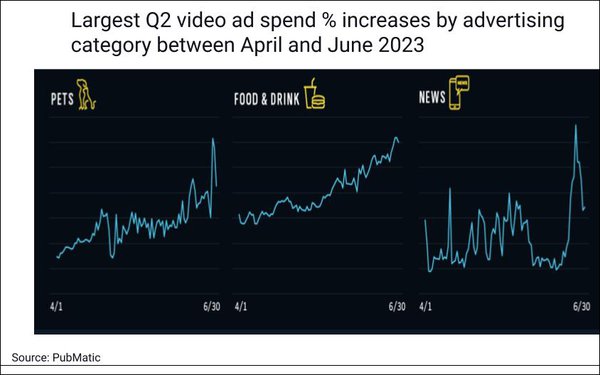
The pets category saw the largest spend growth overall in Q2, and the third-largest YoY growth in video ad spend (up 60%). This category also saw strong video growth between April and June: up 64%. 

Food and drink also saw rapid growth in Q2, including increases in spend in both display and video ad formats. Video spend grew 25% YoY and shot up by 60% between April and June.

Home and garden video ad spend was up 45% YoY, but barely rose (up 1%) between April and June this year. Overall spend in the category rose in April and May, but fell in June.

News, careers, law/government/politics and hobbies and interests were the hardest-hit in terms of Q2 YoY video ad spend, but news, in particular, rebounded between April and June. (Although PubMatic doesn’t mention this, the news uptrend corresponded with a series of indictments against former President Donald Trump.)

Shopping suffered a 19% drop in YoY video spend, and spend in the category declined 8% between April and June.

Shopping suffered a 19% drop in YoY video spend, and spend in the category declined 8% between April and June.


National TV Spending Falls 11% Summer-To-Date, Live Broadcast Viewing Drops 25%


National TV Spending Falls 11% Summer-To-Date, Live Broadcast Viewing Drops 25%

Summer TV broadcast viewing patterns continue to follow that of recent live, linear television trends overall -- registering double-digit percentage declines in viewing, with national TV spend also sinking.

After nearly two months, season-to-date viewership dropped 25% to average 1.81 million viewers per summer prime-time episode, according to Nielsen’s live program- plus-seven days of time-shifted video-on-demand metric for the period from May 25-August 13.

Summer prime-time episodes averaged 2.4 million a year ago.

Some perennial top non-scripted series continue to hold their own this year. Through 10 episodes, NBC’s leading summer show “America’s Got Talent” is down 6% to 7.3 million viewers versus 7.8 million a year ago.

CBS show “Big Brother” is next among the summer reality shows, falling 12% to averaging 4.2 million, with 4.4 million viewers on Wednesdays, 4.1 million on Sundays  and 4.0 million on Thursdays.

ABC’s “Celebrity Family Feud” numbers are more in line with overall broadcast summer viewing trends -- down 24% to 3.9 million (5.1 million a year ago). This is also the the case for ABC’s “The Bachelorette,” which sank 21% to 3.1 million, while ABC’s “The $100,000 Pyramid” was off 17% to 3.4 million.

NBC’s scripted drama “The Blacklist” after seven episodes -- which will soon end its original, live linear TV run after 10 seasons -- came in at 4.1 million.

NBC’s “American Ninja Warrior” is one of the rare original summer shows to show an improvement versus a year ago. After nine episodes this season, it is up 15% to 3.7 million viewers (3.2 million in 2022, through 10 episodes).

ABC’s “The Chase" through four episodes this year also grew, 21% to 3.4 million.

National TV summer advertising revenue during the May 25-August 13 period was down 11% $2.27 billion collectively, looking at five English-language TV networks (CBS, ABC, NBC, Fox and the CW), according to EDO Ad EnGage -- compared to $2.54 billion a year ago.

Thursday, August 10, 2023

How Brands and Retailers are Supercharging Sales Conversion with CTV Advertising


SPONSOR CONTENT FROM PREMION

How Brands and Retailers are Supercharging Sales Conversion with CTV Advertising

    Dave Marquard, Head of Product at Premion

    Analysts are optimistic about improving advertising growth for the second half of the year, with data showing that the economy is moving in the right direction, according to recent Axios reporting. Our own 2023 CTV/OTT Advertiser Study validates this notion — with CTV being the bright spot. We found that investment and optimism for CTV/OTT advertising remain high, and 65% (2 in 3) of advertisers using CTV/OTT will increase their spending, with an average increase of 23%. That's a jump from last year of 53% (more than half), which was already high.

    Simultaneously, advertisers are continuing to prioritize spend efficacy and outcomes and are more focused than ever on allocating more of their ad budgets to performance advertising—to drive sales conversion. In our study, advertisers told us that brand lift (42%), reach and frequency (41%), sales lift (37%), and linear reach extension measurement (35%) are the top KPIs for CTV/OTT advertising.

    Marketers can now measure CTV campaign effectiveness in more precise ways, looking beyond video completion rates as a key success metric and tying CTV viewership directly to critical business outcomes. For instance, an advertiser can match CTV ad exposure with sales data to determine the impact on new sales from a streaming TV campaign. Today, CTV advertisers can delve deeply into measuring outcomes — from website visits to connecting CTV viewership with sales through attribution — truly understanding the ROI of each impression in their campaign.

    Driving Sales Conversion for Advertisers

    Here are some ways that CTV advertisers are driving proof-of-performance and achieving their sales conversion goals:

    After the pandemic, the demand for new home furnishings skyrocketed. A leading regional furniture store sought to boost brand awareness and sales across multiple markets. They shifted more ad dollars to CTV advertising, targeting key furniture buyer audiences, aiming to achieve measurable brand lift, drive website and in-store sales, and ensure a positive return on ad spending. 

    We proved to the furniture retailer that the Premion campaign delivered positive results for every important client success metric throughout the customer journey, from branding and engagement to final sales. Specifically, our campaign drove 37K people to engage with the website within 7 days of viewing the ad. Among them, 2.2K (6%) added merchandise to their carts, validating that these targeted viewers were qualified, in-market home furnishing shoppers ready to take immediate action. By using the client's sales data, we directly attributed 6.2K online and in-store sales to campaign exposure within 30 days of ad viewing, generating $5M in sales revenue with an average spend of $809.

    large foundation repair company with multiple brands nationwide wanted to target homeowners across the country. They previously relied on traditional broadcast TV advertising but sought to supplement their campaigns by reaching untapped streaming TV audiences. We demonstrated the power of CTV advertising with our sales conversion attribution solution, tracking website visits and lead generation. The campaign generated customer interest and engagement in their specialized services, resulting in nearly 5K pre-qualified leads to the call center.

    All told, the Premion campaign drove 33,725 people to the website within 7 days of ad viewing. Among them, 9,344 (28%) visited multiple website pages, showing strong interest in Foundation Repair, Crawl Space Repair, Crawl Space Encapsulation, Basement Waterproofing, and Concrete Lifting services. Leveraging our Sales Conversion Attribution solution, we directly attributed 4,789 call center leads to the campaign within 30 days of ad viewing, providing the client with a complete view of consideration and conversions. The next month, we optimized campaign performance by making zip code targeting modifications, lowering household income (HHI) targeting qualification to $50K in strategic markets, and tested new creative.

    Sales Conversion Attribution, the latest evolution in our industry-leading suite of outcome-based solutions, prioritizes advertisers' business goals to drive campaign performance and optimize ROI.