Wednesday, July 29, 2026

Signing Off

 Good afternoon: Since 2008 I have enjoyed providing sales and station management of television broadcast groups daily updates about our changing and challenging business of media marketing and advertising. 
July 7th I had to take leave as a result of a most needed surgical procedure and that soon as I was able to get back in the office I would jump back in and continue. I had additionally asked  if there was anything that each sales and management team would like to see on this no-charge blog, LeNoble's Media Marketing And Advertising that I would gladly add for even more for your enjoyment. 

Today is July 29th and I'm sure with everything that's been going on in our exciting business, time has run short while budgets have grown perhaps adding to the day's pressures. 

So with great reluctance I am no longer going to update the blog as I have done with hopes each of you have gained from it and wish each of you and long and happy and healthy prosperous career ahead. 

I have truly enjoyed the wonderful career I have had since I began selling and managing radio and television advertising since 1967. The blog was just another fun trip but without you it's no longer fulfilling. So my dear friends, I am signing off. 

If you have a minute send me a note to drphilipjay@gmail.com...I'd love to hear from you!

May peace be with you and your beautiful families!       

Wednesday, July 15, 2026

Gen Z Choosing Pets Over Kids


pets

Gen Z Choosing Pets Over Kids

Asked what they'd prefer to have in the future, more Americans now choose pets over children, according to new data from The Harris Poll.

Some younger owners are cutting their own vacations and even medical appointments to splurge on their animals, according to The Harris Poll’s “The State of Pets.”

The survey was conducted online within the U.S. by The Harris Poll from April 24 to 26, among a nationally representative sample of 2,070 U.S. adults aged 18 and over. Groups polled were 338 Gen Z (ages 18-29), 721 millennials (ages 30-45), 506 Gen X (ages 46-61), and 505 boomers (ages 62 and older). There were 1,625 pet owners in the total.

Tim Osiecki, director of thought leadership and trends at The Harris Poll, answered a few questions from Marketing Daily about the pet trends report. 


Marketing Daily: Which findings surprised even your research team?

Tim Osiecki: What stands out most is the depth of commitment. Nearly three in 10 Gen Z and millennial pet owners say they’ve gone into debt because of pet expenses, which is a striking signal of how high a priority pets have become. 

Marketing Daily: What is the single biggest misconception marketers have about today’s pet owner?

Osiecki: The biggest misconception is that pet ownership is still just a purchase behavior. It’s not. For many consumers, especially younger ones, it’s a life-organizing identity. We’re seeing that pets are influencing how people spend, where they live, and even how they think about family. So the real shift for marketers is to stop seeing pet owners as a niche audience, and start seeing them as modern households making meaningful life decisions around their pets.

Marketing Daily: The report suggests pets are increasingly treated like children. At what point does this become more than just a marketing trope and actually change how brands should position themselves? 

Osiecki: It becomes more than a marketing trope the moment people start making structural decisions around their pets, and this report makes clear that’s already happening. When people are moving to more expensive housing that allows pets, designing parts of their home for them, and making real financial tradeoffs to protect pets' quality of life, brands have to move beyond symbolic messaging. At that point, this isn’t just an emotional insight, it’s a business insight. Brands need to position themselves around practical inclusion, not just pet-friendly language. 

Which non-pet categories have the biggest opportunity because of these shifts?

Osiecki: The biggest opportunities are in categories that shape everyday life: housing, travel, hospitality, financial services, automotive, and healthcare. If pets are now part of the household decision-making unit, then every category that touches the home, mobility, money, or wellbeing has a chance to rethink its value proposition. The most forward-looking brands will recognize that this isn’t about adding a pet perk on the side. It’s about building products, services, and experiences around pet-inclusive living.

Marketing Daily: Should automotive, travel, hospitality, housing, banking, or healthcare companies be thinking differently about pet owners?

Osiecki: These industries should be thinking about pet owners as a major consumer segment with specific expectations, pain points, and loyalty triggers. In automotive, that may mean designing for safer, easier travel with pets. In travel and hospitality, it means making pet accommodation seamless rather than restrictive.

In housing, it means moving beyond tolerance to true pet-forward design. And in banking and healthcare, it means recognizing that pet owners increasingly want financial tools, insurance solutions, and benefits that reflect the real role pets play in their lives. The broader lesson is that pet owners don’t just want permission — they want consideration 

Marketing Daily:  Which trend do you believe marketers are underestimating today?

Osiecki: The most underestimated trend is that the pet economy is becoming an infrastructure story, not just a spending story. A lot of brands still think about pets in terms of accessories, treats, or cute content. But what this report really shows is that pets are influencing systems: housing, travel, benefits, finance, and family planning. That’s a much bigger shift. The brands that will stand out are the ones that don’t just market to pet owners, but actually make pet-inclusive life easier to navigate.

Consumers Don't Move Through Funnels Like They Used To


Commentary

Consumers Don't Move Through Funnels Like They Used To

Marketers have traditionally relied on the funnel to understand customer behavior. Awareness leads to consideration, consideration leads to conversion, reengage and repeat -- it’s simple, logical, and easy to build strategies around.

To be clear, I don’t think the funnel is dead. However, the challenge is that consumers no longer move through the funnel the way they once did.

Today’s buying journeys are faster, far less predictable, and far more interconnected. Consumers can discover a brand, research it, validate it through reviews, compare alternatives, and make a purchase decision in minutes. They can also re-enter the process at any point, often influenced by existing customers.

The middle funnel isn't disappearing -- it's shrinking.

Historically, the consideration stage took time. Consumers gathered information, weighed options, and gradually moved toward a decision. Marketers often had weeks or months to influence that process, depending on the purchase.


Today, much of that research happens before brands even know a consumer exists. Search engines, social platforms, reviews, comparison sites, online communities and AI tools have made information more accessible than ever. Consumers are arriving with a level of education and confidence that once required multiple touchpoints over a longer timeframe.

Consideration hasn’t disappeared. It just happens faster, in a different order, and often out of view. In many cases, consumers enter the journey already halfway through it.

Not everyone starts at the top anymore.

Traditional funnel models assume customers begin with awareness and move sequentially. Behavior is rarely that linear. Consumers might gather information from sources we may not control -- discovering a brand through a friend’s recommendation, a review, creator content, search, or even a retargeting ad. By the time they engage, they may already understand the product and whether it fits their needs. This creates a challenge since we often build campaigns around where we think customers should be instead of where they actually are.

The purchase is no longer the finish line.

The strongest argument for viewing the journey as a cycle is what happens after conversion, and that’s driven by today’s social-first environment. I

n traditional funnel thinking, the purchase is the end of the story. But today's customers don't disappear after making a purchase. They leave reviews, create social content, recommend products, answer questions, and shape opinions in both online and offline spaces.

In many ways, today’s customers power tomorrow’s awareness. A positive experience can generate advocacy that introduces new consumers to a brand. Those new consumers begin their own journeys, influenced by the people who came before them.

What this means for marketers

As customer behavior evolves, strategies need to evolve in tandem. This doesn't mean abandoning the funnel. It’s still a valuable framework for organizing messaging, measurement, and planning. But it’s time to treat it as a guide rather than a rigid map.  Marketers should consider how channels, content, and customer experiences work together across a fluid, dynamic & interconnected journey, rather than a prescribed path.

Customers are discovering brands in new places, researching on their own terms, moving through consideration faster. And they’re influencing future buyers after they become customers themselves.

Gen Z, Millennials Rejecting AI For Films... And On TV?


Gen Z, Millennials Rejecting AI For Films... And On TV?

Amid mounting concerns over AI, TV scripted shows may be safe for now -- especially considering what has been happening lately in the movie business.

Looking at the success of two early-summer season films, “Obsession” and “Backrooms" -- both low-budget theatrical horror movies that came out of nowhere to become blockbusters -- gives us some clues.

The obvious signal is that original concept, non-franchise filmmaking trends reveal that the movie business is not dead.

But for the broader view -- other entertainment content -- it means more.

What does this mean for AI-generated content? The answer is: it's not good.

Prominent film director Christopher Nolan said it more plainly, noting the success of the two movies and the rejection of seemingly “AI Slop”-produced content is significant. 

“So much energy has been expended on bringing in AI, but if you look at that generation’s reaction, they’re utterly rejecting it..... Their judgment of AI slop has been immediate and harsh. “


Adding a perspective, with regard to "Obsession" and “Backrooms," Nolan says: “Those films are so mysterious and ruminative. I mean, parts of 'Backrooms' are like David Lynch at his most obscure. And yet young people can’t get enough of them.”

However, this has not stopped some entertainment companies from at least dipping their toes in the water.

One company is Artlist -- a digital asset company that provides stock footage, templates, and royalty-free music to video creators.

It recently created a number of scripted TV-like content series under Artlist TV that primarily runs on YouTube. The service started up in June with shows covering recent Hollywood themes, including “The Arc," a historical action series of a soldier in 1600s Japan; “Terrible People,” a dark comedy tracking a high-stakes corporate PR publicist; “The Sequence”, a mystery-thriller about an ordinary man who inherits memories that belong to a stranger, and “Deception," a suspense thriller involving a missing woman who is replaced by a perfect clone.

Comments from viewers referred to characters that seemed "wooden” and cliches.

For the first episode of the show “The Arc,” Artlist reveals in the description that it is “the first Artist TV original series created with AI.” That episode pulled in 1,700 views so far on YouTube, and viewers had mixed feelings.

At least three comments described the content as “amazing work.” 

And then was this comment: “This is embarrassing and I’m honestly shocked people who call themselves professionals would release something so obviously discrediting.”

Overall, in his interview with The Telegraph, Nolan sees this as having greater impact: "I've never seen a more rapid wholesale dismissal of a supposedly foundational jump in technology in my lifetime."

More art in Artlist’s efforts may be needed in AI for some critical reviewers and observers.

Paramount-WBD Now: Real Effect Of A 12-State Lawsuit?


Paramount-WBD Now: Real Effect Of A 12-State Lawsuit?

Paramount Skydance's near-completed merger with Warner Bros. Discovery is not so complete. Or near.

Twelve U.S. states just filed a lawsuit to stop the deal, with the primary reason being the combination will curb entertainment content/distribution, putting the TV/movie marketplace into fewer hands, which will hurt entertainment employment for the future.

This comes at what may be a difficult time for Paramount Skydance, with the company looking to complete its $111 billion deal.

This will significantly delay many things on the company’s big list to address.

What really happens with those rapidly declining (through still profitable) cable TV networks the company would own -- around 50 basic channels in total?

Does the company really look to sell them off, combine them, or re-imagine them as exclusive digital and web-based platforms to make them more efficient?


A more high-profile issue is the TV/streaming news channel operations -- the long-time CBS News group (including continued upheaval at shows like “60 Minutes”) and its likely combination with CNN?

What about a movie-studio combination of Paramount Pictures and Warner Bros? Skydance has promised that total output of theatrical movies will stay nearly at the same levels: 15 per year each for Paramount and Warner Bros.

But many are skeptical that all will remain the same -- or what company employment will be like at those studios. For one, Paramount has talked up “content spending reductions” to investors.

And there is this to consider: If the deal gets delayed after October every quarterly period that goes by means Paramount needs to pay WBD and its shareholders a “ticking” fee -- 25 cents a share per quarter. This could amount to $700 million every three months.

Now, adding just under $1 billion to a $111 billion merger deal price by itself won’t, by itself, kill off the deal -- one that is mostly funded by Larry Ellison, father of David Ellison, CEO of Paramount Skydance. Ellison has a net worth of around $200 billion currently.

Long term debt for Paramount Skydance? A massive $79 billion as a result of a $111 billion merger deal price tag.

What is the real picture going forward?

Prediction market platform Kalshi gives roughly 79% odds to the prospective deal being completed. But another 16% say no deal will be completed by anyone taking over WBD until a year from now, in July 2027.

How about the possibility that Netflix returns to make another new WBD bid? Just a 3% chance.

More storylines to consider.

Getting back to work

 Hey All: Apologize for the many days of absence. Following a visit to my primary care physician, I had to see a surgeon and on July 7th, I had surgery. It's been a long time for me not sharing the latest TV media marketing, management and weekly sales and marketing for you on my blog, LeNoble's Media Sales Insights for so long a time. I'm back and will ask you to please send me a quick note to drphilipjay@gmail.com so I can continue this blog for you and your sales teams. 

Hope to hear from you so I may get started again....Best always 

Thursday, June 25, 2026

Why Sales Coaching Needs a New Playbook


Why Sales Coaching Needs a New Playbook

The goal is not to coach more, but to coach with intent.

Sales organizations are under growing pressure. Revenue targets are higher, margins are tighter and buying cycles continue to lengthen. Many teams are still finding ways to hit the number, but performance is becoming harder to sustain. One of the clearest signs of strain sits in the middle of the organization: the frontline sales manager.

Most leaders agree that managers are critical to results. Far fewer have modernized how managers coach. Gartner research shows that only a small minority of sales managers believe they lead high‑performing teams, even though most organizations identify frontline management as essential to revenue performance. Many sales teams remain dependent on a handful of top sellers to carry bookings. When success relies on heroics rather than consistency, risk builds quickly.

The issue is not that managers are not coaching. It’s that they are coaching everyone, on everything, all the time.

Equal Coaching Doesn’t Drive Equal Performance

Many managers distribute seller coaching time evenly across their teams, believing fairness leads to improvement. In reality, equal coaching produces uneven returns.

Manager time is scarce and valuable. Treating it like a blanket activity spreads its impact too thin. High‑performing teams recognize that coaching should be focused where it can deliver the greatest performance lift. The goal is not to coach more, but to coach with intent.

That requires managers to be selective. Not every seller needs coaching at the same time. Some sellers are receptive and capable of applying feedback quickly. Others may struggle with motivation, role fit or fundamentals that coaching itself will not fix. Concentrating effort on sellers who can absorb and apply coaching most effectively strengthens bench depth and reduces reliance on top performers. It also frees managers to address performance challenges directly when coaching is not the right solution.

Skill, Will and Coachability Matter More Than Tenure

A modern coaching approach begins by evaluating the following factors beyond surface-level performance outcomes: skill, will and coachability.

Skill reflects whether a seller has the capabilities needed to execute in role. Will reflects motivation and commitment. Coachability determines whether the feedback given translates into actual changed behavior. Sellers may accept advice, but do they act on it consistently?

These distinctions are important because coaching is not performance management. When managers attempt to solve disengagement or chronic underperformance through coaching alone, they waste time and frustrate both sides. Effective managers separate coaching for growth from conversations that reset expectations or clarify role fit.

Prioritizing coachability helps ensure that coaching time produces real improvement rather than surface‑level agreement.

What Effective Managers Coach

The strongest managers focus coaching where behavior directly influences results: mindset, deal judgment and win‑driving behaviors.

Mindset shapes how sellers interpret risk and opportunity. In complex buying environments, sellers often rush to pitch due to a belief barrier of needing to prove value fast. Coaching mindset helps sellers slow down, reshaping how to diagnose customer problems and engage buyers more productively.

Deal judgment determines how sellers decide their next move. Weak judgment shows up when sellers mistake buyer interest with buyer readiness, advancing deals without clear buyer ownership or validated evidence. Coaching judgment improves decision quality earlier in the sales cycle, when outcomes are still changeable.

Win‑driving behaviors are the high-causal habits of top performers that consistently improve sales results. By coaching these behaviors, such as early stakeholder multithreading across sellers’ execution routines, managers drive repeatability instead of one‑off advice.

The Real Unlock Is the Manager

The most overlooked element of sales performance is the frontline manager’s ability to translate insight into action.

AI, analytics and dashboards do not change seller behavior on their own. Managers do. Gartner research shows that managers who use data to focus coaching on the highest‑impact opportunities are more than four times as likely to exceed expected profit growth. Yet, only a small portion of frontline managers primarily use data to guide coaching discussions. Sales organizations must present information in a consumable, actionable way so managers can apply it in the right context and drive clear next steps for sellers.

Coaching That Scales Performance

Sales complexity is not going away. Teams that continue to rely on hero sellers and generic coaching will struggle to scale. Those that succeed will empower managers with a new coaching playbook that treats time as a strategic asset, focuses on capability over activity, and intervenes when leverage is highest.

Coaching does not need to be louder or more frequent. It needs to be sharper, more selective and better timed. When managers coach with precision, they do more than improve individual performance. They build resilience into the entire revenue organization.

Nielsen: YouTube Gains, Fox-Roku Would Be Third


Nielsen: YouTube Gains, Fox-Roku Would Be Third

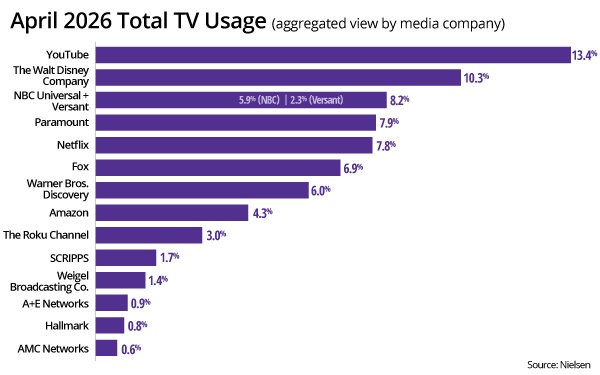
YouTube continues to grow its share of total TV/streaming viewers by a media distributor -- with 13.4%, up a full share point versus the same time period a year ago, according to Nielsen's Media Distributor Index.

At the same time, Walt Disney slipped around half a share point to 10.3% (vs. 10.7%). NBCUniversal/Versant Media remained the same with a combined 8.2% share. Breaking this down, NBCU was 5.9% and Versant Media, the former NBCU cable network, was at 2.3%.

Paramount Skydance slipped a full share point to 7.9% (from 8.9%) while Netflix rose to 7.8% (from 7.5%), followed by Fox Corp at 6.9%, up from 6.8%.

Looking ahead, Fox's proposed acquisition of Roku would give the combined company a 9.9% share -- to land in third place behind Disney. A year ago, a combined Fox Corp./Roku would have landed at 9.2%.


Nielsen also released its monthly “Gauge” total TV viewing for April 2026, which examines specific types of platforms (broadcast, cable and streaming) and individual streaming platforms.

Streaming was at 47.6% (vs. 44.3% a year ago), and cable networks came in at 21.6% (vs. 24.5% in April 2025)).

Broadcast slipped below 20% for the first time -- to 19.9% (vs. 20.8% the year before). Broadcast drama was the most-watched genre within the overall drama category, with a 28% share. CBS’ “Tracker” and “Marshals” and ABC’s “High Potential” were top performers.

Cable was strongest with viewing from the closing days of NCAA’s “March Madness” event, Masters golf tournament, NBA playoffs.

Streaming platforms posting month-to-month growth included YouTube, Prime Video, Tubi, and Warner Bros. Discovery streaming platforms (HBO Max, discovery+).

Nielsen says the Gauge and its Media Distributor Index have not yet shifted to account for the ARF DASH-based media-related universe estimates. That release is scheduled to start up this fall

The Media Plan Is Now a Citation Plan

 Here's what ad agencies are thinking about for their clients which may be adaptable for local direct clients: Philip Jay LeNoble, Ph.D.

Commentary

The Media Plan Is Now a Citation Plan

More than a third of U.S. consumers now begin product research inside ChatGPT, Claude, Gemini, Perplexity, or Google AI Overviews.

The 2026 media plan still does not have a line for that.

Every answer is an ad -- and the spreadsheet your team is filling out right now, which includes GRPs, CPMs, viewability and retargeting, is optimizing distribution for channels your buyers have already partially exited.

The collapse most CMOs haven't priced in

Two years ago, ranking number one on Google meant AI visibility. The same content sat at the top of the page and inside the chatbot answer.

That’s no longer the case. Down from roughly 70% to under 20%, according to data from GEO firm Brandlight and synthesized in our latest research at 5W, the page your media team is buying traffic to does not appear inside the answer your buyer is reading. Your media plan and your visibility plan are now two different documents, but most planners are still treating them as one.


The brief needs to change

Three lines should appear on every 2026 media plan that don't appear today:

Citation share by engine. Your share of mentions inside ChatGPT, Claude, Gemini, Perplexity, and Google AI Overviews. You should be measuring against your defined competitor set and across your defined buyer prompts. This is the new share of voice.

Retrieval anchors. The owned and earned assets, like research, executive bylines, structured FAQ pages, trade coverage, are what the engines pull from when answering category prompts.

Prompt-level reporting. Buyers no longer type "best CRM for mid-market." They type a full sentence to an LLM. You should be measuring against the 50–200 prompts that drive your category.

Without those three lines, the media plan you're putting together is deficient.

Why this lands on media buyers first, not PR

Media buying is where the budget lives. PR teams have been arguing about generative AI for two years. The line item lives with the planner, and the planner reports to the CMO, who is being asked in 2026 board meetings the only question that matters: What is our share of the answer?

Ad budgets and answer-engine visibility have decoupled. The planner who continues to optimize against the old correlation is allocating capital against a chart that no longer holds.

What goes into the plan instead

A modern media plan should include:

A baselineCitation audit, scored across five engines and run quarterly. Measure across Citation Frequency (40%), Cross-Engine Breadth (20%), Query-Type Breadth (20%), Extractability (15%), Crawl Access (5%).

AGEO retainer that produces retrieval anchors monthly.  Proprietary research, FAQ schema, executive bylines, trade-press placement engineered for AI retrieval.

Aprompt panel of 50–200 buyer-stage queries the brand reports against the way it once reported against a keyword set.

That is the citation plan. It sits alongside the media plan. In 2027, it absorbs it.

Agentic Transactions, Relationship-Centered TV Ad Industry Not Mutually Exclusive


Commentary

Agentic Transactions, Relationship-Centered TV Ad Industry Not Mutually Exclusive

So many see the advertising industry’s fast-emerging AI-driven agentic future as anathema to its relationship-driven core. It isn’t and won’t be, as I learned at the Cannes Lions festival this week.

I flew to France excited to talk about the new developments in agentic transactions in the TV ad world, highlighted by Fox Broadcasting and its industry-first end-to-end agentic platform for streaming and linear TV ad transactions.

I was worried that the Cannes world of panels, presentations and impromptu gatherings would rue the day that automated AI agents would drive the selling and buying of the billions of dollars of TV ads, a process traditionally handled through highly personal phone calls, faxes and handshakes between longtime friends.

But I quickly realized that they're not mutually exclusive.

Spending time in Cannes connects all of us to our industry’s history, so I realized that an advertising world driven by agentic transactions is not new. Agency-driven buying and selling of advertising has been a central part of the media marketplace for centuries, just as agent-driven media networks were, a business popularized by Swiss ad specialist Publicitas in the mid-1800s with its network of German and Swiss newspapers.


Those early agentic transactions and media networks relied on trusted human relationships, epitomized by the emergence of specialist ad buyers and sellers who leveraged the most modern technology of the times: trains, timetables, telegraphs and mechanized typography.

That’s correct. Technology-enabled agentic transactions in the advertising industry are not new. Nor is exploiting the best technology available mutually exclusive to the human relationship center of our historic TV ad industry.

AI-driven streaming and linear TV ad transactions can deliver a level of speed, efficiency, yield management and security critical for both advertisers and media owners, maximizing the value of each and every impression and, importantly, delivering the best experience possible to consumers.

Automated, agentic transactions actually give more importance to the human relationship parts of ad buying and selling. Buyers and sellers both need to exercise care picking which agents to transact with, under what rules, and with constant monitoring. That requires real partnership and a predictability of conduct. And it requires trust.

Given the precious, scarce nature of premium video inventory, TV media owners are not going to grant “agentic rights” lightly. Neither will buyers. We have all seen the fraud, pollution and devalued pricing that real-time bidding platforms and disinterested, brokering intermediaries brought to the world of the banner ad, web video, and CTV advertising.

A big theme at Cannes this year was that quality matters, whether in media or data. Also, trust matters, when deciding whom you transact with and how your campaigns are measured. And the ad industry needs to regain control from those focused on harvesting media rather than creating and building it. That message was preached on every stage.

Creating and building the media world that publishers, advertisers, agencies and consumers deserve requires a high degree of human control. That control and trust can only come through strong, personal human relationships.

Yes, agent transactions are the future of the TV ad world. But so are its human-relationship-centered partnerships.

Nielsen: YouTube Gains, Fox-Roku Would Be Third


Nielsen: YouTube Gains, Fox-Roku Would Be Third

YouTube continues to grow its share of total TV/streaming viewers by a media distributor -- with 13.4%, up a full share point versus the same time period a year ago, according to Nielsen's Media Distributor Index.

At the same time, Walt Disney slipped around half a share point to 10.3% (vs. 10.7%). NBCUniversal/Versant Media remained the same with a combined 8.2% share. Breaking this down, NBCU was 5.9% and Versant Media, the former NBCU cable network, was at 2.3%.

Paramount Skydance slipped a full share point to 7.9% (from 8.9%) while Netflix rose to 7.8% (from 7.5%), followed by Fox Corp at 6.9%, up from 6.8%.

Looking ahead, Fox's proposed acquisition of Roku would give the combined company a 9.9% share -- to land in third place behind Disney. A year ago, a combined Fox Corp./Roku would have landed at 9.2%.


Nielsen also released its monthly “Gauge” total TV viewing for April 2026, which examines specific types of platforms (broadcast, cable and streaming) and individual streaming platforms.

Streaming was at 47.6% (vs. 44.3% a year ago), and cable networks came in at 21.6% (vs. 24.5% in April 2025)).

Broadcast slipped below 20% for the first time -- to 19.9% (vs. 20.8% the year before). Broadcast drama was the most-watched genre within the overall drama category, with a 28% share. CBS’ “Tracker” and “Marshals” and ABC’s “High Potential” were top performers.

Cable was strongest with viewing from the closing days of NCAA’s “March Madness” event, Masters golf tournament, NBA playoffs.

Streaming platforms posting month-to-month growth included YouTube, Prime Video, Tubi, and Warner Bros. Discovery streaming platforms (HBO Max, discovery+).

Nielsen says the Gauge and its Media Distributor Index have not yet shifted to account for the ARF DASH-based media-related universe estimates. That release is scheduled to start up this fall. 

Brand-Safe - And Not-So-Safe - News


Commentary

Brand-Safe - And Not-So-Safe - News


New and revealing analysis of ad-supported news content on FAST channels shows that nearly 36% of “news scenes” are fully brand-safe, according to research from Wurl, the streaming subsidiary of AppLovin.

The bottom-line analysis reveals there are significant reasons to buy news content, “meaning advertisers who avoid news scenes altogether are leaving money on the table.”

Research showed brand-safe news content is still lower in brand safety than non-news content (35.7% versus 54.5%, respectively).

Bigger brand-safety risks are involved with content related to "death and harm," at 43%.

Content related to "violence" is next at 31%, followed by content related to "war and conflict" at 31%.

Other categories that were analyzed include content related to sex (at 3%) and profanity (at 2%), content that is derogatory at 2% and drug-related content, also at 2%.


The analysis also notes that politically oriented news is generally brand-safe overall, with brand-safety at 45.5% for blue-leaning news channels vs. 48.3% for red-leaning news platforms.

Better results come with financial news content, which is deemed the most brand-safe.

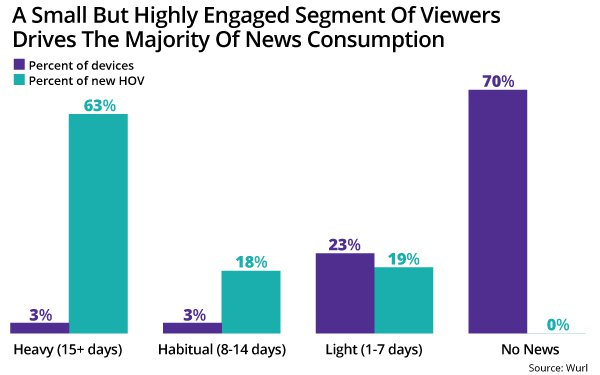
The study also indicates that heavy news viewers make up 3% of viewing streaming platforms, but comprise 63% of all news viewing.

The future could be better when it comes to deciding whether brands should buy into news, featuring new technology such as “scene-level AI analysis” which is slowly replacing less accurate keywords and categories to deal with unsafe news content.

Wurl says this analysis is important because news audiences are highly concentrated and difficult to reach elsewhere.

Fox-Roku: What's Next - And for Fox One?


Commentary

Fox-Roku: What's Next - And for Fox One?

For some time now, Fox Corp. has taken great pains to tell us how important linear TV was -- its Fox Television Network and Fox News Media networks -- even as it launched Fox One, its premium streaming platform, last summer.

So how do we make sense of this in the context of Fox's announcement earlier this week that it would be buying the massive streaming platform Roku for $22 billion?

For many, Fox One (including Fox Corp) the streamer seemed to be a low-key effort to be in the game, with other legacy premium streamers -- Paramount+, Disney+ and Peacock, for example.

Fox One is estimated to have around 2.9 million subscribers -- just a fraction of the business of those other major streamers.

Will the dynamic now change for the company and its streaming platform?

Well, Roku has been offering Fox One since its start in August 2025. So there doesn’t seem to be much of a change there.


With Roku, Fox is now working in another streaming area -- benefitting from its access to Roku’s own Roku Channel, as well as financially from its legacy competitors, to some extent.

For example, Roku gains a share of those streamers' subscription fees -- around 20% revenue share. That is lower compared to the major premium streamers Disney+, Netflix and Prime Video because of their greater market leverage. 

And there is an advertising inventory share as well -- with Roku getting 30% on average, leaving the streamer to maintain 70%. Again, bigger streamers look to command a more favorable share.

This probably will not change things for Fox’s competitors. Many have been through this in the past.

Think about Fox Corp. and others having to negotiate carriage fees with Comcast Corp. on its cable and virtual pay TV services --- all while Comcast’s NBCUniversal operates.

What Fox-Roku gives the company -- in addition to the increasing success of Tubi -- is more heft and reach in terms of more streaming viewership reach and engagement.

This is something major media-buying executives increasingly desire.

Fox is now making its transition back to the big media stage after selling half of its company (movie studios and cable TV networks) to Disney in 2019.

Perhaps the cash-rich Fox Corp. may seek other streaming acquisitions.

Thursday, June 11, 2026

Colbert, Kimmel? Late-Night TV Scores Well on YouTube


Commentary

Colbert, Kimmel? Late-Night TV Scores Well On YouTube


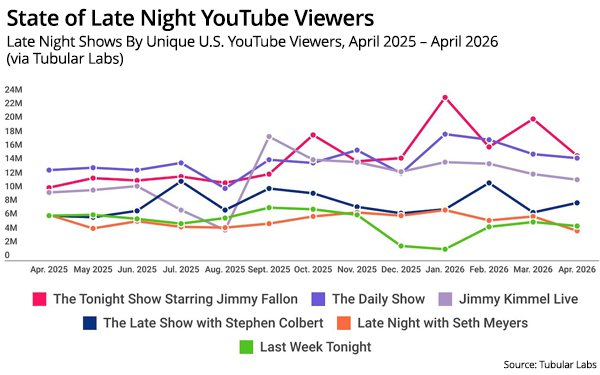
Amid controversy over late-night TV, viewer sentiment has generally increased over the last 12 months -- at least when it comes to YouTube viewers.

CBS’ “Late Show With Stephen Colbert” witnessed a 30% increase in unique viewers in April 2026 versus the same period a year earlier to around 6.5 million, according to Tubular Labs.

This came in connection with the announcement in July 2025 that Paramount Skydance would be ending Colbert’s 11-year run on the show, because of what it said were “purely” financial reasons.

In addition, the show’s watch-time on YouTube was up 20% nearing his final episodes with big-name guests weighing in on his show, ending with video content featuring former host David Letterman throwing some of the show’s furniture off the roof of the Ed Sullivan Theater.

advertisement

640 x 480.png

advertisement

ABC’s “Jimmy Kimmel Live” also grew to 18 million unique viewership in September 2025 following his week-long suspension and reinstatement. Although “Jimmy Kimmel Live” slowly declined in April 2026 (around 11.7 million), it is still up 18% from year-ago levels.

As of April 2026, NBC’s “The Tonight Show Starring Jimmy Fallon” had the strongest results (15.2 million uniques) -- up 45% versus the year before.

Comedy Central’s “The Daily Show” was just behind at 14.8 million uniques -- 13% higher than the previous year.

In terms of minutes viewed on YouTube, “The Daily Show” performed the best at around 500 million minutes watched in April, followed by “Jimmy Kimmel Live” at 350 million; and Colbert at 250 million.