Thursday, June 4, 2026

More Late-Night Ad Dollars? What Remains For Kimmel, Fallon


More Late-Night Ad Dollars? What Remains For Kimmel, Fallon

Now with “Colbert” gone, what is left for late-night television -- from an advertising perspective? Possibly a bit more.

Mark Marshall, chairman of advertising partnerships at NBCUniversal, says there is still strong demand from advertisers for late-night talk content.

All the attention and controversy may play a role in this. Recent estimates show that for the June 2025-June 2026 period,the three big broadcast late-night shows were up70% in total national TV advertising revenue to $311.6 million -- compared to $184.5 million for the previous 12-month period of June 2024-June 2025. This includes all airings and repeats on other platforms.

All this came before the recent major focus, attention, and controversy (and one major cancellation) on “Jimmy Kimmel Live” and “The Late Show with Stephen Colbert.”

Publicly, Paramount Skydance dropped “The Late Show with Stephen Colbert” because it was losing money -- amid controversy, new ownership and the perspective of President Trump, who has not had good things to say about this late-night content -- generally.

So how can NBCU’s “The Tonight Show with Jimmy Fallon” and Disney-ABC’s “Jimmy Kimmel Live” survive -- when “Colbert” could not?

On the surface, one less competitor in the market could change the math somewhat.

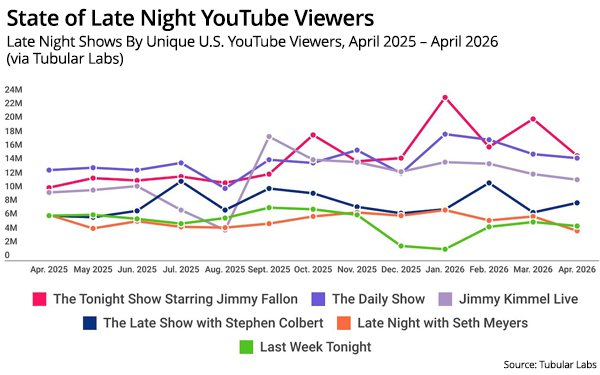
And there is other good news from YouTube, where hosts' monologues, celebrity interviews and musical content appears.

YouTube “views” over the last 12 months have climbed substantially.

Still, from a traditional Nielsen-measured viewership point of view, “Colbert” was the leader with 2.7 million in the first quarter of 2026, followed by Kimmel at 2.5 million and Fallon at 1.3 million.

Can they fill the gap -- and more importantly, will late-night focused advertisers move more money into those shows, and perhaps into Fox News Channel's "Gutfeld!" or Comedy Central’s “The Daily Show”?

There are many digital, streaming and other alternatives for those advertisers to consider.

Broadcast still has the reach factor -- and growing hype from YouTube. Is that enough?

And perhaps the Trump Administration can continue to be a good TV marketing tool (winking emoji here).

Retail Media Stole The Shelf

 Something to share during a sales meeting talking about how retailers realize today media marketing which creates shopping is more about relationship building and persuasion; 
Philip Jay LeNoble, Ph.D. 

Retail Media Stole The Shelf

The retail shelf as moment of truth is officially over.

Now that retail media networks actively shape shopper intent, people aren’t wandering the aisles looking at packaging.

They are entering the store having made their brand decisions. A beautifully designed pasta sauce jar might catch their eye and earn a trial, but let’s not kid ourselves. The heavy lifting happened online.

With first-party data, every search query, abandoned cart and late-night impulse click feeds an ecosystem that brands can’t access on their own. The result is a symbiotic relationship that is starting to resemble dependency. 

Brands, once the undisputed storytellers, now find themselves paying for proximity to their own customers, and margin compression has become the cost of visibility. If you want to show up where the eyeballs are, you pay -- and then pay more. And continue to pay again and again.

Consider the quiet genius of retail pricing psychology: A product listed at $40 plus $9 shipping suddenly looks less appealing than the exact same item at $49 with “free” shipping.

While the math is identical, the perception is not. Retailers don’t just host the transaction, they frame it, influence it and ultimately own it. 

There are exceptions. Some retailers have sidestepped the race to the bottom by building something more emotional and experiential.

They have turned shopping into a relationship rather than a transaction. But those are the outliers.

For most, the game is scale, data and control. So where does that leave brands? Not so much powerless, but at an inflection point. 

Here are three ways brands can win in the retail media marketplace:

Create demand even before the algorithm does. Retail media excels most at capturing intent, not creating it. Brands that rely exclusively on retail platforms run the risk of becoming interchangeable (optimized for visibility but pretty much stripped of distinction).

The advantage still lies in building demand upstream through storytelling that makes consumers seek out a particular product even before they ever open a retailer’s app. If retailers control discovery, brands should own desire.

Invest in creativity that outlasts attribution windows. Retail media promises precision, dashboard models and the seductive illusion that every single dollar ties directly to a sale. But keep in mind, measurability is not the same as effectiveness. The industry’s fixation on immediate ROI risks flattening the creativity that drives long-term growth.

A great pickle ad on Tuesday doesn’t guarantee a purchase on Wednesday. Influence accumulates in less visible ways (through memory, emotion and subconscious nudges).

That messy middle is where great creative works, even if it doesn’t fit neatly onto a spreadsheet.

Compete on perception, not solely on placement. Retailers don’t just host transactions; they actually frame them. The most effective campaigns don’t mirror reality so much as reflect aspiration. In short, consumers don’t see themselves as they are, but as they want to be. In an environment where ads are, by definition, interruptions, the ones that resonate emotionally are the ones that endure.

There are exceptions. In fact, some retailers have resisted the race to the bottom by building experiences that feel relational, not transactional. But those are generally outliers. For most, the game is scale, data and control.

Which makes creativity both more important, and easier than ever to ignore. Retailers may own the pipes, but brands still own the magic.

So as retailers tighten their grip on distribution, data and discovery, brands face a choice: become tenants in someone else’s media ecosystem, or double down on the kind of storytelling that creates demand no algorithm can fully contain.

The shelf may be digital now, but persuasion is still profoundly human. And that’s a game retailers haven’t completely won -- yet.

The Future Of Sports Is Holistic, Accountable, Not Just Transactional


Commentary

The Future Of Sports Is Holistic, Accountable, Not Just Transactional

Sports marketing has never been more culturally influential -- or more commercially misunderstood. As live sports continue to command attention in an increasingly fragmented media landscape, brands are investing billions into sponsorships, media, athlete partnerships, and experiential activations. 

Yet, too many brands still approach sports marketing transactionally: a logo on a jersey, a short-term partnership around a tentpole event, or a media buy designed to maximize impressions. These tactics may generate reach, but reach alone is no longer enough.

Without strategic integration into the broader media and communications plan, sports investments often fail to create sustained resonance with consumers. That model no longer reflects how audiences engage with sports -- or how brands should generate value from it.

Today, sports are far more than a media channel. They sit at the center of culture, intersecting with entertainment, music, fashion, gaming, technology, and social identity. Fans don’t engage with sports in a single moment; they experience them continuously across platforms, communities, creators, and conversations.

For marketers, that creates a massive opportunity to build relevance and emotional connection. But it also requires a more integrated strategy.

Too many brands still treat sports marketing as a standalone discipline operating outside the broader communications ecosystem. A sponsorship team negotiates rights. A media team buys inventory. Social and experiential teams activate independently. The result is often fragmented storytelling and inconsistent brand impact.

The most effective brands approach sports holistically. Sponsorships should reinforce broader brand positioning. Media investments should shape and amplify narrative and engagement. Social, influencer, experiential, and retail efforts should work together to create a connected, seamless consumer journey. Sports should not sit adjacent to the media plan -- they should function as a fully integrated part of it.

That integration matters because consumers increasingly expect, even demand, authenticity and consistency from brands. Audiences can quickly identify when partnerships feel opportunistic rather than meaningful.

The brands succeeding in sports today are not simply borrowing attention from fandom; they are creating genuine participation within culture. That requires long-term thinking, strategic alignment, and disciplined execution.

Just as importantly, sports marketing must be held to the same standards of accountability as every other marketing investment. The emotional power of sports is undeniable, but it should not exempt brands from demanding measurable outcomes. Too often, marketers rely on visibility, excitement, or hospitality value as proxies for success without clearly defining business objectives.

Brands should apply the same rigor to sports that they apply to digital, performance, or linear media. Clear KPIs, measurement frameworks, attribution models, and audience analytics should be established upfront.

Whether the goal is awareness, brand lift, customer acquisition, loyalty, or sales impact, sports investments must be evaluated against tangible business results.

The future of sports marketing belongs to brands that move beyond transactional thinking and embrace integration, accountability, and cultural fluency.

Sports remains one of the few environments capable of delivering mass reach, emotional engagement, and real-time cultural relevance simultaneously. But unlocking its full value requires treating it not as a siloed sponsorship category, but as a strategic business investment embedded across the broader marketing universe.

Half Of Advertisers Buying Programmatic Are Underperforming...

Seems local-direct is still a boon for local TV advertising as it is most controllable with the highest net revenue! Philip Jay LeNoble, Ph.D.


Commentary

Half Of Advertisers Buying Programmatic Are Underperforming...

Ever since 19th Century retail marketer John Wannamaker's "which half" quip, the ad industry has been transfixed by binary results, so it's not surprising that the just-released first quarter 2026 edition of the Association of National Advertisers' quarterly "Programmatic Transparency Benchmark" reports has divided programmatic advertising ROI into a tale of two performance cohorts: the "lower half" and the "upper half."

Specifically, the analysis finds the performance gap is spreading between the two.

Utilizing the ANA's proprietary TrueAdSpend analytics metric, the Q1 report found a delta of 21.9 points between the upper and lower half's programmatic advertising results: the upper half converted 54.0% of its programmatic ad spend into "qualified impressions;" while the lower half converted just 32.1%.

Importantly, the ANA found that the differentiation had little do do with programmatic media-buying costs, and more to do with programmatic inventory "quality."

While transaction costs differed by just 2.4 percentage points between the upper and lower cohorts, "media productivity" losses differed by 19.4 percentage points.

"Programmatic performance is increasingly driven by the ability to actively manage quality, price, measurement, and curate supply at scale,” ANA CEO Bob Liodice explains in a statement provided with the report, noting, “Higher-performing advertisers continue to convert spend more efficiently, while lower-performing advertisers are falling further behind.”