Wednesday, April 30, 2025

Ad Market Rebounds in March, Delivers High Single Digit Growth


Ad Market Rebounds In March, Delivers High Single Digit Growth

March came in like a lamb and went out like a roller coaster ride in the U.S. ad marketplace, according to just refreshed data from Guideline's U.S. Ad Tracker.

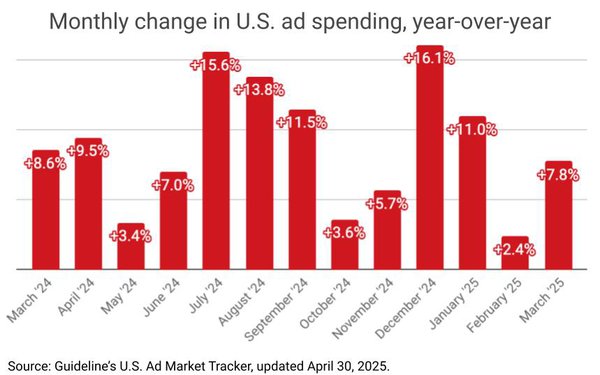
The index, which decelerated to 2.4% in February -- the worst expansion since the last ad recession ended -- bounced back to a 7.8% gain in March, implying a relatively healthy signal for the U.S. ad marketplace despite continuing concerns about the nation's economy, the macroeconomy, and geopolitical instability that have some economists predicting another looming recession.

The March index data also follows Guideline's release of "forward bookings" estimates for advance buys for the first two-months of the second quarter showing a scant 1.8% gain (see below).

At the very least, the volatile nature of final buys and forward bookings compounds the uncertainty of the underlying health of U.S. ad spending.


Thursday, April 24, 2025

Beyond Transactions: How to Build Customer Relationships That Last

 A pretty good read regarding customer relationship management: Philip Jay LeNoble, Ph.D.


Beyond Transactions: How to Build Customer Relationships That Last

If you work in customer experience, you’ve likely heard the phrase “the customer is always right.” In reality, good CX isn’t about always saying yes. True customer experience is about building a consultative relationship – one where you prioritize long-term success over short-term wins. Sometimes, that means having tough conversations, pushing back when necessary, or even walking away from a project if it’s not the right fit.

The companies that get this right aren’t just vendors; they’re trusted partners. They earn loyalty not by agreeing to everything but by providing real value, even when it’s uncomfortable. A well-executed customer experience strategy ensures that every stage of the customer lifecycle is built on trust, transparency and mutual benefit. Here’s how to approach each stage with a strategic mindset that strengthens relationships and positions you as a long-term partner.

The Customer Experience Lifecycle

The customer experience lifecycle isn’t just about transactions. It’s the full journey a customer takes with your brand, from initial awareness to long-term advocacy. At every stage, there are opportunities to create memorable moments that reinforce trust and demonstrate your value as a strategic partner.

The key stages include:

  • Awareness: Customers first discover your brand.
  • Consideration: They evaluate your solutions and decide if they align with their needs.
  • Purchase: They commit to working with you.
  • Retention: They continue to engage with your brand, benefiting from ongoing value.
  • Advocacy: They refer others and champion your company in conversations.

But there’s another stage that often goes unspoken: Exit. Customers leave for different reasons – budget cuts, leadership changes, shifting priorities. Sometimes, they leave because alignment wasn’t there from the start. Every interaction, whether they stay or go, leaves an impression. How you handle these transitions impacts whether they’ll return or recommend you down the road.

Awareness: Making a Strong First Impression

At the awareness stage, your goal is to stand out in a crowded market and capture attention in a way that feels authentic. That means storytelling that connects, not just marketing messages that push a sale.

Be upfront about your strengths and the problems you solve, but also about what you don’t do. Customers appreciate transparency. If you try to be everything to everyone, you’ll dilute your message and risk attracting the wrong audience – leading to misaligned expectations down the road.

Consideration: Building Trust by Being Honest

When customers reach the consideration stage, they’re weighing their options. This is where many companies focus on making the pitch, but building trust is just as important as making the sale.

This is also where tough conversations need to happen. If a client’s expectations are unrealistic, if they’re pushing for an approach that won’t lead to success, or if your solution isn’t the right fit, it’s your job to say so. The courage to redirect a prospect – or even walk away when necessary – is what separates true strategic partners from vendors who chase short-term wins.

Long-term loyalty isn’t built on telling customers what they want to hear. It’s built on guiding them toward the best decisions for their success, even when that means losing a deal in the short term.

Purchase: More Than a Transaction

The purchase stage should be more than just a signature on a contract. It’s a pivotal moment when you transition from a potential partner to a trusted advisor.

A seamless purchasing process is key, but what makes an impact is how you set the stage for success. A well-structured onboarding experience, tailored guidance, and personal touches can turn a new customer into a long-term relationship. If you’ve set clear expectations and positioned yourself as a consultant rather than a vendor, the purchase is just the beginning of a deeper collaboration.

Retention: Strengthening the Relationship

Retention isn’t just about keeping customers engaged – it’s about continuing to earn their trust. This means proactive communication, personalized follow-ups, and demonstrating ongoing value beyond the initial sale.

One of the biggest mistakes businesses make is assuming that once a customer is onboarded, they’ll stick around. Even satisfied customers leave when they don’t see a clear reason to stay. That’s why it’s essential to regularly check in, ask for feedback and adjust your approach based on their evolving needs.

Retention also means recognizing when things aren’t working. If a customer is disengaging or struggling with your solution, don’t ignore it. Address it head-on, offer alternatives and be willing to acknowledge when a shift in approach is necessary.

Advocacy: Turning Customers into Champions

When customers trust you, they don’t just stay – they promote you. Advocacy isn’t just about referrals; it’s about positioning yourself in a way that customers remember you when they move to a new company or when decision-makers discuss solutions behind closed doors.

Are you the name that comes up when they’re looking for guidance? Are you the one they turn to when they need a second opinion, even if they aren’t currently working with you? That’s the difference between being a vendor and being a strategic partner.

Exit: Handling Transitions with Integrity

Not every customer stays forever. Budgets change, leadership shifts, priorities evolve. Sometimes, despite your best efforts, a client will move on.

But how you handle these exits is just as important as how you onboard. If you treat departing customers with respect, provide a seamless offboarding experience, and leave the door open for future collaboration, you increase the likelihood that they’ll return or recommend you in the future.

A client leaving doesn’t mean the relationship is over. It’s a transition. And if handled well, it can set the stage for new opportunities down the line.

The Courage to Lead

Every stage of the customer lifecycle presents an opportunity to build trust, strengthen relationships and position yourself as more than just a service provider. Whether it’s the first interaction or the final goodbye, the goal should always be the same: to be remembered not just for what you sell, but for the value and perspective you bring.

If you focus on that, customers won’t just do business with you – they’ll champion you. And in the long run, that’s what makes all the difference

NBCU Q1 Ad Spend Sinks 7%, Peacock Grows 2.5%


NBCU Q1 Ad Spend Sinks 7%, Peacock Grows 2.5%

NBCUniversal's domestic first-quarter advertising dipped 7% to $1.9 billion due to continuing core advertising declines at its networks, as well as lower political ad business.

But the Comcast-owned business did have steady revenue from distribution fees -- basically flat (up 0.6%) to $2.9 billion. In addition, NBCU's international networks business was up 14% to $1.2 billion.

Overall media revenue inched up 1.1% to $6.4 billion, with cash flow (EBITDA, earnings before interest taxes depreciation and amortization) rising a strong 22% to $1.0 billion.

That good news came despite overall lower losses at its streamer Peacock -- which now has a net loss of $215 million compared to $639 million in the first quarter of 2024.

Craig Moffett, media analyst/co-founder of MoffettNathanson Research, says: “For 2025, Comcast doesn’t need Peacock to actually be a ‘good’ business. Just being ‘less bad – i.e. posting steadily smaller losses – will be a happy outcome.”


Peacock grew advertising by only 2.5% in the period, and now has a 22% share of NBCU’s advertising, says Brian Wieser, media analyst of Madison & Wall.

Although Peacock’s total revenue grew by a strong 16.4% for the quarter to $1.2 billion -- primarily driven by subscriber gains and distribution revenue -- Wieser says it is “decelerating.”

NBCU’s Studio business -- primarily theatrical box=office revenues -- were up 3% to $2.8 billion, primarily coming from digital sales of “Wicked.”

Theme park revenue was down 5.2% to $1.9 billion -- with EBITDA down 32% to $429 million, in part due its pre-opening cost and expense in opening new Universal Epic Universe part of its Universal Orlando resort in Florida next month.

For its local cable systems, Comcast advertising was down 7% to $881 million, due to lower international and domestic political and nonpolitical advertising

Wednesday, April 23, 2025

Retail Media CTV Ad Spend Expected to Hit $5B In 2025


Commentary

Retail Media CTV Ad Spend Expected to Hit $5B In 2025

A growing part of retail media is coming via connected TV (CTV) efforts on those retail media networks that see the combination resulting in strongly engaging customers.

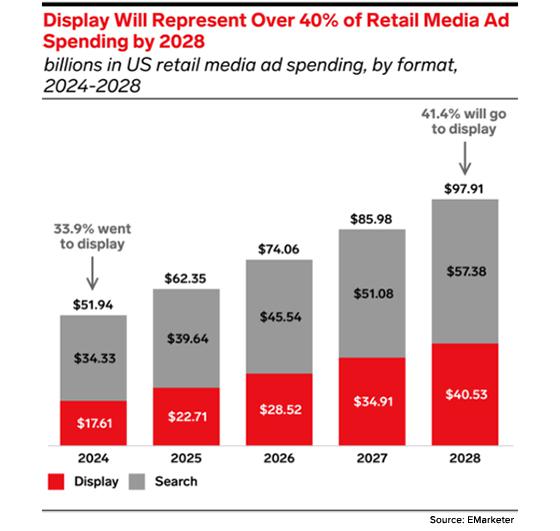
“We expect retail media CTV to account for a significant portion of retail media display growth,” says eMarketer in a recent report. “Advertisers will spend just shy of $5 billion on retail media CTV in 2025.”

Retail media networks like Amazon Ads, Walmart Connect, and Target Roundel are using CTV advertising to expand their reach and offer advertisers more targeted campaigns. This year it is expected that retail media CTV spending would have a 15% share.

By 2028 -- after three years of 27.2% compounded annual growth -- the ad spend of this year’s results is expected to double -- exceeding $10 billion, according to eMarketer.

By comparison, retail media display ad spending is estimated to near $23 billion this year -- rising to $35 billion in 2027.


In three years' time, retail media CTV will be more than a quarter of all retail media display and nearly 22% of CTV ad spending overall.

Retail media CTV advertising can be found on websites/apps of a retailer’s media network or via a demand-side platform. This includes Amazon Ads (on Amazon Prime Video and Freevee), Walmart Connect (with its own self-service CTV platform) and Target Roundel (using The Trade Desk for programmatic CTV buys).

Analysts say combining retail media with CTV ad execution offers rich storytelling and high-level branding of TV ads paired with granular targeting. This can come with closed-loop measurement of retail media.

New Brand Survey: TV Upfront Ad Market Optimism?


Commentary

New Brand Survey: TV Upfront Ad Market Optimism?

Despite tariff-related and economic concerns, a new survey finds 55% of advertisers plan to spend the same amount on TV and streaming advertising this year, according to new research from iSpot.

The survey found that 16% believe there will be declines in their budgets (1% to 49%), while 27% will see gains (1% to 49%). Just 1% said they see their budgets climbing by 50% or more.

Looking specifically at upfront commitments, overall optimism also shows that just 17% will lower their media budgets.

The survey also shows growing interest -- 53% -- for those media buys that reveal/connect to business outcomes. Another 27% are focused on “value” and 11% cite "verified ad delivery”.


The most popular way of buying that TV/streaming time? Demand-side platforms (62%). This was followed by publisher direct deals (58%) and “social” (51%).

Streaming still has major issues. Streaming platforms are lacking -- for the most part -- in a number of data areas. Many results are under the 50% level, such as advertising being offered with linear/streaming comparative data (41%); programming data (44%); and “attribution” data (48%).

The survey comes from 260 marketers representing 208 brands, including advertising and agencies, and was conducted from February 27 through April 2 of this year.

Does all this give a boost that the advertising marketplace would need to survive the dark clouds forming over the TV upfront advertising marketplace? Perhaps to an extent.

Presently, many cite that the economy -- currently -- isn’t all that bad. But the stock market indexes -- the Dow Jones Industrials, S&P 500, and Nasdaq -- are dramatically lower, down around 12% or so from their higher levels.

Stock market pricing is now built in around “future” economic levels, predicting a slide, if not a recessionary economy.

Unlike other upfronts, however, this market one seems even more fragile -- especially with constant Trump Administration missives and changes to the whole tariff plan -- including one where highly focused consumer electronics products might not be subject to the biggest tariff rate issues.

Even amid calls for TV and streaming sellers to offer up more "flexibility" when it comes to upfront deals, marketers are still concerned that they will need to call an audible for a new play at the line of scrimmage during the upcoming upfront ad game.

Legacy TV-Owned Virtual Pay TV: YouTube TV Too Far Ahead?


Commentary

Legacy TV-Owned Virtual Pay TV: YouTube TV Too Far Ahead?

A new style of pay TV packages -- skinny bundles, and combo streaming/linear TV bundles from DirecTV, Charter Communications and Comcast Corp. -- have a lot of work to do.

Is more TV marketing the right approach? Right now, we don't see much evidence of that -- the brand message, that is.

Ongoing TV consumer surveys suggest only streaming continues to be top of mind. A new survey from digital marketing agency Adtaxi shows 70% of U.S. adults make streaming their first choice for TV and video content viewing. Cable? That only earns a 17% "first choice" mark, while broadcast-only comes in at 5%.

Traditional pay TV linear efforts are tracking somewhat similarly to where retail video stores were in the late 1990s/early 2000s.

In 2000, Blockbuster declined an offer from Netflix to purchase the company for $50 million -- now viewed as one of the worst media business decisions of all time.


The deep irony then was revealed when four years later, in 2004, Blockbuster introduced an online DVD rental service called Blockbuster Online -- allowing customers to rent movies via the internet to compete with growing popularity of... yes, Netflix.

Now, to be fair -- in the current marketplace -- YouTube TV wasn’t the first into this marketplace -- it was Dish Network’s Sling TV in 2015.

That was 10 years ago. Two years after Sling’s start, YouTube TV began.

YouTube may have had modestly better brand positivity -- that and premium content, immediately making deals with TV station groups, sports networks (though not regional sports networks) and the NFL.

YouTube TV is now at 8.4 million subscribers, according to industry estimates, and poised to be the leading pay TV provider -- virtual, traditional or otherwise topping those legacy TV companies -- soon.

And consider that YouTube TV's standard monthly price is $82.99 -- not much of a deal for consumers versus what they paid for traditional legacy, cable-centric or satellite-centric pay TV.

A skinny bundle may be a lure for consumers going forward -- especially with a possible recessionary economy knocking at the door. But is that enough?

On top of this, legacy pay TV providers like Comcast and Charter now have other concerns. A bigger piece of their business -- broadband -- is weakening.

How do traditional pay TV providers and communications companies work around this?

New high-level messaging, of course -- of all types -- on lots of regular TV screens.

Ditching The Cart: Why Consumers Abandon Purchases


Commentary

Ditching The Cart: Why Consumers Abandon Purchases by  , Columnist, Yesterday

If you are prone to outbursts of profanity when trying to buy online, you are not alone. People are so frustrated by the process of logging in that a 87% have abandoned a purchase because they are fed up, according to a new study by Frontegg titled: Forgot Your Password? So did Everyone Else—And they Ditched Your Site Because Of It. 

The average value of these transactions is $85. Worse, 13% of shopper have left behind orders worth $150.  

Frequent shoppers — those who buy online multiple times per week—are even more likely to jump: 92% have done so. 

The most common log-in frustrations are:

  • Forgetting/resetting passwords — 68% 
  • Getting locked out of accounts — 47% 
  • Passwords having to meet specific requirements — 41%
  • Multi-step authentication — 38%
  • Long/complex password requirements — 36% 
  • CAPTCHA/security challenges — 35%


Many consumers prefer guest checkout for these reasons:

  • Faster/easier to check out as a guest — 77% 
  • Don’t want to receive marketing emails/promotions — 71% 
  • Don’t plan to shop there regularly — 57% 
  • Already have too many online accounts — 50%
  • Don’t trust websites with their personal information — 28%
  • Had trouble logging into accounts in the past — 14%

The most frustrating online accounts are: 

  • Banking and financial services — 43% 
  • Government websites — 38%
  • Online shopping websites — 30% 
  • Work-related accounts — 28%
  • Email providers — 26% 
  • Streaming services — 23%
  • Social media platforms — 22% 

Here are a couple of other negative findings: 

  • Roughly 65% will bail when forced to create an account.
  • 55% will stop using a site after forgetting their password.  

Frontegg surveyed 1,003 consumers.