Friday, October 11, 2024

Heineken 0.0 Promotes Safe Driving, Brings Mobile Racing To U.S.

 Here's Something you may want to share with your local-direct clients: Philip Jay LeNoble, Ph.D.


beverages

Heineken 0.0 Promotes Safe Driving, Brings Mobile Racing To U.S.


Racing fans may not be able to rev their engines on an actual track in Heineken 0.0’s new mobile gaming experience, but they can win a chance to meet Oracle Red Bull Racing's 3x World Champion F1 driver Max Verstappen and play against fans around the world.

The non-alcoholic brew recently launched its global simulator racing platform, Player 0.0, to the U.S., after a successful three-year run across the globe.

The mobile game brings together both virtual and real worlds in a simulated racing competition, where players have the opportunity to “race” against some of the world’s best race car drivers. Yet speed isn’t the goal of the game; safe driving is. Players earn points for safety and avoiding obstacles, and their stint ends if they crash.

"We believe entertainment and community can influence safe driving and moderate drinking," said Heineken USA CMO Jonnie Cahill in a release. "We are bring(ing) the excitement of the Player 0.0 gaming platform to the States, to meet our customers where they are… and remind them the best driver is the one who is not drinking."

The now globally competitive game will award U.S. winners one through six with the chance to compete in the U.S. Finals this October, with the first-place winner of that game moving on to the Global Finals in Spain to compete against Player 0.0 drivers from around the world and meet Oracle Red Bull Racing's 3x World Champion F1 driver Max Verstappen.

The game can be accessed by visiting https://heineken.com/player00.

Player 0.0 is a part of Heineken’s “When You Drive, Never Drink” campaign, which “is addressing the issue of overconfidence when drinking alcohol by encouraging consumers to make the right choice to never drive if they've had anything to drink,” per the brand. The effort is being promoted via the brand’s Instagram and Facebook platforms.

Headwinds Are Buffeting TV Stations. What Can They Do to Survive the Storm?


TV News Check

Broadcast Industry News - Television, Cable, On-demand

TV News Check

Broadcast Industry News - Television, Cable, On-demand

Headwinds Are Buffeting TV Stations. What Can They Do to Survive the Storm? 

BIA Advisory Services’ Rick Ducey: “You have to look more than quarter by quarter” to navigate a difficult year ahead.

Local TV stations are certainly in a period of change and challenge, but with some strategic thinking and planning, they can stay competitive in the local video marketplace, said Rick Ducey, managing director, BIA Advisory Services, at TVNewsCheck’s Local Television Strategies at the NAB Show New York on Wednesday.

This year saw the dual boon of political advertising and the Olympics, but things will fall back to earth in 2025, when core advertising revenue is predicted to be basically flat. And as advertising moves more and more to digital platforms, broadcasters need to be moving in that direction as well.

TV stations face competition in the local video space from powerful digital companies, with Facebook and Google taking half of all of the local advertising dollars in any given market, according to Ducey. Retail marketing networks — think Walmart or Kroger — are coming on strong with powerful first-party data platforms. Walmart this year bought smart TV company Vizio for $2.3 billion in order to merge its data with Vizio’s viewership data to create highly targeted consumer profiles for itself and third-party brand advertisers.

“All local advertising is a $174 billion business. Retail media and commerce is a $130 billion industry. Why didn’t we get some of that growth?” Ducey asked.

Retransmission consent fees are expected to decline over the next several years as people cut the cord and move away from traditional pay TV services. Those viewers frequently move to virtual MVPDs (multichannel video programming distributors) such as YouTubeTV or Hulu+LiveTV, and thus far the broadcast companies have maintained the right to handle negotiations with those providers, something broadcast ownership groups want to change. 

Meanwhile, the media conglomerates that own broadcast networks are demanding a larger percentage of reverse compensation from station groups, while prioritizing their direct-to-consumer streaming services. 

Even broadcasters’ core offering — local news — is being challenged, with Americans preferring to get their news on digital devices (58%) versus TV (32%). One quarter of American adults turn to news websites for their news, Pew reported in September. Overall, broadcast viewing makes up only 20% of total viewing, Ducey said, with viewing on streaming, gaming, digital and social platforms making up the rest.

The regulatory environment has not been favorable toward broadcasters recently. The FCC, led by chair Jessica Rosenworcel, is not interested in revising outdated broadcast regulations and it effectively quashed Standard Media’s proposed $8.6 billion acquisition of Tegna in 2023. The Biden administration in general has taken an anti-consolidation stance, personified by controversial FTC Chair Lina Khan. That said, DirecTV and Dish just announced their intention to merge without seeming to encounter opposition. 

Finally, the local measurement problem still has not been solved, with broadcasters unable to provide advanced audience metrics against linear broadcasts. That’s becoming a bigger problem as advertisers demand outcome-based buying. Nielsen is rolling out its local Big Data product in January and broadcasters are hopeful that will help, but warn it will take at least a year to fully comprehend the data. 

It’s not all doom and gloom, but it does require broadcasters to spend time rethinking the business model that’s served them until this period of extreme disruption, Ducey said. 

“There needs to be a strategic reframing of what it means to be in the local TV business,” he added. “As the multiplatform video market continues to morph and evolve, local TV must keep pace with competitors by tapping innovations in technology, data, business models, audience and ad trends.”

Broadcasters have six potential revenue streams: broadcast advertising; digital advertising; retransmission consent fees; connected TV and over-the-top TV (CTV/OTT) channels and apps; NextGen TV (also known as ATSC 3.0); and datacasting, Ducey said. While broadcast advertising and retransmission consent both are declining, there are growth opportunities in the other revenue streams, he noted. 

But even those revenue streams face obstacles.

Some 10% of broadcasters’ total revenue currently comes from digital and streaming options, with advertising on linear services still making up the lions’ share of broadcast advertising revenue. The supply of digital and streaming advertising inventory is plentiful, which serves to keep pricing down. That situation was made worse when subscription-based streamers like Netflix and Prime Video opened their platforms to advertising, flooding the market with inventory. 

“You know you are underperforming in digital,” Ducey said. “You should be making twice as much money in digital as you are now.”

NextGen TV is on track to be rolled out in 80% of the country, but it requires consumers to adopt it by using digital antennas and acquiring smart TVs with ATSC 3.0 tuners. Since most consumers don’t even know NextGen TV exists, it’s a heavy lift to get them to take the necessary steps to start using it. Moreover, broadcasters received no new bandwidth to help them roll out NextGen TV, and ATSC 1.0 remains in place.

Ducey had some suggestions for broadcasters to pursue, including partnering with retail media networks on cross-platform advertising buys, something broadcasters should be offering as broadly as possible. He also suggested offering self-serve programmatic advertising on CTV and OTV platforms to local buyers, such as small and medium-size businesses. With their own streaming products, broadcasters should be acquiring their own valuable first-party data on which they can build better advertising networks. And ATSC 3.0 means that datacasting could become a real offering for broadcasters

“It all comes back to those six revenue streams,” Ducey said. “We have to allocate resources in a meaningful way. If you are planning big businesses, you have to look more than quarter by quarter.

Friday, September 20, 2024

FTC Blasts 'Commercial Surveillance Ecosystem,' Calls for New Laws


FTC Blasts 'Commercial Surveillance Ecosystem,' Calls for New Laws

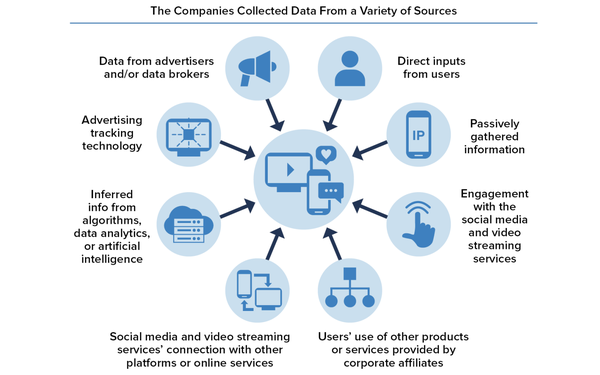
Large social media companies and streaming video services threaten consumers' privacy by collecting a “staggering” amount of data in order to serve behaviorally targeted ads, the Federal Trade Commission said Thursday in a new staff report.

“The status quo is unacceptable,” Samuel Levine, director of the FTC's consumer protection bureau wrote in a preface to a critical new report, “A Look Behind the Screens: Examining the Data Practices of Social Media and Video Streaming Services.”

“The report leaves no doubt that without significant action, the commercial surveillance ecosystem will only get worse,” Levine added. “Our privacy cannot be the price we pay to accomplish ordinary basic daily activities, and responsible data practices should not put a business at a competitive disadvantage.”

FTC Chair Lina Khan added that the report shows how tech companies “harvest an enormous amount of Americans’ personal data and monetize it to the tune of billions of dollars a year.”

“While lucrative for the companies, these surveillance practices can endanger people’s privacy, threaten their freedoms, and expose them to a host of harms, from identify theft to stalking,” Khan stated.

The report, unanimously approved Thursday by the FTC, grew out of an investigation launched in December 2020, when the agency sought detailed information from Meta, Amazon, Twitter, YouTube, TikTok, Discord, Reddit and Snap about their data gathering and ad targeting practices.

The amount of data the companies collect is “simply staggering,” Levine wrote.

“They track what we read, what websites we visit, whether we are married and have children, our educational level and income bracket, our location, our purchasing habits, our personal interests, and in some cases even our health conditions and religious faith,” Levine continued.

He added that the companies amassed so much information that they often couldn't answer questions about all the “data points” that were collected, or the third parties that received the information.

The report recommends both that Congress enact new privacy laws, and that tech companies minimize the amount of data they collect and share.

"Self-regulation is not the answer and federal legislation is necessary to ensure that the companies protect consumers’ privacy," the report states. 

The FTC said legislation should include “default safeguards against the over-collection, monetization, disclosure, or undue retention of personal data."

“Users should be able to proactively choose whether they do or do not wish to be tracked, and they should be able to make this choice freely, rather than under conditions that restrict their autonomy,” the FTC added.

The ad industry's current self-regulatory standards generally call for companies to notify people about the collection of cross-site data, and allow them to opt out of receiving behaviorally targeted ads. (The standards also call for companies to obtain consumers' explicit consent to the collection of certain sensitive data.)

In addition to calls for legislation, the report also urges social and streaming platforms to avoid using “privacy-invasive tracking technologies” like pixels to collect sensitive information from consumers. The report doesn't define all types of “sensitive” information, but suggests the term includes demographic categories such as race, religion, sexual orientation, and political affiliation.

Khan specifically singled out online behavioral advertising as the driving force behind current practices.

“Marketers have always sought to reach their desired audience, but digitization enabled an unprecedented degree of behavioral targeting,” she stated Thursday. “This newfound ability to monetize people’s behavior, activity, and characteristics helped drive the creation of a multi-billion dollar industry specializing in tracking and collecting vast amounts of Americans’ personal data.”

The report itself asserts that targeted advertising “can pose serious privacy risks to consumers.”

“Consumers are frequently unaware of the potential downstream uses -- including the sale to third parties of location data that may be used to identify consumers and their visits to sensitive locations, such as houses of worship and doctors’ offices -- of the immense amounts of data collected about them,” the report states.

The authors add that targeting based on “sensitive categories” of data “can be extremely harmful to consumers and cause a wide range of injuries to users” -- including discrimination, embarrassment and harms to reputations.

“Targeted ads based on knowledge about protected categories can be especially distressing,” the report says. “One example is when someone has not disclosed their sexual orientation publicly, but an ad assumes their sexual orientation.”

The report also found that most social platforms and streaming services collected the same types of data from teens as from users over 17.

FTC Commissioner Andrew Ferguson, though he approved the report, took issue with its criticism of targeted advertising.

“I do not share the report’s apparent view that the display of targeted advertising to adults is, on balance, harmful,” he stated Thursday, adding that targeted advertising to children and teens “is another matter entirely.”

Association of National Advertisers' CEO Bob Liodice criticized the report as “sensationalist.”

"Rather than simply throwing out the baby with the bathwater, this FTC report decides to tear down the entire house with a sensationalist report that claims that the theoretical harms of data use outweigh all the staggering benefits of the digital economy to individuals and businesses,” he stated.

"Interest-based advertising is the economic engine that funds free and low-cost services to millions of Americans through the digital apps, online services, news publishers, and websites they love.” Liodice added.

Interactive Advertising Bureau CEO David Cohen stated that the organization was “disappointed with the FTC’s continued characterization of the digital advertising industry as engaged in ‘mass commercial surveillance.'”

He added that the organization supports a national data privacy law.

“Congress, rather than a federal agency, should balance consumers' privacy rights, competition and the value exchange between consumers and publishers,” he stated.

Lou Mastria, CEO and president of the self-regulatory group Digital Advertising Alliance, responded to the report by touting the industry's AdChoices program, which uses a clickable icon to notify consumers about online behavioral advertising and take them to sites that offer opt-out links.

He stated that self-regulatory initiatives like AdChoices "have provided ubiquitous real-time access to information and choices around interest-based advertising across millions of web pages and billions of ads."

The advocacy group Consumer Reports, which has supported strong state privacy laws, called the FTC's findings “alarming but not surprising.”

“We need to rein in the rampant overcollection and misuse of consumer data by making strong data minimization protections the default and ensuring companies are held accountable when they violate the trust of consumers,” Justin Brookman, the organization's director of technology policy, stated Thursday.

Halloween shoppers hunt for early deals while total spending eases, survey shows

 Reuters

Halloween shoppers hunt for early deals while total spending eases, survey shows

Avilia Palenca looks at Halloween merchandise at the new 142,000 square foot Wal-Mart during the grand opening
A customer looks at Halloween merchandise in Chicago in this file photo. REUTERS/Joshua Lott/ File Photo Purchase Licensing Rights, opens new tab
Sept 19 (Reuters) - Consumers started shopping for Halloween decor and costumes well before October this year, taking advantage of special events, even though overall spending has decreased from last year's record high, data from the National Retail Federation (NRF) showed on Thursday.

WHY IT'S IMPORTANT

Interest in Halloween shopping is usually driven by individuals aged 25 to 34 years and data from the NRF shows that 56% of shoppers within this age group kicked off their shopping before October.
This year, retailers have rushed to bring in their holiday season and Halloween shipments early, hedging against potential strikes by port workers and shipping disruptions.
Despite recent increase in cocoa prices, candies are still expected to remain the most popular category, with total spending projected to reach $3.5 billion.

CONTEXT

As the holiday season approaches, consumer spending is set to be closely monitored, as retailers roll out early promotions on items such as electronics, apparel and home decor.
With the Federal Reserve delivering an expected 50 basis point interest rate cut this week, consumer sentiment is expected to improve, while retail sales remain steady due to strong online spending.

KEY QUOTE

"Consumers are still prioritizing these events, especially Halloween, which has become a moment of great cultural significance in the U.S. over time," Katherine Cullen, NRF vice president, industry and consumer insights, said.

BY THE NUMBERS

Total spending is projected to reach $11.6 billion, down from 2023's record high of $12.2 billion, according to NRF data.
Still, per-person spending is expected to fall by only $4.6, with Cullen pointing out that individual expenditures remain elevated, compared to the levels in 2022 and 2019.
Shopping for Halloween and the fall season began before October for 47% of shoppers surveyed by the NRF, an increase from 37% five years ago.