Wednesday, December 22, 2021

Do You Know What Makes Reps Happy or Frustrated?


Do You Know What Makes Reps Happy or Frustrated?

For company leaders to have success hiring and holding on to top sales talent, it’s imperative they understand what matters most to sales professionals. Every employee has individual characteristics, of course, but a recent survey of 600 sales professionals by Dooly, a Canadian provider of sales enablement software, provides interesting insights into what matters most to today’s sales professionals and, perhaps more importantly, what is triggering them to leave a current employer.

Pay and benefits – The good news, according to the Dooly Sales Happiness Index, is that 87% of respondents are happy working in their current role, and 89% are happy at their current company. More concerning to management is that six in 10 respondents say they would be motivated to leave their company for an employer that offers better benefits. Slightly more than half (51%) would be motivated to leave for higher pay, and half would be motivated to leave for more flexibility.

What leads to departure – For those who reported wanting to leave a current employer, 43% cited lack of benefits; 33% cited lack of access to the best tools and technology to be successful; 31% cited a lack of bonuses.

Frustration over non-revenue-generating tasks – Nearly eight in 10 respondents (78%) said a lack of understand- ing from management on how much time is consumed by non-revenue-generating activities leads to misalignment between expectations and what sellers can reasonably achieve. Attending internal meetings, scheduling calls or meetings, and responding to internal inquiries via email, Slack and other internal communication platforms are the top time-sucking tasks that keep them from selling more. Another 25% said updating CRM data prevents them from being more productive selling. A whopping 95% of respondents agreed that reducing time spent on non-revenue-generating activities would help them achieve quota.

Technology is a vital retention tool – 75% of respondents said their company’s tech stack makes a big difference in their productivity, while 57% said their company’s tech stack is harmful to their output. The average number of tools in a company’s sales tech stack is 13, but respondents said they only use an average of eight of these tools regularly.

Wednesday, December 15, 2021

Increased CTV Spend Comes with Heightened Q4 2021 Ad Fraud


Increased CTV Spend Comes With Heightened Q4 2021 Ad Fraud

Increased spending on connected TV (CTV) advertising is attracting heightened levels of ad fraud during this year’s holiday season, according to newly released data from DoubleVerify (DV).

While ad fraud normally peaks in the fourth quarter due to the period’s higher ad-spend levels, fraud activity is already higher than that seen in Q4 2020, reports the digital media measurement, analytics and anti-fraud solutions company.

Ad fraud in unprotected programmatic connected TV (CTV) has reached a nearly 20% level. In addition, a sampling of unprotected programmatic inventory found that up to 6.6% of video ads and 18% of CTV ads were fraudulent, including SIVT (sophisticated invalid traffic).

“For advertising to perform, it must be seen by real people,” stresses DV. “Fraud has a dramatic impact on campaign performance, misrepresenting impressions and undercutting marketers’ holiday investments.”

“The more in-demand and premium the inventory, the more likely it is to attract bad actors,” adds DV CEO Mark Zagorski.

In particular, tracking has identified current spikes in two streaming ad-fraud schemes that have attempted to spoof billions of ad impressions since they began operating in 2020.

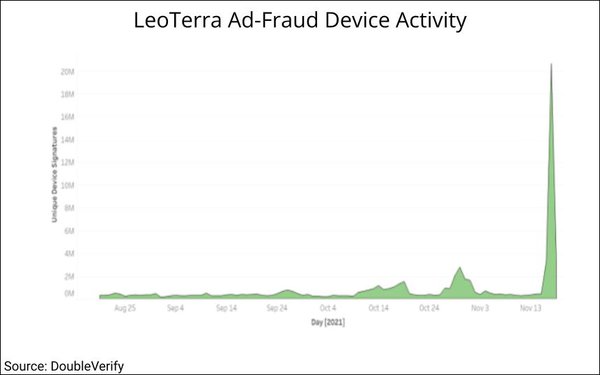
LeoTerra (chart above) — a scheme in which fraudsters set up counterfeit server-side ad insertion (SSAI) servers to drive manufactured CTV inventory across an unlimited number of apps, IPs and devices — increased activity at the start of this holiday season, falsifying up to 20.5 million unique CTV devices per day, according to DV, which says it identified the scheme in July 2020.

That volume is more than 20 times higher than the level detected at the end of 2020, and nearly 40 times higher than the average in the previous three months.

Similarly, the number of spoofed CTV devices and fraudulent impressions associated with CelloTerra — a scheme identified in March 2020 in which fraudsters use mobile apps to run background ads and falsify CTV traffic — has tripled during this year’s final quarter.


When Social Media Becomes The Message


COMMENTARY

When Social Media Becomes The Message

On Nov. 23, U.K. cosmetics firm Lush said it was deactivating its Instagram, Facebook, TikTok and Snapchat accounts until the social media environment “is a little safer.” And by a “safer” environment, the company didn’t mean for advertisers, but for consumers. Jack Constantine, chief digital officer and product inventor at Lush, explains in an interview with the BBC: "[Social media channels] do need to start listening to the reality of how they're impacting people's mental health and the damage that they're causing through their craving for the algorithm to be able to constantly generate content regardless of whether it's good for the users or not."

This was not an easy decision for Lush. It came with the possibility of a substantial cost to its business, "We already know that there is potential damage of £10m in sales and we need to be able to gain that back," said Constantine. "We've got a year to try to get that back, and let's hope we can do that."

In effect, Lush is rolling the dice on a bet based on the unpredictable network effects of social media. Would the potential loss to its bottom line be offset by the brand uptick it would receive by being true to its core values? In talking about Lush’s move on the Wharton Business Daily podcast, marketing lecturer Annie Wilson pointed out the issues in play here: “There could be positive effects on short-term loyalty and brand engagement, but it will be interesting to see the long-term effect on acquiring new consumers in the future.”

I’m not trying to minimize Lush’s decision here by categorizing it as a marketing ploy. The company has been very transparent about how hard it’s been to drop -- even temporarily -- Facebook and its other properties from the Lush marketing mix. The brand had previously closed several of its UK social media accounts, but eventually found itself “back on the channels, despite the best intentions.”

You can’t overstate how fundamental a decision this is for a profit-driven business. But I’m afraid Lush is probably an outlier. The brand is built on making healthy choices. Lush eventually decided it had to stay true to that mission even if it hurts the bottom line.

Other businesses are far from wearing their hearts on their sleeves to the same extent as Lush. For every Lush that’s out there, there are thousands that continue to feed their budgets to Facebook and its properties, even though they fundamentally disagree with the tactics of the channel.

There has been pushback against these tactics before. In July of 2020, 1000 advertisers joined the #StopHateForProfit Boycott against Facebook. That sounds impressive - until you realize that Facebook has 9 million clients. The boycotters represented just over .01% of all advertisers. Even with the support of other advertisers who didn’t join the boycott but still scaled back their ad spend, it only had a fleeting effect on Facebook’s bottom line. Almost all the advertisers eventually returned after the boycott.

As The New York Times reported at the time, the damage wasn’t so much to Facebook’s pocketbook as to its reputation. Stephen Hahn-Griffiths, the executive vice president of the public opinion analysis company RepTrak, wrote in a follow-up post, “What could really hurt Facebook is the long-term effect of its perceived reputation and the association with being viewed as a publisher of ‘hate speech’ and other inappropriate content.”

Of course, that was all before the emergence of a certain Facebook data engineer by the name of Frances Haugen. The whistleblower released thousands of internal documents to the Wall Street Journal this past fall. It went public in September of this year in a series called “The Facebook Files.” If we had any doubt about the culpability of Zuckerberg et al, this pretty much laid that to rest.

Predictably, after the story broke, Facebook made some halfhearted attempts to clean up its act by introducing new parental controls on Instagram and Facebook. This follows the typical Facebook handbook for dealing with emerging shit storms: do the least amount possible, while talking about it as much as possible. It’s a tactic known as “purpose-washing.”

The question is, if this is all you do after a mountain of evidence points to you being truly awful, how sincere are you about doing the right thing? This puts Facebook in the same category as Big Tobacco, and that’s pretty crappy company to be in.

Lush’s decision to quit Facebook also pinpoints an interesting dilemma for advertisers: What happens when an advertising platform that has been effective in attracting new customers becomes so toxic that it damages your brand just by being on it? What happens when, as Marshall McLuhan famously said, the medium becomes the message?

Facebook is not alone with this issue. With the systematic dismantling of objective journalism, almost every news medium now carries its own message. This is certainly true for channels like Fox News. By supporting these platforms with advertising, advertisers are putting a stamp of approval on those respective editorial biases and -- in Fox’s case -- the deliberate spreading of misinformation that has been shown to have a negative social cost.

All this points to a toxic cycle becoming more commonplace in ad-supported media: The drive to attract and effectively target an audience leads a medium to embrace questionable ethical practices. These practices then taint the platform itself, leading to it potentially becoming brand-toxic. The advertisers then must choose between reaching an available audience that can expand its business, or avoiding the toxicity of the platform. The challenge for the brand then becomes a contest to see how long it can hold its nose while it continues to maximize sales and profits.

For Lush, the scent of Facebook’s bullshit finally grew too much to bear -- at least for now.

Advertisers Cite Digital Supply Chain As Top Transparency Issue


Advertisers Cite Digital Supply Chain As Top Transparency Issue

Concerns about the digital supply chain is the number one transparency issue for advertisers, according to new research from ID Comms.

ID Comms, a media and marketing consultant and auditor, is out with a new report on transparency that finds that the biggest issue for advertisers right now is a problematic digital supply chain.

The research, conducted in May and June and based on responses from 56 global, regional and local advertising executives found that 76% are dissatisfied with current levels of transparency in the digital supply chain.

Problems include inaccurate data, hidden fees and undisclosed trading deals all of which contribute to reducing the effectiveness of digital ad dollars, per the report.

The report notes that digital transparency issues are not new, but the perception is those issues are getting worse.

Looking ahead, the report found that 93% of those surveyed indicated a top priority for 2022 is to implement a stronger media governance process. Also high on next year’s priority list: establish clear media buying and reporting principles for their agencies.

And for many, the most effective remedy to the problems is external regulation. Nearly 60% agreed that transparency would improve significantly if media activities were regulated by an external body.

Millennials Become Moms and Dads


COMMENTARY

Millennials Become Moms and Dads

Since 2007, the U.S. has experienced a profound baby bust. That year, which gave us the iPhone, also gave us 4.32 million births, narrowly edging out the peak baby boom year of 1957 as the most fertile in U.S. history. But since then, we’ve seen a slow and steady decline to just 3.75 million babies born in 2019, the fewest since 1986. And the CDC estimates that in COVID-impacted 2020, live births fell further to 3.6 million, as the expected uptick in “COVID babies” conceived during quarantine failed to materialize.

Don’t look now, but the long-awaited millennial baby boom might finally be here. COVID inspired many young adults to leave big-city apartments and buy houses in the suburbs. The Millennial generation is now between the ages of 25 and 40, prime years for having kids. Many white-collar workers emerged from COVID more financially secure than before, and with more flexible working arrangements where they can do their jobs mostly or entirely from home. Today’s blue-collar workers enjoy a seller’s market for their talent. And perhaps the events of the last two years have reinforced the importance of family.

In a November research report, Bank of America notes that sales of pregnancy tests are up by an average of 13% year-over-year, compared to average growth of 2% from 2016-2019. Live births increased 3.3% in June, the highest increase since 2013. And in a recent survey, 11.3% of respondents said they were expecting a child or trying to conceive, the highest rate in the year that the survey has fielded.

Bank of America suggests these trends carry positive implications for grocers, big-box retailers and warehouse clubs that sell baby-related merchandise or are near millennials settling in the suburbs. Walmart, Target, Albertsons, Kroger, Dollar General, Dollar Tree and BJ’s Wholesale Club are all potential beneficiaries of a fast-growing baby-products market, currently estimated at $1.7 billion.

How can brands better connect with millennial moms and dads?

*Represent millennial parents. Don’t show young, childless millennials meeting up for avocado toast; show them on play dates and shuffling kids to after-school activities. Don’t show them at Coachella; show them at backyard birthday parties. Represent their lifestage authentically in your marketing campaign and remember to reflect the diversity of today’s families: most children today are people of color, and many are raised by a single parent, or two parents of the same gender.

*Promote new use cases. A childless millennial might order a Coke at a restaurant, while one with kids might buy a liter bottle for the pantry. A childless Amazon Prime customer might subscribe mostly for streaming video and free shipping, while a new parent might upgrade to Amazon Fresh to keep food in the house. A childless Honda driver might favor a racy Civic Si, while one with kids might find that the CR-V or Pilot fits their needs better. Consider how a parent might use your brands differently, and communicate those differences in your marketing.

*Reflect their values. They’re becoming parents, but they’re still millennials, and they’re going to “do parenting” differently than previous generations. Does your baby/parent brand help combat climate change? Is it made of green materials? Does it support pro-social causes? Can parents order it frictionlessly from their mobile devices, or subscribe to it as a service? Does it have a social/community-building aspect? Is it led by a diverse group of executives? Millennial parents will be keeping long scorecards, and brands will need to speak to their needs, not those of boomers in 1980, or Gen X in 2000.

The baby boom is finally here, and the brands that best capitalize on it will boom, too.

6 Traps that Catch New Sales Managers


6 Traps that Catch New Sales Managers

Why the transition from sales star to sales manager so often fails

Great salespeople eat, breathe and sleep the art of selling. They’re masters at building relationships and solving problems. Why, then, do so many selling superstars have lackluster performances when they become managers?

The simple answer is that for most salespeople, their previous skill sets and mindsets don’t translate well to supervisory roles. For a refresher, a skill set is an observation action, whereas a mindset is a belief or value that guides those actions. Both are tough to change — especially when they’ve worked for years and years.

Take the case of a sales professional who reaches the management level. Her skill set might be, “If I don’t know how to do something, I always figure it out on my own.” To correspond, her mind-set would look something like this: “If I do things independently and authoritatively, the people around me will respect me.” These approaches helped her become a successful salesperson. Yet they end up being quicksand for her when she takes a leadership position because managing is different than selling. Sure, it helps that she understands what her sales team does from a practical, hands-on perspective. But her presence isn’t helpful if she doesn’t embrace her responsibility to guide, coach, mentor, and develop other people.

How widespread is this phenomenon of fantastic salesperson/ineffective sales manager? It’s common enough that most ineffectual sales leaders can be lumped into one of six descriptors:

The Super Rep

This is the sales manager who eagerly jumps in to lead every sales opportunity. Need a closer? No problem. The issue, of course, is that this approach isn’t scalable. It can also lead sales agents to decline in performance because they know the super rep will always swoop in to save the day.

The Performance Manager

Who cares about coaching? Not the performance manager. This sales leader feels representatives should “get it.” Instead of empowering employees by helping them improve their skills, the performance manager expects accountability without offering any advice.

The Friend Manager

It’s appropriate and frequently helpful for sales managers to have camaraderie and rapport with their people. However, the friend manager puts being liked above all else. As a result, sales teams feel less compelled to deliver or grow because they don’t feel like they’re expected to change.

The ‘This Is What Worked for Me’ Manager

Part of being a leader is understanding that every seller brings unique traits, strengths, and needs to the table. By assuming that “what worked for me will work for you,” a sales manager ignores the individuality of team members.

The Administrator

Data. Reporting. Tasks. The administrator persona will handle everything in an effort to free up reps’ time. Over time, those reps never learn how to be smart time managers; they just learn to put all their paperwork and other duties onto the administrator.

The Ready-Fire-Aim Manager

What’s most essential to a ready-fire-aim manager? Speed of action and agility. This type of sales leader puts a premium on moving fast, ostensibly to stay ahead of the competition. Although speediness can be an asset, it can also cause people to move ahead without taking the necessary breathers to update their skills and knowledge.

In general, these six personas come from a place of good intention. After all, sales leaders typically don’t set out to fail. Nevertheless, these tendencies can cause a company to lose traction and momentum. That’s why every sales manager needs to remain open to reflection and change.

Replacing Ineffective Sales Manager Habits

Breaking out of poor sales manager instincts starts with introspection. That is, sales leaders must be willing to acknowledge that what they’ve been doing isn’t working. After introspection, they must be able to talk with the people they report to and those who report to them. Getting a 360-degree understanding of what they’re doing well and where they’re stumbling offers an opportunity to embrace change.

Again, change can be hard for anyone – and particularly a sales leader unaccustomed to underperforming. However, shifting to a “my success comes through the success of others” mindset can help sellers representing any of the six aforementioned seller personas make significant improvements. It can also help with personal development and transformation, thus fueling adaptability, self-awareness, attentiveness, conscious (and conscientious) decision-making, and empathy.

All leaders, including sales managers, are under a microscope. From the attitudes they project to the moves they make, their choices inform and influence their teams. By moving from a “me” to “we” ideology, any sales leader can promote better group outcomes and a stronger, more cohesive culture.

MRC Auditing Nielsen's 'Digital Ad Ratings,' Adds Phases For Mobile And CTV


MRC Auditing Nielsen's 'Digital Ad Ratings,' Adds Phases For Mobile And CTV

The Media Rating Council (MRC) today announced it has begun auditing Nielsen’s Digital Ad Ratings (DAR) measurement service, which put its accreditation on “hiatus” beginning in September 2020.

The MRC said the audit includes four phases, including one covering Nielsen’s originally accredited service covering desktop display and video ratings, as well as new ones covering audience measurement coming from mobile and connected TV (CTV) devices.

The first of the new audit’s reports, focused on Nielsen’s “Snapshot” identity graph solution, which is now integrated into the DAR service, was delivered in November for an MRC audit committee to review.

Reports covering additional phases of the audit are are scheduled to be delivered throughout the first half of 2022 and will likely span into the fall.

“MRC plans to issue updates on the statuses of other significant in-process audits in which we are engaged over the coming weeks and months, and additional updates on Nielsen DAR as events warrant,” the council said as part of its statement.

The news follows the MRC’s suspension of accreditation for both Nielsen’s national and local TV ratings services in September, though Nielsen CEO David Kenny has told shareholders and Wall Street analysts in September that Nielsen would regain it “in months.”

Nielsen, of course, has been consumed by the development of its new cross-platform measurement service, dubbed “Nielsen One,” which is expected to launch in the first half of 2022.

Currently, the only Nielsen service actively accredited by the MRC is Nielsen Audio (formerly Arbitron) for both national and local radio audience measurement.