Monday, March 14, 2016

WHDH Suing Comcast Over Loss Of Affiliation

 TVNewsCheck Alerts
The Sunbeam Television-owned Boston station says the loss of its NBC affiliation violates its agreement with the network as well as the conditions of Comcast’s acquisition of NBC. NBC calls it a "meritless lawsuit."
 
By
TVNewsCheck,
    
Sunbeam Television, owner of WHDH Boston, today filed suit against Comcast in federal court in Boston over NBC’s January announcement that it intends to terminate its 22-year affiliation with WHDH at the end of 2016. NBC is a unit of Comcast.
NBC plans to create an O&Os in the market, using WNEU, which now airs NBC's Telemundo..
 
WHDH says that WNEU’s signal does not reach nearly four million greater Boston residents who currently receive WHDH’s signal, including residents in primarily minority communities such as Roxbury, Dorchester, Mattapan and Brockton. Most of those residents, WHDH claims, would have to purchase cable service from Comcast if they want to keep receiving NBC programming.
WHDH says that when Comcast bought NBC in 2011, “there was widespread concern about the impact this unprecedented accumulation of power in the television industry would have on viewers and other market participants.

"Particularly in markets like Boston, where Comcast is the dominant cable provider, citizen groups, industry participants and government agencies expressed concern that Comcast would seek to leverage its cable holdings and in the process degrade its broadcasting presence and diminish the important public service role that broadcast television stations historically have played.”
To address those concerns, Comcast promised its NBC affiliates (including WHDH) that it would negotiate affiliate extensions in good faith such that over the air access would be maintained, and cable interests would not influence those negotiations. As part of the FCC’s approval of Comcast’s acquisition of NBC, the FCC adopted these same conditions in order to protect the public interest.
                 
WHDH said that it believes that “Comcast has violated these conditions. It also believes that Comcast’s actions violate Massachusetts law prohibiting unfair and deceptive business practices. Finally, WHDH believes that Comcast’s actions violate federal and state antitrust laws because they have enabled Comcast to increase its monopoly power in the Boston television market, and the resulting decrease in competition will harm consumers, advertisers and other broadcasters.”
In its suit, WHDH is seeking an injunction and an order requiring Comcast to comply with its obligations under its agreement with WHDH and the FCC order. WHDH will also seek damages.
Sunbeam Television Corp. also owns Fox affiliate WSVN Miami.

An NBCUniversal spokesperson commented: "NBC has had a long, mutually successful relationship with Sunbeam, which is expiring under the agreed-upon terms of WHDH’s affiliation contract at the end of the year.  We are disappointed that Sunbeam has chosen to file this meritless lawsuit, and that it has chosen to do so by constructing baseless claims against our parent company. Rest assured that we will continue to deliver Boston-area viewers the best local news, weather and information along with the NBC news, sports and entertainment programming they already enjoy. Indeed, with the extensive investments we’ve made and will continue to make in our over-the-air service, we will have the best television broadcast offerings in the region, with two major broadcast network stations – NBC Boston and Telemundo Boston – that can reach over-the-air viewers throughout the Boston region in both English and Spanish, as well as a 24/7 cable news network – NECN – that reaches viewers throughout New England."

Local TV News Still Looking For Some Digital Magic

MediaPost's
TV Watch
Full Frontal Television


A media critique by Wayne Friedman, Staff Writer Thursday, March 10, 2016
Just as  the digital world needs more content, perhaps TV news stations need more journalists -- at a price, anyway.

Fresco News will be working with Fox TV stations, offering to pay “citizen journalists” as much as $50 per video and $20 for a still photograph if their content is used on the air.
Sounds like a good deal for TV news shows, especially considering what local TV news futurists have long discussed about “hyper-local” news efforts: niche, neighborhood-by-neighborhood TV news content.

This goes hand in hand with local TV stations’ plans for local multicast digital signals, as extra TV-media platforms for news and other TV content. To date, few have capitalized on this trend.
People have used smartphones to produce “user-generated video”-- cats riding around on donkeys; young men trying to dunk a basketball in their backyards only to wind up in some dumpster -- virtually all for free to digital video platforms.

But consider this: Cultivating premium local TV news video takes work, and journalistic skills, in determining what is news and what isn’t. Fresco News doesn’t let users go it alone; it has a 24/7 assignment desk where citizen journalists can respond to a potential news situation. Fresco does “qualify” these video shooters, as well as evaluating if the news situations are safe to cover.
For a long time, AOL’s Patch local news effort seemed to play in the arena of neighborhood niche news. Two years ago there was massive layoffs after hundreds of millions of dollars were spent on the project. Patch is now a shell of its former self.

This current citizen journalism local TV effort seem to mimic that effort. But just a cautionary tale here: Local TV news operations aren’t interested in a quick fix, but long-term answers with staying power.

Wednesday, March 9, 2016

The Powerful Correlation Between Consistency and Success


Whether you're looking at your career in the exciting, daily changing media business or creative for a client, here is a great essay on consistency. Philip Jay LeNoble, Ph.D. CA

Media Village logo
                                                    

Darren Hardy's book The Compound Effect is an excellent resource for understanding the power of consistency. The "compound effect," as Hardy describes it, is "based on the principle that you can reap huge rewards from a series of small, smart choices." Hardy was the owner of a $50 million company by the age of 27, so one probably wouldn't hesitate to associate him with the word "success." That doesn't mean money is success, but rather, the actions Hardy took in order to be such a success happened to accumulate a great deal of money along the way.
So how did Hardy do it? Not surprisingly, he habitually practiced a set of these "small, smart choices."

In an interview soon after his book release, he said: "If I were to boil down the number one trait responsible for any unusual success I have experienced in life, I think it would be this: unyielding and relentless commitment to consistency."

Consistency, or lack thereof, is what separates those that say they want to be successful from those that do succeed. Think about the last time you were really excited about something. The quality of your work most likely reflected accordingly. Now reflect back on a day when you woke up on the wrong side of the bed. Your productivity, motivation and overall character likely mirrored how you felt.

But people that intentionally practice consistency in their daily lives are disciplined enough to keep up with their daily habits; that is, the good habits that move them forward. Successful people understand the power of consistency, and they also see the rewards down the road.

Hardy packages this concept perfectly: "It's not how fast you start; it's how long you can remain consistent. I believe it's the biggest reason why people don't end up with the results they want and the life they seek. Most people don't have a problem starting. Everybody easily gets excited, joins, signs-up, starts and begins. Millions of people make New Year's resolutions, start diet programs, join gyms, buy personal development books, go to seminars, hire coaches, etc., but their life doesn't change. Because success is not defined by how you start, but by how you continue ... over a long period of time."

And Hardy isn't the only example of success as a result of consistency. Thinking back on my most inspiring mentors, I can honestly say that consistency was a major driver, if not the driver, of their success. This is why society is so obsessed with celebrities, athletes and high-profile business people: They did the things most people don't do (notice I didn't say can't do), they continued what they started and they kept up with it every single day.

I will be the first to admit that I have quite a few areas in my life lacking consistency, but I will also admit that I am working on them. Creating smart, life-long benefitting habits isn't always easy, but know that it is doable. So the next time you catch yourself reading someone else's success story, stop and think about what small, smart choices you're making every day that will lead you to your own success story.

Success doesn't happen overnight, but making small, smart choices -- consistently -- is a commitment you can make right now. After all, the only way to eat an elephant is one bite at a time.

Digital Media Ad Spend To Surpass TV In 2017


Digital advertising spending looks to surpass traditional TV ad spending next year -- with growing digital video making the picture more complex.
 
Digital advertising spending will grow 12.4% in 2017 to $77.37 billion, while traditional TV advertising climbs 2% to $72.01 billion, according to eMarketer. This year, digital is estimated to hit $68.82 billion, while TV reaches $70.60 billion.
 
TV estimates include broadcast TV -- network, syndication and local TV spot -- and all cable TV.
But digital video is also a factor -- getting to $9.84 billion and rising 12% next year to $11.72.
 
Traditional TV programmers/networks benefit from the large piece of premium digital video; increasingly, local TV stations look to gain as well, according to analysts.
 
Mobile is a major component of digital media growth -- estimated to climb 21% to $52.76 in 2017. Mobile media is forecast to hit $43.60 billion this year.
 
This year, TV will command a 36.8% share of total U.S. ad spend, followed by digital at 35.8%; print (newspapers and magazines), with a 13.9% share; radio at 7.4%; out-of-home with 3.9%; and directories, at 2.2%.
 
Estimates from eMarketer say total U.S. advertising spend will rise 4.8% to $201.32 billion in 2017; growing 5% in 2016 to $192.02.

Tuesday, March 8, 2016

Radio Ink - Radio\'s Premier Management & Marketing Magazine

Kantar Exec: Radio Political Revenue To Jump 10% to 20%
March 8, 2016
That’s according to Steven Passwaiter, the director-business development for Kantar Media’s Campaign Analysis Group. In an Advertising Age interview Passwaiter says that increase has a lot to do with how radio’s biggest company, iHeartmedia has set up shop in Washington this year, specifically targeting political campaigns and explaining how radio can target voters. iHeartMedia has a 10-person political team in D.C., and another 150 salespeople across the country all focused on political. Passwaiter says “By setting up shop here, and in a meaningful way, they are showing they are taking it seriously. There is no substitute for actually being here. They have put themselves in a good position to get a piece of all the money that’s going around.”

For years, radio has taken home peanuts of the political ad revenue pie. And iHeartMedia CEO Bob Pittman tells Ad Age that’s the fault of the radio industry. “Radio has never gotten its fair share of political spend, but a lot of that was our fault, because we tried selling what we had instead of what they needed. Campaigns should allocate 15% to 20% of broadcast budgets to radio or risk leaving some voters on the table. It’s not just that radio’s cost per voter impression is much lower, enabling greater frequency; radio’s flexibility also makes it easier to turn on a dime and pivot on key messaging whenever campaigns need it.”

Kenny Day is iHeartMedia’s Senior VP-political sales and strategy, recently joining team Pittman from ad-tech firm BrightRoll. Day says, “iHeartMedia can tell campaigns where moms are, where millennials are, where African-Americans are, across all formats and locales because the company now offers the data and tools to do just that. While this particular election will end in November 2016, we are taking a much broader and longer term view: there are elections taking place all the time across the country — judgeships, gubernatorial, House and Senate, local statehouse elections, local and national ballot initiatives and more.”
Edison: 50% of Americans Listen to Online Radio
Edison Research continues to dribble out teases leading up to its Infinite Dial webinar this Thursday, presented in conjunction with Triton Digital. The latest tidbit of information is about Online listening which Edison says 50% of Americans now do on a weekly basis.
 
That would mean that about 136 million people listen to radio online every week. So far Edison has not said how that breaks down between Pandora, iHeartRadio, Radio station apps or other streamers. We are told that detail will be part of the Thursday webinar. As you can see by this chart, online listening has come a long way. In 200 only 2% of respondents in the study said they listened to radio online.
As you can see by this chart, online listening has come a long way. In 200 only 2% of respondents in the study said they listened to radio online.
weekly listening


Radio Remains America’s Top Reach Medium

Media Village logo                         

Today the words “radio” and “audio” mean many different things to many different people: music, commentary, podcasting, digital listening, in-car entertainment and on and on. What’s certain is that radio consumers comprise a highly qualified audience, delivered in real-time across hundreds of markets every single day.
As highlighted in Nielsen's report, State of the Media: Audio Today, radio reaches more Americans than any other platform. On a weekly basis, more people listen to radio than watch TV or consume content on smartphones. Even among the most connected Millennial consumers radio has a greater reach than TV or smartphones, with 92% of those aged 18-34 listening on a weekly basis and spending an average of more than 11 hours doing so.

The vast majority of Americans get their radio from local network affiliate stations, listen throughout the day, and do so when they’re away from home and therefore more likely to make purchases. There are a few key differences in listening patterns depending on the age group, however.
Millennials listen to the least radio, although they still manage to tune in for more than 11 hours a week, especially during the afternoon rush hours. Generation X prefers listening during the morning commute and spends an additional 2.5 hours a week in the company of the radio. Boomers with more time on their hands listen to the most radio of all -- over 15 hours a week -- and are more likely to be tuned in during the middle of the day.

The popularity of radio spans not only all ages and genders, but also all cultural groups. Hispanics are the fastest-growing radio audience, accounting for 40 million weekly listeners -- or about 97% of the Hispanic population. Similarly, more than 90% of black Americans, or over 31 million people, use radio each week. Both groups listen to an average of well over 12 hours of radio a week.

Because the majority of radio usage occurs outside the home among working consumers, radio skews slightly more male than TV, Internet and print. The heaviest radio consumers are not likely to be heavy TV watchers, but they do have a lot in common with heavy Internet users, in particular an average age in the 40s, a similar average household size and a strong affinity to social media.
It’s clear that radio is an integral part of media consumption for millions of Americans.

Long-Term Ad Spending Growth Forecast: +5% Annually

Broadcast Industry News - Television , Cable, On-demand - TVNewsCheck.com   

   
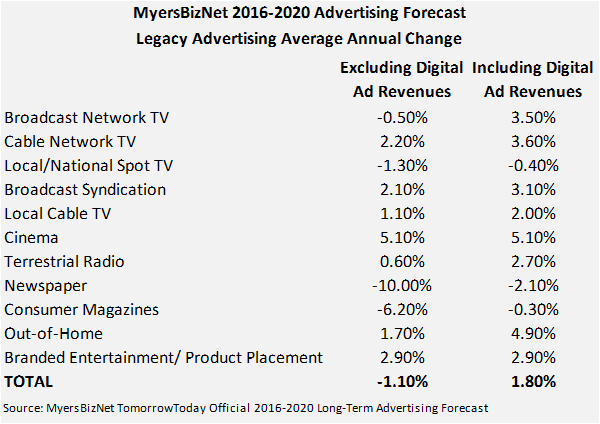
Total ad spending is forecast to grow an average 5.0% annually through 2020 according to a new report issued today by MyersBizNet, the leading independent forecaster of advertising and marketing investments since 1986.
 
Ad spending growth is led, of course, by digital media including the digital assets of legacy media companies. MyersBizNet projects total digital advertising will increase an average 21.2% annually from $58.3 billion in 2016 to $113.3 billion in 2020. Legacy media categories, excluding their digital revenues, are forecast to decline an average 1.1% annually from $129.4 billion in 2016 to $124.7 billion in 2020.

Based on these forecasts, suggestions that total digital spending (excluding search) will surpass legacy advertising are exaggerated. Mobile and online search investments are reported separately in MyersBizNet’s below-the-line marketing data, due to be released later this month.Mobile advertising (excluding search) is forecast by MyersBizNet to increase an average 32% annually, from $20.3 billion in 2016 to $41 billion in 2020. The greatest growth category is interactive/VOD and addressable advertising, which MyersBizNet projects will increase from $704 million this year to $8.7 billion in 2020, an average of 84% annually.

Advertising placed with online originated video content sites is estimated to increase 36% annually to $14.0 billion in 2020 from $5.5 billion in 2016.
Declines in legacy spending are led by traditional newspaper (-10.0% annually) and consumer magazines (-6.2%) advertising. The fastest growing legacy spending is for cinema advertising, with projected annual growth of 5.1%.
The digital and total revenues of these legacy media 2016-2020 are provided in the full MyersBizNet long-term advertising spending report available at MediaVillage. MyersBizNet includes 18 media categories in its above-the-line advertising data, with legacy and digital spending in each category reported separately. MyersBizNet will publish Hispanic media data and below-the-line marketing forecasts later this month.