Wednesday, May 28, 2025

US Moms Concerned That Tariffs Would Affect Holiday Season

Commentary

US Moms Concerned That Tariffs Would Affect Holiday Season

It’s not too soon to focus on the 2025 holiday season with potential tariff increases and changing consumer behaviors. In fact, U.S. mothers start shopping for deals as early as July.  Moms spend $1.6 trillion a year in the U.S. economy and are the decision-makers when it comes to holiday expenditures. We surveyed 500 moms across the U.S. on what matters to them as they gear up for the upcoming holiday gift-buying season.

According to the survey, 81% of moms are concerned about the impact of tariffs on their families, and 58% intend to change their shopping habits this year for the holidays. They are concerned foremost about groceries, followed by clothing and shoes, home goods and appliances, cars, electronics, and toys.

Seventy percent of respondents are worried about how tariffs on toys will impact their holiday shopping. Moms expressed concern about increased prices (84%), limited choices 51%, limited distribution 39%, online sellouts (36%) and the scarcity of hot toys (27%).


When asked about how they would adapt their shopping strategies, the majority said they would limit the number of toys their child receives, while 46% would consider purchasing experiences over toys. In a nod to sustainable practices and a bit of ingenuity, 37% of moms said they would sell toys that are no longer used to offset the cost of new ones, and 33% said  they would purchase gently used items from thrift stores or resell sites as gifts.  Moms also look to other moms for good advice: 32% said they would take recommendations from other moms for saving money, and 33% said they would use social media to identify sales.

Notably, when asked if they were willing to pay a little more for a product made in the U.S. to avoid tariffs, 30% said yes, 11% said no, and almost 60% said it depends on the price difference. It was an even split between moms who shop websites or retailers that highlight products made in the U.S., and those that do not. When it comes to toys, 63% admitted that they do not seek out American-made toys.

Winning Shoppers This Holiday Season

As brands prepare to win sales this holiday season, it is important to design marketing tactics that meet buyers where they are stretching their family dollars.  Here are three marketing tactics to add to your plans:

-- Bundle products that present a higher perceived value to shoppers.

-- Host toy trade-in days or promotions that give moms credit toward purchasing new toys in return for trading in old toys.  Donate old toys to earn social responsibility points with moms.

-- Engage with mom influencers focused on frugal living and smart shopping, as their audiences will grow this holiday season.

Start now to develop a dynamic holiday marketing plan that will evolve with ever-changing factors.   Preparation will allow your brand to capture sales for moms this year. 

Signal Vs. Noise: How Economic Volatility Is Rewriting the Ad Playbook


Commentary

Signal Vs. Noise: How Economic Volatility Is Rewriting the Ad Playbook

There’s a moment in every downturn when leaders realize: This isn’t just a blip. It’s the new operating reality. By now, the signs are clearer. Budgets are tightening. Consumer confidence is wavering. Teams are anxious. And economic policy is reshaping how brands go to market. Now is the time for marketing leaders to adapt strategically to help brands evolve and succeed during recession periods. 

Tariffs, inflation, and volatility in global supply chains aren’t just economic footnotes. They’re active forces reshaping marketing operations. Tariffs, for example, may not hit your media line directly, but they indirectly influence campaign timing, messaging, and budget strategy. When inventory gets delayed or costs jump mid-cycle, media plans shift, and often at the last minute. This requires strong collaboration between finance, operations, and marketing. Ask yourself: Which trends are cyclical and which are systemic? The better you can distinguish between headlines and hard data, the more confidently you can lead a brand through turbulence.


Protect marketing as a strategic investment. It’s tempting to view marketing as an expense, but history tells a different story. Brands that continue investing in marketing during recessions recover three times faster than those that don’t, according to WARC. Long-term risks of not protecting marketing include a decline in brand equity and diminished customer loyalty.

With an impending recession and tariff-induced volatility, we’re now operating in a newly created white space in the market. As ad rates drop, competition fades, and consumer attention becomes cheaper to earn, it’s going to be harder and more expensive to regain visibility than to maintain it. Brands that stay the course and stay visible often emerge stronger, more memorable, and better positioned for growth.

Lean into performance and precision. Confidence drives ad investment, and when it wanes, media spend is often the first line item on the chopping block. This can lead to media deflation and market share shifts -- which can actually be advantageous by shifting spend toward performance media that offers measurable ROI. Whether it's reallocating dollars based on real-time conversion data or adjusting creative based on shifting consumer sentiment, the ability to move fast is now a competitive edge.

Communication is key. Tariffs and supply shocks not only affect your bottom line, but also complicate marketing calendars and message-to-market alignment. Clients, partners, and teams need transparency, which is why internal communication is just as important as external messaging. For example,  budget cuts in one area should come with clarity on where dollars are being spent. The more you communicate and are in alignment, the faster you can act.

The advertising playbook is being rewritten in real time. Recessionary pressure, tariff unpredictability, and consumer caution all demand a more inventive approach to content, targeting, and media strategy. This is the time to retool, test new formats, rethink audience segments, and explore channels you have deprioritized in prior years.

While an impending recession is reshaping consumer behavior and the noise is deafening, the brands that stay focused on the signal won’t just survive. They’ll set the pace on the other side.

Tuesday, May 20, 2025

Walmart V. Trump: New Twist in the Tariff Smackdown


Walmart V. Trump: New Twist in the Tariff Smackdown


Last week, Walmart became the largest U.S. company yet to push back against President Donald Trump’s proposed tariffs. In an earnings call, CEO Doug McMillon warned investors the company would have little choice but to pass increased costs on to consumers.

Trump fired back with a Saturday morning social-media broadside: “EAT THE TARIFFS,” he wrote, accusing Walmart of making “BILLIONS OF DOLLARS” and adding, “I’ll be watching—and so will your customers.”

The suggestion, of course, is economically absurd. Trump has repeatedly claimed that countries like China would bear the brunt of tariff costs, not American companies or consumers. Walmart, which operates on razor-thin margins, is hardly in a position to absorb new import taxes unscathed.


Even conservative media outlets were stunned. In a blistering editorial, the Wall Street Journal said Trump’s demand was “bizarro world” economics, adding, “Mr. Trump doesn’t know much about retail.” The piece likened Trump’s CEO cosplay to his previous outbursts against “Comrade Kamala,” accusing her of inflation-control proposals that were “socialist, communist, Marxist and fascist.”

Walmart responded with restraint. “We have always worked to keep our prices as low as possible and we won’t stop,” a spokesperson told Marketing Daily. “We’ll keep prices as low as we can for as long as we can, given the reality of small retail margins.” The company’s net profit margin is about 3%.

But the dust-up reflects what’s quickly becoming a broader war of words between the White House and Corporate America. Earlier this month, after reports that Amazon was exploring tariff disclosures on product pages—similar to how it now itemizes shipping and handling—Trump reportedly phoned co-founder Jeff Bezos to box his ears. The White House later called Amazon’s proposal “a hostile political act,” and Amazon quickly said it had no intention of pursuing the plan.

Meanwhile, tariffs are no longer just a trade issue—they’re starting to reshape consumer confidence. Although most Americans haven’t yet felt the impact at checkout, they know it’s coming. The University of Michigan’s latest Survey of Consumers ticked downward again, including a 7% drop among Republicans. The index is now down nearly 30% since January, with current assessments of personal finances falling almost 10%.

“Tariffs were spontaneously mentioned by nearly three-quarters of consumers, up from almost 60% in April,” the report says. “Uncertainty over trade policy continues to dominate consumers’ thinking about the economy.”

Performance Media Takes Center Stage


Commentary

Performance Media Takes Center Stage

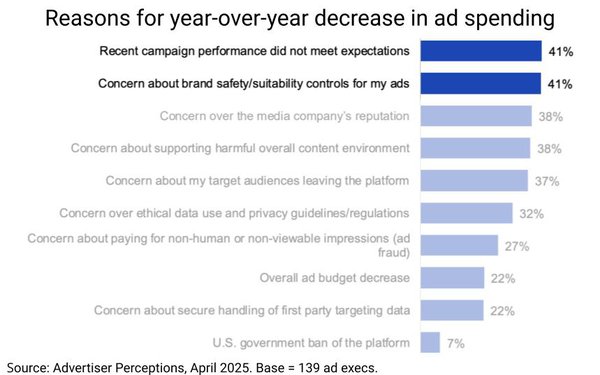
A recent study by Advertiser Perceptions revealed that current “economic uncertainty is driving advertisers to prioritize performance over brand safety.

Fortunately, a focus on performance media achieves both. As we head into upfront season, there is a reason you're hearing the term “performance media” now more than ever. Data, and the collection of it, has never been more robust.

Some brands will even admit that they have more data than they know what to do with.  As a result, many are not harnessing it for its greatest potential value … as an indicator of how well their media is performing.

Look no further than direct-to-consumer (D2C) advertisers if you want to understand the most practical use of data to drive media optimization.


D2C advertisers are on the front lines of using first- and third-party data to better inform their media strategy.  

There was a time when only certain media channels were trackable for performance.  If a viewer dialed a unique 800 number on a TV ad, you knew what network they were watching. Or if they clicked on a banner ad, it was simple for digital strategists to know what site worked for driving leads.

Today, virtually all media can be attributable due to the proliferation of data tracking that exists.

With the right data attribution platform advertisers no longer rely on last touch attribution.  Instead, advertisers correctly apply multi-touch attribution to understand which media channels are truly driving meaningful KPI lift.  

Sure, the efficiency and flexibility of performance media make it a huge draw for D2C advertisers looking to build their brand while maximizing their return on ad spend. After all, every dollar counts when trying to move sales and beat expectations. However, the real star of the show is knowing how to apply the right data in the right way to guide optimization.

Which is why more advertisers are considering themselves “performance” advertisers in today's market. Reporting and analyzing impression delivery, reach, and frequency are still mainstays in our industry and stand front and center when it comes to building a brand.  But focusing on data and analytics that decipher which media works best for driving business outcomes … that is new marketing.

Today's most successful growth brands are those that emphasize audience reach while giving consumers a direct opportunity to respond or purchase product within the message.  Using third-party attribution platforms like iSpot, Extreme Reach, or TV Squared (to name a few) can help advertisers understand which media is driving tangible results beyond audience measurement.  Results that drive actionable insights and measurable bottom-line growth.

Virtually all brands are looking for engagement with viewers.  Visit a website, purchase a product, sign up for a service or simply request more information. With the right attribution platform and the acumen to understand what data means, advertisers can drive improved business outcomes while also building their brand…in real-time.  It's called Performance Media.

Streaming TV's 44.3% April Share Nearly Tops Total Broadcast/Cable

Streaming TV's 44.3% April Share Nearly Tops Total Broadcast/Cable

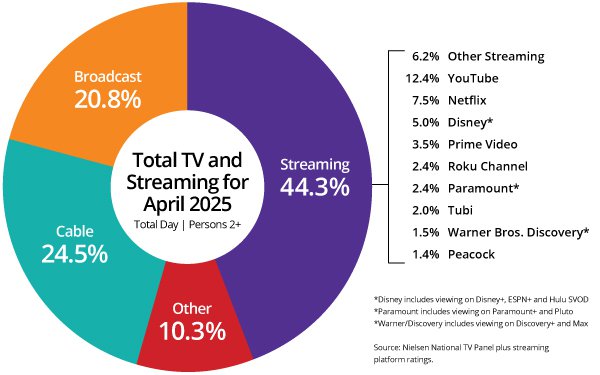
Streaming TV viewing keeps gaining on legacy TV -- nearly topping the combined viewing share of both broadcast and cable TV, according to Nielsen’s total TV/streaming viewing measurement.

In April, its 44.3% share was just a share point behind the combined broadcast/cable viewing share of 45.3%.

Streaming TV grew 4% versus March and 15% over the same month a year ago.

Broadcast viewing was down 6% compared to a year ago to 20.8% share, with cable 16% lower to 24.5% share.

The most-watched streaming TV show was “Grey’s Anatomy” (at 3.9 billion viewing minutes), which airs on both Hulu and Netflix.

While “Grey’s Anatomy” airs exclusively for its current 21st season on Hulu, Netflix had 60% of total streaming viewing of the show for the month.

Right behind "Grey's Anatomy" was Warner Bros. Discovery Max's “The White Lotus,” coming in at 3.7 billion minutes.


In terms of individual channels, YouTube continues to sharply climb -- hitting another new high with 12.4% of total TV watch-time -- up 15% from March., and 30% higher compared to the same time period a year ago.

The Roku Channel also moved higher -- up nearly 70% versus as year ago (1.4%, April 2024) -- to a 2.4% share. Netflix remains in second place versus YouTube -- down 1% to 7.5% share -- while Amazon Prime Video grew 9% to 3.5% share.

Commentary: You Reap What You Fund: Advertising's Moral Debt

Commentary

You Reap What You Fund: Advertising's Moral Debt

We speak so much about business goals. Sustainability and DEI used to be part of them (at least on paper).

But what about something even more fundamental? A moral compass. A shared red line. The industry’s version of “Don’t be evil.”

Something that makes the entire ad tech ecosystem say: STOP.”

Maybe it’s the absence of that line -- or the absence of consequences for crossing it -- that led to the recent wave of disturbing CEO statements.

These aren’t just red flags. They’re flares in the sky.

Meta:

Zuckerberg on ads: You [brands] tell us what your objective is, connect your bank account… You don’t need measurement, just read the results we spit out.”

Perplexity:

The CEO proudly announces its browser will track everything users do online, to power hyper-personalized ads.


A surveillance engine dressed as convenience.

X: CEO Yaccarino declares the platform a megaphone for truth,” while legacy media is “left whispering.”

This, while doubling down on “real-time fact-checking" -- on a platform riddled with brand safety disasters.

These statements aren’t just tone-deaf. They’re the sound of an industry crossing a line and daring us to notice.

So where’s the response? Where is the collective industry “Stop”?

Advertising Doesnt Just Reflect Culture, It Funds It

We like to act as if advertising is neutral  -- as if media buying is just a job.

But the influence of this industry runs deep and wide.

Advertising isn’t a side effect of the digital economy. It is the economy.

According to the Interactive Advertising Bureau, 75% of all U.S. ad spend -- nearly $300 billion -- now flows through digital channels.

Behind that number are millions of jobs: agencies, platforms, publishers, creators, engineers.

We don’t just sell products. We shape culture, sustain industries -- and fund the internet.

That kind of influence isn’t neutral -- and it shouldn’t be directionless.

We Keep Pretending We Dont See It

We’ve normalized the absurd:

•   Platforms profiting from chaos while offering brand safety as a premium feature.

•   Agencies funneling spend to risky platforms because the incentives are aligned somewhere, just not with the client.

•   Advertisers outraged one day, back in the media plan the next.

We talk about “values,” but behave like there’s no alternative.

We warn about misinformation, but reward it with spend.

We say we want safety -- for brands, users, and society -- and then optimize toward volume anyway.

The Consequences Are Already Here

If you’ve ever wondered how the internet got this toxic, don't just blame the platforms.

The issue is what we’ve chosen to fund.

You can’t build a media ecosystem on attention at any cost, and then be shocked when the cost shows up.

You can’t prioritize performance over people and then panic when trust evaporates.

You Reap What You Sow

This isn’t about cancel culture. It’s about accountability.

It’s about the long-term consequences of building an industry on volume, velocity, and plausible deniability.

Ad tech has spent the last decade optimizing for conversion, automation, and scale, while neglecting the foundation of credibility, trust, and shared responsibility.

Time to Rethink What Were Growing

We can’t fix everything, but we can stop pretending this is fine.

We can demand better from platforms and from ourselves.

We don’t need more acronyms. We need a compass.

We don’t need another workaround. We need a stance.

Because in this industry, as in life, you reap what you sow

Charter/Cox Merger: The Start of Something Big? Maybe Just a Good Play


Commentary

Charter/Cox Merger: The Start of Something Big? Maybe Just a Good Play

Looking at the Charter Communications-Cox Communications massive merger, one wonders --why didn't this happen earlier -- like ten years ago?

Cord-cutting of cable TV bundles began its slow rise about two decades ago. Now it is much more prevalent. But that is not the main issue -- especially for one of the dominant pay cable TV players.

Charter is currently is the biggest pay TV provider, with 12.7 million cable subscribers -- slightly above that of Comcast Corp (12.5 million).

Analysts have been musing over a possible combination of Charter and Comcast -- even some company executives. Still, although streaming platforms (and streaming distributors) have made major headway -- regulatory concerns would no doubt be heightened.

For over a decade, Charter and Comcast focused on the necessary business strength around other communication businesses -- broadband and especially mobile. The latter seems to be the business with the most upside -- where the likes of Charter and Comcast specifically put a lot of emphasis.


Other parts of the pay TV industry have been rumored to see a possible merger -- that of DirecTV and Dish Network -- in the early 2000s, when both were major players.

In 2002, the two satellite pay TV providers were turned down by U.S. regulators -- the Federal Communications Commission. These days, the two companies carry much less marketplace dominance, making it much a more likely scenario.

Mobile communications businesses are another story. That is why Chris Marangi, co-CIO of Value at Gabelli Funds, muses that perhaps T-Mobile -- a mobile/broadband-first company -- might be thinking about a bid: “Don’t expect an overbid but if T-Mobile ever had a desire for Charter, now would be the time to express that.”

With regard to the Charter-Cox deal Marangi says -- “Cable is a scale business -- added size should help Charter compete better with the larger telcos, tech companies and Starlink.”

In this regard, Charter has been making some headway with better bundling of cable TV and streaming platforms, to compete with the likes of Roku and Amazon Channels.

It was the first to leverage deals from legacy, TV-networks based media companies in their efforts to maintain revenue from traditional linear TV network carriage deals -- like its deal with Wall Disney for ESPN and ABC, which also gave it the ability to sell Disney+, Hulu, and ESPN+. Other legacy cable TV distributors have been doing similar agreements.

With the deal, Cox’s business will gain from Charter better’s cable TV/streaming business leverage for Cox’s 6.5 million overall customer base. But bigger gains appear to be with broadband and mobile in the long term.

"Speculation has swirled since Cox went private in 2004 whether it would participate in consolidation and with whom," Marangi says.

So.. who will be next