Tuesday, November 19, 2024

How to Create a Marketing Strategy That Aligns with Business Goals


                                                                    SMM

Sales & Marketing Management


How to Create a Marketing Strategy That Aligns with Business Goals


Nothing is ever guaranteed in business. However, you stand a better chance if you know how to create a marketing strategy for business success.

A marketing strategy helps you set a clear direction for your marketing campaigns. It helps you clearly define your marketing goals, channels and key messaging to sell your products and services effectively.

This quick guide will show you how to create a marketing plan aligned with your business goals. Whether you’re starting a new business or have an established one, this guide will help you.

How to Create a Marketing Strategy for Business Success

Marketing can transform your business when done right. Here is a step-by-step guide on how to create and execute marketing strategies to get the best results.

1. Define Your Business Goals

You first need to understand the direction your business is taking before setting marketing goals. Review your business mission and vision alongside your short- and long-term goals.

A good place to start is using the SMART goals strategy. The business goals should be specific, measurable, achievable, relevant and time-bound.

For example, when it comes to specificity, avoid vague goals like “increasing brand reach.” Instead, make it clear like “increase social media reach by 15% in three months through ads.” 

Here’s an image that illustrates a process you can follow to set goals.
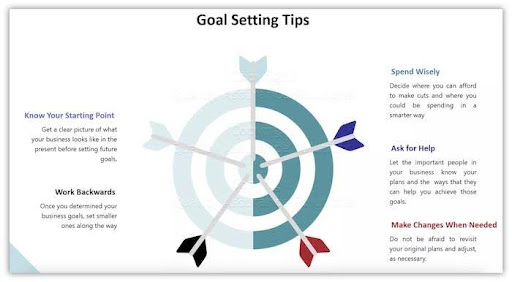
Image via Quality Assurance Solutions

2. Conduct Market Analysis

Market analysis involves evaluating your specific market to understand current conditions, trends and potential opportunities. You must understand your industry, target audience and competitors before launching any marketing campaign.

Analyzing market trends helps you keep tabs on major changes that impact your business. Follow this up with creative ways of reaching your target audience by studying their behaviors and needs.

Finally, look at your competitors and the strategies they’re using. Check out their social media, websites and customer reviews to identify their strengths and weaknesses.

Thorough marketing research is an effective way of identifying gaps you can exploit. Here’s a visual illustration of the market research process you can follow.
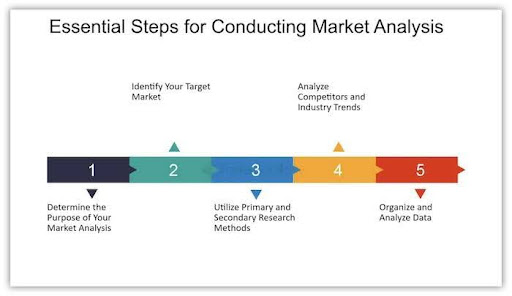
Image via Faster Capital

3. Set Your Marketing Objectives

Marketing objectives are specific measurable goals you plan to achieve through marketing efforts. Examples include increasing brand awareness, generating leads, boosting sales or improving customer retention.

You need to set up marketing objectives that are measurable using key performance indicators (KPIs). Tracking your progress this way helps you know early on if your marketing plan is working or not.

For instance, if you’re targeting social media engagement, then your KPIs could include the number of likes, comments and shares.

Set your marketing objectives based on your overall business goals. Here’s how.
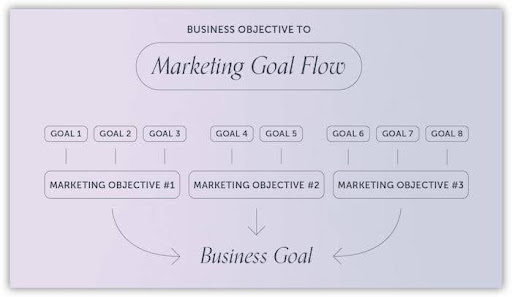
Image via Coschedule

4. Choose Marketing Channels

Marketing channels are platforms and mediums your business uses to reach your target audience. Choose multiple channels that can help you reach your target audience.

These channels can either be digital or traditional. Digital marketing channels include saas email marketing, social media and SEO. They are ideal for tracking or calculating vital data like campaign impressions in real time.

Traditional channels include TV, direct mail and print ads and they work best for older audiences. Ultimately, the best approach would be going with a multi-channel integration to cast a wider net.

5. Create a Timeline for Implementation

Every marketing plan needs a timeline of implementation to help you organize and keep your marketing efforts on track. You can achieve this by using marketing calendars to map out when each campaign will start and end.
For example, you can schedule blog posts and social media campaigns leading up to a product launch. Speaking of social media, be sure to explore Attrock’s curated list of the best social media marketing tools.

Lastly, consider rolling out your marketing plan in phases instead of launching everything at once. This creates room for instant adjustments as you monitor the results.

Here’s an example of how to build a marketing timeline.
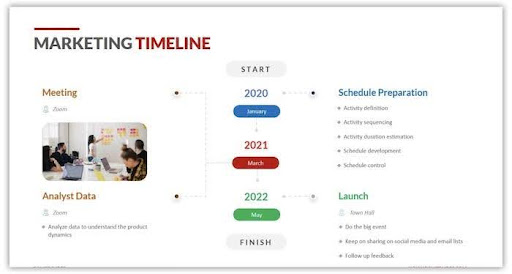
Image via Powerslides

6. Set a Marketing Budget

A marketing budget is more than just ad money. It involves allocating available resources effectively to maximize the returns on investment (ROI) from your marketing efforts.

The budget is mostly influenced by the medium you intend to use and usually, digital mediums are cheaper. For example, hiring influencers or using ambassador marketing may be cheaper than paying for a billboard ad.

Other cost considerations include marketing automation tools, branding efforts, software subscriptions and market research.

Ideally, you should develop your marketing budget toward the end of creating your marketing plan. At that stage, you already have a clear picture of what you need. Here are some benefits of setting a marketing budget.
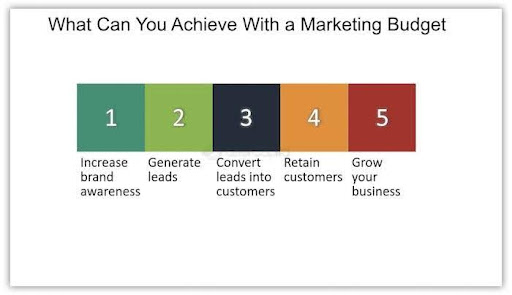
Image via Faster Capital

7. Execute the Marketing Plan

With everything in place, it’s time to put your plan into action. Start by delegating responsibilities and ensuring everyone in the team understands their deliverables. For example, a social media manager handles social media posts while a content strategist deals with blog posts.

Seamless teamwork among different team members will help you hit your online business goals faster.

Additionally, it would help to use project management tools like Trello or Asana at this stage. These tools make assigning tasks to team members easier and more manageable.

Turn Things Around with a Good Marketing Strategy

That’s how to create a marketing strategy for business success. The first steps involve defining your business goals, conducting marketing research, and setting your marketing objectives.

The results may not be instant, but by following these tips, your business stands a better chance at success. So try them today and share with us more tips you believe may also work in the comment section.

5 Ways Media Agencies Can Help Brands Navigate Business Challenges

As a local-direct media marketing professional...you are like the agencies this article speaks of having added System 21 to your tools. Philip Jay LeNoble, Ph.D.  


5 Ways Media Agencies Can Help Brands Navigate Business Challenges

From navigating the complexities of digital advertising to increasing competitions and waffling consumer loyalty, marketers require partners that can help them navigate these ongoing hurdles. While many marketers seek the help of consultancies and even full service shops, there is another sector of adland that often goes overlooked: media agencies.

Here’s a few ways how a good media agency partner can be a catalyst for your brand growth.

Identifying your target audience:. This is where media agencies truly excel. By analyzing consumer behavior, demographics, psychographics, and digital habits, media agencies create precise and strategic audience profiles. 

Additionally, media agencies can uncover untapped opportunity segments that you may have not considered- emerging demographics, behavior-based niches, or even cultural trends. This data driven approach not only helps refine your brand messaging but can also inspire new product offerings, optimized distribution strategies and drive overall growth.

Mapping the customer journey: Today's customer journey is not linear. Consumers interact with brands across multiple touchpoints, from billboards to social media ads, search engines, influencers, or direct website visits before they make a purchase. Understanding how these touc points work together and which ones drive conversion is crucial for optimizing both marketing spend and creative output.

Media agencies help brands allocate budgets more efficiently by focusing on the touchpoints that have the greatest impact, ensuring that creative, messaging, and media placements are all working harmoniously to maximize return on investment.

Identifying the leaks and plugging the holes, aka funnel analysis: Media agencies perform funnel analyses to pinpoint where consumers are falling out of the purchasing process. This allows brands to not only optimize downstream channels, but also ensure top-of-the-funnel activities, like awareness campaigns, are performing efficiently

Providing unbiased creative testing and personalized content at scale:  Media agencies can test creative in real time to understand what resonates best with different audiences and can recommend tweaks or pivots to improve performance. This objectivity is invaluable, ensuring the creative is held accountable for driving business outcomes. 

Media  agencies have expanded their core offerings to include personalized content services at scale. With access to advanced tools like dynamic creative optimization  and AI-powered, data-driven content platforms, they can produce customized content tailored to different audiences in real time. This allows brands to deliver highly relevant messages to consumers based on factors like location, behavior, and preferences, all while keeping costs in check.

Harnessing the power of analytics and research. Through advanced analytics and market research, these agencies can uncover valuable insights into consumer behavior, preferences, and trends. These capabilities can shine a light on why businesses struggle, and surface specific solutions to help them navigate through those challenges.

Similar to analytics, media agencies excel at research. They conduct thorough competitive audits and market research, helping brands understand their position in the market and uncover white space opportunities. This is particularly beneficial for challenger brands with smaller budgets, allowing them to compete against bigger players by owning niche space.

As today’s landscape is only becoming more complex and competitive, media agencies provide more than just media buys. They provide strategic guidance, cutting-edge technology, and deep insights necessary to navigate channels and ultimately drive growth.

Monday, November 18, 2024

Breaking Fake News: Media Under Trump?


Commentary

Breaking Fake News: Media Under Trump?

Under the Trump administration, a complex business environment may develop for legacy TV-network-based media companies to work through.

First is the promise of deregulation -- something that can ignite a much-needed fire for media mergers, according to ambitious senior executives.

At the same time, those same executives are concerned about fallout from a number of lawsuits pending by former candidate Donald Trump -- lawsuits against Walt Disney’s ABC and Paramount Global’s CBS.

This all revolves around what Trump perceives is “fake” news content.

Are there hints that he wants to do more? If so, how then to navigate through all this?

Analysts surmise Trump will certainly want to play with the belief that attacking the media will be a popular thing among his supporters.

He has already talked up the vague concept of the “enemy within” -- which seemingly extends with no bounds, into not just his targeted goal of deporting immigrants but also dealing with some businesses, and yes, the media and journalism.

Major local TV station groups -- Nexstar Media Group, Sinclair Inc., Tegna and Gray Television Group -- have been ebullient about the possibility of major deregulation coming, which could remove the longtime 39% cap on TV station ownership -- something that many feel needs updating. The FCC rule was instituted in 2004, twenty years ago.

Throwing out this restriction, in theory, could allow big TV station groups to amass perhaps a hundred or more of stations across the U.S., where they could have 90% to 100% of U.S. coverage of TV markets when it comes to ownership.

TV station groups say current regulations restrict their ability to compete with fiercely competing streaming platforms -- especially locally.

Those stations are also concerned about affiliation deals with legacy TV network groups that could loosen the long-time bonds with affiliates and networks.

In addition, some TV networks are considering the idea of scaling back programming, and/or the programming time periods under those network-station deals. Many might like to be where Fox Corp. is -- in the 8 p.m. to 10 p.m. prime-time period.

Typical network-TV station affiliate deals are also about having local TV stations help their networks with on-air marketing around national TV programming. Does that go away?

While seeming to free up TV stations to do more of their own programming, that comes with the pressure of finding high-impact content for their airwaves.

Taking scores or even hundreds of stations would, in effect, build their own national TV network -- helping them to do just that, and perhaps even multiple outlets in one market. In 2017, there were 1,761 commercial TV stations.

But could the rub come with TV news content? Local TV station groups have been heavily dependent on their ever-expanding TV news content. Where will they go next?

Although it's crazy to imagine, let's just throw it out there: Will any of this be an issue with the Trump Administration amid the promise of freeing their businesses?

5 Ways to Ensure Your Marketing Plan Is Holiday-Ready


5 Ways to Ensure Your Marketing Plan Is Holiday-Ready by Jared Smith, November 15, 2024

 This year, the holiday rush isn’t just about sales; it’s about navigating the fine line between algorithm-driven advertising and meaningful brand-building in a crowded marketplace. Now more than ever, brands must adapt quickly to stay ahead. Following are five key strategies to ensure your marketing plan is primed and ready for the holiday season. Maximize AI ad solutions. 
AI capabilities have transformed our approach to paid media, especially during the holiday season.

 AI campaigns like Google’s Performance Max or Meta’s Advantage+ Shopping Campaigns are purchase-driving tactics that make up a significant portion of paid media revenue. To maximize their performance, it's crucial to set these campaigns up for success with a large variety of creative assets to prevent oversaturation. Meta has reported that 56% of performance is determined by creative. 

Opt into AI-driven campaigns this holiday season, keeping consistent with creative refreshes, to keep campaigns optimized and performing at their best. Prepare strong creative -- and a lot of it. To stand out in a crowded market, you need a diverse mix of assets and formats, from static text-overlay images to shoppable content. Video remains a top-performing format across all platforms, so invest in both high-quality branded and influencer videos to add third-party validation. 

Static images are effective during key promotional days like Black Friday and Cyber Monday for delivering clear and concise sale messaging. Plan for before, during and after key moments. The holiday season is short this year, as we are losing five days of this promotional period due to a late Thanksgiving, making advanced planning more crucial than ever. 

You should already be ramping up your prospecting efforts to build awareness before November when the focus shifts to converting interested consumers. Consider increasing your budget for key promotional days and transitioning to buy online, picking up in-store options afterward. Also, ensure your ads are trafficked early, as ad platforms often slow down or experience issues closer to Black Friday and Cyber Monday. Have a contingency plan. Even the best-laid plans can go awry, so having a contingency plan is crucial. Ensure open communication with your media reps, especially during high-spend periods, and check on your credit lines so you can remain agile and capitalize on strong performance. If you are a marketer, having your CFO on speed dial might not be a bad idea! 

Prepare for pixel or catalog issues, identifying alternate platforms or products you can drive traffic to. Monitor the market. Be aware of what's happening in the market, both with consumer sentiment and competitor activity. Keep track of when your competitors are launching promotions, what discounts they're offering, and how aggressive they are in their strategies. This will help you decide if you need to adjust your own tactics to remain competitive. 

Make sure you're meeting your customers where they are, understanding which channels they're using, and being present when their intent to purchase is highest. Preparing for the holiday season requires careful planning, adaptability, and a solid understanding of the market dynamics. 

With these five strategies, you'll be ready to navigate the challenges and seize the opportunities of the holiday promotional period.

Friday, November 15, 2024

Retail sales up solidly in October as Americans showed continued willingness to spend

AP SETS THE STANDARD FOR POLITICAL REPORTING. SUPPORT INDEPENDENT, FACT-BASED JOURNALISM. Business Retail sales up solidly in October as Americans showed continued willingness to spend By CHRISTOPHER RUGABER and ANNE D’INNOCENZIO Updated 3:17 PM MST, November 15, 2024 WASHINGTON (AP) — Americans stepped up their spending at retailers last month in the latest sign that healthy consumer spending is driving the economy’s steady growth. Retail sales rose 0.4% from September to October, the Commerce Department said Friday, a solid increase though less than the previous month’s robust 0.8% gain. A 1.6% jump in sales at auto dealers drove much of the gain. Purchases climbed 2.3% at electronics and appliances stores and 0.7% at restaurants and bars. Though some of October’s rise in retail sales reflected higher prices, it mainly indicated increased purchases. Sales in some categories fell — furniture stores, clothing outlets and drug stores, among them — though economists said that weakness likely resulted, at least in part, from last month’s hurricanes. Sales at home and garden stores rose, potentially reflecting rebuilding activity after the storms. “The moderation in the pace of price growth is allowing consumers to ratchet up spending,” said Tim Quinlan, an economist at Wells Fargo. “People may not love how much it costs to go out to eat, but their bar and restaurant spending is growing faster than prices are.” The latest retail sales figures suggest that the economy is growing briskly again in the current October-December quarter, after having expanded at a sturdy 2.8% annual rate in the previous quarter. Since peaking at 9.1% more than two years ago, inflation has sunk to 2.6%, not far above pre-pandemic levels. And Americans’ take-home pay, on average, has surpassed inflation for about 18 months. Still, the post-pandemic inflation spike has left prices about 20% higher than they were three years ago and dimmed Americans’ outlook on the economy. That was a key reason why Donald Trump was able to capitalize on public discontent with the Biden-Harris administration and recapture the White House in last week’s election. Despite high price levels, though, Trump inherits an economy in which spending is strong, growth is solid and unemployment low. Other recent economic reports have also pointed to a healthy economy. In a sign that households, whose purchases drive most of the economy, will continue spending, the Conference Board’s most recent consumer confidence index posted its biggest monthly gain since 2021. The proportion of consumers who expect a recession in the next 12 months dropped to its lowest point since the board first posed that question in 2022. One cautionary note is that grocery-store sales barely rose last month, a sign that many Americans may still be struggling to adapt to food prices that are still much higher than they were three years ago. Lorraine Thompson, who was food shopping this week at a Walmart in Secaucus, New Jersey, said she’s not noticing any slowdown in inflation. “Everything is high,” she said. “The meat, the cheese.” Thompson said she’s been buying less cheese and has been food shopping more at Walmart because she thinks the prices there are lower than at other supermarkets. The National Retail Federation has predicted that shoppers will increase their spending in November and December by between 2.5% and 3.5% over the same period a year ago. During the 2023 holiday shopping season, spending had surged by a stronger 3.9% from 2022. Some retailers say they expect consumers to spend more freely in the coming months. Affirm, a buy-now, pay-later company that has been expanding as more consumers seek online installment loans, last week reported that growth in its active consumers accelerated for a third straight quarter to nearly 20 million. “Everything we see suggests the consumer feels like they want to be out spending,” Michael Linford, Affirm’s chief operating officer, told The Associated Press. Analysts will be dissecting quarterly results next week from Walmart and Target, among others, to gauge how shoppers are navigating still-high prices and to assess their mood after a presidential race that pivoted in large part on voters’ discontent with the economy. One of the first major retailers to report fiscal third quarter earnings was Home Depot, which continues to grapple with a pullback in spending from customers. But the retrenchment was less severe than in the past, and its performance beat Wall Street’s expectations. Home Depot’s CEO Edward Decker said that Trump’s proposed high tariffs on imports, if implemented, would intensify pressure on the company. But he added that Home Depot sources well more than half its goods domestically and elsewhere in North America.

Commentary Political Ad Local TV For Q3 And Beyond: Big Gains Or Something Else?


Commentary

Political Ad Local TV For Q3 And Beyond: Big Gains Or Something Else?

Although political advertising so far for local TV stations has come in mostly as expected, there are concerns -- especially in tandem with where core (non political) advertising has been for major operators.

Looking at a couple of the biggest TV stations owners might offer some perspective.

Nexstar Media Group, the biggest owner of U.S. local TV stations, soared 16% in the third quarter to $154 million in political advertising one the same period in 2020 -- with the company growing 22% in overall ad revenue to $622 million.

For that $154 million, the company lost $22 million year-over-year in core TV advertising due to market softness as well as “political displacement.”

FCC rules mandate that TV stations must run political advertisers' campaigns that can push out core, non-political marketers.

For its part, Sinclair, the second-biggest U.S. owner of TV stations, rose 42% to $433 million in overall ad revenue, with $140 million coming from political advertising.

Although political advertising can mess up its regular seasonal advertiser media scheduling, Sinclair said core advertising inched up 1%.

For the fourth quarter, Sinclair says core advertising will be down mid-single digits. But that’s not too bad, says Daniel Kurnos, media analyst at Benchmark. “Political numbers like this would normally produce anywhere from 6% to 15% declines per quarter in core revenue due to crowd-out.”

He adds that Sinclair can do this because it has a “new algorithmic yield management strategy" that "is still working.”

All this suggests that local TV stations still believe that political advertising will continue on this pace -- if not increase -- in future years. Are hungry local and regional market political groups -- and the expected big Presidential media years (as well as midterms election years) -- still trending higher?

Some political advertising shadows may be lurking around.

The broader picture may suggest a cloudier side to political advertising, especially when looking at Nexstar -- which for the year so far in 2024 through Election Day, pulled in $491 million.

The problem is that this was a big $100 million below consensus, says Kurnos.

Sinclair came in at $406 million for the year, down around $30 million, an expected $440 million.

And perhaps the concerns are not just for Nexstar and Sinclair, but for all media platforms looking to make hay with political.

“It feels like total political may come in below lofty expectations across every medium this campaign cycle, with last minute cancellations or dollar shifts particularly damaging to broadcasters who typically require longer lead times to fill inventory," Kurnos adds.

Core advertisers have already been an issue with local TV stations, and adding in political messaging uncertainty is not good news.

Will Skydance Transform Paramount, CBS Into A 'Modern' Media Company?


Will Skydance Transform Paramount, CBS Into A 'Modern' Media Company?

Could CBS make a dramatic move now with Jeff Shell at the helm as president of Paramount Global -- in cutting back on programming in certain time periods?

For years, TV network executives floated the idea of cutting back on programming/production costs.

That in turn has meant reducing the time periods -- especially in prime time -- where it generates major value from advertisers.

In 2022, Jeff Shell, then CEO of NBCUniversal, mulled the idea of giving back the 10 p.m. hour to network affiliates.

Ultimately -- for a number of reasons -- NBCU did not make the move. Hollywood producers, agents, and talent resisted this approach.

In addition, NBC had a long-time major relationship with “Law & Order” producer Dick Wolf, as the network where much of his programming airs.

Much of the 10 p.m. time period continues to be filled with crime/procedural dramas for networks including ABC, CBS, and NBC. (But not Fox).

For more than a decade, however, there has been a rapid decline in viewing for prime-time programming, and especially in the 10 p.m. time period.

Currently on CBS its 10 p.m. weekday lineup includes “NCIS: Origins,” “FBI: Most Wanted,” “Elsbeth,” and “Blue Bloods.”

Now two years later, with streaming platforms continuing to make gains, there is a higher expectation that Shell could make some dramatic, industry-shaking moves at CBS.

This would work with the vision of the new incoming Skydance ownership of Paramount Global. CEO David Ellison wants to transform Paramount and CBS into more of a “modern” media company. But that would also have ripple effects.

If indeed CBS gives up time periods, longtime affiliates would need to re-evaluate their production/programming needs in terms of being able to foot higher programming costs in filling time periods.

Without high-value prime-time shows, local/regional advertisers would be shifting their media campaigns elsewhere.

Do local TV stations then need to develop their own TV shows, or perhaps tap into the national TV syndication market, either purchasing other original or library programming to fill those time periods?

The flip side to all this is that legacy TV broadcast networks are still generally in a positive revenue-generating position. Prime-time shows act as a marketing launchpad of sorts for their TV series that then move to their respective streaming TV platforms.

Prime time, however, continues to trend down due to cord-cutting -- which in turn has meant declining advertising revenue. Long-time TV network marketers continue to seek more reach -- and that means tapping into streaming platforms.

The betting this time around is that big show-stopping changes are coming under Shell. It’s a new TV season.