Tuesday, September 17, 2024

Strong Ad Market Means Smaller Drop in TV Revenues, Says Magna Forecast

Broadcasting & Cable

Strong Ad Market Means Smaller Drop in TV Revenues, Says Magna Forecast

A closeup of U.S. money
(Image credit: Yuriy Kulik/Getty Images)

A stronger-than-expected U.S. advertising market and special events meant smaller declines in national TV ad revenues in the second quarter, according to media agency Magna, which boosted its full-year ad spending forecast for 2024.

National television/video revenues fell 1.1% in Q2. That included a 6.4% drop for linear networks and a 19.6% increase for ad-supported video-on-demand, connected TV and free ad-supported streaming television (FAST). 

For 2024, Magna forecasts that national TV will finish down 1.7%, an improvement from Magna’s earlier forecast of a 3% decline. Linear networks will be down 6.8% while AVOD, CTV and FAST will be up 19.3%.

Local TV is expected to be up 25.4% in 2024 including cyclical events, and down 3.9% excluding cyclical events.

For all media, Magna sees ad revenues including cyclical events as rising by 11.4% (the previous forecast was 10.7%) and up 8.9% excluding cyclical events (the earlier forecast was 8.2%). That would mark the strongest growth rate in 20 years.

Those cyclical events will bring in $10 billion in incremental ad sales in 2024. The election will add a record $9 billion to media owners. Magna estimates NBCUniversal’s ad sales during the Paris Olympic Games at $1.5 billion, including $1.1 billion for linear and $400 million for digital and streaming.

On the digital side, ad revenue rose 16% in the first half of 2024. Magna noted that Meta and Google credited AI tools with driving incremental spending.

Overall, noncyclical ad spending will grow 6.3% to $291 billion in 2025, Magna said, while sales including cyclical events, like the Olympics and elections, will rise only 3.9%. 

National television sales will drop 2.7% while local television sales will underperform and decline 3.6% (excluding election spending) in 2025.

Digital pure players will again drive the market, growing 9.3% to $289 billion, while traditional media owners will erode by 1.5% to $102 billion.

Digital revenues are expected to be up 8.7% in 2025.

In 2026, the ad market should top $400 billion, the agency said.

Manga Forecast Chart


IAB: Video Commerce Ads Closing Gap Between Discovery, Purchase


IAB: Video Commerce Ads Closing Gap Between Discovery, Purchase

Three-quarters of consumers feel commerce in video ads is more relevant to their purchase process than other ad types, as more look for a seamless experience to combine product discovery with purchases.

Some 95% of advertisers using video rely on this ad type, Commerce Video, more often than not to drive purchase.

The insights from a new study released Tuesday by the Interactive Advertising Bureau, conducted in partnership with research consultancy Alter Agents, defines this new ad type in a study titled Unconnected Commerce: the Disconnect between Brands and Consumers in Digital Video Shopping.

Results from the study -- fielded between June 28 and July 21, 2024 -- combine responses from 1,000 consumers and 300 marketers. Through quantitative, qualitative and ethnographic research, the analysis looks to define the media, provide details the rise of commerce in videos, and highlight the ad format as an emerging seamless experience as the purchase funnel continues to change.

Consumers have preferences as to what they want to see in Commerce Video ads when shopping. Some 58% want to see details on costs and promotions, while 58% want to see clear product demos and details, 44% want to see visual and emotional appeal, and 35% want to see comparisons of different products. There are other considerations, but those are the top four.

Length of the video also matters, but consumers do not always agree with advertisers. Forty-eight percent of advertisers favor Commerce Video ads of less than 15 seconds in length. Consumers have their own preferences, with 67% preferring 45 seconds, followed by 65% who prefer 30-second ads. Fifty-seven percent prefer 60-second ads, while 41% prefer 15-second ads, and 31% prefer less than 15-second ads.

Nearly 70% of digital video advertisers participating in the study leverage commerce video -- which the report defines as digital video ads designed to drive action, especially purchases. Nearly all who participated in the study plan to increase their commerce video spend in 2025.

Although it forecasts success, there seems to be a bit of a disconnect when analyzing effective messages in the media. Advertisers can be overly confident with their messages.

While 96% of advertisers think their messaging is on target to drive purchases, 70% of consumers report feeling annoyed or negative on a monthly basis with commerce video ads, while one-third feel that way at least weekly.

Poor commerce video ad experiences can trigger a backlash for advertisers -- one of the major challenges in this media, per the report. When they are annoyed by commerce video ads, two-thirds of consumers take actions such as switching to competitors, complaining on social media, or unsubscribing from services or newsletters.

Tuesday, September 10, 2024

An Off-Platform Solution for In-Game Advertising


An Off-Platform Solution for In-Game Advertising

Although the global games market attracts 3.4 billion gamers and generates revenues of $184 billion annually -- surpassing both the music and movie industries -- there are important reasons why advertisers have been slow to make use of in-game ad opportunities, 

Serving ads to gamers outside of live esports events can be difficult, especially among premium titles that typically require a direct partnership with game developers, which can be an expensive and competitive undertaking.

Advertisers also seem intimidated by the gaming ecosystem’s wide range of targeting opportunities traversing devices, formats, genres and market preferences.

The share of advertisers that plan to increase spending on gaming -- which has fallen 20 percentage points, from 72% to 52%, since 2021 -- could possibly improve if ad monetization within games was more straightforward and less expensive. 

Last month, Alex Brownsell, the head of WARC Media, commented on this issue, saying this task rests on the shoulders of game publishers. But there may be another option. 

One company called Overwolf has come up with a way to make it possible for brands to run immersive ads in premium games without partnering with publishers. 

Overwolf is not a game publisher, but a third-party in-game app and "modification platform" that players of popular desktop games use to run apps that enhance their gameplay via features such as real-time stats, guides, playing tips, social aspects, video capture and more.

Because these apps run throughout entire gaming sessions, advertisers are able to run ads while players are actively gaming. 

“We’re the gamers’ companions, allowing them to play better, win and better enjoy their games that from the product-side. From the brand-side, these apps basically allow us to reach and serve media,” Noam Korin, Overwolf’s vice president of brand partnerships, tells MediaPost.

While ad firms have yet to land sizable amounts of premium gaming inventory, major brands and agencies like Procter & Gamble, Hulu, WPP, Havas, Omnicom and Dentsu are able to utilize Overwolf’s ad technology and create campaigns around key gaming moments without the need to partner with publishers. 

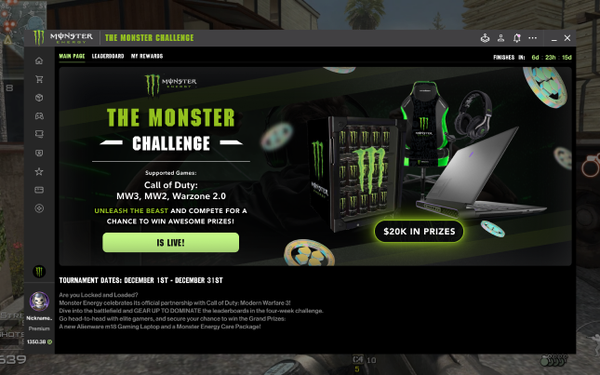
The benefits of this brand option become especially clear when looking at Overwolf’s recent partnership with Monster Energy. 

Already a longtime official sponsor of “Call of Duty,” Monster wanted to target “Call of Duty” players on the precise launch date of the franchise’s newest game, “Call of Duty: Modern Warfare 3” in a more active way via a simultaneous ad campaign and a custom tournament designed to drive awareness and gameplay. 

Upon the game’s release, Overwolf launched a Monster-branded tournament for online gameplay designed to further engage Overwolf users across 20 countries with Monster-branded in-game challenges and prizes.

Overwolf allows brands to serve relevant messages via moment-triggered ads throughout gameplay, by cheering them on when they win, giving them advice when they lose, and rewarding them for helping other players honor their achievement.

According to Korin, this creates a “very strong emotional connection” with gamers. 

To further personalize in-game messaging and develop custom tournaments, Overwolf also collects a deep well of data, including the type of hardware players are using.

For example, if Intel is attempting to sell new hardware to Overwolf gamers, the platform will send an Intel-branded game-relevant message to players who are using older hardware about updating to a newer model, such as “Hey your device is too slow, you might win more if you upgrade your CPU.” 

Monster’s four-week, in-game Overwolf tournament resulted in over 65,000 matches and 14,000 hours played, with a 63% purchase intent uplift, according to Overwolf.

According to Onur Koyuncu, senior gaming marketing manager at Monster, the campaign with Overwolf propelled brand recall in its sector to the top spot among gamers surveyed after the campaign, who ranked Monster as their favorite energy drink brand when gaming. 

Korin tells MediaPost that its campaign with Monster was among its most unique brand launches, as “it combined being in the game on launch date, engaging the gamers in an innovative way through a tournament and promoting the partnership to the gamers while they were playing.” 

Korin says the majority of Overwolf’s 100 million monthly active gamers prefer to view ads instead of paying to skip them. Additionally, Overwolf’s ads are certified brand safe and the company makes a point at working only with Fortune 500 companies across brand safe industries. 

These factors contributed to Overwolf earning over $50 million in ad sales in 2023, more than doubling its ad revenues between 2021 and 2022, according to the company, which continues to work on strengthening brand relations, recently expanding its brand partnerships team and buying publisher ad platform NitroPay.  

Commentary Dodging the Crossfire of Political Advertising


Commentary

Dodging The Crossfire of Political Advertising

Marketers have front-row seats to arguably the most digitally charged presidential election in political history. This year’s political spending will gluttonize digital ad inventory, ripping deeper into an assortment of media that brands typically rely on to drive high-converting traffic. Keeping any brand visible despite limited ad space and consumer fatigue requires well-timed, segmented media placements and a renewed focus on creativity and resonance.

With 2024 political ad spending estimated to reach a record high of nearly $13B, we predict that about 35% of that spending ($4.6B) will be allocated to digital media. The digital economy will be most noticeably impacted by higher CPM’s (about a 20% to 45% increase) during the six weeks leading up to the election.

Brands can expect political advertising to be concentrated on awareness-driving channels such as CTV, YouTube, and Programmatic Display starting in late September with a ramp-up of social media advertising on platforms such as Facebook, Instagram, and X in October.

Targeting will be centered around the usual swing states with an emphasis on the influx of 16 million first-time Gen Z voters.

For brands to engage this demographic, they could prioritize organic interactions that provide relief from the bombardment of political ads. Light-hearted social media posts or personalized promo emails are a few ways to cut through the noise. Alternatively, brands could consider shifting advertising budgets to TikTok, where political advertising is banned and Gen Zs are easy to reach.

Despite the pressures of political advertising, brands can maintain favorable ad costs with a full-funnel marketing approach that segments media prioritizations month-by-month.

Here’s how: During August and September, brands can prioritize spending on awareness media like programmatic display or YouTube preroll. If timed correctly, brands can multiply the volume of prospects entering the top of the marketing funnel while dodging the heightened CP’s that will plague these platforms in the election heat of October.

Then, shifting spending in October and November to prioritize mid and bottom-funnel media can retarget and nurture a pool of new prospects from awareness to conversion. This enables ad spend to be maximized on channels that are less contested by politicians while simultaneously engaging a wealth of prospects with initial exposure to a brand.

Inevitably, all target markets will be overstimulated by the onslaught of political ads come October; ad fatigue will set in, and engagement rates will fall. Avoiding adjacency with political ad spaces will be insufficient for capturing and retaining the attention of tiresome consumers.

To maintain optimal engagement rates, brands should renew their focus on creativity and resonance within their messaging, which will provide consumers with a much-needed diversion from the chaotic political landscape. Seek to contrast with ads that build connection amid the chaos. Consider building ads that champion consumer stories or showcase how a product can improve life.

Amid these difficulties, we predict that some brands will completely pause their ad spend during October, only to reflood the market with increased spending in the election aftermath of November and December. Combined with the fact that retail brands will be competing for additional advertising space during those same months, don’t expect normalcy to return to advertising rates anytime soon.