Thursday, April 11, 2024

OTT, Streaming Subscription Revenues Projected to Rise 8% In 2025, Slower Growth


OTT, Streaming Subscription Revenues Projected to Rise 8% In 2025, Slower Growth

Industry-wide OTT/streaming platforms’ subscription revenue will rise 8% next year and will command a majority share of the total video subscription market, according to eMarketer.

But some headwinds are coming.

This would be substantially lower than the double-digit percentage growth of previous years. 

Going forward, “streaming customers are becoming more likely to choose advertising plans or cancel their subscriptions,” say the authors of the research.

Ad-supported streaming plans typically yielded 40% to 50% lower pricing versus non-advertising streaming platform options.

Streaming/OTT platforms' monthly consumer fee revenues are estimated to $71.9 billion next year -- up from $66.2 billion in 2024.

These projections include virtual pay TV distributors such as YouTube TV, Hulu+Live TV, and Sling TV. This will give OTT subscription revenue a 53.5% share of the overall video subscription market.

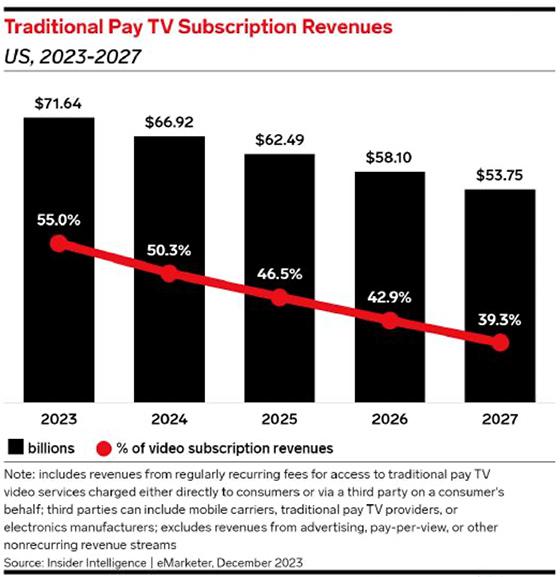
Traditional pay TV subscriptions -- from cable, satellite and telco -- are estimated to sink 7% to $62.5 billion in 2025, down from $66.9 billion this year -- all due to continued cord-cutting by consumers

Looking broadly at all video subscription revenue (OTT/streaming and traditional pay TV platforms), the business is forecast to slow to a 1% increase in revenue from 2025 to 2027.

eMarketer estimates that this year, video subscriptions will total $133.2 billion for traditional TV and streaming fee revenues.

Paramount, Shari Redstone face investor angst over possible Skydance deal

Los Angeles Times

COMPANY TOWN

Paramount, Shari Redstone face investor angst over possible Skydance deal

The famed arches of the Melrose Gate of Paramount Pictures Studio located at 5555 Melrose Ave in Hollywood.
The Melrose Gate of Paramount Pictures Studio located at 5555 Melrose Ave. in Hollywood.
 
(Al Seib / Los Angeles Times)

Some shareholders have expressed concerns too. They worry that the structure of the deal would confer significant benefits to Redstone, who is Paramount’s nonexecutive chairwoman, at the expense of regular investors.

Earlier in the week, shareholder Blackwood Capital Management sent a letter to Paramount’s board of directors, saying they “vehemently object” to the proposed Skydance deal.

“Under the terms reported by the media, you’ll be cashing out one shareholder at a huge premium and leaving the rest of us stuck with heavily diluted shares in a very speculative new venture,” Justin Evans of Blackwood, wrote. “This violates the law as well as your fiduciary duty to shareholders. Further, the proposal includes material conflicts of interest and painfully obvious self-dealing.”

The letter also included a warning: “If you move forward with this toxic unfair proposal, the next letter you’ll receive is a litigation hold notice from our attorneys.”

Paramount shares fell 47 cents, or 4.3%, to $10.50 on Wednesday. The stock had fallen as much as 7% in midday trading.

Earlier in the day, the Wall Street Journal first reported that Dawn Ostroff, Nicole Seligman and Rob Klieger would be stepping down from their roles on the board in the coming weeks.

The three are among the directors closest to Redstone; Ostroff and Seligman have been longtime friends with Redstone, and Klieger was late patriarch Sumner Redstone’s attorney, picked for the board by Shari Redstone. Frederick O. Terrell is also exiting the board, the outlet later reported.

Rising concerns among investors put the spotlight on the independent committee, which included Redstone’s allies. There were concerns about a potential conflict of interest as directors have a fiduciary duty to all shareholders, according to a person who had been briefed on the tensions but was not authorized to comment.

The stock has fallen 15% in the last five days, wiping out gains made last week amid escalating deal chatter.

Paramount declined to comment.

The stock slump comes as investors express dismay at reports of the potential deal between Skydance and National Amusements — the Redstone family’s holding company and controlling shareholder of Paramount. The two sides are in a period of exclusive negotiations, according to people familiar with the matter who are not permitted to comment.

Such a deal would give Ellison control over Paramount, marking the start of an uncertain new chapter for a company that has gone through major upheaval in recent years as the entertainment industry transitions from traditional television to streaming.

In a Monday letter to Paramount’s board, investor Matrix Asset Advisors wrote that the in-the-works deal between NAI and Skydance would be “detrimental” to Paramount’s value.

The investment firm urged the board not to accept a “sub-optimal” offer from Skydance, and instead more seriously consider a competing $26-billion bid from private equity giant Apollo Management Group.

Blackwood Capital Management, too, urged the board to explore Apollo’s offer, writing, “The last thing the company shareholders need is yet another silver-spooned movie enthusiast to run our entertainment company into the ground.”

Ellison first expressed interest in a deal for Paramount in December. Shari Redstone had long viewed him as a preferred buyer because of Ellison’s long association with the film studio, his respect for what’s been built and the fact that Ellison is from a younger generation, according to a person close to the sales process but not authorized to comment publicly. Ellison’s father, Oracle Corp. co-founder Larry Ellison, is also expected to contribute funding to the deal.

Skydance has an existing relationship with Paramount, co-producing each film in the “Mission: Impossible” franchise since 2011’s “Mission: Impossible — Ghost Protocol,” along with the 2022 hit “Top Gun: Maverick.”

The two studios’ prior collaborations, as well as the allure of combining their intellectual properties and the cachet of owning the longest-operating Hollywood studio, probably was attractive to Ellison, analysts said. Paramount’s rich history of films includes such cinematic hits as “The Godfather” and “Chinatown,” as well as blockbuster franchises such as “Transformers,” in addition to groundbreaking cable channels including BET, MTV and Nickelodeon.

But Paramount today faces significant challenges, including the decline of linear TV, which has shrunk valuable ad revenue, the company’s struggles with its streaming service Paramount+ and a larger, industrywide question about when — if ever — box office revenue will return to pre-pandemic levels.

“Paramount still is a historic studio with a legendary venue; I can’t imagine that would change,” said Stephen Galloway, dean of Chapman University’s Dodge College of Film and Media Arts.

But he noted how many of Paramount’s historical rivals have been bought up by other studios — MGM by Amazon, Fox by Disney and Warner Bros. combining with Discovery.

“Recent history doesn’t bode well for the future of these brands that basically all came about in the ‘20s ... and lasted 100 years. A hundred years is a long time. Nothing lasts forever,” Galloway said.

Ellison is not the only interested buyer. Apollo’s bid for the company is seen as more attractive to some analysts and shareholders. The Ellison bid heavily favors Redstone and her controlling class of shares and would dilute the value of shares for the vast majority of stockholders, they say.

“The notion of National Amusements getting a premium for their voting stock is totally warranted,” said Mario Gabelli, chief executive of GAMCO Investors Inc., whose clients own 5 million shares in Paramount. “The question is how much. My clients want to be treated the same as the voting stock. All voting stock should be treated equally.”

Redstone is said to have recused herself from the deal-vetting process.

Warner Bros. Discovery also previously expressed some interest in a merger, though it has struggled under the load of its debt from previous deals and is in similar straits as Paramount. Warner Bros. Discovery’s interest, though, was short-lived. Media mogul Byron Allen also made a bid for the company, though his financing seemed more uncertain.

7 Winning Strategies to Shorten Your B2B Sales Cycle


7 Winning Strategies to Shorten Your B2B Sales Cycle


7 Winning Strategies to Shorten Your B2B Sales CycleWhen you meet a new lead, I bet the first thing that pops into your head is how to close the lead and how to close it fast. There’s nothing as dreary and frustrating as a long sales cycle.
Well, I have good news. This blog post will uncover seven proven strategies to shorten your B2B sales cycle.

From identifying potential leads to successfully sealing the deal, I’ll guide you through winning tactics to make your sales cycle less complex.

1. Identify Your Ideal Customers

The first step to shorten your B2B sales cycle and one of the most effective strategies for ultimate success in sales is to clearly define your ideal customers. Conduct in-depth market research to gain insights into your customers’ interests. Use those insights to create your ideal customer profile (ICP) and find leads that fit that profile.

Using this targeted prospecting approach, you can tailor your value proposition to their interests. This gives you a higher chance of presenting sales pitches to leads  that are more likely to patronize your business.

2. Qualify Leads Effectively

Have you ever spent hours, days or weeks chasing a prospect only for it to fall through at the last minute? While this can be frustrating, this can be prevented by qualifying leads in the initial stages of the sales cycle.

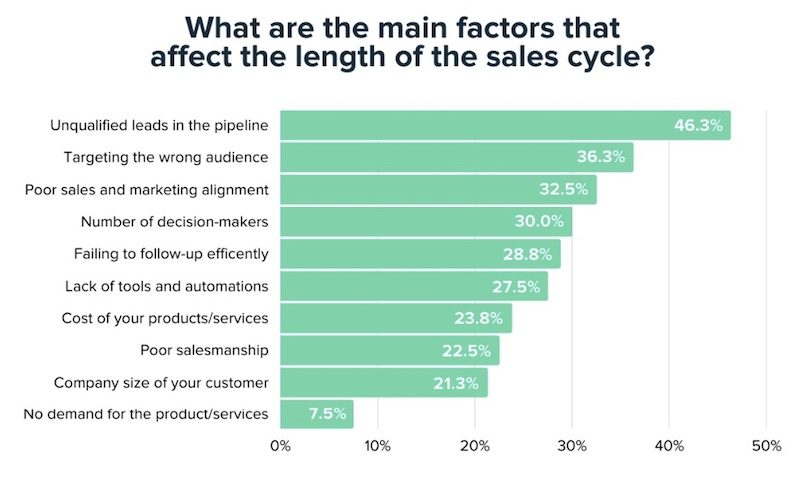
Ruler Analytics research shows that some factors that affect the length of a sales cycle include unqualified leads, poor sales and marketing alignment, and the wrong target audience.

Source: Ruler Analytics

This is why one of the most essential strategies to shorten your B2B sales cycle is correctly qualifying your leads. Screen your leads according to qualifications like needs, demographics, and company size.

3. Personalize Outreach

Another way to shorten your B2B sales cycle effectively is by personalizing your outreach emails. This goes beyond addressing your potential customers by their first name. You also need to know their pain points. Remember that selling is not just about your product or service; it’s about value. When you understand the specific needs of your target audience, you can offer valuable solutions. This captures the prospect’s attention and accelerates the decision-making process.

4. Discuss Pricing Early

One of the most significant factors that can lengthen your sales cycle is unclear pricing. If you lead the prospect with vague pricing and it turns out your prices are out of their budget, then all your marketing efforts would go down the drain.

Get price negotiations out of the way as early as you can. If the prospect raises any objections about pricing, discuss them and steer the conversation back to the benefits of your products and services.

5. Apply Social Proof

One of the most essential strategies to shorten your B2B sales cycle is social proof. Your potential customers need to know that they can trust you. However, don’t merely state this fact. Leverage user-generated content in marketing to show the positive results your product or service has accomplished for other organizations.

6. Leverage Automation

If you’re looking for the best B2B marketing automation tools, you can read the Attrock comprehensive list of best tools. These tools will help you automate repetitive tasks so you have more time to focus on closing the deal. Here are some easy ways to use automation to shorten your B2B sales cycle:

  • Create a lead scoring system: Use lead scoring software for B2B sales lead generation and tracking to move leads further down the marketing funnel automatically.
  • Schedule meetings: Use automation tools to book appointments and streamline scheduling.
  • Optimize the sales process: Use automation to create, track, and manage sales documents and contracts. This doesn’t just reduce administrative overhead but also helps you land the sale faster.

7. Follow Up

Now that you’ve finally closed the sale, do you just sit back and relax? Absolutely not! You must diligently follow up after the sale to maintain customer satisfaction.

Automated communication tools like customer service apps, live chat and AI chatbots can send automated personalized follow-up messages to get feedback from your customers and address any issues they may have faced during your transactions. This will help you establish a stronger connection with your customer, setting the stage for future business transactions.

You don’t want a one-time customer; you want a lifetime customer. Since selling to a recurring customer is much easier than selling to a new one, the sales cycle is automatically shortened.

Use These Strategies to Shorten Your B2B Sales Cycle

There you have it – the effective strategies to shorten your B2B sales cycle. Start by creating an ideal customer profile and qualifying your leads. This will help you reach the right target audience.

Remember to personalize your sales proposition. Offer a customer-centric service with tailored solutions, and closely follow up even after you’ve landed the sale.

Focusing on retaining your customers can automatically shorten the sales cycle and create time to chase new prospects.

Big Media Storms to Come: Paramount Global Moving Through Rough Seas


Big Media Storms to Come: Paramount Global Moving Through Rough Seas

TV network disruption is now waiting for the next big wave. 

One of the potentially eye-opening moves by legacy TV network groups and legacy pay TV distributors revolves around issues for their seemingly much maligned, smaller cable TV networks.

A year ago, Charter Communications effectively put a stake in the ground with those companies: Allow us to sell your modern streaming services -- like Disney+, ESPN+ -- along with your linear cable TV networks, or perhaps we just might drop your cable TV networks altogether.

That would have caused an implosion of sorts for the entire industry. Both Charter and Disney are still profitable from carrying and owning TV networks. But that it won't last long. 

Paramount Global's upcoming negotiations might be a tester.

What will Paramount offer up somewhat akin to ESPN for Charter to sell? Is Paramount+ enough of a lure?

If not, perhaps Charter will force Paramount to drop demands to include all or most of the cable TV networks in its renewal distribution deal-making.

Even then, Disney had do to that with eight channels: In its deal with Charter, dropped channels included: Baby TV, Disney Junior, Disney XD, Freeform, FXM, FXX, Nat Geo Wild and Nat Geo Mundo.

What if it goes further for Paramount -- and it needs to scale back on its branded channels and spinoffs including MTV, Nickelodeon, VH1, BET and others? The business will surely hurt.

Maybe that is why Paramount is now rushing ahead find new buyers or some of all of its businesses -- with Skydance Media for a possible deal of Disney's TV/movie studio operations and/or with Apollo Management Fund in a reported $26 billion deal for all of the company.

Robert Fishman, media analyst for MoffettNathanson Research, wrote this week in a note:

“The new Disney/Charter template could have a meaningful impact on the company should Charter choose to either drop Paramount's long-tail cable networks and/or force Paramount+ to be bundled at a heavily discounted wholesale price to Charter subscribers.”

Legacy TV-movie companies know what to do with drama on big and small screens. How does this drama reveal itself off-screen with sensitive creative types and hard-working executives?

Thursday, April 4, 2024

Getting Selling Down to a Science – Data Science, That Is

 From Sales & Marketing Management 

April 1, 2024

Getting Selling Down to a Science – Data Science, That Is


With the rise of corporate governance and risk management, sellers face a more challenging environment than ever. Companies have become increasingly rigorous about decision-making processes. More people and structures are involved in researching alternatives, which makes the seller’s job increasingly tricky, wildly challenging, and exceptionally exciting.

The upside of this increased hurdle usually equates to increased commitment. Data- and diagnosis-driven selling will help you put clients’ needs and relationships first. Once a group of decision-makers spends a great deal of time and resources making a decision, that decision tends to stick. In conducting due diligence, decision-makers become more connected to you, your team and your value proposition. Just as we see in our personal lives, the more invested one is in a relationship, the more loyal they are likely to be.

Winning as a data-enabled sales leader or rep requires a deep understanding of what drives your prospect to make a change. How does each individual decision-maker process the situation and their place in the bigger picture? The seller who genuinely understands their client wins consistently. Doing this in a systematic, repeatable and predictable way is what separates the best from the rest.

Measuring the Trends and Impact

Measuring the efficacy of a data- and diagnosis-driven sales process includes understanding both effectiveness and efficiency. Here are the critical metrics involved:

Outbound Sales Activity Efficiency Metrics

  • Activity to conversation
  • Conversation to scheduled meetings
  • Schedule meetings to qualified leads
  • Qualified leads to qualified opportunities

Sales Process Effectiveness Metrics

  • Win rate
  • Stage-by-stage conversion rate
  • Average contract value
  • New revenue per sales representative
  • Overall team quota achievement
  • Sales representative time to productivity

Sales Process Efficiency Metrics

  • Opportunity conversion rate by stage
  • Sales cycle time by stage
  • Sales efficiency ratio
  • Percent of sales representatives hitting quota
  • Forecast accuracy

In today’s customer-buying, journey-centric world, which inherently requires integrated collaboration between sales, marketing and customer success, it’s essential to go beyond sales process efficacy measurements. Your team should also measure customer acquisition, retention and expansion metrics directly impacting company value.

Customer Journey Efficacy Metrics

  • Customer acquisition cost (CAC)
  • Customer acquisition cost payback period (CPP)
  • Customer acquisition cost ratio (CAC Ratio)
  • Customer lifetime value (CLTV)
  • CLTV to CAC ratio
  • Gross revenue retention rate (GRR)
  • Net revenue retention rate (NRR)

What a Difference Data Makes

Data- and diagnosis-driven selling is scalable, repeatable and measurable. It creates a shared framework for your company to win clients with the highest probability of long-term success. Note: this sales process does not replace the traditional selling methodologies you love. It is entirely complementary and in sync.

Data can help you determine where to focus your precious resources.

Diagnosis can help you maximize and focus your EQ on improving your probability of closing a deal. It can also help you understand, in specific terms, how your decision-makers feel about the business problems they are describing to you.

The additional value in the data- and diagnosis-driven selling approach includes the clarity of flow from step to step and the improved detail in the diagnosis as a basis for solution design.

By focusing on client relationships, deals offer improved longevity and stability in addition to monetary value. This takes your relationship-building skills and adds a more systematic, scientific approach.

By controlling everything that’s able to be controlled, you increase the probability of winning a deal.

When you exude confidence in your process, the prospective client is more likely to feel secure that your process has value. This should increase their commitment and lead to better real business success.

Process Makes Perfect

Once you master this, you’ll know how to help them at every stage. You’ll build deeper relationships with your prospects and start to create symbiotic business engagements. These relationships have longevity, are often much more profitable, and are certainly more impactful. As process-oriented people like to say, process makes perfect!

How Do Radio’s Top Leaders Recruit Tomorrow’s Top Leaders?


How Do Radio’s Top Leaders Recruit Tomorrow’s Top Leaders?

0

With media creation and distribution rapidly evolving, particularly among Gen Z who are deeply immersed in digital platforms, how can radio recruit a demographic known for their digital nativity in a new world of increasingly democratized broadcasting?

Radio Ink asked Radio’s Top 20 Leaders of 2024: What are the biggest challenges in recruiting young people into the industry, and how can radio overcome them? 

“Gen Z is addicted to their phones and their social media. We need to connect with them there. I just recruited a very talented 21-year-old who was doing some skits I found on a social media platform, and we are currently training for a radio show. They need to know their talent can work on our platform simultaneously with social digital platforms.”

“We need to champion radio’s reach as a tool for recruiting. The sheer reach of radio is so much greater than most individual podcasts and many individual social media accounts. Radio needs to point out this reach differential with great frequency.”

“We had a college media tour last week and the young adults were fascinated by what they saw. We must have teen and young adult open houses at our stations and re-engage with them the way we used too and with all aspects of social media. I believe many in our industry gave up on reaching or hiring them. We have way more hiring competition than before and we have to put in the work to convince them that this is the place for them!”

Where did the $25 billion of 2023 US CTV ad spend actually go?


COMMENTARY

Where did the $25 billion of 2023 US CTV ad spend actually go?

There is no question that the connected TV advertising market in the US is big, growing fast and is a major disruptor – and likely complement – to its older, still much larger, legacy sibling, linear TV advertising.

When people talk about how big the CTV ad market is in the US, they tend to throw around numbers like $25 billion for this past year, and project $30 billion-ish for 2024. It’s hard to know where those numbers come from first, but eMarketer, which tends to be viewed as a bible in the business these days by practitioners and analysts, has published numbers along those lines.

However, when you dig a bit into the numbers, some things just don’t make sense. First, let’s try to figure out what each of the major CTV platforms are doing in capturing CTV ad spend.

eMarketer’s January 2024 “Guide to Connected TV” projects Hulu at $3.84 billion and YouTube at $3.29 billion as #1 and #2 in the US market. Parsing Roku’s public numbers, $2.5 billion seems to be pretty close and Amazon’s 2023 CTV numbers suggest something under the $1.5 billion range. For  Netflix and Disney+, eMarketer projects $830 and $750 million respectively in 2024, each up significantly from 2023.

The remaining major TV companies, Warner Bros Discovery/Max, NBCU/Peacock, Paramount/ParamountPlus/Pluto and FOX/Tubi probably capture around $2 billion as a group. The major CTV manufacturers, VIZIO, Samsung and LG probably capture just in excess of $1.5 billion collectively.

If you add up all of the numbers above, you get approximately $16 billion. If $25 billion was spent on CTV ads in the US in 2023, and the major players who account for 95+% of CTV viewing according to Nielsen’s Gauge got something in the ballpark of $16 billion, where did the other $9 billion go?

CTV Long Tail? Nope. Not only does Nielsen confirm that the big players listed above constitute almost all CTV viewing, but all of the companies with CTV viewing data concur. Small publisher CTV viewing in the US is under 10% and has much lower pricing than the large, premium players, so they can’t (legitimately) be capturing billions of dollars of ad revenue.

MFA’s & Outstream? Probably. As we’ve learned from analysis from groups like the VAB, Adalytics and the ANA, “made-for-advertising” sites are being programmatically inserted into the buying supply chain across all media types. No reason not to expect it is impacting CTV ads. We also learned that many publishers and platforms have mislabeled (fraudulently?) their “outstream” web video ads as “instream” to capture the significant premium CTV ads command over web video.

Mysterious margin capture. As they say in the world of adtech, “In mystery there is margin,” and there is a lot of opacity in the CTV ad world. First, there is margin being captured by SSP’s, DSP’s, ad verification and data targeting, but a decent chunk of that is already reported in the supplier/platform revenue numbers, since many of them get paid gross and then pay out the tech and data vendors.

Also, agencies are certainly taking a good piece, but their client agreements are typically only paying them low/mid single digit percentages of spend. But since we're not so naive, we know that there are lots of methods for agencies to capture more money if they want.

Is it possible that 40% of CTV ad spend is disappearing in the nooks and crannies of the adtech world? It might be. If so, I suspect that the large suppliers will increasingly go direct, cutting out the middleman and the margins.

Or, instead, maybe the gross market projections are not right.

Maybe the CTV ad market is significantly smaller than many like to think it is? What about that? The amount of $16-20 billion is nothing to sneeze at, and maybe it's much more realistic, particularly when trying to understand how each company is doing. Maybe the players listed above have more market share than they’re being given credit for.

What do you think?