Friday, September 23, 2022

Another Big TV/Media Merger -- Even Bigger Than Warner Bros. Discovery? Why Not?


COMMENTARY

Another Big TV/Media Merger -- Even Bigger Than Warner Bros. Discovery? Why Not?

Could there be another even bigger media merger than the recently completed WarnerMedia and Discovery?

How about this wrinkle: Another media company now eyeing the new Warner Bros. Discovery?

Some analysts are mulling whether Comcast Corp. might just consider buying that company. (That's right -- raise your eyebrows).

A report suggests the impetus here is that WBD’s stock price is so low, it could be an acquisition target.

All this might have some Federal regulators asking what is really going on in this business -- perhaps looking to slow down monopolistic tendencies by some companies. But wait.. Is this really about big media?

Not as much. The dominant players in media revenues are other companies -- Google, Facebook, Apple, and Amazon.

Big legacy TV and movie-based media has seemingly been on the ropes due to soaring digital and streaming media companies for a while.

For many, it is logical that three of the biggest companies -- Comcast, WarnerMedia, and Discovery, or perhaps other combinations -- need to combine to stay with still rapidly growing digital media.

For Comcast, the issues also relate to its current streaming efforts, with its Peacock streaming brand.

According to some observers, Peacock seems to be way at the back of the pack -- perhaps behind Disney+, HBO Max, and Paramount+  --when looking at different industry measures, including that of Nielsen viewing.

Comcast's Chairman and CEO Brian Roberts has already suggested the company would like to buy Hulu, which is currently controlled by Walt Disney. Disney, however, is not in any way ready to part with the veteran streaming on-demand and pay TV service.

Some of this market speculation might be coming from David Zaslav, president and chief executive officer of Warner Bros. Discover, who has had a long-time focus on running a lean TV network group operation and minimizing production expenditures.

All this has magnified the situation at Warner Bros. Discovery due to its announced cutbacks -- and much of it has been expected.

Still, unlike previous owner AT&T, Discovery executives are more TV-movie savvy.

Zaslav is a veteran legacy TV and media company executive. Before coming to Discovery Inc, he was a business-side NBCUniversal senior-level executive. So he is familiar with the need for big-spending movies and TV shows.

No matter. Much of this could be steering Warner Bros. Discovery into a deeper financial situation, especially considering that a recessionary economy seems more likely now, and could last for a significant amount of time.

Media stock prices, advertising revenues, and everything else -- including consumer entertainment purchasing -- would no doubt take a big hit.

So misery will love company.

Hispanics' Rising Wealth Fuels Growth Of New Luxury Market

 The value of our neighbor countrymen and women is overwhelming! They are families, men, women and children just like so many of our Americana! Philip Jay LeNoble, Ph.D.

COMMENTARY

Hispanics' Rising Wealth Fuels Growth Of New Luxury Market

Hispanics are a major force behind the current trend toward growing wealth and social mobility. According to Merrill's “Diverse Viewpoints: Exploring Wealth in the Hispanic/Latino Community” report, the number of wealthy Hispanics (those earning $125,000 or more) increased 81% in the last five years, compared to 53% for the general population.

We have an empowered base of roughly 25% of Hispanics, or 15.5 million consumers, earning $100,000 or more per year and, in many cases, with disposable cash to buy what they want while supporting multigenerational households.

In the past, advertisers would run English-only, total market campaigns with the mistaken belief that affluent Hispanics would be reached.

We've learned since then that this approach fails to portray specific segment nuances and cultural insights that have proven to boost advertising ROI. While there has been some progress, Hispanics remain underserved and underrepresented.

In this time of cultural pride and spending habits that are unique to Hispanics, there are golden growth opportunities for luxury brands who understand what matters to this demographic group.

Luxury is inclusivity rather than exclusivity. Globalization has rendered luxury more aspirational than exclusive. Hispanics yearn for more tailored experiences. It’s not so much about cost, but the value a luxury brand brings.

Luxury is having a voice, a purpose and an impact, being able to express oneself and grow as a person. For brands, it's about helping people connect with themselves and facilitating a positive transformation.

Hispanics have ample criteria when it comes to determining value. Bicultural Hispanics have traveled, usually speak more than one language, and have seen both poverty and the fruits of their labor. They've either made significant sacrifices themselves or witnessed their parents do so. Marketers who understand where Hispanics come from are able to build stronger emotional connections and communicate these experiences and emotions through their campaigns.

It's all about circumstances and identities. This group sees themselves as both Hispanic and American. They know that their identities are what make them who they are, and that these identities change depending on context.

According to the Merrill study: “We’re more likely to think of ourselves as a manager when we are at work and less likely to feel that way at home, where we may think of ourselves as a partner or teammate.”

Whichever identity is stronger tends to drive goals, attitudes, and choices. As a marketer, understanding the role of your product or service can help you determine how it fits into the context of their lives.

Hispanics are motivated by the legacy they leave. The ability to financially support their family and leave a legacy for future generations remains the most crucial motivator for Hispanic affluent consumers. Their parents and grandparents sacrificed so much for their children's economic stability, and they are following in their footsteps. According to the same report, “one out of ten are driven by a desire to make their family proud, which is 3x higher than the affluent general population.” 

Brands that are willing to appeal to affluent Hispanics from a place of cultural awareness and value will be able to make genuine inroads with this demographic, celebrating all their successes.

Thursday, September 22, 2022

Broadcasters are looking to the future with sports betting, cannabis, retail media and more political coming down the pike.

 TVN FOCUS ON ADVERTISING

Spot TV Forecast: After Political Bonanza In ’22, Flat Will Suffice For ’23

Broadcasters are looking to the future with sports betting, cannabis, retail media and more political coming down the pike.

Flat is the new up when it comes to spot TV revenue in 2023. Without political advertising to buoy broadcaster’s results, and auto still in the doldrums, station groups should consider it a win if they avoid spot TV revenues declining next year, which they could do by as much as 5%, station group executives and industry observers predict.

“In markets without political, I think flat is a good story [because] we don’t think core gets back to 2019 levels until 2025,” says one broadcast ad sales executive. “Overall, I think people need to get really comfortable with group-wide numbers that are flat to down 4% for 2023.”

But first, to focus on the good news.

Political is up and final tallies are far from in. The true political spending does not begin until next month when stations in such large markets as Atlanta, Los Angeles, Phoenix, New York City and Philadelphia, and smaller ones such as Topeka, Kan.; Juneau, Ala., and more should see a frenzy of spending as candidates battle it out in hard-fought, divisive races.

“Political is going to be a record-setting year and for some broadcasters it will rival 2020 based on their location, stations and competitive races,” says Steve Lanzano, president and CEO, TVB.

Estimates for total political spending in 2022 range from Kantar’s $8.4 billion to BIA’s $8.6 billion (which will probably be increased a bit in early October), to AdImpact’s $9.7 billion. The 2020 presidential election came in at $9.5 billion, so AdImpact thinks 2022 midterm spending could actually outpace a presidential year. If that turns out to be true, it could mean huge numbers for the 2024 presidential election, especially if it turns into a two-primary race.

BRAND CONNECTIONS

Nicole Ovadia

Steven Passwaiter

Of BIA’s estimated $8.6 billion in political spend, some 44% or $3.8 billion, is expected to go to local TV stations, says Nicole Ovadia, VP, forecasting and analysis, BIA Advisory Services. Kantar places that a bit higher with TV stations pulling in $4.2 billion in political spending this year.

“Because we’re in a mid-term, the voting public will tend to be older than the public in general and broadcast TV isn’t a bad place to find those people,” says Steven Passwaiter, VP, growth and strategy, media intelligence team, Media by Kantar.

S&P Global Marketing Intelligence comes in a bit lower at $3.5 billion spent on political spots on local stations, up 15% from the last midterm in 2018, says Justin Nielson, principal research analyst at S&P Global Marketing Intelligence.

Rob Weisbord

Justin Nielson

“A lot of the early indications are that spending is above what [the major broadcast groups] were tracking in terms of guidance,” Nielson says. “Gray, Nexstar, Sinclair — they are all tracking ahead of their estimates.”

“We’re looking at a record midterm election spend and we’re still bullish on that,” says Rob Weisbord, president of broadcast and chief advertising revenue officer, Sinclair Broadcast Group. “Next year, how early the political spending starts will depend on whether the current president is running or not. If he’s not running, then there will be two primaries and spending will start late in the third quarter of 2023.”

Once political concludes this year, spot TV spending is expected to flatten out in 2023. Local TV’s formerly largest category — automotive — is still facing supply-chain shortages as well as fundamental shifts in the way cars are sold, and that’s keeping advertising suppressed in that sector. While estimates for auto’s return are as optimistic as the second half of 2023 to as pessimistic as sometime in 2025, everyone expects auto to come back in some way, just not as soon as everyone would like.

“There’s always a need and interest for brands to maintain a share of voice and a share of consideration,” says Kate Scott-Dawkins, global director of business intelligence, GroupM. “You may be seeing cars pre-bought but there are still people in the consideration phase who can’t buy a car on the lot right now so the time to convince them of your new electric vehicle is now and not necessarily when you have the car on the lot.”

“Auto is like a catch-22,” Weisbord says. “If you’re a car dealer, you are making more money on your net than you normally would have. Once the supply chain is fixed, however, I see a lot of people who have delayed purchase coming into the market.”

Beyond automotive’s struggles, the overall economy is depressing the advertising market a bit.

Mark Fratrik

“Obviously, it’s not the greatest economy,” says Mark Fratrik, strategic industry adviser, BIA Advisory Services. “Inflation is still really high but there’s only 3.7% unemployment, so one could quibble about whether we’re in a recession. That plays a role in TV advertising as well as on other advertising platforms.”

And the Federal Reserve’s increasing of interest rates, while necessary to slow inflation, can also have a slowing effect on certain sectors, including auto.

“We’re watching what’s happening with interest rates,” says Scott-Dawkins. “Whether or not that slows consumption down to a different level, I’m not sure.”

Beyond auto, core categories that seem to be holding strong are home improvement and legal and health care services with travel and retail on the upswing.

Broadcasters are also looking out toward up-and-coming categories, such as sports betting and retail media, and out further in the future: cannabis, although it’s still illegal at the federal level.

Thus far, sports betting isn’t turning into the spending bonanza broadcasters first hoped it would be. It can bring a temporary infusion of cash, but the spending doesn’t seem to stick around once a sports betting outfit has opened a market.

Moreover, sports betting companies — such as FanDuel and DraftKings are finding that the costs of subscriber acquisition are higher than they expected, there’s no brand loyalty in the sector and in some markets, like New York, legislation is forcing them to surrender 51% of their revenues in taxes, making profitability even more challenging.

Still, in markets where legislation is just allowing sports betting to get started, there tends to be heavy spending on advertising, at least during the ramp-up phase. And with the industry just getting set up, there’s almost nowhere to go but up.

Jack Myers

“Sports betting is going to, at a minimum, double over the next five years,” says Jack Myers, media ecologist and founder of Media Village. “With both sports betting and cannabis, both of those are in a limited number of states now, but ultimately the number of states will increase and the major companies getting into those businesses will increase. It’s just inevitable.”

Broadcasters are also just starting to look at the retail media sector, with companies such as Amazon, Kroger, Target, Home Depot, Wal-Mart and more creating their own digital networks and looking to advertise to drive consumers to them. These networks have grown over the past several years from a $5 billion annual business into a $50 billion business, Myers says.

“We’ve just turned on a faucet and we’re waiting for it to get hot but the water is still flowing,” Myers says. “Money that the retailers are generating is being used not only on their own digital networks but to fund their advertising. This is a category that potentially will be an engine of growth for local television and radio.”

While 2023 looks to be a relatively slow year — with no political races and no Olympics — there are new industries emerging that need to advertise locally, which is good news for broadcasters.

“Overall, I’m bullish on local television and local media,” Myers says. “The saying used to be ‘think globally, act locally.’ Now brands are thinking locally and acting locally.”

Turning Up the Efficacy Dial with CTV Advertising this Holiday Shopping Season


SPONSOR CONTENT FROM PREMION

Turning Up the Efficacy Dial with CTV Advertising this Holiday Shopping Season

    Author: John Vilade, Head of Sales, Premion

    The 2022 holiday shopping season is upon us! This year, U.S. holiday retail sales are expected to reach $1.3 trillion, a 3.3% increase over 2021, with holiday ecommerce growth expected to increase 15.5% reaching $236 billion, according to Insider Intelligence. While the season is projected to be a healthy one, brands and retailers will need to cater to more budget conscious consumers amidst inflationary pressures and adapt to a changing shopping season — one that starts earlier, is flatter, and has less concentrated ad spending during the Cyber Five period from Thanksgiving through Cyber Monday.

    With the proliferation of streaming TV viewers, savvy advertisers are turning up the dial to reach the highly engaged Connected TV (CTV) audience. In fact, a May 2022 IAB report finds that three out of four buyers labeled CTV a “must buy” as CTV enables them to leverage first-party brand data, location data, and shopping data in ways they can’t with traditional linear TV.

    Data-driven targeting capabilities in CTV allow marketers to optimize ad spending to meet changing consumer needs and local market conditions — and to ensure that their ad dollars are spent reaching high-value audiences to drive measurable outcomes.

    Advertisers are not only realizing the significant shift as to where to reach their consumers but are relying far more heavily on the accelerant of CTV in their total media mix through TV reach extension, precision targeting, attributable outcomes and brand lift.

    And it’s not just for TV buyers looking to extend reach, as more performance marketers are turning to CTV for effective targeting in the wake of consumer privacy changes. In fact, our 2022 CTV/OTT survey found that 56% of advertisers say the ability to precision target audiences is the top reason for increasing CTV/OTT spending in 2022.

    Here are three ways that advertisers can tap into the precision targeting capabilities in CTV advertising to drive holiday shopping success:

    Reach Precise In-market Audiences: The evolution in CTV targeting allows advertisers to reach precise, in-market audiences. Brands and retailers can blend mass reach with in-market intender targeting to reach viewers throughout the funnel — or find relevant audiences by specific behaviors and interests. With this approach, advertisers are using precise data options to find their intended buying audience.

    Leverage Sophisticated Audience-First Targeting: For advertisers interested in reaching audiences with personalities and lifestyles that align with their brand, they now have access to a more sophisticated, persona-based targeting approach with our Audience First targeting packages. Specifically, we’ve hand-picked audience segments to build advanced consumer audience personas based on — not only direct interests — but also adjacent interests and behaviors that align with those audience personas, such as budget-conscious shoppers, luxury shoppers, outdoor adventurers or millennial-minded. This can unlock additional, relevant layers of targeting that can capture potential customers missed by a narrower targeting approach.

    Deliver highly localized and personalized CTV ads: New innovations make CTV ads more dynamic and personalized — and more relevant, especially during a crowded time of holiday promotions. With the use of dynamic creative ads, we can transform CTV ads to deliver messaging unique to each individual household with localized and interactive enhancements. Advertisers can localize an ad with scannable QR codes, nearest location, inventory availability and more. This adds an extra layer of ad relevancy to drive advertiser results with specific localized and personalized call to actions. For instance, a retailer can embed a promo code in their CTV ads to promote specific holiday and seasonal offers.

    With the advancements in CTV advertising, marketers can take advantage of a wider array of precision targeting as well as localized and personalized capabilities to deliver a highly relevant streaming TV advertising experience to drive holiday performance outcomes.

    Local TV Stations' OTT Advertising Forecast to Rise 57%, OTA Still Leads


    Local TV Stations' OTT Advertising Forecast To Rise 57%, OTA Still Leads

    Although U.S. local TV stations' over-the-top (OTT) advertising continues to grow sharply -- estimated to be 57% higher in 2022 to $2.0 billion versus 2021 ($1.3 billion) -- legacy over-the-air advertising continues to dominate, with $20 billion plus revenues.

    According to BIA Advisory Services, over-the-air (OTA) local TV advertising continues to post gains -- although at a much slower pace -- on its traditional two-year cycle, where major political and Olympics ad buying occurs every other year.

    BIA estimates that traditional over-the-air advertising will hit $20.4 billion in 2022 -- rising to $21.1 billion in 2024 and $21.9 billion in 2026 -- while local TV station OTT advertising will grow 40% to $2.8 billion in 2024 and 21% to $3.4 billion in 2026.

    BIA says that during the period from 2019 to 2022, OTT ad spending grew at a 33% compound annual growth rate (CAGR).

    Looking ahead, for the period from 2022 to 2026, BIA estimates that local OTT will continue to climb at a slower 14.3% CAGR.

    Specific advertising categories buying into local TV stations' OTT platforms, BIA says, include supermarkets/grocery stores; quick-service restaurants (QSRs); physicians, dentists and chiropractors; legal services; and fitness and recreational sports centers.

    Rick Ducey, managing director of BIA Advisory Services, said in a release that although OTA advertising remains a strong business for local TV stations, “the growth in OTT demonstrates that it is delivering a proven opportunity for broadcasters to grow revenue... Consumers continue to shift, and are sticking with, viewing habits supported by OTT.”

    Dentsu Strikes Advanced Local TV 'Currency' Deal with Comscore


    Dentsu Strikes Advanced Local TV 'Currency' Deal With Comscore

    Comscore says Dentsu will become the first media agency network to partner with the media-measurement company’s advanced audience local TV buying “currency.”

    Comscore’s advanced audience data is working in Dentsu’s audience platform M1.

    The media agency network will conduct test buys for two clients in top 10 local markets based on impressions. The media buys from the Dentsu clients are planned to go live in early 2023.

    The agency network will place buys in local markets using advanced audiences -- extending beyond age/gender-based measures -- across its three U.S. media agencies, Carat, Dentsu X, and iProspect.

    All major broadcast stations in the markets and local cable inventory will also participate in these buys. The deal will expand to additional markets next year.

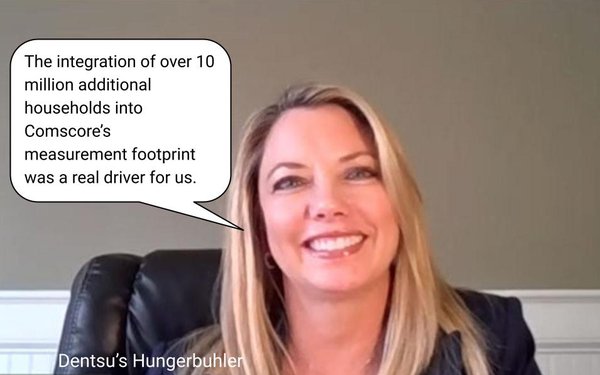
    In February 2021, expanding the agency’s deal with Comscore to focus on impressions-based TV viewing data, Jennifer Hungerbuhler, executive vice president and managing director, local video and audio investment, Dentsu Media, said:

    “The integration of over 10 million additional households into Comscore’s measurement footprint was a real driver for us, and we look forward to transacting on the audience-based data in 2021.”

    Is Linear TV Dying? Perhaps Not Yet - Look At Retrans Revenue


    Is Linear TV Dying? Perhaps Not Yet - Look At Retrans Revenue

    Don't get trapped into thinking all structural TV businesses lead to streaming.

    For TV networks and TV stations, look at still-rising linear TV retransmission revenues -- at least for the near term.

    Michael Morris, media analyst of Guggenheim Securities, writes that broadcasters -- through retransmission fees -- only receive about 22% of TV subscription revenue. 

    At the same time, broadcasters (TV networks and TV stations) account for around 41% of Nielsen-measured audience viewership on average, with the big four networks/stations accounting for around 34%.

    “We expect this gap to continue to close as retransmission fee growth significantly outpaces growth in affiliate fees paid to traditional cable networks,” he writes.

    Why? For linear TV, the key is still-strong NFL viewership. Defying what seems to be TV ratings gravity, to some extent, NFL programming is again climbing compared to the previous year.

    First-week regular-season NFL TV ratings were up 8%.

    Morris says this “is a positive for local broadcasters seeking to extract further retransmission economics.”

    And the second week of this season's college football continues to be among the top three of all TV telecasts on Fox, ABC, and ESPN.

    All this comes amidst the backdrop of pay TV subscriber declines -- around 6% year over year.

    And in addition, the NFL looks to be shifting resources to digital media platforms  -- like Amazon Prime Video for “Thursday Night Football.” This also includes legacy TV media companies ability to simultaneously air games on their respective streaming platforms as well as on their linear TV channels.

    “Bottom line [is that] as scaled audiences become more scarce advertising, subscription, gaming, and next-gen revenue power of football continues to charge forward.”

    This includes growing business in part -- not just for TV networks and their owned stations, but for those independent TV station groups (Nexstar Media Group, Gray Television, of note per Guggenheim) that have affiliates-network stations who benefit from local TV news programming as well as linear, live sports programming.

    And Morris adds a final point about his bullish outlook: Broadcast-based TV media companies have virtually all NFL rights locked up for another 11 years.

    More big scores and viewership wins are on the way.

    But will TV advertisers continue to play ball?