Tuesday, July 19, 2022

Local OTT Advertising To Hit $2B, Doubling 2020 Total


Local OTT Advertising To Hit $2B, Doubling 2020 Total

Local over-the-top (OTT) TV advertising is estimated to sharply climb to $2 billion in revenues by the end of this year -- up from $1 billion in 2020, according to a new study.

The research comes from BIA Advisory Services, a local media consultancy, and is sponsored by Vevo, the digital music video network.

The authors say the average compounded annual growth rate (CAGR) over the past two years for OTT was 43% -- which makes it the fastest-growing local media.

After local TV OTT comes local digital radio, with an annual growth rate of 24.3% over the last two years, followed by local mobile at 20.8%, local digital magazines at 17% and local PC/laptop advertising at 16.6%

The top advertising local OTT category for 2022 is projected to be general services, at $337.2 million. This includes legal/law firm businesses, as well as plumbers, HVAC contractors, utilities, and funeral home operators, to name a few.

The second-biggest local OTT category is automotive, at $273.2 million, followed by restaurants ($203.4 million); health ($202.8 million); and finance/insurance ($182.8 million).

Looking at six U.S. regions, the biggest growth was in Mid-Atlantic markets, with 53% CAGR, and the lowest was the Pacific Southwest, 39% Other regions were as follows: Northeast (47%), Southeast (40%); Midwest (42%) and Pacific

The Expansion Is Over: Ad Economy Recedes For First Time In 16 Months


The Expansion Is Over: Ad Economy Recedes For First Time In 16 Months

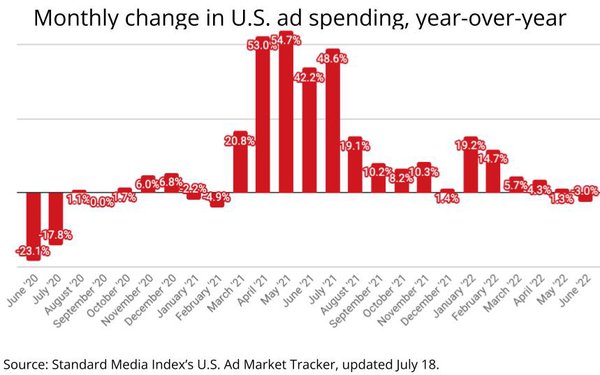
The U.S. ad market contracted 3% in June, marking the first decline since February 2021, according to a MediaPost analysis of data from Standard Media Index's U.S. Ad Market Tracker.

The contraction follows a steady deceleration of the U.S. ad market's expansion coming out of the COVID-19-related advertising recession.

Relative to June 2020, which fell 23.1%, June 2022's ad market index actually expanded 36.6%.

Most of the June 2022 contraction was due to reductions by the nation’s largest advertising categories. Spending by the top 10 categories fell 5.2% in June, while all other categories actually expanded 1.2%.

Most of June’s erosion occurred among traditional media spending.

Among media, the erosion was mostly among traditional media, which contracted 16.6% from June 2021, while digital expanded 8.6%.

Digital’s share of all media spending rose to six points to 62% in June

Wednesday, July 13, 2022

Gen Z Wants Video and Personalization, But Is Less Interested in Email


Gen Z Wants Video And Personalization, But Is Less Interested In Email

Email is the preferred communication channel of consumers: 52% choose it, versus a distant 17% for text and 14% for online accounts.

But young people are not as fond of it as their elders, according to the 2022 Digital Communications Market Study, a new report from Idomoo. 

The rate of email preference varies greatly by age cohort: 

  • Generation Z — 29%
  • Millennials — 40% 
  • GenerationX — 58%
  • Baby Boomers — 64%
  • Silent Generation — 67%

Despite all that, the study seems  more focused on showing the growing popularity of video.  

Of those polled, 62% want more video, but 74% rarely or never receive it. 

The study also found that video is the preferred medium for brand communications, especially among Gen Z and high-income earners.  

For instance, 40% of Gen Z and 61% of the high earners, who presumably are older, are most likely to want personalized video.  

In addition, 59% of Gen Z and 47% of high earners are most likely to desire video interactivity. And 69% of Gen Z and 33% of high earners want videos they can customize. 

The similarity is also seen in trust in brands. 

Overall, 55% of consumers trust brands to keep their data secure, versus 16% who don’t trust them, 26% who are neutral and 4% who don’t know. And 72% will share data in return for personalization. 

Gen Z and millennials are 20% more likely to share information, and high earners are 25% more likely. 

It could be that Gen Z and the high earners feel more free to let their imaginations wander. 

When do people expect a brand to understand their needs and interests and tailor content for them? They say: 

  • Before I have a relationship with them — 13% 
  • When I first sign up/create an account — 34%
  • During onboarding — 33%
  • After a few months or years of being a customer — 40%
  • Once I’ve opted in for a rewards or loyalty program — 24%
  • When I cancel or stop being a customer — 7%

And how should brands show they understand customers? They expect to be recognized by: 

  • Name — 51% 
  • Past purchase behavior — 44%
  • Interests — 35% 
  • Location — 22%
  • Device — 22%
  • Future goals — 15%

Meanwhile, 71% more people saw an increase in personalized brand communications since the pandemic began, versus those who said they did not see an increase. Americans were 20% more likely to note an increase.  

Continuing the country comparison, 30% of UK consumers don’t feel valued by brands, compared to 20% in the U.S.

Can this be the reason? Only 13% of UK consumers have ever received a personalized video, compared to 22% in the U.S.

On behalf of Idomoo, Arlington Research surveyed 2,000 consumers in the U.S. and UK in January 2022. These respondents have a relationship with a brand. High earners are defined as those with $150,000+ annual income in the U.S., and £75,000 in the UK. 

Senators Press Meta Over 'Censorship' Of Abortion Posts


Senators Press Meta Over 'Censorship' Of Abortion Posts

Two Senate Democrats are questioning Facebook and Instagram over reports that the platforms have been removing posts related to abortion.

It's now “more important than ever that social media platforms not censor truthful posts about abortion, particularly as people across the country turn to online communities to discuss and find information about reproductive rights,” Senators Amy Klobuchar (D-Minnesota) and Elizabeth Warren (D-Massachusetts) say in a letter to Facebook CEO Mark Zuckerberg and Instagram head Adam Mosseri.

The lawmakers say the Supreme Court's recent decision in Dobbs v. Jackson Women’s Health Org., which cleared the way for states to outlaw abortion, led to a spike in social media posts about abortion.

“Many took to social media to share stories about the impact of the decision, let others know how to legally obtain abortion services, and to discuss their personal experiences,” Klobuchar and Warren wrote.

The pair added that reports indicate that Facebook and Instagram removed “multiple posts providing accurate information about how to legally access abortion services,” and tagged other posts with warnings.

Meta spokesperson Andy Stone said late last month that the company doesn't allow any posts offering to sell or donate pharmaceuticals.

He added that the company had “discovered some instances of incorrect enforcement and are correcting these.”

Klobuchar and Warren are now asking Meta for detailed information about their content-moderation policies regarding abortion related posts, including how many such posts have been removed since June 24 -- the date of the Dobbs decision.

What Brands Can Learn from Retail Media


COMMENTARY

What Brands Can Learn From Retail Media

Data is power in the world of business when used wisely. Data allows you to make smarter, more informed decisions about critical business matters, from store locations to product innovations to P&L. Arguably, compliantly collected consumer data is the most important and valuable piece of information for marketers.

Early entrants in the loyalty marketing space are seeing the enormous opportunity this data holds for their own companies as well as other brands looking to reach those same consumers. Furthermore, brand marketers without access to these robust customer databases are realizing they need to find long-term targeting solutions (and fast) as they face the impending challenges of the cookieless future.

Thus, retail media networks were born and have exploded, with a new solution seeming to emerge every other week.

Marketers who are continually pressured to show immediate ROI are drawn to the end-to-end solutions from targeting to measurement, being able to tie incremental sales to their advertising efforts.

But what are the roots at the foundation of retail media’s success? Trust, segmentation, accountability, scale.

Learn how brands can build on these four key principles of retail media networks and improve their marketing efforts across all channels.

#1 Trust and convenience are everything. This valuable consumer data is available because brand loyalty was a priority for these retailers. And in order to gain brand loyalty, you first have to build trust. Is there consistency in their consumer touchpoints? Are the desired products and services always, or at least consistently, available? Are the employee-customer interactions positive and helpful?

If the answer is yes, the customer will continue to return, warranting the time spent to enroll in a loyalty program. One-time shoppers won’t even spend the two minutes to save $5 if the experience is negative to neutral and they don’t have a reason to return.

#2 Smart customer segmentation and analysis are essential. Without proper segmentation and analysis of your customer base, consumer data is only providing a fraction of its value. Drive learnings from this data collection to help improve the customer experience and provide personalized engagements. By understanding your customers on both a personal level as well as cohorts based on common likes and interests, you will be able to drive affinity through unique offers and discounts, leading to cross-selling, upselling, and incremental store or site visits.  

#3 Accountability is the gateway to success. Retail media is wildly popular with CPG brands because it informs the answer to the question of “Is the marketing working?” Being able to tie ad exposure to sales is important to show how and if marketing efforts are resulting in meaningful business outcomes. Without the proper accountability to understand if your marketing is driving results, you are, at worst, causing waste and, at best, flying blind. Put together a smart strategy to keep your media accountable at each stage of the marketing journey. Even if retail media isn’t the ideal solution for your brand, identify measurement partners that can help you determine if you are moving the needle in the right direction.

#4 Scale sells. When you are talking about retail networks the size of Kroger, Walgreens, and Walmart now offering access to their customer data for targeting, the number of customers alone is enough for marketers to see dollar signs in their eyes. This is especially true for brands whose CRM data is minimal. Lean into these second-party data providers to supplement your own data targeting, while continuing to use lead-generation strategies to grow your data over time.

Emotional Attachment To TV Commercials - Should We Care?


COMMENTARY

Emotional Attachment To TV Commercials - Should We Care?

Emotional attachment to TV commercials is something NBC wants to consider -- as well as its value for its marketers.

Now before you roll your eyes and take a big sarcastic breath, let’s dig deeper. This isn’t your father's fuzzy consideration of what value a TV advertising is worth. New science is behind it.

Let’s start with the general premise, concerning other TV content -- TV programming.

Kelly Abcarian, executive vice president of measurement and impact for advertising and partnerships at NBCU, in a blog post, suggests that if TV networks continue to hone in on why certain shows emote specific “emotional” attention -- and get high viewership and engagement -- shouldn’t marketers also want the same thing for ad creative?

It kind of makes sense, especially in a streaming world where there can be limited ad availability. Thus, each piece of creative -- with hopefully less frequency as well -- becomes that much more important. At the same time, we know that TV sellers selling streaming ad inventory may want a higher price. (Oh well. You get what you pay for -- mostly).

Consumers would generally rather not want to see any advertising.

Cost is always an issue. Want to spend $15 or $16 a month for the likes of an HBO Max or Netflix, or -- on the other end of things -- $5 or so a month for a Apple TV+, Paramount+, and Peacock? That's the new TV battleground.

So what might then make it easier for consumers when it comes to those lower-priced considerations? Finding the best possible advertising content that goes along with the programming content, that's what.

But what about that "fuzziness" -- creative value attached to emotions for each consumer, and then attached to those TV commercials?

Well, that apparently was in the past. New measurement systems -- such as Dumbstruck -- can combine insights from psychology, cutting-edge facial coding and eye tracking AI, says Abcarian.

Other companies are doing similar work -- including System 1, Emoto.AI, Kantar’s Link Ad Test, and Dynata's Ameritest.

Abcarian says NBC is working on building a “scalable model for creative testing” that “evaluates the emotional resonance of creative.”

This is all to say that future “alternative” measurement systems -- which are all the rage -- should not just be concerning measuring or guaranteeing on a specific set plain-old, diverse pieces of audience data, such as marketers' pre-set business outcomes levels or matching first party data of NBCU viewers with that of first party data of marketers.

The bigger question starts not only figuring out what viewers liked -- whether they were entertained by a commercial -- but what specific emotions were revealed. Consider everything I'm guessing: Cry, laugh, mull, or melancholy gazing into space included.

Legacy Cable TV Operators Continue To Seek Another Bundling Metamorphosis


Legacy Cable TV Operators Continue To Seek Another Bundling Metamorphosis

Broadband growth for legacy cable TV operators continues to slow down -- while the likes of Comcast, Charter, Altice and others continue to look for the next big thing.

Decades ago these companies and others made a prescient, and obvious, move in transitioning from being just cable TV operators into a fast-growing broadband business (which now makes up the majority of revenues) as many communications lines led into the homes.

But now that business has slowed -- and in future estimates, will continue to weaken -- in terms of subscriber growth. Wells Fargo estimates cable broadband growth to slow to an average of 2.4% per year (2020 to 2025) from around 4%.

Benjamin Swinburne, media analyst at Morgan Stanley, adds: “With competitive intensity rising and cyclical headwinds building, it remains too early in our view to get more bullish on this defensive group within our coverage.”

He sees “the reality of rising cable broadband competition from fixed wireless, an uncertain path to 5G success at Dish [Network], and cyclical pressures at SiriusXM.”

There is some hope, however: Mobile.

With the big three cable operators renewing agreements with mobile partners, it will allow for more “flexibility around packaging and pricing their wireless products within the bundle. Comcast, Charter, and Altice have all come to market with new unlimited wireless offerings starting at $30/line.”

Initial results, according to Swinburne, indicate that net mobile subscribers have initially ticked up.

Longer-term, these companies -- especially Comcast and Charter -- are looking ahead to perhaps move into other modern distribution of content -- the streaming apps distribution business, which Roku and Amazon Fire TV are in. However, those companies have a major head start -- each with around 50 million to 55 million monthly active users currently.

This is not to say that Comcast/Charter (which have a joint venture for a new streaming distribution platform) and perhaps other cable operators, cannot catch up.

Bundling services has always been at the core of their communications operations. Currently, the big bundle elements are cable/video, broadband, and phone (now mobile).

If they can figure out a way to pull in potential consumers -- especially those who are now looking to trim back on services, including cord-cutters -- they might be able to find yet another communication transition.

Then again, those legacy cable TV operators were a key reason why many consumers became “cord-cutters” in the first place: High cable TV monthly fees on the order $90 to $125 a month depending on your favorite estimate.

'Maybe someone needs to redefine then what “bundling” means.