Wednesday, December 15, 2021

Golden Globes Is A No-Go For NBCU In 2022 - But The $43M Loss May Be A Good Thing


COMMENTARY

Golden Globes Is A No-Go For NBCU In 2022 - But The $43M Loss May Be A Good Thing

With legacy TV companies seeking all kinds of revenue alternatives -- streaming, sports betting operations, or even revenues from digital assets -- what remains for linear TV?

Sports programming does. But another key area are annual one-time specials, mostly live shows. Big live award shows have grown to be important pieces in a linear TV world full of declining viewership.

But TV networks have their limits: The Golden Globes is one of them.

NBC won’t be airing one of the better-rated annual awards shows. This is due to longtime diversity and other issues by the group that owns the Globes: the Hollywood Foreign Press Association.

Historically, the relatively small group of journalists "didn't play by the same rules. They took gifts. They took free trips. They went on junkets paid for by the studio or the networks,” entertainment journalist Mary Murphy told NPR.

They mixed in some curried favor for these extras, like votes for Globe awards, according to sources. Welcome to Hollywood.

But then, major actors and producers started speaking up against the group, in addition to saying they weren’t going to attend the event.

All that pushed the ultimate to happen: NBC said it wasn’t going to televised the event schedule for January 2022 -- though the group will still hold its awards ceremony.

For NBC, this probably wasn’t an easy decision. But when actor/producer Tina Fey, a co-host of the 2021 live event, spoke on stage about all this, that put the kibosh on things.

She said: "There are no Black members of the Hollywood Foreign Press... “I realize, HFPA, maybe you guys didn't get the memo because your workplace is the back booth of a French McDonald's, but you gotta change that."

NBC pulls in sizable advertising revenues from the Globes show. In 2021, it took in an estimated $42.6 million in national TV advertising from the event, according to iSpot.tv.

Two years before, in 2018, Kantar says the Globes totaled in $49 million, with the average unit cost at $684,000 for a 30-second spot. By comparison, the Academy Awards were at $133 million; the Grammy Awards hit $96 million.

HFPA now says it added 21 new members — six of them African-American. Total members are now at 103, including 12 Latinos, 18 Asians, and nine from the Middle East.

Too little, too late? Maybe an occasional TV benching is good

Wednesday, December 8, 2021

150 Newspapers Have Filed Advertising Antitrust Suits Against Facebook, Google


150 Newspapers Have Filed Advertising Antitrust Suits Against Facebook, Google

Over the past year, 17 newspaper groups have filed antitrust lawsuits against Google and Facebook on behalf of more than 150 newspapers, charging that the platforms have engaged in illegal competition with local media by monopolizing digital advertising. 

Together, the lawsuits add up to a national effort to take on the big platforms, at a time when Google and Facebook are already under unprecedented legal challenges from regulators in the U.S. and other countries, reports Axios. 

More lawsuits are in the works. In total, more than 30 newspaper groups owning more than 200 publications have retained the same group of attorneys — specialists in antitrust litigation who are working on contingency. 

The lawsuits seek to recover past damages — which could be three times any actual damages established — and establish a new system that will ensure that newspapers can compete and thrive going forward, such as Australia’s law requiring platforms to pay publishers for their content, lawyers involved in the litigation told Axios. 

HD Media, which owns the Charleston Gazette-Mail and several other newspapers in West Virginia, filed the first newspaper antitrust lawsuit, in that state, in January 2021. 

That followed key developments in 2020, including the U.S. House Judiciary Committee’s report on digital competition, released in June; an antitrust lawsuit filed against Google by the Justice Department and a group of state attorneys general in September 2020; and an antitrust lawsuit filed against Facebook by the Federal Trade Commission in December 2020. 

This summer, the newspaper lawsuits were consolidated in the Southern District of New York, where Associated Newspapers had earlier filed a similar suit against Google. 

The court’s options include selecting some of the cases as test cases, or sending some back to the states in which they were filed.

Google responded to the report with a statement: “These claims are just wrong. The online advertising space is crowded and competitive, our ad tech fees are lower than reported industry averages, and publishers keep the vast majority of revenue earned when using our products. We are one of the world's leading financial supporters of journalism and have provided billions of dollars to support quality journalism in the digital age."

Facebook declined to comment.

GroupM Finds Ad Budget Paradox Preserving TV's Share Among Big Brands


GroupM Finds Ad Budget Paradox Preserving TV's Share Among Big Brands

One of the most telling analyses to come out of the Big 3 year-end 2021 advertising forecasts was this chart (see above) pushed by GroupM to illustrate its analysis of the share of ad budgets going into digital media vs. TV for big advertisers vs. the overall advertising market.

The analysis, which varies somewhat by country, shows an overall consistent pattern that the world's largest brands still budget significantly higher percentages of their ad spending in TV than the overall advertising marketplace. And with the exception of China, TV still is the largest share of ad spending vs. digital among the biggest brands.

"If you look at the U.S. here," GroupM Business Intelligence Global President Brian Wieser said pointing to the chart during Monday's UBS Media Week ad forecasting panel, "the typical large brand is allocating something close to 50% of their budget to digital. They're allocating something like 50% of their budget to television."

"The entire U.S. advertising market," he continued, "is 64% digital and about 25% television."

Wieser noted that similar patterns exist "in every country on earth" because "the typical large brand is big enough to make use of television.

He also noted during the presentation that GroupM analyzes the total advertising market for each country based on media company ad revenues, which in many cases reflect smaller advertisers, as well as newer "digital endemic" and direct-to-consumer ones that may be allocating most of their budgets to digital.

Speaking about the disproportionate share of big brand ad budgets still going into television, Wieser quipped, "That doesn't mean for a second that they should be in television."

He noted that looking back over time there has been a clear "incremental shift" of their budgets into digital, but that it mostly has come out of other analogue media -- especially print and out-of-home -- "but it's a very incremental shift."

Wieser did not predict how long TV would maintain its hold on big brand advertising budgets, but he noted the medium will be challenged in its ability to "achieve reach and frequency goals" as more of consumer viewing shifts to big streaming platforms worldwide.

Video Streamers Raise National TV Marketing Spend 40% In Q3


Video Streamers Raise National TV Marketing Spend 40% In Q3

Over the last three months, video streaming companies have sharply raised TV marketing efforts -- now up 40% to $672.2 million in total estimated TV spend and media value versus the same period a year ago, according to iSpot.tv.

Much of this is coming from a number of new entries this year, including discovery+, Paramount+ and DirecTV Stream -- as well as existing streamers upping their marketing efforts.

This breaks down to an estimated $444.2 million in paid TV advertising and $228.0 million in media value coming from premium streaming messaging on sister company TV networks, garnering 52 billion impressions over 261,220 airings.

A year ago, total estimated TV spend and media value was $403.8 million -- $277.8 million in paid TV spend, $126 million in media value from on-air network promotions. This pulled in 27.8 billion impressions from 137,383 airings.

Disney+ grabbed 7.1 billion impressions (4.9 billion a year ago); discovery+, 6.8 billion; Paramount+, 6.6 billion; DirecTV Stream, 5.8 billion; and Hulu, 4.5 billion (3.2 billion a year ago) are the big beneficiaries.

That means more than 43 billion impressions coming from national TV live programming plus same-day airings and 4.3 billion impressions coming from local TV impressions.

Top programs that are getting the messaging this year include NFL Football (2.4 billion impressions), NBA Basketball (660.3 million), college football (642 million) and MLB Baseball (374.3 million). Syndication reruns of “Friends” was the only non-sports TV content in the top five, with 297.5 million impressions.

Automotive TV Spending Down 8.8% In November


AUTOMOTIVE

Automotive TV Spending Down 8.8% In November

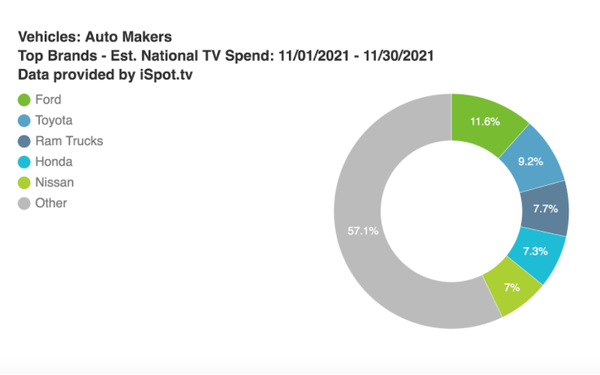
Automakers' estimated TV spending was down 8.8% in November compared to a year ago, while impressions fell 29.4%, per iSpot.tv.

Spending in November 2021 was $342.2 million, compared to $375.1 million in November 2020. Impressions for the month registered at 25.9 billion compared to 36.7 billion in November 2020. 

While automakers’ national TV ad spend may be down year-over-year, there’s a deeper story around how some brands just spent more in late 2020 to make up for a lack of live sports earlier in the year, says Stuart Schwartzapfel, SVP, Media Partnerships at iSpot.

“Additionally, some of 2021’s biggest-spending auto brands on a national level are also buying more TV ad impressions in specific local markets as a result of both supply chain issues and vehicle inventory concerns to close the year,” Schwartzapfel tells Marketing Daily.

The top five brands by spending for the month were Ford ($39.6 million), Toyota ($31.4 million), Ram Trucks ($26.4 million), Honda ($25.1 million) and Nissan ($24.1 million).

The top five brands by TV ad impressions in November were Ford (2.5 billion), Nissan (2.3 billion), Hyundai (2.2 billion), Lexus (1.8 billion) and Chevrolet (1.6 billion).

The most-seen automaker ads in November 2021 were Honda, "The Origin of Determination" (839.7 million TV ad impressions); Ram Trucks, "The Nice List" (828.7 million); Jeep, "The Best Things" (749.0 million); Nissan, "From Dealer to Driveway" (721.7 million) and Lincoln, "Unexpected (686.1 million)."

Over 78% of Ford’s November national TV ad spend was related to football -- NFL games, college football and FOX NFL Sunday, among other related programs, per iSpot. Toyota’s emphasis was even more football-focused, with nearly 90% of the month’s TV ad spend dedicated to NFL and college football games. 

The biggest spend increases among top 15 brands by spend, Nov. 2021 vs. Nov. 2020, were Honda, up 74.5%, followed closely by GMC (+68.6%), Ram Trucks (+45.7%), Mercedes-Benz (+20.6%) and Kia (+13.2%).

Honda increased its investment in national ads during both NFL and college football games, and also Spanish-language programming year-over-year, per iSpot. The same goes for GMC, which more than doubled its national TV ad spend during NFL games compared to last November, while also appearing during NBA games this year (wasn’t an option last year given the pandemic-altered schedule that started the new season in December).

The top programs for automakers by TV ad impressions share of voice in November were the NFL (15.7%), college football (11.0%), SportsCenter (1.4%), NBA (1.2%) and NBC’s “Today” (1.2%).

As is usually the case, automakers put ads where they’d find the most eyeballs: NFL games. Automakers also led the way among all NFL advertisers in November 2021, with 8% of impressions during games during the month, per iSpot.

Autos were the second-most-seen industry by impressions share-of-voice during college football games, NBA games and SportsCenter (all trailing quick serve brands).

The top networks for automaker TV ad impressions in November 2021 were Fox (13.6%), NBC (9.2%), CBS (8.8%), ESPN (7.4%) and ABC (6.2%).

The emphasis on sports means that the big four broadcast networks and ESPN end up as the largest sources of impressions for auto brands. That said, automakers also expanded beyond just sports on these networks. On Fox, 1.2% of auto impressions were delivered during “The Masked Singer.”

Gracenote Launches Entertainment Programming Measurement To Forecast TV, Movie Performance


Gracenote Launches Entertainment Programming Measurement To Forecast TV, Movie Performance

Amid the explosive growth of connected TV (CTV)/linear TV/digital video-related programming -- TV shows and movies -- Nielsen’s Gracenote is launching a new tool to predict audiences for entertainment programming on all platforms.

Audience Predict will make forecasts by using Gracenote’s content metadata, as well as Nielsen audience-measurement data and advanced machine-learning technology.

It will analyze the relationships between a streaming service and TV network distribution to estimate potential audience size, audience composition, reach and viewing minutes under different distribution scenarios.

Audience Predict will factor program genre and how platform distribute episodes on a particular TV series -- for example, one at a time per week or an entire season worth of episodes. Show air dates and air times, as well as lead-in programming for linear content, will also be analyzed.

It will also help content creators find the best-performing streaming platforms or networks for content and develop program packages for target buyers.

Gracenote believes this will help with program acquisitions, renewals or cancellations for streaming and linear content distributors.

The company says Audience Predict will join a suite of other similar Gracenote products, such as what content creators might want to produce, whom to cast, and where to place programming to maximize audience reach and return on investment.

Monday, December 6, 2021

Holiday Sales on Track to Establish New Sales Record.

Something to share with your local direct clients. Philip Jay LeNoble, PhD


Holiday sales on track to blow past record for spending, topping retail trade group’s biggest forecast

KEY POINTS
  • Holiday sales could best even the rosiest expectations for the major shopping season, according to the National Retail Federation.
  • The major trade group’s economist, Jack Kleinhenz, said Friday that spending in November and December could grow as much as 11.5% compared with the same period a year ago.
  • The NRF had already called for a record holiday season, projecting in late October that sales would rise between 8.5% and 10.5% from last year.
A person wears a face mask while carrying shopping bags in Columbus Circle on November 28, 2020 in New York City.
Noam Galai | Getty Images

Holiday sales could exceed even the rosiest expectations for the major shopping season, according to the National Retail Federation.

The major trade group’s economist, Jack Kleinhenz, said Friday that spending in November and December could grow as much as 11.5% compared with the same period a year ago — higher than many retail analysts and NRF itself had predicted.

The NRF had already called for a record holiday season, projecting in late October that sales would rise between 8.5% and 10.5% from last year. The group said it expected sales in November and December would hit an all-time high of between $834.4 billion and $859 billion. The sales forecast excludes spending at automobile dealers, gas stations and restaurants.

Last year, holiday sales rose 8.2% from 2019 to a record $777.3 billion, according to the NRF.

“People have the ability to spend and I think they are in the mood to spend,” Kleinhenz said in an interview. He pointed to strong balance sheets coming out of the pandemic, the low unemployment rate and the desire to reunite for holiday gatherings.

Kleinhenz acknowledged uncertain factors, including how consumers will react to the omicron variant and whether that may change how they shop and celebrate or what they may buy.

“There’s no crystal ball to provide a definitive answer, but the latest data is encouraging and provides useful insights,” he said in a news release. “In fact, the season could turn out even better than we expected.

So far, this holiday season has had a different rhythm and unique challenges. Shoppers began buying gifts early because of concerns about product availability and shipping delays. Retailers worked to keep goods moving amid congested ports and truck driver shortages. And inflated prices on everything from materials to fuel means consumers are finding fewer deals whether they shop online or in stores.

That pulled forward a lot of spending into October and early November, stealing some of the thunder from major shopping holidays like Black Friday and Cyber Monday. The total number of shoppers and average spending dropped during the extended Thanksgiving weekend compared with each of the past two years, according to the NRF.

Kleinhenz said thinks shoppers will keep spending, even if they have already bought many gifts. “If you look If you look at what happened last November, we had an early October and we had a very, very strong November,” he said. “People are creatures of habit. There’s still a lot of time between now and the holidays.”

At least some of this season’s higher sales will come from inflation, which has raised the prices of many gift items from toys to electronics. Retailers, including Macy’s and Kohl’s, have also spoken about having reduced inventory and seeing higher consumer demand — which means they can sell more merchandise at full price and have little that winds up on the markdown rack.

On a call last week, NRF Chief Executive Matt Shay said omicron could actually boost retail sales this holiday. Instead of booking a trip or buying a gift card for a spa day, he said some of that experiential spending may shift back into goods.