Monday, May 17, 2021

Millennials Most Likely To Spend Big On Travel, Per TripAdvisor, Accenture

If your community is going to be a potential hot bed for travelling millennials, local businesses should promote their best selling points on radio and TV this summer because travelers will be listening to local radio and TV when they hit town! Philip Jay LeNoble. Ph.D.

TRAVEL

Millennials Most Likely To Spend Big On Travel, Per TripAdvisor, Accenture

While confidence to travel appears to be returning among all age groups, it is high-income millennials who are most likely to spend big on travel this year, per a joint study by Tripadvisor and Accenture.

The study was fielded before the latest mask guidance issued late last week by the Centers For Disease Control, which could help the category if it results in consumers feeling more comfortable in engaging in pre-pandemic activities like travel.

"The Future of Travel," executed by Qualtricson on March 3, interviewed 1,000 respondents from 49 states, evenly distributed across Gen Z, Gen X, millennial and baby boomers. 

The findings are encouraging for brands because among those planning to spend more than $5,000 on their next trip, as many as 62% have not yet made a booking. For brands, the opportunity is there to attract the purchasing power of this audience now, per the results.

Of those U.S. respondents who did not take a trip at all in 2020, nearly two thirds (61%) said they are comfortable doing so in 2021. Respondents earning $100,000 or more are leading the way in likelihood to travel in 2021, with over a third (34%) having already booked a trip for 2021, compared to less than one in five (19%) of the remaining population.

Those who traveled in 2020 are more likely to have booked a 2021 trip already. Of those respondents that traveled last year, 41% have already booked 2021 travel compared to just 13% of those who did not travel at all in 2020.

U.S. travelers are getting more adventurous in their plans, especially in the higher income brackets. Over half (54%) of all U.S. respondents earning more than $50,000 are considering domestic air travel for their next trip, while 25% of those earning $100,000 or more are considering flying abroad for their next trip.

Millennials earning above $50,000 are the most eager to fly. Three out of five (58%) of those surveyed are considering domestic air (compared to 41% among other age groups) and 25% are considering international air travel (that’s 1.8 times higher than the average among respondents in other demographic groups).

Respondents who have already booked a trip are five times more likely to be taking an international trip as opposed to a staycation (a trip less than three hours from home).

Travelers are planning longer trips this year — 87% of respondents who have already booked travel have opted for a trip of three nights or more. Of those yet to book a trip, 77% are also planning a break of three nights or more. 

Luxury vacations are the order of the day. More than a third (37%) of high-income Mmllennials are planning to spend more than $5,000 on an upcoming luxury trip.

Elsewhere, MediaRadar released an analysis of tourism ad spend, including trends from hotels and regional tourism efforts, like Visit California.

The platform analyzed ad spend across print, national television, and digital formats between January and April 2021.

In the weeks leading up to National Tourism Week (May 3-9, 2021), regional tourism ad campaigns spent $67.7 million across print, national television, and digital formats. This is up 136% month-over-month when comparing March 2021 ($28.7m) to April 2021 ($67.7m).

When comparing year-over-year (YoY), April 2021 saw a 130% increase from $29.4 million in 2020 to $67.7 million this year.

The largest campaigns came from Visit California, Las Vegas Convention and Visitors Authority, Visit Maryland, Visit Myrtle Beach South Carolina, and Visit Florida. Collectively, their spend accounts for $9.5 million 15% of total spend in the category.

Hyper-local campaigns from California far outpaced any other regional campaigns in the month of April 2021. San Diego, Lake Tahoe, Laguna Beach, Long Beach, Big Bear and the Central Coast all appear in the top 15 spending advertisers over the past four weeks.

Spend in the hotel and hospitality industry increased 8% from March 2021 to April 2021, with $44.7mm invested across print, television, and digital formats. Luxury hotel groups are contributing to the resurgence of this industry as consumers are more likely to travel as pandemic restrictions are lifted.

Airbnb and VRBO continue to maintain a strong presence in the hospitality market. Ad spend from both of these companies account for 26% of all ad spend in the month of April 2021, per the research.

Let's All Go To The Movies, Again: CDC Guidance Boosts Cinema Outlook

 Time to go help the local movie theaters to help them regain traction now that the CDC has lessened restrictions. Philip Jay LeNoble, Ph.D.

COMMENTARY

Let's All Go To The Movies, Again: CDC Guidance Boosts Cinema Outlook


Two weeks before the unofficial start of summer, the cinema advertising industry is preparing for a strong -- if not blockbuster -- Memorial Day weekend, following last week’s guidance from the CDC that fully vaccinated Americans can return to indoor public places without their masks.

The weekend also marks the first that the U.S. cinema advertising audiences will be measured via the industry’s new ad currency, Epicenter Experience, which replaces the one Nielsen shut down last fall, giving the industry a much-needed boost following what likely has been its worst year ever.

According to the last major update by an agency holding company ad-forecasting unit, Dentsu’s January update, cinema ad sales plummeted nearly 60% in 2020, making it the medium worst hit by the COVID-19 pandemic.

While Dentsu projects cinema ad spending will rebound 42% this year, the U.S. cinema advertising industry is hoping it can beat that based on pent-up demand from both moviegoers and advertisers who want to reach them.

Even before the CDC’s new guidance, proprietary tracking studies by the two big U.S. cinema networks -- National CineMedia (NCM) and Screenvision -- indicated that loyal moviegoers have already gone back to the theaters.

According to the seventh wave of post-COVID-19 pandemic tracking of its “Behind The Screens” moviegoer panel, more than half -- 56% -- say they have already gone back to the movies -- up from just 5% in June 2020, when it first began asking that question.

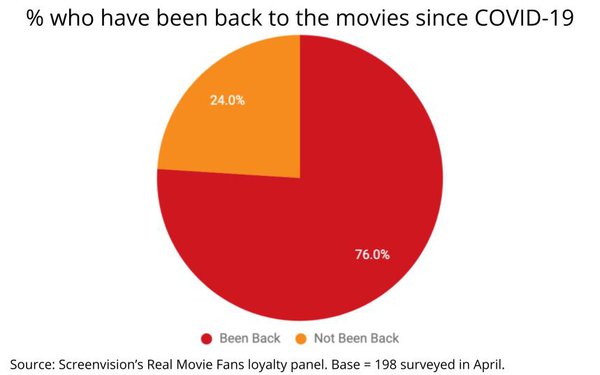
An April survey of Screenvision’s “Real Movie Fans” loyalty panel found that 76% have been back to the movies since the COVID-19 pandemic began.

“It’s a real interesting nexus for us,” says Doug Pulick, a long-time media industry researcher who just retired as senior vice president of strategic insight and analytics at NCM, who presided over seven waves of NCM’s pandemic tracking studies.

“We have the new Epicenter research starting and there's two years worth of major movies being released in one summer,” he said, adding that while even he and his wife were still little perplexed by exactly what the new CDC guidance means in terms of mask-wearing and safety in public indoor places, it's good more good news for the cinema ad industry because it will overcome reticence from people who are not necessarily the diehard fans who have braved the pandemic to date.

Pulick, who will remain a consultant to NCM for a while, and Sheila Farina, director of custom research at NCM, will take over the tracking study.

Meanwhile, the team at Screenvision are equally buoyant about a U.S. cinema advertising rebound.

“Just like Hollywood scriptwriters like to write about, we are having a comeback story of our own,” Katy Loria, chief revenue officer at Screenvision, told me during a recent Zoom meeting with her research team, which was armed with equally upbeat findings from its proprietary loyalty panel.

While those fans many not necessarily be representative of the general moviegoing public, Loria and her research colleague Sarah Barasch, senior vice president-insights and measurement at Screenvision, shared some other important data for advertisers and agencies -- including the fact that people returning to the theaters are getting their earlier, pre-ordering concessions, and spending more time in their seats before the films start.

While it is a little bit of an apples-to-oranges comparison, Barasch said that looking at the difference between some of Nielsen's older data and recent numbers from Epicenter, it looks like there has been an average increase of about five minutes in the amount of time moviegoers are in their seats before the films start.

That's important for both Screenvision and NCM, because the majority of their most premium advertising inventory is in their pre-show content that runs on the screens before the films start.

While it's unclear whether these moviegoing patterns will sustain themselves as consumers adjust to post-pandemic life in public places, Screenvision's Barasch said their reason to believe consumers will continue to spend more time in their seats, because of the convenience of using apps to pre-order tickets and concessions, which means they will spend less time in the lobby or milling around the theater.


Local TV's Big Ad Fight: Digital Media Delivers Competitive Punch

 Local-direct businesses must become a major financial resource for each community as well as the direction of TV stations going forward! Philip Jay LeNoble, Ph.D.

COMMENTARY

Local TV's Big Ad Fight: Digital Media Delivers Competitive Punch

Big digital media companies -- social media and otherwise -- seem to have an uneasy marketing and content connection with local TV stations. Should we really believe digital will always benefit from those longtime local media outlets? Probably not so much.

A report conducted by BIA Advisory Services says Google and Facebook algorithms tend to result in under-compensating TV news stations contentby $1.9 billion per year in value -- especially with regard to local TV content on digital platforms where consumers will hopefully click through to TV stations' sites.

Sometimes, consumers don’t click through -- but this doesn’t mean digital media walks away empty-handed. Google and Facebook still sell advertising around this content.

In addition, content on digital platforms can sit around other iffy journalism content. That can lower "value."

All this doesn’t do much good for TV stations that are increasingly dependent on original TV news content.

So what is really going on?

Well, this is Google and Facebook. Lots of walled gardens of data and privacy on these platforms don’t always clarify things for traditional and competing media -- intentional or not.

It has been incumbent on TV stations to strike out on their own to bolster new sources of revenue -- especially with new locally and regionally based OTT operations, where local TV marketers can extend their reach for advertisers. This is an area in which Tegna’s Premion, Sinclair’s CompulseOTT and Fox Corp.'s new FLX operate.

BIA Advisory Services estimates local OTT ad spending will total $1.2 billion this year, $1.6 billion in 2022; and $1.8 billion in 2023. But these ad-revenue gains aren’t exclusive to local TV station groups.

The BIA’s estimate also includes geotargeted/local-regional ad deals on Roku and Hulu. Many TV based and other local OTT ad operations have ad-share revenue deals with publishers' inventory.

These local OTT revenue projections are in addition to the estimated $1.5 billion local revenue TV stations make selling their own digital media inventory -- on their own site/mobile platforms.

The question is how fast these alternative digital revenue streams can grow -- especially for local TV stations' business, which is still traditionally dependent on live, linear TV. Now sinking to around $15 billion in ad revenue per year, this was $18 billion to $20 billion a few years ago.

Take note -- TV stations do see major advertising growth every other year from political marketing and advertising -- a record $3.5 billion for broadcast TV for 2020's presidential election (virtually all on local TV), according to Kantar.

But big-time competitors are hot on their heels. Digital media  took in $1.8 billion in political advertising last year.

All of which brings us back to you-know-who. Google and Facebook are looking to overcompensate on everything.

For Retail, Expect Reboot, Not Return To Usual


COMMENTARY

For Retail, Expect Reboot, Not Return To Usual

As we edge closer to a full reopening across the U.S., retail sits at the edge of a second pandemic-fueled transformation. With the future of consumer experiences at stake, retailers must reexamine the prevailing approaches that have defined omnichannel retail for the past decade.

Here are four key areas that will change the retail landscape in the coming months:

#1. The end of omnichannel as we know it. COVID-19 flipped the balance of power between online and physical retail after the greatest and most accelerated digital transformation in history. The new default of digital discovery and purchase, as well as expectations around delivery, and the trend toward buy online, pickup in-store and curbside, are here to stay.

Despite this, it's not time to abandon physical locations, since 91% of shoppers say they miss shopping in stores, according to a McKinsey report. Moving forward, retailers will need to offer specialized, not seamless experiences, creating clear differentiation, and use cases, for each point in their customer experience and sales cycle.

#2. Permanent shifts in the way we shop. Accessibility and availability have taken precedence during the pandemic, with McKinsey reporting that 73% of U.S. consumers have changed stores, brands, or the way they shop. Changing these new habits will prove difficult, as what started as convenience has now become preference.

The long-lasting impact of changes to daily routines means that many of these shifts in how and where people buy will become permanent. For destination retail, the coming months will be a critical period to regain customers and establish the value of returning to shop. 

#3. The second coming of experiential. Post-pandemic, we’ll see the return of browsing as a pastime after a year of home shopping has reminded people of all the things they loved about the in-store shopping experience. Digital experiences offer a huge opportunity during this period, as stores begin pursuing new avenues for driving visits.

Whether extending online buying experiences, offering a product demo, or a one-of-a-kind brand experience, experiential offers an opportunity for retailers to become a destination—attracting shoppers and offering them a unique experience that enhance their perceptions of a brand.

#4. The end game: A green Christmas. All these factors point to the 2021 holiday season being one of the biggest for brick-and-mortar retail in years. Where 2020 was the year of the digital Christmas, 2021 will be the return of in-store shopping, as last year’s socially distanced holiday season left most wanting.

Retailers can expect to see a huge appetite for the pageantry of the season this year, with retail and in-store shopping regaining their esteemed role in the quintessential holiday experience. This presents a major opportunity for brands and stores to create engagement and ensure they’re at the center of the holiday shopping experience.

Time for a reboot, not a reset.

As we emerge from lockdowns, the opportunity and challenge for retail is to look forward, not back. The aim will be to create the store of the future today—one built around a differentiated experience for customers that leverages the best of physical and digital environments.

How businesses adapt or address these changes will not only have an impact on their individual prospects, but how we think about the roles of digital and physical experiences in the retail ecosystem for years to come.

How Brands Can Honor Grads

 Some good stuff for local-direct clients. Philip Jay LeNoble, Ph.D.

COMMENTARY

How Brands Can Honor Grads

With nearly half the country at least partially vaccinated for COVID-19, and more than a third fully inoculated, the rites of spring and summer are beginning to resume: proms, weddings, vacations and graduations; holidays honoring Mom, Dad, our fallen service members, national independence, and the labor movement. There there are picnics, concerts, movies, beach trips, and the simple pleasure of dining indoors.

As social gatherings resume and life continues on, we remember the pandemic’s nearly 600K confirmed fatalities; the millions left behind, mourning their loved ones; the nearly 10 million who remain unemployed; and those continuing to suffer from a virulent virus and its pernicious aftereffects. However, another group deserves recognition and consideration: the millions of Americans whose high school or college graduation has been disrupted.

The Class of 2020 missed all its major milestones: no prom, spring break, in-person graduation, Grad Night, award ceremony, Senior Reflections, or post-graduation travel. For the Class of 2021, some of these activities are beginning to resume, but slowly and inconsistently. The Wall Street Journal recently surveyed 50 colleges, and found that all held virtual graduation ceremonies last year, while just a third plan to resume in-person ceremonies this year.

As a result, recent grads remain in limbo. After three and a half years of hard work, the Class of 2020 abruptly returned home two months before graduation. Overnight, the economy cratered, taking with it a generation’s internships and careers. Now, they’re seeing the next class graduate into a world returning to normal, complete with vaccines, unprecedented government stimulus, a reopening economy, an acute labor shortage in so many sectors, in-person ceremonies and celebrations, and widespread resumption of air travel. As a result, some 2020 alums feel cheated, further deepening Gen Z’s mental health crisis.

How can brands honor these grads and help them recoup a portion of their lost year?

*Sponsor makegood trips. Now that the travel sector is reopening, with airlines and hotels looking to fill seats and beds, brands should encourage grads (and their families and friends) to make up last year’s cancelled trips. Those with a Class of 2020 diploma (and any others in their party) should enjoy a 20% discount so that they can finally go back to campus to walk in a ceremony; take the spring break or “gap year” journey of their dreams; or go visit Grandma and Grandpa and give them a big hug.

*Throw belated parties. Food, beverage and CPG brands should sponsor campaigns to “throw your new grad the party they deserve,” safely but splendidly. These campaigns can provide best practices for entertaining in a post-COVID world, while still toasting the grad with, say, Coca-Cola beverages, Frito-Lay snacks and Dreyer’s ice cream, served on Dixie plates with Bounty napkins. Few have hosted parties in the last 14 months, so these celebrations for the Classes of 2020 and 2021 could be a great way to ease back into socializing.

*Mark other milestones. Because the last two classes have missed out on so much, brands should make their next life events a little easier to achieve. A whole generation now struggles to obtain their first car, apartment, work wardrobe, etc. And, of course, birth rates have plunged, demonstrating all the new challenges of starting a family in the age of COVID. Brands should speak to this “lost generation” with empathy, extend discounts whenever possible, provide them with constructive advice and life lessons -- and streamline their customer journey to make it digital, mobile and virtual.

Millions will be graduating into a post-COVID world this spring. The brands that help walk them down the aisle will gain fans and followers for life.

Radio Ad Dollars In 2021 Projected To Rise To $11.7 Billion


Radio Ad Dollars In 2021 Projected To Rise To $11.7 Billion

Like other media this year, radio is trending to make back some gains versus the pandemic-related declines of 2020. Over-the-air advertising is projected to rise nearly 10% in 2021 to $11.7 billion, according to BIA Advisory Services.

A year ago, radio was hit with a massive 23.6% drop to $9.7 billion. Radio advertising came in at $12.8 billion in 2019.

Better news in 2020 was seen with digital ad revenues. That piece of the overall total ad revenues for radio stations had a more modest decline of 6% to $939 million. It was $1 billion in 2019.

For this year, BIA sees digital ad revenue returning to the $1 billion level.

“Local radio stations have been feeling the impact of new competition for the past few years; unfortunately, the pandemic just exacerbated the problem — and it will take some time to recover,” stated Mark Fratrik, senior vice president-chief economist of BIA Advisory Services.

In addition, radio stations' deal-making steeply dropped to just 534 stations sold in 2020, with a total estimated value of $139 million.

In 2019, there were 752 stations sold with a total valuation of $1.12 billion.

The Marketing Must Be Working: Consumers Give More Consideration To EVs

 Time to get to the dealership and help them market these EVs. I personally think one day we will see a lesser carbon footprint with vehicle using nitrogen fuel cells. The same network across the U.S. for charging stations for RVs can be equipt with hydrogen fuel. Much better for our planet! Philip Jay LeNoble, Ph.D.

COMMENTARY

The Marketing Must Be Working: Consumers Give More Consideration To EVs


This 
post was previously published in an earlier edition of Drive Time.

Another study has emerged that says consumers are “more open” to electric vehicles.

That sentiment has doubled since 2018, per the CarGurus Electric Vehicle Sentiment Survey. Tesla is once again the most trusted EV brand, but most shoppers are open to others, per the study.

The report joins similar recent surveys by Consumer Reports and J.D. Power.

But the practicality (or lack thereof) for electric vehicles in many parts of the country remains a challenge. Here in Detroit, the infrastructure is definitely an issue. There is a pronounced lack of Level 3 fast chargers in public places, and the ones that are available aren’t cheap. 

I encountered this during a test drive with a Nissan Leaf in August 2019. Not much has changed, unfortunately. 

During a recent test drive in the Ford Mustang Mach-E, it cost me nearly $20 for 63 minutes of fast charging in downtown Detroit, which yielded a paltry 39 miles of charge. Considering I could fill up my internal combustion engine (ICE) tank in 1/60th of the time that took, it’s definitely a time issue as well as a money issue. I know it’s different in California and perhaps in New York. But in most of the country, it’s still a challenge to make an EV work. 

I can’t imagine that both drivers in a two-car household will opt for an EV any time soon. With road trips taking on favor due to the pandemic, having access to an ICE vehicle is more paramount than ever.

But back to the survey. CarGurus analyzed consumer feedback on an array of EV-related topics, including future ownership, how gas prices would impact EV consideration, opinions of EV brands and overall purchase preferences. The survey of 1,097 U.S. automobile owners was conducted in February 2021. Respondents were balanced in terms of key demographics (gender, region, income) in alignment with the U.S. census. CarGurus also surveyed owners in 2019 (n= 1,702) and 2018 (n=1,279) for earlier iterations of this benchmarking study.

When asked how likely they were to own an electric vehicle within the next five years, 30% of respondents noted that they were probably or definitely going to do so — a number that has doubled since 2018. 

Even though EV interest has surged over the past few years, there are still many consumers who would not yet consider owning one. In the study, 65% of respondents noted that more charging stations in their area would be effective in convincing them to buy an EV, followed closely by the ability to find replacement parts and batteries (62%).  

In previous years, Tesla earned top status as the most trusted company to make electric vehicles, and that trend continued, with 36% of respondents in this most recent study putting their faith in the company to develop EVs. However, Tesla's leading status is vulnerable, with almost 80% of those planning to buy TVs agreeing they’re open to several brands, per CarGurus.

Tesla’s lead is tight when looking at those shoppers that plan on owning an electric vehicle in the next 10 years. While 57% are likely to consider purchasing from Tesla, Toyota (52%) and Honda (45%) are closing in on Tesla’s lead. However, when comparing recently launched models, Tesla’s Cybertruck has an early advantage in consumer consideration when compared to Ford’s F-150 EV and Hummer’s EV, with 31% of total respondents considering it as a vehicle, compared with 28% and 16%, respectively, for the other brands. 

More than half (57%) of respondents would be much more likely to consider purchasing an electric vehicle if gas prices were at $5 per gallon, and 26% would do so if gas were at $4 per gallon. Among those who plan to own an alternative fuel vehicle in the next 10 years, 73% would consider buying a new electric vehicle, and 67% would consider the SUV/crossover body style. 

While the survey yields some interesting information, when push comes to shove, the automakers and the infrastructure still have a considerable ways to go to make EVs truly palatable for the masses.