Thursday, February 7, 2019

Radio’s Future Revenue Focus: Digital Dollars


Radio & Television Business Report - The Financial + Regulatory Voice of Electronic Media 

Radio’s Future Revenue Focus: Digital Dollars

By

 February 5, 2019

Local radio stations generated $804 million in digital ad revenue in 2018. They are forecast to make $949 million this year, a report released Tuesday by the Radio Advertising Bureau and ad-tracking firm Borrell Associates finds.

Radio’s “attitudes toward digital strategies improving and industry revenues” are fast approaching $1 billion, the RAB and Borell note.

Local radio stations generated $804 million in digital ad revenue in 2018. They are forecast to make $949 million this year, the report says.

The report showed that the average station earned more than $250,000 in digital revenue in 2018, up 15% from the previous year.

Further, the research shows that digital revenue will surpass 10% of the average station’s ad revenue this year.

“Some stations are exhibiting remarkable performance,” the RAB notes. “The research shows that top-performing market clusters get three to five times the market share of peer stations.”

The findings are a part of the RAB and Borrell’s seventh annual report on how radio’s digital efforts are faring, “Radio’s Digital Sales Inch Closer to $1 Billion.”\

Borrell Associates CEO Gordon Borrell commented, “This year’s findings quantify that there’s great upside potential. Nearly all radio buyers are also buying digital advertising, yet only 1 in 4 of a typical station’s customers is buying digital products from the station. Closing that gap represents a big opportunity.”

Released today to RAB members, the report analyzes online ad revenue from 3,121 radio stations, as well as survey responses from 1,715 local radio buyers and a survey of 132 radio managers.


Among the findings:
•    
97% of radio advertisers buy digital advertising with traditional forms of advertising in their marketing campaigns, up from 85% a year ago.
•    25% of the average station’s radio customers buy digital advertising from the station.
•    Streaming-video advertising is gaining high interest. Among radio buyers, 27% already buy it and 9% more plan to start.
•    Attitudes toward digital strategies have improved. Managers who believe their station’s strategy is good has grown from 49% to 72% over five years.
•    57% of stations report that they include digital products with every sales pitch.
•    Depending on market size, the average radio cluster gets between 1.0% to 6.6% of the addressable digital market. Best-practice market clusters get four to five times that.


“Digital has been integrated into all facets of broadcast radio’s offering both in programming and sales, and the results are definitely paying off,” said RAB President/CEO Erica Farber.  “As radio continues to provide integrated marketing solutions to its advertisers we expect to see continued growth. Broadcast radio has been focused on digital’s integration into its overall offerings and as this year’s study reveals, we continue to see growth and attributable results.”


The full report is available to RAB members on RAB.com. Live webinars featuring the survey results presented by the RAB and Gordon Borrell are available on February 12 or February 14 for free to RAB members and survey participants. 

Wednesday, February 6, 2019

DOJ OK with Scripps-Cordillera Station Buy

Broadcasting & Cable News
By John Eggerton February , 2019
That came in an early termination notice Tuesday (Feb. 5) released by the Federal Trade Commission, which divvies up merger reviews.
The notice means that the antitrust review has been ended early with no issues that would cause the deal to be blocked or conditioned. The FCC still has to sign off on the transfer, but the FCC and DOJ coordinate their reviews so approval is likely there as well.
Scripps announced back in October that it was buying the 15 stations in 10 markets. The deal gives Scripps 51 stations in 36 markets reaching 21% of U.S. households.
"The Cordillera stations have strong local brands and are well run and nicely positioned in their markets," said Brian Lawlor, president of Local Media for Scripps, back when the sale was announced. “Through this transaction, Scripps will operate the No. 1-rated TV stations in a third of its markets, enhancing the durability of our portfolio,” Lawlor said. “The acquisition also allows us to go deeper in new markets with the addition of three new duopolies, including two with Big Four combinations.”
The stations Scripps is acquiring are primarily a mix of NBC and NBC affiliates. They are KATC Lafayette, La. (ABC); WLEX (NBC), Lexington, Ky.; KOAA (NBC) Colorado Springs; KSBY (NBC) Santa Barbara; KRIS (NBC) and KAJA (Telemundo), Corpus Christi, Texas; KPAX and KAJJ (CBS) Missoula, Mont.; KTVQ (CBS) Billings, Mont.; KXLF-KBZK (CBS), Butte-Bozeman, Mont.; KRTV (CBS) and KTGF (NBC) Great Falls, Mont.; and KTVH (NBC) and KXLH (CBS), Helena, Mont. 

Market Forces Threaten Future Of Cox Reps


Market Forces Threaten Future Of Cox Reps

With growing station group M&A and more in-house repping, industry observers say Cox Media Group may have to decide whether to sell the rep division or shutter it. However, Cox’s automated sales platform Videa remains a key asset.

What’s going to happen to Cox Reps? That’s a question many broadcasters are asking as parent Cox Media Group considers bids for the sale of its stations, a bedrock of the Cox Reps’ business.
The question arises because of the possible loss of the Cox stations as clients and the actual recent loss of Raycom Media. Its new owner, Gray Television, handles all its national sales in-house.
ADVERTISEMENT
And there’s the possibility of another blow. “The biggest elephant in the room is the fate of the Tribune stations,” said one executive, who like many people contacted for this story requested anonymity because of the sensitive nature of the topic. Cox represents all of Tribune’s 42 owned-and-operated stations.
“Tribune is now being bought by Nexstar,” the source said. “I don’t think there’s a lot of time left on the contract for the Tribune stations. That would make it easy for Katz [Media Group], which represents a lot of Nexstar, to take the Tribune business in-house at Katz.”
Another source, who formerly headed sales for a TV station group, said that in light of everything, Cox Reps is “going to be really, really challenged.
“There are less and less station groups to go after. So, at some point, the owners of Cox are going to have to say, ‘We’re going to sell this off’ — and they may or may not be able to — or they’ll say, ‘We’ll shutter it.’ ”

Tuesday, February 5, 2019

Marketing Vs. Advertising: Making It Personal

Marketing Vs. Advertising: Making It Personal

Last year I wrote a lot about the erosion of the advertising bargain between advertisers and their audience. Without rehashing at length, let me summarize by simply stating that we no longer are as accepting of advertising because we now have a choice. One of those columns sparked a podcast on Beancast.
As the four panelists -- all of whom are marketing/advertising professionals -- started debating the topic, they got mired down in the question of what is advertising, and what is marketing. They’re not alone. That confuses me, too.
I’ve spent all my life in marketing, but this was a tough column to write. I really had to think about what the essential differences of advertising and marketing were, casting aside the textbook definitions and getting to something that resonated at an intuitive level.
I ran into the same conundrum as the panelists. The disruption that's washing over our industry is also washing away the traditional line drawn between the two. So I did what I usually do when I find something intellectually ambiguous: tried to simplify down to the most basic analogy I could think of.

When it comes to me -- as a person -- what would  be equivalent to marketing, what would be advertising, and -- just to muddy the waters a little more -- what would be branding?  If we can reduce this to something we can gut-check, maybe the answers will come more easily.

Let’s start with branding. Your brand is what people think of you as a person. Are you a gentleman or an asshole? Smart, funny, pedantic, prickly, stunningly stupid? Fat and lazy, or lean and athletic?
Notice that I said your brand is what other people think of you, not what you think of yourself. How you conduct yourself as a person will influence the opinions of others, but ultimately your brand is arbitrated one person at a time, and you are not that person.

To me, although it involves other people, marketing is somewhat faceless and less intimate. In a way, It’s more unilateral then advertising. Again, to take it back to our personal analogy, marketing is simply the social you -- the public extension of who you are. One might say that your personal approach to marketing is you saying “This is me, take it or leave it!”

But advertising is different. It focuses on a specific recipient. It implies a bilateral agreement. Again, analogously speaking, it’s like asking another person for a favor. There is an implicit or explicit exchange of value. It involves an overt attempt to influence.

Let’s further refine this into a single example. You’re invited to a party at a friend’s house. When you walk in the door, everyone glances over to see who’s arrived. When they recognize you, each person immediately has their own idea of who you are and how they feel about you.

That is your brand. It has already been formed by your marketing, how you have interacted with others your entire life. At that moment of recognition, your own brand is beyond your control.
But now, you have to mingle. You scan the room and see someone you know who is already talking to someone else. You walk over, hoping to work your way into their conversation. That, right there, is advertising. You’re asking for their attention. They have to decide whether to give it to you or not. How they decide will be dependent on how they feel about you, but it will also depend on what else they’re doing -- how interesting the conversation they’re already engaged in is.

Another variable is their expectation of what a conversation with you might hold, and the anticipated utility of said conversation. Are you going to tell them some news that would be of great interest to them, ask for a favor, or just bore them to tears?

So, the success of the advertising exchange in the eyes of the recipient can be defined by three variables: emotional investment in the advertiser (brand love), openness to interruption and expected utility if interrupted.

If this analogy approximates the truth of what is the essential nature of advertising, why do I feel advertising is doomed?

I don’t think it has anything to do with branding. I’ve gone full circle on this, but right now, I believe brands are more important than ever. No, the death of advertising will be attributable to the other two variables: Do we want to be interrupted -- and, if the answer is yes, what do we expect to gain by allowing the interruptions?

First of all, let’s look at our openness to interruption. It may sound counterintuitive, but our obsession with multitasking actually makes us less open to interruption.

Think of how we’re normally exposed to advertising content. It’s typically on a screen of some type. We may be switching back and forth between multiple screens, juggling a full load of enticing cognitive invitations: checking our social media feeds, deciding which video to watch, tracking down a wanted website, trying to load an article that interests us. The expected utility of all these things is high. We have "fear of missing out," big time!

This is just when advertising interrupts us, with brands asking us to pay attention to their message.
“Paying attention” is exactly the right phrase to use. Attention is a finite resource that can be exhausted  and that’s exactly what multitasking does. It exhausts our cognitive resources.

The brain, in defense, becomes more miserly with those resources. The threshold that must be met to allow the brain to allocate attention goes up. The way the brain does this is not simply to ignore anything not meeting the attention worthy threshold, but to actually mildly trigger a negative reaction, causing a feeling of irritation with whatever it is that is begging for our attention. This is a hard-wired response meant to condition us for the future.

Secondly, what is the expected utility of paying attention to advertising? This goes hand in hand with the thought that advertising was always type of a toll gate we had to pass through to access content -- but now, we have choices. The expected utility of the advertising-supported content has been largely removed from the equation, leaving us with just the expected utility of the advertisement itself. The brain is constantly running an algorithm that balances resource allocation against reward -- and in our new environment, the resource allocation threshold keeps getting higher as the reward keeps getting lower.

Memo To Sponsors: Please Can The Sad Super Bowl Spots

COMMENTARY

Memo To Sponsors: Please Can The Sad Super Bowl Spots

The face and voice of a sad little boy has no place in a joyous, fun environment such as the Super Bowl.
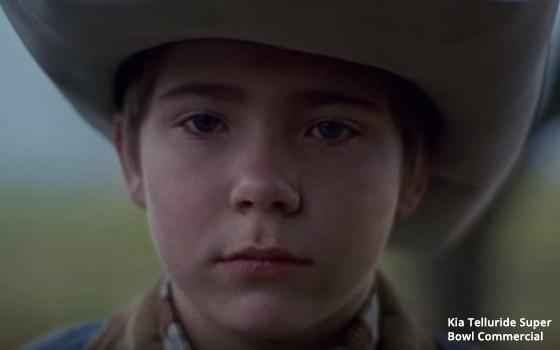
This is why, for me, the Kia Telluride Super Bowl commercial emerged as the game's worst commercial during the big show Sunday on CBS.
When this commercial came on, I really could not believe my eyes and ears. This was the one in which the lad pictured above suddenly appeared and began to narrate the ad in the saddest monotone the spot's directors could elicit from him.
In a forlorn voice, he described his hometown -- a place called West Point, Georgia -- in terms so desolate you might have thought he was describing a town that had been deserted in the Dust Bowl of the 1930s.
And then he droned on about the anonymity of the town's residents, as if the town's apparent paucity of famous people represented a black mark against it.
At long last, the spot concluded with an attempt at an upbeat ending. “No, we are not famous,” said the sad little boy, lamenting his town's acute fame deficit. “But we are incredible, and we make incredible things,” he said joylessly. The “incredible things” were these Kia Tellurides, which are being built in West Point.
Unfortunately, by the looks of them, these townsfolk seemed pretty unhappy, despite the availability of this factory work. This leaden commercial had the effect of stopping any fun you might have been having watching the game dead in its tracks. One thing it didn't do: Make you excited about the Kia Telluride.
While this spot was the worst example on Sunday, all of the Super Bowl ads that attempted to deliver messages of vital importance about social or emotional issues had this same deadening effect.
For example, late in the game came a spot for The Washington Post voiced by Tom Hanks that inventoried a handful of national tragedies and paid tribute to journalists who had been killed in the pursuit of their profession. It was then followed immediately by an upbeat promo for the Grammy Awards.
It should go without saying, but these two kinds of ads are not compatible with each other. The latter is more appropriate for a telecast such as the Super Bowl. Moreover, it had the effect of completely negating the sad, “important” message of the WaPo ad (“Democracy dies in darkness”).
The ad that earned runner-up in the biggest bummer category was Hulu's spot for “The Handmaid's Tale.” It started with upbeat messages about “morning in America,” but eventually ended with the words “Wake up, America, morning's over.” Hulu reportedly operates in the red to the tune of many hundreds of millions of dollars. Go figure.
These inappropriate sad commercials were not the worst moments in the Super Bowl telecast, however. The worst was the moment Adam Levine removed his shirt during the halftime show. The halftime entertainment overall was one of the worst seen in recent memory.
Speaking of entertainment, the high point came before the game when Gladys Knight sang the national anthem. She is a national treasure.
For its part, CBS put on a great show. Play-by-play man Jim Nance and color commentator Tony Romo applied just the right touch throughout the entire game. Romo's explanations of on-field football strategy and tactics were especially effective.
And hats off to plucky on-field CBS Sports correspondent Tracy Wolfson, who somehow battled her way to the center of that very aggressive and tightly bunched media scrum that surrounded Tom Brady on the field after the Pats’ victory. Her effort to stand her ground and conduct a coherent interview should earn her a bonus.
As for the game itself, many are calling it a Super Bore, thanks to its low score. But in the same way that some people love pitchers’ duels in baseball, this battle of defenses made for riveting televised football.
And the Patriots’ victory was a storybook ending for a true sports dynasty, even if many people say they dislike the Pats. Oh, well, as Yogi Berra might have said about them: “Nobody likes the New England Patriots. They're too popular!”

Traditional TV Super Bowl Viewing Takes A Hit

Traditional TV Super Bowl Viewing Takes A Hit

Super Bowl LIII’s slow-moving, low-scoring game, in which the New England Patriots bested the Los Angeles Rams, resulted in an eye-opening TV viewing decline of 5% from a year ago.
Nielsen says traditional TV viewing on the CBS Television Network came in at 98.2 million viewers-- down from the 103.4 million who watched Philadelphia beat New England on NBC in 2018.
It is the lowest Super Bowl viewing number for a traditional linear TV network since 2008, when the New York Giants beat the New England Patriots, getting to 97.5 million Nielsen viewers.
CBS says TV and digital viewing amounted to a collective 100.7 million viewers, from totaling viewing on CBS Television Network, CBS Interactive, NFL digital properties, Verizon Media mobile properties and ESPN Deportes television and digital properties.
The average minute audience on digital platforms grew 31% to 2.6 million viewers during the game window. Last year, Super Bowl viewing on digital platforms was at 2.02 million viewers; it was 1.72 million in 2017; and 1.4 million in 2016.
The network says streaming of the Super Bowl was seen on 7.5 million unique devices, up 20% from last year. Viewers took in more than 560 million total minutes of live game coverage, up 19% from last year.
CBS says its ad-supported streaming service, CBS All Access, posted an increase of 84% in subscriber sign-ups on Super Bowl Sunday.
Nielsen says there were 32.3 million social-media interactions across official Facebook, Instagram and Twitter accounts  -- and fan Twitter accounts about the Super Bowl. Last year, Nielsen said there were 170.7 million social media interactions across Facebook, Instagram and Twitter in the Super Bowl.

Friday, February 1, 2019

CBS Nears Sell-Out of Super Bowl Advertising (EXCLUSIVE


Variety

CBS Nears Sell-Out of Super Bowl Advertising (EXCLUSIVE)

By BRIAN STEINBERG February 1, 2019


CBS is almost sold out of its Super Bowl commercial inventory, according to  people with knowledge of the network’s sales process, nearing an end to what is always a frenzied process to sew up millions of dollars in advertising revenue.

The network has secured agreements for the last few slots it has available for broadcast in Super Bowl LIII, which is slated to air this Sunday, these people said. CBS needs to work with the National Football League to secure certain approvals for these recent sponsors, these people said.  And while the network is keeping the business window open in case of last-minute changes or late inquiries from clients, the news should come as a relief: NBC’s 2018 broadcast of Super Bowl LII secured $482 million in commercials in the game and in pre- and post-game coverage, according to Kantar Media, a tracker of ad spending.

CBS has been seeking between $5.1 million and $5.3 million for a package of advertising that includes a 30-second spot in the game as well as some digital inventory, according to people familiar with the matter.

CBS had to navigate some headwinds before moving to the end of its Super Bowl sales process. Coca-Cola and Fiat Chrysler, two advertisers that for years have purchased multiple ads in each year’s Big Game, opted to sit on the sidelines in 2019. Coke is running an ad just before kickoff, while Fiat Chrysler has opted to run ads in digital venues around the event. What’s more, CBS had to contend with a decline in interest from U.S. car manufacturers as well as movie studios, these people said.

Technology and telecommunications companies appear to have saved the game. A range of big tech firms – companies that have come forward so far include Amazon, Google, T-Mobile, Microsoft and Sprint – have rushed into the 2019 Super Bowl. T-Mobile alone has purchased four ads in the game, the company said Friday. Some of these companies have goods and services to sell. Others are pushing streaming-video content. Amazon intends to boost its new dramatic series “Hanna,” and Hulu has also purchased a 30-second commercial.

Selling the Super Bowl is not as easy as it once was. Not too long ago, the TV network selling the gridiron championship was able to announce sell-out by autumn.These days, the process is more arduous. The price for an ad in the game has surpassed $5 million and, thanks to the advent of “Thursday Night Football,” marketers have more inventory available to them during the season that reaches a similar demographic at what can be a more effective price.

CBS has also stocked a full commercial load in pre- and post-game content, these people said, and has seen healthy demand for the programs that will follow its Super Bowl broadcast. CBS plans to debut the reality competition series “World’s Best,” along with a special Sunday broadcast of “The Late Show with Stephen Colbert.”