Thursday, July 13, 2017

Mobile, Social Drive Local Media Growth

Local media spend is estimated to reach $174 billion by 2021.

Mobile, social and video will drive the 3.8% compound annual growth rate, according to the BIA/Kelsey forecast released Wednesday.

The midyear revenue update to BIA/Kelsey's U.S. Local Advertising Forecast 2017 suggests a slight decline to $147.9 billion in 2017, on an overall weaker-than-expected economy and softer-than-expected advertising revenue.

Weaker numbers in 2017 won't last.

However, BIA/Kelsey forecasts higher-than-expected numbers through 2021, growing at a CAGR of 11.9% for online advertising. During the same time frame, traditional advertising revenue will see a slight decrease between 2016 and 2021, with a CAGR of -0.6%.

Direct mail will take the largest share at 25% or $37.1 billion in 2017. Local TV follows with 14% share or $21 billion.

Online interactive, newspapers and mobile all take an 11% share each. They help round out the top five with revenue of $18.6 billion, $16 billion and $16 billion, respectively.

This year, mobile replaces local radio as the fifth top revenue-generating media for local advertising. Local radio will earn $15.6 billion. 

Leadership: It's what you make of it


This post is adapted from "Becoming the New Boss," a new leadership book by Naphtali Hoff, PsyD, (@impactfulcoach). He became an executive coach and organizational consultant following a career as an educator and school administrator. Read his blog at impactfulcoaching.com/blog.

Leadership is the ability to not only understand and utilize your innate talents, but to also effectively leverage the natural strengths of your team to accomplish the mission. There is no one-size-fits-all approach, answer key or formula to leadership. Leadership should be the humble, authentic expression of your unique personality in pursuit of bettering whatever environment you are in. – Katie Christy, founder, Activate Your Talent
A parable is told about a pencil-maker who was preparing to put an important pencil in a box. Before doing so, though, he took the pencil aside. “There are five things you need to know,” he said. “If you can remember these five things, you will become the best pencil you can be.”
You will be able to do many great things, but only if you allow yourself to in someone else’s hand.
  1. Sharpening is painful, but it is critical if you want to write sharply.
  2. Since you have an eraser, you can correct most mistakes you make, though some may be harder to erase than others.
  3. Remember, it’s what’s inside that’s most important.
  4. Whatever surface you on, make sure you leave your mark. No matter how hard, rough, or easy, you must continue to write.
This parable shares powerful lessons for every leader:
  1. Be humble. You can achieve greatness, but not when you go it alone. Allow yourself to be taught and coached by others and identify the strengths of those around you to help advance the cause.
  2. Stay sharp. Strong leaders find ways to keep learning and sharpening their skills. Feedback can be painful at times, but without it, you will become dull.
  3. Accept mistakes. We all err. Though mistakes may make for challenging moments, they are ultimately part of a process of becoming a better leader. Embrace your mistakes as opportunities to learn, erase, and become better! As John Maxwell once said, “A good leader is a person who takes a little more than his share of the blame and a little less than his share of the credit.”
  4. Your best is what’s inside you. You may be good-looking, dress well, and have a great personality. But what makes you who you are and the person with whom others want to connect is your character. Seek to continually grow and refine your character so that you can lead and serve with utmost integrity.
  5. Stick with it. There will be times when you think that you’re making no imprint and that your actions are not having an effect. But people will still depend on you, so you need to keep on going. Hold to your vision and your dreams, even when it seems they have dimmed.
I have attempted to offer guidance to you, the new leader, as you assume your leadership position. By now, one thing should be clear: Leadership is not easy. It takes much effort to position yourself to achieve a leadership post, and perhaps, even more, work to build a sustainable leadership platform.
But it is doable. And the world needs you.
In a 1913 address to students at Swarthmore College, Woodrow Wilson said, “You are not here merely to make a living. You are here to enable the world to live more amply, with greater vision, with a finer spirit of hope and achievement. You are here to enrich the world, and you impoverish yourself if you forget the errand.”

The fact that you have been promoted into leadership means that you have the tools and energy to make it happen. Things will get in your way, but if you continue to believe in yourself, you can become the leader that everyone around you hopes that you will be.

Leadership blogger and Minister Brian Dodd summarized the roles and opportunities of a leader as follows:
  1. Leaders provide vision and offer direction.
  2. Leaders believe in others and give them confidence.
  3. Leaders stretch others’ thinking and make them look at things differently.
  4. Leaders sharpen others’ skills and help them become better at what they do. 
  5. Leaders support others and provide what is needed to be successful.
  6. Leaders make hard decisions. They pay the price so others don’t have to.
  7. Leaders take the bullets and bear responsibility. 
  8. Leaders create experiences that help others see things in a new and different light.
  9. Leaders raise others’ self-image and make them feel better about themselves.
These are many of the opportunities that leaders have each day to impact those around them.
As much as I have endeavored to support you in your leadership journey, it bears repeating that there is no one-size-fits-all approach, answer key or formula to leadership. Each leader finds his or her way to the top and must determine what style and approach best suits him or her, as illustrated by this powerful story (quoted in "Living Forward," by Michael Hyatt and Daniel Harkavy).
High in the Himalayan mountains lived a wise old man. Every so often, he ventured down into the nearby village to entertain the locals with his special knowledge and talents. One of his skills was to use psychic powers to tell the villagers the contents in their pockets, boxes, or minds.

A few young boys from the village decided to play a joke on the wise old man and discredit his special abilities. One boy decided that he would capture a bird and hide it in his hands. He knew, of course, that the wise old man would know that the object in his hands was a bird.
The boy came up with a plan. He would ask the old man if the bird was dead or alive. If the wise man said the bird was alive, the boy would crush the bird in his hands and kill it. If the wise man said the bird was dead, the boy would open his hands and let the bird fly free. In this way, the boy would prove the old man to be a fraud.

The following week, the wise old man came down from the mountain into the village. The boy quickly caught a bird and cupping it out of sight in his hands. He walked up to the wise old man and asked, “Old man, what do I have in my hands?”
The wise old man said, “You have a bird,” and he was right.
The boy then asked, “Old man, old man tell me, is the bird alive or is it dead?”
The wise old man looked at the boy and said, “The bird is as you choose it.”
This is the essence of your leadership journey. The path that you take and your ultimate destiny are in your hands. The question is, what will you do with your opportunity?

Next Generation Of Cable TV Networks Could Be Skinny Bundles

New types of cable-like TV networks for OTT services are coming from traditional TV network creators -- not only in restructuring older fringe cable networks, but developing new cable channels. Traditional TV network groups -- NBCUniversal, Discovery, Viacom and others, with around a dozen or more channels each -- have worried about their fringe, smaller business networks in a future of “skinny” TV bundles.

Many network groups look to focus on just a handful of networks -- leaving others to fend for themselves. Viacom has already said it will be concentrating on six “core” network brands -- Nickelodeon, MTV, Nick Jr., Comedy Central, BET and the new Paramount Network.
But what about the other six to eight smaller-scale networks that big TV networks groups own? Does anyone believe those will make their way to new digital TV providers? For these services, consumers insist they will pay far less than the $100 a month or so for traditional pay TV providers.

Perhaps the answer is reinventing parts of those networks -- or culling programming pieces as the basis for new networks. CNN’s Great Big Story is one example of where TV might be going.
Launched in October, Great Big Story quickly established itself online -- on Facebook and other social media -- producing three to five videos a day, short three- to-five-minute-long videos. It also wants to do longer-form TV (like regular half-hour and hour TV shows?) as well theatrical releases. The network describes its goal as “cinematic storytelling.”

It aims to be a new kind of TV network. That would include operations on live, linear TV networks and OTT providers, such as Sling TV, DirecTV Now, or PlayStation Vue.
Great Big Story -- as perhaps Vice Media has done with Viceland -- wants to have a foot in the traditional TV cable network arena, with the other in new digital platforms.

Does that play better for traditional TV marketers? Given all this, big traditional TV network groups might need to think differently about their future.

In The Race for Local Ad Dollars, Are Big Tech Plans Enough?


Commentary

Local TV stations believe they need more room to grow. Others call it room to fall. Chris Ripley, president and CEO of Sinclair Broadcast Group, touted numbers recently that local TV stations pull in only 16% of all local advertising. Conversely, more internet/online platforms are offering innovative localized and targeted commercials.

Estimates are total local advertising will hit $148.8 billion this year, according to BIA/Kelsey -- with local TV accounting for a 13.3% share, and local TV-based digital revenues amounting to 0.7%.
What’s the promise for local TV? Future technology systems that can one-up internet/digital businesses, as well as other content distribution systems.

That is what the new proposed ATSC 3.0 standard is about. It can deliver up to five times the amount of data as the existing digital broadcast standard. For the consumer, it will offer "lower costs than conventional wireless systems."

Also included in ATSC’s promise is better local targeted/addressable advertising — another hopeful revenue generator.

That's good news. Right now, the biggest of the digital-advertising platforms — Google and Facebook — continue to irk some traditional media buyers when it comes to video metrics. Smaller digital platforms have these issues, as well.

Local TV stations may have a better rep with advertisers — despite legacy, paper-centric deals for local media ad selling and buying.

But premium digital media platforms — slowly getting better at transparency, viewability, safety and other issues — will continue to eat away at business from traditional/linear local TV.

Despite its issues, local TV still has the power of the big screen — major marketers say it is effective — especially when it comes to their key value local news content.
Can it figure out a way — quickly — to power up its businesses?

Ripley said: "When you look at the entire communications industry, broadcasting is a pimple.”  The goal then? A beauty mark, maybe?

Friday, July 7, 2017

The Disconnect Between Buyers And Sellers In Advertising, Marketing

Commentary

I wanted to talk to you about the art of the deal. No, not that one, but the one in marketing and advertising sales.

 
Over the last few weeks I have had a bunch of meetings and workshops with a diverse groups of sellers, ranging from TV to radio to CRM. And it struck me that salespeople could really do with applying a truth of modern marketing.

I think it is fair to say that B2C marketers have, by and large, learned to place the consumer at the center of their communication plans. Most have moved away from a brand-centric --  or worse, a campaign-centric approach -- to reaching customers.

We are seeing marketers figure out customer purchase paths and/or customer journeys -- which, to nobody’s surprise, look quite different from five or 10 years ago.

Marketers are also finding better tech solutions to help them deal with the data needed prior to developing these new customer journeys, and to benefit from the data that spins off from the campaigns they thus deploy.

However, salespeople in advertising/marketing still don't take this approach. The majority seem to develop their sales pitch based on their perceived brand or service strengths, rather than having me, the intended buyer, at the center of their pitch.

For example, both the TV and radio sales teams I worked with were unanimously convinced that their strongest selling points were essentially the same as 20 or 30 years ago — namely reach, impact, brand-building ability, and so on. And while these arguments are undoubtedly true, they are not the things marketers care about most.

According to research published by OnBrand Magazine in March of this year, CMOs’ top three metrics and KPIs used to determine brand marketing success were:
-- New customer acquisition (75%)
-- Social media engagement (72%)
-- Qualitative feedback from customers (58%)

The stuff that the TV and radio reps were using as arguments were not even in the CMOs’ top 10, and in fact fell into the “Other” grouping, which comprised only 9% of respondents.

We can argue at length whether these are the right metrics and KPIs, but that argument is immaterial because they simply are the right metrics -- because the CMOs say so. And since that's the case, it makes all the sense in the world to build your sales arguments around these criteria.

This doesn't  mean that your product benefits are not relevant (or, perhaps, even “better”) than what the CMOs are using. But I have always believed that if you can translate what you are trying to sell into something that the other party wants to buy, you stand a much better chance to seal the deal.
Your problem might be a sales slump, an inventory overload or a sales target you are trying to reach. But that is your problem, not the buying party’s problem. If the buyer wants to work on “new customer acquisition,” you should build your argument around how you can deliver that with your amazingly appropriate platform. You will probably find an open mind if you come in with “Here's how we can help you deliver your goals” rather than “Please listen to why our product/service is so great.”

Salespeople: Put your consumer, your end user, at the heart of your pitch.

Your Summer Recap Of What Data Makes Possible

Commentary

Are you tired of talking about data?
Then let’s try talking about use cases — what data makes possible.  Data is not the end result – it is simply a means to an end.  Data is also a highly overwhelming concept because it’s intangible.
So let’s make it tangible.  Consider this your summer primer on what data can do for you.

Data + Advertising = Targeting & Measurement
Data in an advertising context is the simplest and easiest use case.  Data can be used to identify an audience, target them for delivery of a message and to report what the campaign did.  Did it drive an engagement or not?  Data in advertising is simple because it creates efficiency and measures effectiveness. This is where every marketer starts.

Data + Website = Personalized Engagement
Data in the context of your website creates a more personalized interaction between your customer and your brand.  Data helps you identify who is on the site, what they’ve done in the past, and what message you should be delivering to them.  Data means you don’t waste that opportunity to engage by talking about something that isn’t relevant to the consumer.

Data + Email/CRM = A More Personalized Walk Down The Customer Journey
Data in an email or CRM context means you can more efficiently push consumers down the path to purchase or extract more value from them. If you have their email, they’ve likely expressed interest in your brand already.   If you know who they are, speak with them in a personalized way,  just as you would with any person you know.  Leverage what you know to figure out what to do next. Offer them accessories or upsell complementary products to them.  Teach them ways to products of yours they already have, and create more loyalty.

Data + Social = Retention, Advocacy & Reach
Data in a social environment means you can further engage your existing customers and turn them  into advocates that help you reach new customers.  Social creates ongoing engagement, and data can ensure you maximize each engagement and hopefully push the consumer down a designated path.  The more you know, the more likely you are to engage properly.

Data is a tool — but just one tool in the arsenal.  It complements the use cases mentioned above so they become stronger, more effective and more valuable.

Think of the analogy of each use case is an arrow in the quiver. Adding data is like adding accuracy and effectiveness to each arrow, ensuring each arrow flies true, strikes its mark and inflicts maximum damage.  (Of course, we’re assuming you’re just target shooting here.  Not inciting violence of any kind :)

Now it’s back to the summer season and spending time with friends and family.  If this little recap was helpful, please let me know!
Thanks, everyone!!

TV's Next Big Show Is Shaping Up To Be Media-Buying Workflow


Commentary


At a time when the TV industry is focused on pushing the sizzle of new shows and upfront ad sales, a group of top television data and technology executives met quasi-secretly to tackle a burgeoning problem more akin to watching paint dry: workflow management.

The TV industry was the earliest innovator of electronically managing the workflow of advertising deals — especially the exchange of data verifying, posting and measuring its ROI and yield.
But the digital ad business has overshadowed it in recent years with major investments in so-called “ad ops” to reduce the amount of friction advertisers and agencies have managing their digital media buys.

That’s a real turnabout from 2006, when the American Association of Advertising Agencies released a so-called “eBiz” report showing that conventional TV advertising had the most state-of-the-art electronic workflow, while online media actually had the worst.

Eleven years later, the marketplace has grown incredibly more complex, thanks to the proliferation of new media options, sources of data, and importantly, systems for managing and processing advertising buys. They include programmatic, addressable TV, attribution and modeling.
That’s why US International Media Advanced TV Strategist Mitch Oscar organized a special workflow spinoff of his so-called “Secret Society” meetings of advanced TV advertising stakeholders.

Estimating there currently are “31 different products from six companies” that advanced TV advertising buyers must vet and choose from, Oscar kicked the meeting off by suggesting it is time to devise standards and common language for defining the data and processes used to manage such buys.

The meeting, which was held in USIM’s New York City offices, was attended mainly by suppliers of data, workflow management and TV advertising inventory representatives of Comcast, AT&T, Cablevision, DISH, Freewheel, Google, TiVo, ESPN, Fox, Turner and others. It focused primarily on the current state of complexity and what the TV industry needs to do to reduce it in order to remain competitive.

One key development contributing to the complexity: Many of the biggest TV players have recently created their own data management platforms. The goal is to help advertisers and agencies target their audiences with the same precision they use in digital media buys, utilizing actual consumer segments instead of Nielsen’s flatter demographic audience breaks.

In many cases, the data is very rich, granular and tied to valuable first-party data, albeit on privacy compliant bases. The problem is there is no unified way to compare the segments, much less the overlap in reach and frequency that might occur from trying to build TV advertising schedules across them.

In April, three of TV’s biggest purveyors -- Fox, Turner and Viacom -- joined together to form OpenAP, a platform that seeks to unified the language used by their audience-targeting systems, which is a good step in that direction.

But some of the attendees at Oscar’s meeting indicated it doesn’t go far enough.
“We have to find a lingua franca that we can all use,” Oscar said. He noted the problem is bigger than simply unifying a common definition of audience segments. It also relates to the growing complexity of measuring ROI for the buy-side and yield for the sell-side of advanced TV advertising deals, which may also include some digital and OTT inventory, too.

“There’s a lot of black box in terms of the attribution model,” noted Walt Horstman, who recently joined TiVo as senior vice president-general manager of analytics and advertising from Comcast’s AudiencExpress, which pioneered programmatic sales and yield management for local cable TV advertising.

One of the problems with so-called black boxes that process outputs, but don’t necessarily disclose how the data was processed, he implied, is that they can be used to optimize any outcome the user wants to see.

“It was clear that whoever was paying for the study was going to get the results they wanted,” he said, referring to some of the attribution analyses he witnessed while working at AudiencExpress.
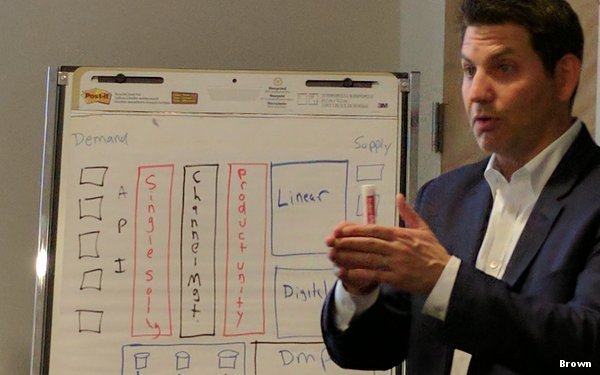
As complex as advanced TV’s new workflow ecosystem is getting, some data management processors are taking steps to make it easier to use. The first step, said Lorne Brown, president of SintecMedia, is simply figuring out how to categorize how the data needs to be organized.
Brown began outlining a working model for that on a post-it board (photo below).
Brown said the initial goal is to conceive a method of “product unity” the entire TV industry can accommodate. He added the industry is moving toward a “fluidity model” built around commonly defined parameters that individual companies can use to make their own cases.
“This is an incredibly complex problem we’re trying to solve,” he said. “How do we connect linear systems to nonlinear systems and let the work flow?”