Thursday, June 25, 2026

Nielsen: YouTube Gains, Fox-Roku Would Be Third


Nielsen: YouTube Gains, Fox-Roku Would Be Third

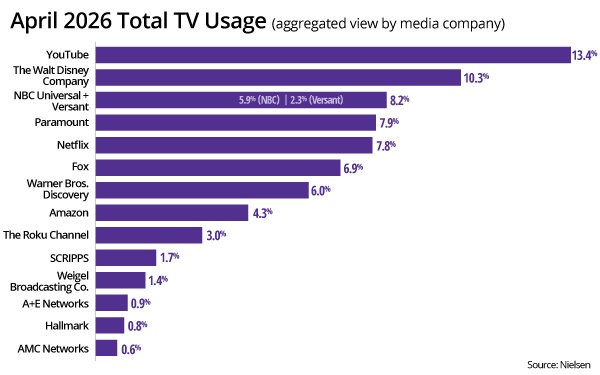
YouTube continues to grow its share of total TV/streaming viewers by a media distributor -- with 13.4%, up a full share point versus the same time period a year ago, according to Nielsen's Media Distributor Index.

At the same time, Walt Disney slipped around half a share point to 10.3% (vs. 10.7%). NBCUniversal/Versant Media remained the same with a combined 8.2% share. Breaking this down, NBCU was 5.9% and Versant Media, the former NBCU cable network, was at 2.3%.

Paramount Skydance slipped a full share point to 7.9% (from 8.9%) while Netflix rose to 7.8% (from 7.5%), followed by Fox Corp at 6.9%, up from 6.8%.

Looking ahead, Fox's proposed acquisition of Roku would give the combined company a 9.9% share -- to land in third place behind Disney. A year ago, a combined Fox Corp./Roku would have landed at 9.2%.


Nielsen also released its monthly “Gauge” total TV viewing for April 2026, which examines specific types of platforms (broadcast, cable and streaming) and individual streaming platforms.

Streaming was at 47.6% (vs. 44.3% a year ago), and cable networks came in at 21.6% (vs. 24.5% in April 2025)).

Broadcast slipped below 20% for the first time -- to 19.9% (vs. 20.8% the year before). Broadcast drama was the most-watched genre within the overall drama category, with a 28% share. CBS’ “Tracker” and “Marshals” and ABC’s “High Potential” were top performers.

Cable was strongest with viewing from the closing days of NCAA’s “March Madness” event, Masters golf tournament, NBA playoffs.

Streaming platforms posting month-to-month growth included YouTube, Prime Video, Tubi, and Warner Bros. Discovery streaming platforms (HBO Max, discovery+).

Nielsen says the Gauge and its Media Distributor Index have not yet shifted to account for the ARF DASH-based media-related universe estimates. That release is scheduled to start up this fall

The Media Plan Is Now a Citation Plan

 Here's what ad agencies are thinking about for their clients which may be adaptable for local direct clients: Philip Jay LeNoble, Ph.D.

Commentary

The Media Plan Is Now a Citation Plan

More than a third of U.S. consumers now begin product research inside ChatGPT, Claude, Gemini, Perplexity, or Google AI Overviews.

The 2026 media plan still does not have a line for that.

Every answer is an ad -- and the spreadsheet your team is filling out right now, which includes GRPs, CPMs, viewability and retargeting, is optimizing distribution for channels your buyers have already partially exited.

The collapse most CMOs haven't priced in

Two years ago, ranking number one on Google meant AI visibility. The same content sat at the top of the page and inside the chatbot answer.

That’s no longer the case. Down from roughly 70% to under 20%, according to data from GEO firm Brandlight and synthesized in our latest research at 5W, the page your media team is buying traffic to does not appear inside the answer your buyer is reading. Your media plan and your visibility plan are now two different documents, but most planners are still treating them as one.


The brief needs to change

Three lines should appear on every 2026 media plan that don't appear today:

Citation share by engine. Your share of mentions inside ChatGPT, Claude, Gemini, Perplexity, and Google AI Overviews. You should be measuring against your defined competitor set and across your defined buyer prompts. This is the new share of voice.

Retrieval anchors. The owned and earned assets, like research, executive bylines, structured FAQ pages, trade coverage, are what the engines pull from when answering category prompts.

Prompt-level reporting. Buyers no longer type "best CRM for mid-market." They type a full sentence to an LLM. You should be measuring against the 50–200 prompts that drive your category.

Without those three lines, the media plan you're putting together is deficient.

Why this lands on media buyers first, not PR

Media buying is where the budget lives. PR teams have been arguing about generative AI for two years. The line item lives with the planner, and the planner reports to the CMO, who is being asked in 2026 board meetings the only question that matters: What is our share of the answer?

Ad budgets and answer-engine visibility have decoupled. The planner who continues to optimize against the old correlation is allocating capital against a chart that no longer holds.

What goes into the plan instead

A modern media plan should include:

A baselineCitation audit, scored across five engines and run quarterly. Measure across Citation Frequency (40%), Cross-Engine Breadth (20%), Query-Type Breadth (20%), Extractability (15%), Crawl Access (5%).

AGEO retainer that produces retrieval anchors monthly.  Proprietary research, FAQ schema, executive bylines, trade-press placement engineered for AI retrieval.

Aprompt panel of 50–200 buyer-stage queries the brand reports against the way it once reported against a keyword set.

That is the citation plan. It sits alongside the media plan. In 2027, it absorbs it.

Agentic Transactions, Relationship-Centered TV Ad Industry Not Mutually Exclusive


Commentary

Agentic Transactions, Relationship-Centered TV Ad Industry Not Mutually Exclusive

So many see the advertising industry’s fast-emerging AI-driven agentic future as anathema to its relationship-driven core. It isn’t and won’t be, as I learned at the Cannes Lions festival this week.

I flew to France excited to talk about the new developments in agentic transactions in the TV ad world, highlighted by Fox Broadcasting and its industry-first end-to-end agentic platform for streaming and linear TV ad transactions.

I was worried that the Cannes world of panels, presentations and impromptu gatherings would rue the day that automated AI agents would drive the selling and buying of the billions of dollars of TV ads, a process traditionally handled through highly personal phone calls, faxes and handshakes between longtime friends.

But I quickly realized that they're not mutually exclusive.

Spending time in Cannes connects all of us to our industry’s history, so I realized that an advertising world driven by agentic transactions is not new. Agency-driven buying and selling of advertising has been a central part of the media marketplace for centuries, just as agent-driven media networks were, a business popularized by Swiss ad specialist Publicitas in the mid-1800s with its network of German and Swiss newspapers.


Those early agentic transactions and media networks relied on trusted human relationships, epitomized by the emergence of specialist ad buyers and sellers who leveraged the most modern technology of the times: trains, timetables, telegraphs and mechanized typography.

That’s correct. Technology-enabled agentic transactions in the advertising industry are not new. Nor is exploiting the best technology available mutually exclusive to the human relationship center of our historic TV ad industry.

AI-driven streaming and linear TV ad transactions can deliver a level of speed, efficiency, yield management and security critical for both advertisers and media owners, maximizing the value of each and every impression and, importantly, delivering the best experience possible to consumers.

Automated, agentic transactions actually give more importance to the human relationship parts of ad buying and selling. Buyers and sellers both need to exercise care picking which agents to transact with, under what rules, and with constant monitoring. That requires real partnership and a predictability of conduct. And it requires trust.

Given the precious, scarce nature of premium video inventory, TV media owners are not going to grant “agentic rights” lightly. Neither will buyers. We have all seen the fraud, pollution and devalued pricing that real-time bidding platforms and disinterested, brokering intermediaries brought to the world of the banner ad, web video, and CTV advertising.

A big theme at Cannes this year was that quality matters, whether in media or data. Also, trust matters, when deciding whom you transact with and how your campaigns are measured. And the ad industry needs to regain control from those focused on harvesting media rather than creating and building it. That message was preached on every stage.

Creating and building the media world that publishers, advertisers, agencies and consumers deserve requires a high degree of human control. That control and trust can only come through strong, personal human relationships.

Yes, agent transactions are the future of the TV ad world. But so are its human-relationship-centered partnerships.

Nielsen: YouTube Gains, Fox-Roku Would Be Third


Nielsen: YouTube Gains, Fox-Roku Would Be Third

YouTube continues to grow its share of total TV/streaming viewers by a media distributor -- with 13.4%, up a full share point versus the same time period a year ago, according to Nielsen's Media Distributor Index.

At the same time, Walt Disney slipped around half a share point to 10.3% (vs. 10.7%). NBCUniversal/Versant Media remained the same with a combined 8.2% share. Breaking this down, NBCU was 5.9% and Versant Media, the former NBCU cable network, was at 2.3%.

Paramount Skydance slipped a full share point to 7.9% (from 8.9%) while Netflix rose to 7.8% (from 7.5%), followed by Fox Corp at 6.9%, up from 6.8%.

Looking ahead, Fox's proposed acquisition of Roku would give the combined company a 9.9% share -- to land in third place behind Disney. A year ago, a combined Fox Corp./Roku would have landed at 9.2%.


Nielsen also released its monthly “Gauge” total TV viewing for April 2026, which examines specific types of platforms (broadcast, cable and streaming) and individual streaming platforms.

Streaming was at 47.6% (vs. 44.3% a year ago), and cable networks came in at 21.6% (vs. 24.5% in April 2025)).

Broadcast slipped below 20% for the first time -- to 19.9% (vs. 20.8% the year before). Broadcast drama was the most-watched genre within the overall drama category, with a 28% share. CBS’ “Tracker” and “Marshals” and ABC’s “High Potential” were top performers.

Cable was strongest with viewing from the closing days of NCAA’s “March Madness” event, Masters golf tournament, NBA playoffs.

Streaming platforms posting month-to-month growth included YouTube, Prime Video, Tubi, and Warner Bros. Discovery streaming platforms (HBO Max, discovery+).

Nielsen says the Gauge and its Media Distributor Index have not yet shifted to account for the ARF DASH-based media-related universe estimates. That release is scheduled to start up this fall. 

Brand-Safe - And Not-So-Safe - News


Commentary

Brand-Safe - And Not-So-Safe - News


New and revealing analysis of ad-supported news content on FAST channels shows that nearly 36% of “news scenes” are fully brand-safe, according to research from Wurl, the streaming subsidiary of AppLovin.

The bottom-line analysis reveals there are significant reasons to buy news content, “meaning advertisers who avoid news scenes altogether are leaving money on the table.”

Research showed brand-safe news content is still lower in brand safety than non-news content (35.7% versus 54.5%, respectively).

Bigger brand-safety risks are involved with content related to "death and harm," at 43%.

Content related to "violence" is next at 31%, followed by content related to "war and conflict" at 31%.

Other categories that were analyzed include content related to sex (at 3%) and profanity (at 2%), content that is derogatory at 2% and drug-related content, also at 2%.


The analysis also notes that politically oriented news is generally brand-safe overall, with brand-safety at 45.5% for blue-leaning news channels vs. 48.3% for red-leaning news platforms.

Better results come with financial news content, which is deemed the most brand-safe.

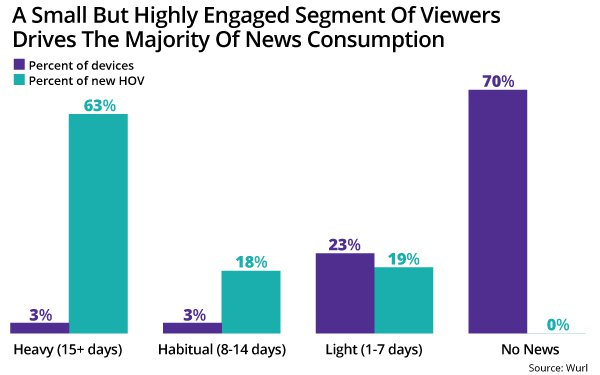
The study also indicates that heavy news viewers make up 3% of viewing streaming platforms, but comprise 63% of all news viewing.

The future could be better when it comes to deciding whether brands should buy into news, featuring new technology such as “scene-level AI analysis” which is slowly replacing less accurate keywords and categories to deal with unsafe news content.

Wurl says this analysis is important because news audiences are highly concentrated and difficult to reach elsewhere.

Fox-Roku: What's Next - And for Fox One?


Commentary

Fox-Roku: What's Next - And for Fox One?

For some time now, Fox Corp. has taken great pains to tell us how important linear TV was -- its Fox Television Network and Fox News Media networks -- even as it launched Fox One, its premium streaming platform, last summer.

So how do we make sense of this in the context of Fox's announcement earlier this week that it would be buying the massive streaming platform Roku for $22 billion?

For many, Fox One (including Fox Corp) the streamer seemed to be a low-key effort to be in the game, with other legacy premium streamers -- Paramount+, Disney+ and Peacock, for example.

Fox One is estimated to have around 2.9 million subscribers -- just a fraction of the business of those other major streamers.

Will the dynamic now change for the company and its streaming platform?

Well, Roku has been offering Fox One since its start in August 2025. So there doesn’t seem to be much of a change there.


With Roku, Fox is now working in another streaming area -- benefitting from its access to Roku’s own Roku Channel, as well as financially from its legacy competitors, to some extent.

For example, Roku gains a share of those streamers' subscription fees -- around 20% revenue share. That is lower compared to the major premium streamers Disney+, Netflix and Prime Video because of their greater market leverage. 

And there is an advertising inventory share as well -- with Roku getting 30% on average, leaving the streamer to maintain 70%. Again, bigger streamers look to command a more favorable share.

This probably will not change things for Fox’s competitors. Many have been through this in the past.

Think about Fox Corp. and others having to negotiate carriage fees with Comcast Corp. on its cable and virtual pay TV services --- all while Comcast’s NBCUniversal operates.

What Fox-Roku gives the company -- in addition to the increasing success of Tubi -- is more heft and reach in terms of more streaming viewership reach and engagement.

This is something major media-buying executives increasingly desire.

Fox is now making its transition back to the big media stage after selling half of its company (movie studios and cable TV networks) to Disney in 2019.

Perhaps the cash-rich Fox Corp. may seek other streaming acquisitions.

Thursday, June 11, 2026

Colbert, Kimmel? Late-Night TV Scores Well on YouTube


Commentary

Colbert, Kimmel? Late-Night TV Scores Well On YouTube


Amid controversy over late-night TV, viewer sentiment has generally increased over the last 12 months -- at least when it comes to YouTube viewers.

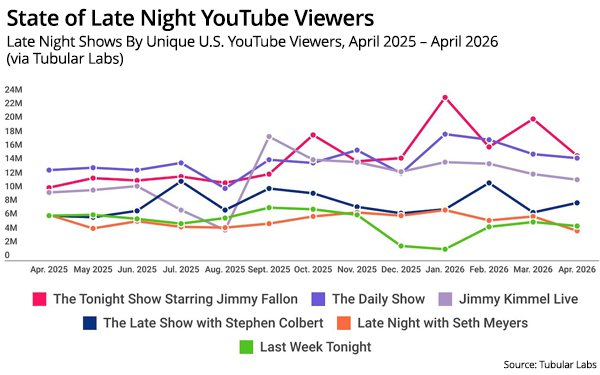
CBS’ “Late Show With Stephen Colbert” witnessed a 30% increase in unique viewers in April 2026 versus the same period a year earlier to around 6.5 million, according to Tubular Labs.

This came in connection with the announcement in July 2025 that Paramount Skydance would be ending Colbert’s 11-year run on the show, because of what it said were “purely” financial reasons.

In addition, the show’s watch-time on YouTube was up 20% nearing his final episodes with big-name guests weighing in on his show, ending with video content featuring former host David Letterman throwing some of the show’s furniture off the roof of the Ed Sullivan Theater.

advertisement

640 x 480.png

advertisement

ABC’s “Jimmy Kimmel Live” also grew to 18 million unique viewership in September 2025 following his week-long suspension and reinstatement. Although “Jimmy Kimmel Live” slowly declined in April 2026 (around 11.7 million), it is still up 18% from year-ago levels.

As of April 2026, NBC’s “The Tonight Show Starring Jimmy Fallon” had the strongest results (15.2 million uniques) -- up 45% versus the year before.

Comedy Central’s “The Daily Show” was just behind at 14.8 million uniques -- 13% higher than the previous year.

In terms of minutes viewed on YouTube, “The Daily Show” performed the best at around 500 million minutes watched in April, followed by “Jimmy Kimmel Live” at 350 million; and Colbert at 250 million.