Tuesday, February 17, 2026

Key Sales and Sales Management Trends (As of 2/17/2026):


As of February 17, 2026, the broadcast television sales landscape is defined by an urgent, AI-driven shift from "experimentation" to "execution" in a "Total TV" (linear + streaming) model, aimed at maximizing reach and accountability in a landscape where streaming viewership has surpassed combined cable and broadcast, say reports.

Key Sales and Sales Management Trends (As of 2/17/2026):
  • "Total TV" Implementation: Broadcasters are breaking down silos between linear and digital teams to sell audiences, not just channels, treating streaming and linear as a unified inventory source.
  • AI-Driven Performance: Sales management is adopting AI to automate workflows, reduce production costs for SMBs, and enable real-time campaign optimization, moving away from "set-it-and-forget-it" models.
  • Speed as a Competitive Moat: Sales teams are accelerating internal workflows to meet advertiser demands for rapid, data-driven proofs. Delayed approvals are causing missed opportunities, with competitors winning on speed and personalization.
  • First-Party Data Necessity: Building and using direct viewer data is no longer optional but foundational to competitive, outcomes-based measurement.
  • Localism via Technology: Local ad sales are shifting to programmatic, allowing for ZIP-code level targeting, with high-stakes, local sports content on broadcast driving revenue, while political advertising continues to utilize digital/streaming tools.
  • Content and Commerce Convergence: Broadcasters are developing shoppable TV experiences (QR codes, interactive ads) to prove ROI, making TV a direct-response driver.
  • Industry Consolidation: Major networks (like Hearst) are actively exploring deals to build scale to compete with tech giants.
Technological and Operational Shifts:
  • IP-Native Infrastructure: The transition to IP-based workflows has moved from pilot projects to required, "essential" technology in 2026, allowing for more flexible, software-defined operations.
  • "Agentic" AI in Ad Ops: Sales ops teams are evolving from "doing" to "directing" by using AI agents to handle repetitive tasks, enabling human sales management to focus on higher-order strategy.
Key 2026 Media Events Driving Revenue:
  • Super Bowl LX (Feb 8, 2026): Reached $8–10 million for 30-second spots, with NBCUniversal selling out inventory across NBC, Peacock, and Telemundo.
  • Milan Cortina 2026 Winter Olympics & NBA All-Star Game: Managed via hybrid IP/digital infrastructures by partners like Comcast Business.

NFL, College Football Scores: Big January for Linear, Streaming


NFL, College Football Scores: Big January for Linear, Streaming

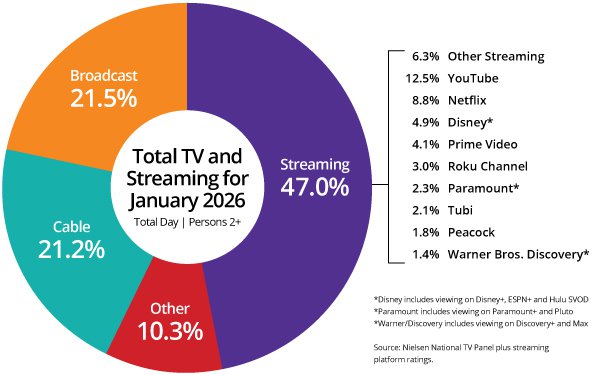
Backed by football -- both the NFL and college -- TV viewing of persons two years and older climbed to 12-month high in January 2026, according to Nielsen’s Total TV/Streaming Snapshot.

But live, legacy TV networks and streaming platforms continued their share trends of the market, respectively, of overall decline and ascending year-over-year.

Broadcast dipped one percentage point to 21.5% (from 22.5%), while cable was down 3.2 percentage points to 21.2% (from 24.4%). All the while streaming rose 4.4 percentage points to 47% share.

On a month-to-month basis (January 2026 to December 2025), both broadcast and cable rose with high-performing sports.

For broadcasts, the NFL accounted for the top 15 telecasts.

On the cable side, ESPN witnessed an increase of 82% in its sports programming, with news networks climbing 17% for Fox News Channel and CNN up by 29%.


Looking at ESPN and Fox News together, the two channels pulled in 21% of all cable TV viewing.

Streaming witnessed a 3% hike in total viewing from December, and 10% higher share versus January 2025.

A number of streamers showed year-over-year gains. YouTube remained in the top spot with 12.5% (vs. 10.8% in January 2025), while Netflix was next at 8.8% (versus 8.6%) and Disney, for all its platforms, came in at 4.9% (4.7%), while Prime Video had 4.1% (3.7%); Roku, 3.0% (2.1%), and Tubi, 2.1% (1.7%).

Apple Releases Dynamic Ad Insertions for Live Streaming Video Podcasts


Apple Releases Dynamic Ad Insertions for Live Streaming Video Podcasts

Apple made it possible to dynamically insert ads in live streaming video podcasts, allowing creators to control content and monetize the video stream using its HTTP Live Streaming (HLS) technology.

The change brings a YouTube-style monetization service to Apple's podcasting ecosystem. For advertisers, the move to HLS shifts video podcasts from static files to dynamic media assets.

Eddy Cue, Apple senior vice president of services, explains in a post that while it gives advertisers more choices, creators more options, and listeners and viewers a higher-quality experience.

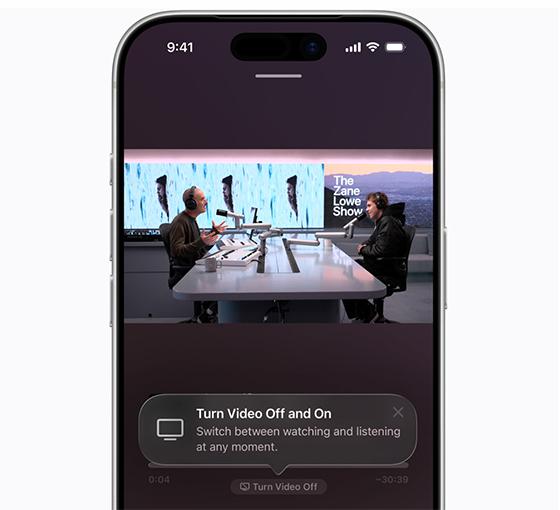
Those using the podcast service can switch between watching and listening to shows. It makes discovery and viewability of video podcasts as easy as listening to audio.

Cue marked the day as a "milestone," noting that 20 years ago Apple created an audience for podcasting by integrating iTunes, which the company introduced in January 2001.


"By bringing a category-leading video experience to Apple Podcasts, we’re putting creators in full control of their content and how they build their businesses," he wrote in a blog post.

The theory is that increasing available ad supply in video podcasts will enable a more efficient programmatic media buy and lower costs.

The Trade Desk estimated in June 2025 that 46% of U.S. podcast listeners never miss an episode of their favorites.

While the introduction of HLS for video podcasts gives advertisers a broader video ad market to search for lower CPM rates, the company's announcement this week focused on the ability to dynamically add ads to serve video campaigns — including host-read video spots — that can be updated across a show's entire back catalog. 

The dynamic ad-insertion technology allows advertisers to replace or insert new video ads into each episode of a podcast simultaneously, rather than being placed in one file at the time of recording.

Video episodes will integrate with existing features like personalized recommendations and editorial curation on the “New” tab and in Category pages.

HLS video is available to test in beta versions, with functions coming to iPhone, iPad, and Apple Vision Pro users, as well as via Apple Podcasts on the web this spring.

Commentary: Is Roku's Growth Fostering A 'Switzerland' Of All Streaming Video?


Commentary

Is Roku's Growth Fostering A 'Switzerland' Of All Streaming Video?

It may still be amazing to some to witness Roku's growing strength in the streaming world.

Recent outperforming earnings results showed a 16% revenue increase to $1.39 billion and a return to profitability, and analysts are all thumbs up on the company.

In terms of controlling streaming hardware and operating system (OS), Roku has 50% market share. Perhaps even more significant is that this is substantially more than Amazon Fire TV, Google TV and Apple TV.

Those are some giant media competitors. But perhaps those big names have their focus elsewhere -- on other rapidly growing businesses.


Strategically, Roku has been able to squeeze into this niche and succeed.

Some say Roku’s performance is all about platform neutrality. Roku does not give specific weight to just one premium streaming service.

For example, Amazon focuses heavily on Prime Video, Google on YouTube and Apple on Apple TV. It does not necessarily play favorites even as it heavily promotes The Roku Channel.

For many, as a free ad-supported streaming service, this does not really compete directly with the bigger premium streamers.

All that means more easily working with TV set manufacturers that want to place the Roku OS without fear they are pushing one big-name streamer over another.

What about the downside? Going forward, that could be a Walmart-Vizio combination.

Walmart has been a major retailer for Roku -- a marketing partner of sorts to help foster that "neutrality," which consumers may have been looking for.

For many, Roku is now an accepted as a replacement -- or partial replacement -- for old-school "cable TV" distributors.

That's all the more reason why the likes of Comcast, Charter and other traditional cable TV-centric companies are trying to play catch-up by also distributing streaming services through video packages at the same time as their traditional TV networks.

Can Roku keep the "neutrality" thing going -- as well as huge media companies like Amazon, Google, and Apple?

Perhaps Roku needs to talk up its status more as the industry’s "Switzerland."

Super Bowl Sentiment: AI-Tainted Advertising


Commentary

Super Bowl Sentiment: AI-Tainted Advertising?

Super Bowl advertising is always a high-value affair for many brands -- but now increasingly critical. 

Does artificial intelligence (AI) have anything to do with it -- either from what was promoted or from customer sentiment around perceived AI -- creative advertising?

One survey, for example, says 50% of social media comments about Super Bowl AI-driven advertising were sharply negative, according to Meltwater Advertising. Audiences believed "automation" hurts the overall production standards for typical high-quality TV Super Bowl advertising.

That’s right. Consumers are looking more critically at Super Bowl commercials than at other times.


One report says 23% of Super Bowl commercials -- 15 out of the 66 ads -- featured AI.

Looking specifically, the Dunkin’ “Good Will Dunkin” ad took the brunt of this -- with 37% of AI-related mentions and 9% of engagement share.

Audiences were critical of the disjointed nature of Dunkin’ ad featuring AI-generated sitcom-style/celebrity integrated characters.

Meltwater defines "sentiment" as the tone of the conversation by volume of mentions versus "engagement sentiment" as the tone of the conversation by volume of reactions to those mentions.

What effect will any of this have on real financial and business outcomes for brands? So far we can see some early-round results.

The best result so far was from AI.com, a future personal AI assistant. The ad was so powerful that viewers immediately signed on to reserve a "handle" on the site. 

The spot was so popular that it crashed the company’s servers. TV advertising/data analytics company, EDO says the ad got 9.1 times as much engagement as the median Super Bowl LX  ad.

This ad nipped out the second-biggest ad in terms of engagement -- Universal Pictures’s upcoming theatrical movie "Minions & Monsters," which posted 9.09 times the engagement of other Super Bowl ads.

Other high-performing spots included ads from Lay’s, Netflix, Universal Pictures' "Disclosure Day," Cadillac, Budweiser, Invest America, and Wegovy. 

The bottom line is that brands believe consumer interest lies around AI-platforms consumer services, cryptocurrencies, sports wagering and weight-loss medications.

Will any of this be driving the economy in 2026?

NBA Team Valuations Spike, Driven by Rising TV Advertising


Commentary

NBA Team Valuations Spike, Driven By Rising TV Advertising


Valuations of NBA teams have been skyrocketing -- and TV revenue is a major reason why.

We can thank rising sports rights fees -- now at $75.9 billion over 11 years, up more than two-and-a-half times the previous contracts -- by way of major TV advertising and sponsorship revenue.

A collective $637 million in regular-season TV advertising for the 2024-25 NBA season was pulled in, according to EDO Ad EnGage, followed by $845 million for all post-season media buys.

The big three advertising categories include quick-service restaurants, automotive and insurance (auto and home).

The broader picture shows that for this season alone -- the 2025-26 season -- total league-wide revenue will grow 12% to $14.3 billion.

Higher rates and fees had a lot to do with it, stemming from rising ad revenue. This has given about $142 million to each team from those current TV partners: Walt Disney, NBCUniversal, and Amazon.


The average revenue for the previous season per team was at $416 million -- nearly 7% more than 2023-24.

This has pushed team valuations -- including new ownership deals for some teams -- to a level where three teams have valuations of more than $10 billion, according to CNBC.

This includes the Golden State Warriors ($10.8 billion), the New York Knicks ($10.1 billion), and the Los Angeles Lakers ($10.0 billion).

The biggest valuation change -- year-over-year -- was with the Lakers, due to a controlling interest purchase by Mark Walter, at nearly 20 times that of the team’s 2024-25 revenue of $565 million.

Early viewership for the 2025-2026 shows saw 18% improvement due to more games on over-the-air TV, ABC and NBC.

Overall local TV revenue from cable TV channels and/or streaming TV platforms for the biggest markets -- such as New York and Los Angeles -- are figuring in big-time. The Lakers and the Knicks grab the most -- around $185 million and $140 million respectively, according to Sports Business Journal.

Still, everyone is benefiting -- all 30 NBA teams. The average value of an NBA team is up 18% versus a year ago to $5.52 billion.

With regard to downside, that may be subscription fatigue on the streaming side -- Disney’s ESPN streamer, NBCU’s Peacock and Amazon Prime Video.

Another downside is that high sports-rights fees from regional sports cable TV networks have evaporated.

Much of what remains has shifted to over-the-air TV, with one new exception -- many teams now sell their local TV advertising.

In the future, it seems that teams may need assists from financial teammates to come to keep up the big scores.

Friday, February 13, 2026

National/Local TV Ad Silos Will Collapse Before Linear/Streaming Silos Do

 Local-direct media marketing will always top revenue opportunities going forward when compared to transactional media. Philip Jay LeNoble, Ph.D

Commentary

National/Local TV Ad Silos Will Collapse Before Linear/Streaming Silos Do

Many of us have been waiting many, many years for advertisers and agencies to view streaming and linear TV channels as a holistic premium video world, where planning, buying, selling and measurement can be truly done together in a fully integrated way.

Historical silos in organization products, planning, buying, workflows and metrics have prevented this from happening. Yes, I know that day in and day out folks in our industry take stages at events or give quotes to trade media that claim to be true silo-busters operating in a real cross-channel way. But we know that, all too often, our industry loves to embrace what people say without a lot of attention to what they actually do.

Managing cross-channel linear and streaming TV media is a great example of that.

We’re an industry that is quite accustomed to silos. It wasn't that long ago that most major buying and selling organizations were structured by daypart, distribution and strategy. Broadcast daytime buyers couldn't touch prime, nor could they touch cable. Direct-response broadcast sellers couldn’t sell broadcast sports, and broadcast sports sellers couldn’t sell entertainment. And don’t even think about what would happen if a USA Network seller tried to sell CNBC.


BISRetail-sp26-WorkPlay-640x480dbl.gif


Well, much of that world has changed. Shifts to streaming, increasing focus on audience-based approaches, and massive reductions in force across teams have finally broken the walls between many roles that had remained mysteriously disparate and siloed.

And national and local linear TV are next, even before linear and streaming come together. As national TV takes on more of an audience-based approach, with increasing focus on strategic target delivery and resulting outcomes, it’s only natural we will see local impressions optimized into national programs in a data-driven way to best meet advertisers’ goals.

Most advertisers had some geographic biases in where their target customers live, and where they can be found at scale cost-efficiently. We have had un-wired networks for a long time, but it was really hard to pull together truly integrated national and local activation and planning without tons of staffing to make it work. But predictive analytics, spot-level activation automation and integrated local and national measurement are changing that game.

Who knows, if Skydance/Paramount isn’t able to buy Warner Bros Discovery, why wouldn’t it buy a large local broadcast company, now that the government doesn’t seem to worry too much about the 40% coverage rule? If that’s the case, then the only way to maximize yield for the various national products and local programs and audiences need to be sold in a truly integrated way, not just sold in separate siloed buckets.

That future is coming fast, I think. What do you think?