Wednesday, September 17, 2025

Risky Business: Why Smart Brands Are Avoiding Social Media Ads


Risky Business: Why Smart Brands Are Avoiding Social Media Ads

Social media’s collision with politics has transformed social advertising from branding no-brainer to reputational risk. Social media companies have slashed content moderation policies that protect users from hate speech, repulsive or violent images, misinformation, and so on.

The result? These platforms are no longer neutral spaces for ads. Instead, they’re dicey political arenas where purchasing ad space can be interpreted as an ideological statement in and of itself—a move that smart brands would be wise to avoid.

How We Got Here

Existing concerns about social media’s ability to breed toxicity ratcheted up in 2022 when Elon Musk bought Twitter. Within weeks, content moderation policies relaxed and banned users previously deemed too dangerous for the platform were reinstated. Soon, Mark Zuckerberg too scaled back Meta’s safeguards, ostensibly in the name of “free expression.”

Without regulation, ads can appear alongside agitprop, hate speech, or worse, with little recourse. While social media managers for brands can decide how to engage on these platforms, they have less control over where ads appear and how customers interpret them.


It’s tempting to risk it anyway: Clicks, impressions, and conversions for an ad on Instagram or X have impressive immediate reach. But they don’t build long-term brand trust. Quick sales may feel like a victory at the moment, but they don’t foster the sustainable, positive engagement and trust that brands need in an increasingly polarized world. Marketing efforts should be judged accordingly—a long-term view that’s especially critical when engaging with younger audiences.

After all, Gen Z has grown up with social media and is increasingly aware of its power as consumers, meaning brands targeting them must be vigilant. This audience won’t allow brands to ignore the ethics or potential dangers of their marketing practices. Young consumers are also at the forefront of an overall trend toward reduced engagement on social media across the board.

The Illusion of ROI

Organic reach—the ability to connect with audiences without paid ads—is plummeting. As online environments curdle, more people are logging off for good. What was once a conduit for brands and customers to engage directly is now a reputational and ethical minefield with less promise of payoff. Savvy communicators are responding in kind: 26% of marketing professionals say they plan to reduce ad spend on X in 2025, with just 4% believing their brand is safe on the platform.

Good Riddance to Advertising on Social Media

Social media advertising is no longer the golden ticket. The evolving landscape has made it reputationally and financially risky. Companies that adapt by eschewing the volatility of social media and favoring more sustainable marketing strategies will thrive. Inspirational examples abound. Patagonia has long invested in mission-driven storytelling through its own platforms, building customer loyalty without relying on traditional social ads. Starbucks, despite its massive online presence, paused advertising on social platforms in response to ethical concerns. And Chick-fil-A leaned into its own app to build community engagement beyond social media.

The question is no longer whether social media advertising is worth the risk. It’s whether brands can afford not to move on.

This post was previously published in an earlier edition of Marketing Insider.

The Silver Linings Advertising Playbook


Commentary

The Silver Linings Advertising Playbook

There appears to be some good news in the bad news surrounding the angst Americans continue to feel about the economy -- if you're a media planner or buyer, that is.

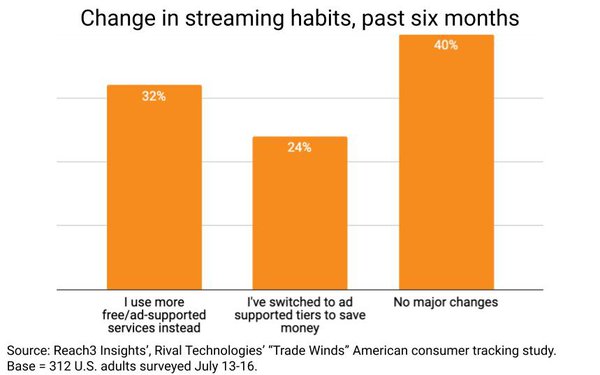
The good news is that while Americans are increasingly pinching their pennies, that's driving many more of them to switch to ad-supported streaming services or ad-supported tiers of premium ones, according to the latest in a series of ongoing tracking studies about how Americans are responding entertainment-wise to higher costs of living.

The in data, released this morning by Reach3 Insights and Rival Technologies as part of their periodic "Trade Winds" study, finds six in ten Americans have made some material adjustment to their streaming media budgets, and the No. 1 change has been using more free/ad-supported services instead of premium ones (32%), followed by switching to ad-supported premium streaming service tiers to save some money (24%).

While the findings are a strong leading indicator for an expansion of ad-supported streaming inventory, the macro trend doesn't bode well for streaming services overall, because while the ad industry might benefit in the long run, economic duress is contributed to more churn and turmoil over business models across the streaming industry.

The study finds nearly half of American adults responding to their survey have canceled or downgraded a streaming subscription service in the past 12 months.

Asked which streaming services they deem "most essential," respondents ranked Netflix No. 1 by a margin of two-to-one over the next most essential service: Hulu.

Which streaming platforms are most essential:

  • Netflix: 68%

  • Hulu: 33%

  • Prime Video: 25%

  • Peacock: 13%

  • Disney+: 9%

  • HBO Max: 8%

Hulu's ranking is interesting for a couple of reasons, including that it was the pioneer in hybrid premium/ad-supported tier options, and that parent Disney is poised to consolidate it with Disney+ (which was deemed essential by only 9% of respondents).

“Consumers are redefining entertainment in the face of broader economic concerns,” Reach3 Insights Research Director Varun Jog notes, adding, “The winners will be the brands that adapt quickly, offering deep value in ways that reflect their shifting priorities.”

Wednesday, September 10, 2025

Netflix Adds Amazon Ads to DSP Partners

 Would local-direct clients benefit from this new ad platform? Philip Jay LeNoble, Ph.D.

Netflix Adds Amazon Ads to DSP Partners

Netflix is extending its demand-side platform partnerships -- now with Amazon Ads to be offering premium advertising inventory of its TV and movie content.

“By integrating Amazon DSP and enabling even more advanced capabilities together over time, we’re making it easier than ever to connect with Netflix's global engaged audience,” said Amy Reinhard, President of Advertising, Netflix, in a release.

Other DSPs used by Netflix include Yahoo, The Trade Desk, and Google's Display & Video 360 (DV360), where advertisers can programmatically buy ad inventory on Netflix's ad-supported tier.

The partnership will start up in the fourth quarter 2025 in the United States, the U.K., France, Spain, Mexico, Canada, Japan, Brazil, Italy, Germany and Australia.

This extends Amazon Ads' efforts around all major streaming platforms. 


Amazon Ads already has deals with NBCUniversal (Peacock); Warner Bros. Discovery (HBO Max); Fox Corp. (Tubi and Fox One); Paramount Skydance (Paramount+ and Pluto TV. Recently it inked a deal with Walt Disney (Disney+, Hulu and ESPN).

At the same time, Amazon is in the unusual commanding position of owning a big DSP and strong and growing premium streaming service -- Prime Video.

Amazon Ads continues to widen its competitive business -- including possibly threatening the largest independent DSP, The Trade Desk, according to analysts.

'Downton Abbey' Movie Gets Glamorous New York Premiere


Commentary

'Downton Abbey' Movie Gets Glamorous New York Premiere

The third and final “Downton Abbey” movie is sensational, and so was the premiere event Focus Features put on in New York Monday night.

The event had two parts -- the premiere movie screening in the intimate Rose Theater (capacity 1,109) at the Jazz At Lincoln Center performance venue, and then a reception in the famed New York Public Library building at Fifth Avenue and 42nd Street (charter bus transportation provided).

Opened in 1911, the imposing, Beaux-Arts building -- first conceived in the 1890s -- is a product of the Gilded Age, a likely unintentional reflection of “Downton Abbey” creator Julian Fellowes’ current series “The Gilded Age” on HBO.

Although the new “Downton” movie -- titled “Downton Abbey: The Grand Finale” -- takes place in 1930, a celebration of the TV series and the new movie felt right at home in the grandeur of the building’s marble-clad, first-floor entrance hall and spacious corridors that shoot off in two directions just behind the entrance space.


At the theater, the movie was preceded by the appearance on-stage of Julian Fellowes and then most of the stars of the show, including Michelle Dockery (Lady Mary), Hugh Bonneville (Robert Crawley, Earl of Grantham), Elizabeth McGovern (Cora Crawley, Countess of Grantham), Laura Carmichael (Lady Edith), Allen Leech (Tom Branson), Joanne Froggatt (Anna Bates), Paul Giamatti (Harold Levinson), Penelope Wilton (Isobel Crawley), Douglas Reith (Lord Merton) and others.

Adding to the celebratory mood, some members of the audience attended in period apparel. 

Among the celebrities on hand was Bob Balaban, who played a key role in the creation of “Downton Abbey,” according to Fellowes.

From the Rose Theater stage, Fellowes singled out Balaban, and told the audience how the actor had connected him with director Robert Altman for the 2022 movie “Gosford Park,” the movie about the English aristocracy that laid the very foundation for “Downton Abbey.”

As for the movie, the TV Blog will refrain from revealing any elements of the plot, but a word of advice to those planning to see it when it opens Friday: Bring tissues and hankies. 

The movie renders the world of Downton, its residents and servants, the surrounding community, and 1930s London with the attention to minute detail that has characterized the series and mesmerized its audiences since 2010 (time frame of the first season: 1912-14).

At the party, members of the “Downton Abbey” cast mingled with the guests. The TV Blog and guest ran into Hugh Bonneville, Douglas Reith and Simon Curtis, the movie’s director.

We also made an effort to greet Julian Fellowes to congratulate him on the movie and express our thanks for this event. Whether or not he was the actual host, I always like to thank somebody anyway.

Speaking of thanks, the TV Blog and guest were the guests of Viking, the Switzerland-based cruise and travel company which credits its long sponsorship of “Downton Abbey” with helping it establish its brand as “a household name.”

Indeed, anyone who ever watched “Downton” (and other series on PBS’s “Masterpiece”) knows the Viking company, with its commercials showing its sleek tour ships cruising the rivers of Europe in search of on-shore castles, museums and fine food.

By now, the Viking company’s commercials featuring founder and chairman Tor Hagen have achieved iconic status.

The company’s association with “Downton” extends to dry land. Since 2011, the company has partnered with the owners of Highclere Castle (in Highclere, U.K.), the grand English home dating to 1679 that served as the filming location for the Crawley home on “Downton.”

The show has made the Castle -- owned by the Earl and Countess of Carnarvon -- one of Britain’s most popular tourist attractions, and Viking has long offered tours of the Castle and surrounding areas.

Throughout the movie, the late Maggie Smith and the powerful character she played on the TV show -- Violet Crawley, Dowager Countess of Grantham -- was not forgotten.

The family matriarch came up often in conversations in the movie, and a portrait on a wall was seen many times within the Crawley home. In a touch of class, the movie was dedicated to the beloved star.

Midterm Political TV Ad Spend Up 22% To $10.8B


Commentary

Midterm Political TV Ad Spend Up 22% To $10.8B

Strong political TV/streaming advertising will continue next year for the 2026 mid-term elections, rising to a projected new record total of $10.8 billion, according to AdImpact.

This would be up 22% from the 2022 midterms ($8.9 billion) and a 4% decline from last year’s Presidential-focused political ad season estimated at $11.2 billion.

For next year, AdImpact sees broadcast TV still taking a dominant 49% share of political spend -- $5.28 billion (down slightly from $5.36 billion in the 2024 political year)

All media platforms are expected to be down versus 2024 -- except connected TV, which is projected to climb to $2.48 billion from $2.34 billion.

Digital media will slip to $1.43 billion (from $1.7 billion), with cable TV down to $1.29 billion (from $1.37 billion), radio dipping to $280 million (from $330 million) and satellite dropping to $80 million (from $90 million).


Spending on U.S. Senate campaigns in 2026 will rise slightly versus 2024 to $2.8 billion. The widely watched U.S. House of Representatives races will climb 27% to $2.2 billion -- the first time those races will top the $2 billion mark.

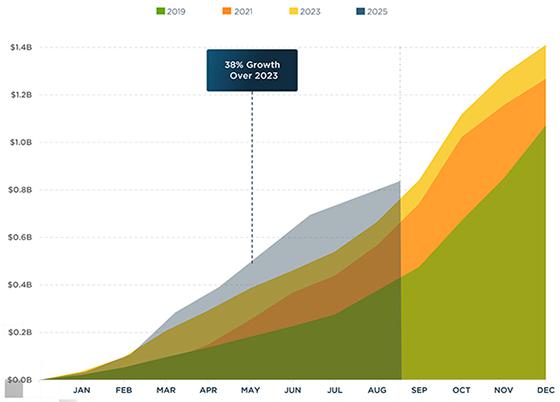
Even so-called "off-year" political spending is improving. Through August 26, 2025 -- season-to-date -- AdImpact tracking for political ads is now 38% higher ($900 million) versus $657 million in 2023. It is also 58% higher than 2021’s $572 million.

Research comes from AdImpact's monitoring of more than 24,000 elections, 33 million ad airings, and $41 billion in overall political ad spendin

Streaming Subscriptions Climb 10% In Q2, 'Unique' Customers Up 8%


Streaming Subscriptions Climb 10% In Q2, 'Unique' Customers Up 8%


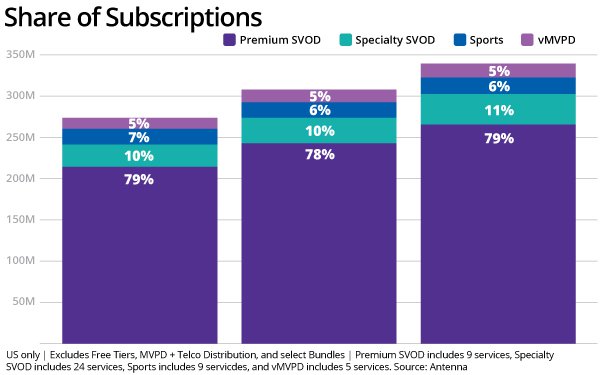
Although streaming video subscriptions have slowed down a bit, they continue to see growth in the second quarter of 2025 -- adding 10% to now total 339 million, according to subscription research company Antenna.

At the same time, "unique" individual streaming consumers for those connected TV apps (CTV) are up 8% to 177 million versus a year ago.

Premium streaming apps -- like Apple TV+, Disney+, Netflix, Hulu, Paramount+ and Peacock -- now command a 79% share (267.8 million) of the total 339 million subscriptions-- up from 78% in the year-ago quarter.

Specialty streaming -- such as A&E Crime Central, Hallmark+, BET+, BritBox, MGM+, Crunchyroll, Shudder, ViX Premium and Lifetime Movie Club and CuriosityStream -- added 12% (40.7 million) during the period.

On the losing end is sports streaming, which has slipped 1% to 20.3 million. This includes DAZN, ESPN+, FanDuel Sports Network, MLB TV, MLS Season Pass, NBA League Pass, NFL+, NFL Sunday Ticket -- and UFC Fight Pass.


Virtual multichannel video program distributors (vMVPD) grew 5% to 16.95 million (a 5% share), according to Antenna.

All non-premium streaming categories were up 6% in subscriptions to 89 million in the period.

Good news for streamers is that consumers cancelling their subscriptions are down slightly. Premium streamers have the lowest/best "churn" rate -- at 4.1%. This includes DirecTV Stream, Hulu + Live TV, Philo, Sling TV, and YouTube TV.

Specialty streamers have the highest/worst churn rate at 6.6%, while sports comes in at 5.1% and virtual multichannel video program distribution (vMVPD) is at 4.5%.

Commentary YouTube Scores Another Touchdown: What's Next - A Favorite Unscripted Show?


Commentary

YouTube Scores Another Touchdown: What's Next - A Favorite Unscripted Show?

Have we just hit a new level -- a real game-changer -- when it comes to linear TV networks squaring off with streaming TV world?

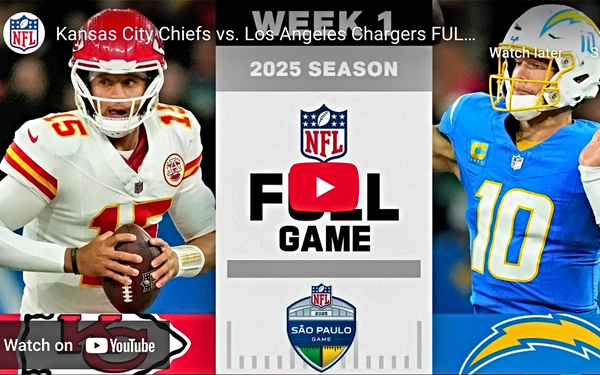
YouTube averaged a big 16.2 million Nielsen-measured (and YouTube first-party data) for an NFL regular-season game -- the one in San Paulo, Brazil featuring the Los Angeles Chargers upsetting the perennial Super Bowl champion Kansas City Chiefs. (And okay, it was exclusive. That didn’t hurt viewership).

Consider that NFL regular-season games on all its other platforms last season achieved an average of 17.5 million. This puts YouTube on a level (or at least in the same ballpark) with the linear TV networks, Netflix and others (especially for live sporting events).

If you have been shrugging your shoulders over YouTube becoming dominant and ascending in TV-video U.S. share -- now around 12%, according to Nielsen’s monthly Total TV measure -- you have something to think about beyond typical YouTube content featuring crocheting lessons, loud, combative podcasts, and Mr Beast stunts.


Think specifically about a new way to compete for your attention: YouTube Vs. “Sunday Night Football," YouTube Vs. “NCIS," and YouTube Vs. "Hannity."

Live sports bring immediate and valuable engagement to the likes of streamers: Netflix (the Christmas Day NFL content and special boxing events), and Amazon Prime Video (“Thursday Night Football”).

What happens next? It may not be bigger, dramatic live content -- just mid-size, but still important, staple legacy TV content that devoted viewers follow.

Think about possible exclusive episodes of well-known brand TV series: NBC’s “The Voice,” ABC’s “American Idol,” Bravo’s “The Real Housewives” and TLC’s “90 Day Fiance” or “Sister Wives.”

These are efforts to grab attention as the streaming world dilutes -- or in many cases eliminates -- legacy "time period" scheduling strategy, making things a bit more complex.

Want to dip into an important political podcast (real-time or otherwise), a jazz guitar lesson, a new season of Netflix’s “Virgin River” or a live Major League Baseball playoff game? Your choice. But how to market that content?

Other competitive parts of the now diverse, broader digital media world still pursue your attention and your time.

The immediacy of real-time content -- the impact of which can quickly disappear -- becomes important.

And just in case you were wondering, YouTube is still also your backup: It does have a replay of the Sao Paulo NFL game -- if you want to catch up.