Friday, April 23, 2021

After Strong 2H 2020, Q1 Sports Ad Spend Down 28% YoY


After Strong 2H 2020, Q1 Sports Ad Spend Down 28% YoY

Although the U.S. advertising market as a whole saw record expansion in March, ad spend across major sports leagues in this year’s first quarter was below 2020 levels, according to Q1 data from MediaRadar.

After plummeting 84% year-over-year in last year’s second quarter (from $1.4 billion to $221.74 million) due to pandemic-forced shutdowns, ad spending on NFL, NASCAR, NBA, MLB and NHL games and events rebounded strongly during the rest of 2020, as games and limited seasons resumed.

In Q3, year-over-year ad spend significantly exceeded 2019 levels, leaping 59%, from $1.29 billion to 2.05 billion.

The same pattern applied in Q4, the biggest sports quarter of the year, when ad spend rose 9.5% YoY, from $4.02 billion to $4.4 billion.

However, the $1.99 billion spent in this year’s first quarter — while 23% higher than 2019’s $1.62 billion, was down 28% versus largely pre-pandemic Q1 2020’s $2.75 billion.

Looking at by-category trends, despite the overall drop in spending in Q2 2020, the relative shares of total spend for three of sports’ largest categories — tech, finance and entertainment — saw only modest changes between 2019 and 2020.

Automotive saw the largest decline during 2020, from a 15% share to 12%, reflecting a 10% decrease in overall sports spending during the year.

Tech’s share declined from 16% to 15%.

Finance and entertainment each picked up 1 percentage point, for 2020 shares of 15% and 13%, respectively.

Overall, the tech, finance, and entertainment categories spent $3.9 billion in 2020 — up 13% versus 2019.

MediaRadar's data reflect advertising analysis of more than 3.1 million brands across media platforms including TV, digital, mobile, email, social media and print.  

IAB: Ad 'Confidence' Has Surged, Less Frequent Reviews Of Budgets


IAB: Ad 'Confidence' Has Surged, Less Frequent Reviews Of Budgets

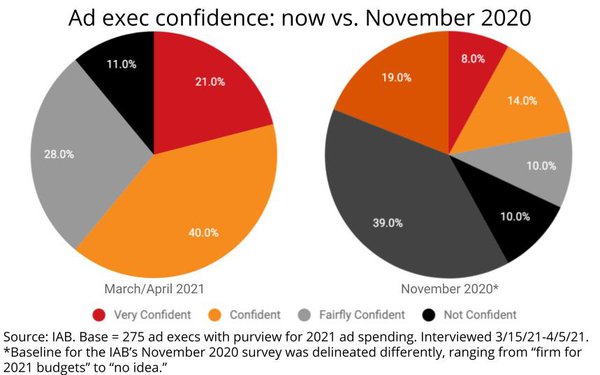
U.S. advertising executives with a "purview" for 2021 ad spending -- both advertisers and media agency planners and buyers -- are significantly more confident about their ad budgets for the duration of this year than they were when surveyed late last year, according to the latest edition of a tracking study by the Interactive Advertising Bureau (IAB).

Sixty-one percent of the 275 executives interviewed by the IAB in March and April said they are either "very confident" or "confident" in the "stability" of their ad budgets for the remainder of this year.

While the IAB delineated responses differently to a similar question asked in November 2020, the trade association's analysts implied it's a marked improvement in ad executive confidence. (In the November 2020 interviews, the IAB outputted the responses on a six point scale ranging from "firm 2021 full year budgets" to "no idea," see our coverage here.)

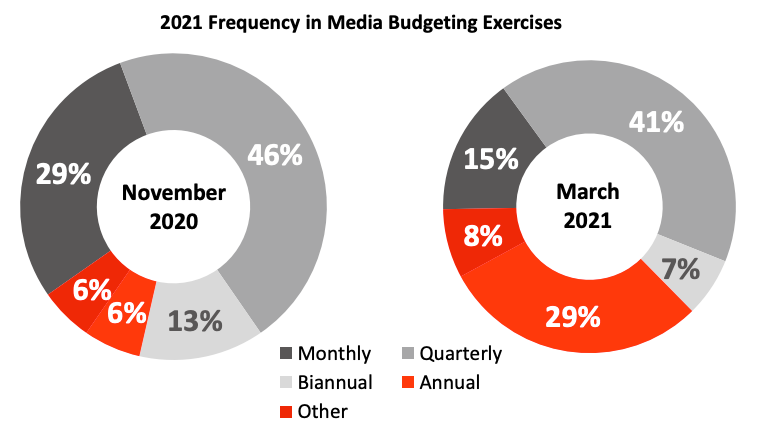
"Ad buyer optimism for 2021 has increased in just the past five months," the new IAB report asserts, adding, "Confidence in 2021 ad budgets has reduced the need for frequent re-examination and reallocation of spend, which was common in 2020 (see data below).

In November 2020, 29% of ad execs said they were reviewing their media budgets monthly vs. only 15% currently.

NextGen TV May Be Able To Fact-Check News Content


COMMENTARY

NextGen TV May Be Able To Fact-Check News Content

Plenty of websites offer fact-checking of news stories. But those can be a little daunting for the average TV news consumer -- and a bit of work.

New ATSC 3.0 technology on TV stations -- so-called NextGen TV-- promises lots, in the way of advanced advertising, interactive opportunity and streaming programming.

Now some reports suggest ATSC 3.0 might also be a tool to identify fake news and distinguish it from the real stuff. Few details have been disclosed, but this would be an incredible marketing draw for avid TV news consumers -- especially those who also consume news content from social media.

At the outset, all this seems like some instructional tool for consumers to use to make their own decisions.

For example, could there be a high-tech approach to communicating an on-screen video/display tag touting the veracity of a piece of content?

TV Watch has worried that consumers don’t have much time to comb through all the vagaries of newsgathering and distribution. Veteran news/media reporters can spend a lot of time doing this -- and they get paid for it.

Perhaps interactive screens can appear via a special remote with a "verify news content" button. That would be easier than linking to an online digital fact-checking site.

It gets a bit more complicated. Some news could be half-correct, mostly correct, or totally a fabrication. Many fact-checking sites already offer different degrees of real versus fake news content.

Now, if you are a local TV advertiser on a local TV station that runs news programming, does this make a difference to your media buy?

And while much of this would seem to be an attack specifically on social-media platforms -- which, according to analysts, distribute lots of fake news -- what if local TV stations have their own problems with questionable news content?

Errors in judgment, quick content decisions and outright mistakes can happen anywhere.

Media Buyers Are Upping Digital Video's 2021 Budget Share, But Also Linear's


COMMENTARY

Media Buyers Are Upping Digital Video's 2021 Budget Share, But Also Linear's

Media buyers surveyed by the Interactive Advertising Bureau at the end of this year’s first quarter plan to increase U.S. spending for digital video, including CTV/OTT, to 20% of their total media budgets this year — up from an average of 13% in IAB’s last survey, conducted in November 2020.

However, it's not a case of more money coming out of linear TV, which is now expected to command an 18% share of total media spend, on average — up from 15% in November. (Chart above.)

Instead, all other traditional media are set to take a hit, with their share pegged at just 10% -- down from 14% in November.

Search is also being somewhat de-prioritized, with its share downgraded from 16% to 13%, as are podcasts, digital audio and digital out-of-home, which in combination are set for a 9% share, versus 12% as of November.

Also, in a separate question, most buyers confirmed that their 2021 linear TV investments will match or exceed 2020’s, although 37% each expect to allocate less to linear upfronts and the scatter market.

As far as buying methods go, more than half (54%) of CTV buyers say they'll be allocating more of that channel’s investment to programmatic buying than in 2020, while most indicate their allocations for the NewFronts, traditional TV upfronts and the scatter market will be about the same.

Most who buy digital video also said that reserve-based buying will probably (52%) or definitely (27%) become more “scatter-like” as programmatic continues to grow.  

Two-thirds (64%) of those who buy digital video use self-serve bidding platforms for buying, either through a partner (51%) or an in-house platform (13%).

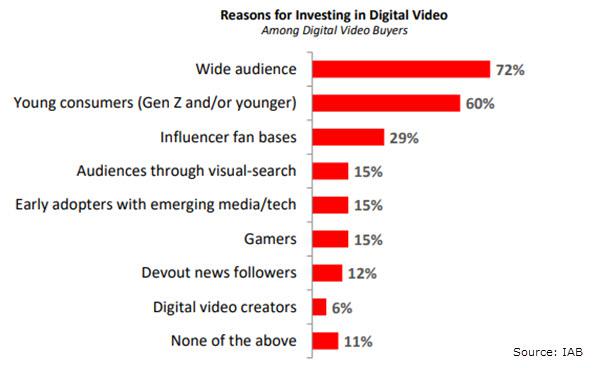
Asked why they invest in digital video, nearly three quarters (72%) cited its wide audience, followed by 60% citing its reach to young consumers.

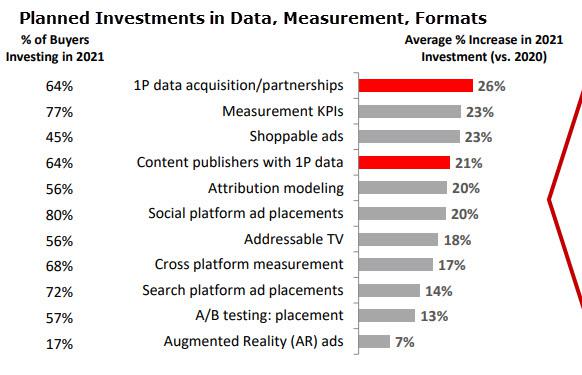
Looking at other types of investments, ATV followers take note: 56% plan to invest in addressable TV, and that’s up 18% versus November.

Investment in first-party data acquisition and partnerships has seen the largest increase in prioritization since November — up 26%, with 64% now citing this as a priority. Not terribly surprising, given Google’s phasing out of cookies Apple’s looming location tracking opt-in, and privacy regulations, of course.

Still, social platform ad placements, measurement KPIs and search platform ad placements get somewhat higher prioritization than first-party data — and all of those saw double-digit increases in the percentages citing them, versus November’s survey.


IAB’s latest survey also shows media buyers expressing significantly more confidence in their advertising budgets now than in November, and being considerably less apt to review their media budgets on a weekly basis.

For the latest research, IAB surveyed 275 brand and agency executives with “purview” over 2021 U.S. advertising spend. Sample size varied by question.

Thursday, April 15, 2021

COMMENTARY Millennials, Gen Z: What's Trending, 1 Year Into Pandemic


COMMENTARY

Millennials, Gen Z: What's Trending, 1 Year Into Pandemic

One year into the pandemic, priorities have changed for businesses and young adults alike.  Here are the trends uncovered by recent research among Gen Z and millennials, along with comments from four female entrepreneurs.

Mental health: The pandemic had an economic impact on millennials and a cultural, social impact on Gen Z.

Ninety-two percent of young adults said they are more self-aware, notably when it comes to mental health. Young adults expect to be asked about their mental health status and expect brands to join the discussion. This means exploring mental health in campaigns and engaging with customers on ways to assist. As young people reevaluate their life, how are they navigating the journey -- and how can your brand help?

“Physical, mental, and emotional can’t be looked at independently,” said Elianna Goldstein, co-founder/CEO at GETMr. “When I have a great purse, how does this affect my confidence during the day? Or if I wear nice clothes or not on a Zoom? [Small acts such as these] can drive our long-term health.”

Life experiences: Young adults went from having FOMO (fear of missing out), to NOMO (NO MOments), to magnifying the memories they have, and are now living in a meaningful and intentional way. Actions matter and are carefully considered. The pandemic forced many to miss out on life events like weddings, graduations and prom.

Gen Z under-20-years-old enjoyed being home, spending time with their families and growing closer to their parents. They craved a sense of security, and unlike older Gen Z and millennials, feel no real sense of loss because it’s hard to miss what they never experienced.

Advertising: A new sense of brand discovery.  

When Gen Z and millennials purchase something they saw online, they are increasingly reporting that it is something they “found” --  nothing about how a targeted ad appeared in their timeline. Advertising is so organic that people don’t realize they are being advertised to. Millennials have more of a spending budget than Gen Z, but the younger demographic plays a vital role in driving sales to brands, even when they aren’t the ones buying. Gen Z introduces brands to their followers, friends, and family.

“Our company was very much founded on Instagram,” said Vanessa Holfert, senior vice president of marketing at Slumberkins. “The primary purchaser of our product has always been the millennial audience. Millennials are so important, but we’re also seeing a really interesting trend that young audiences are actually increasing their conversion rates with us year over year.”

Is your brand ready to celebrate? When the pandemic hit and everyone started hoarding toilet paper and hand sanitizer, consumers went online for some comfort buying. Now that millions of people are vaccinated and group restrictions are lifting, friends and family will gather together, and last year’s comfort buy will be this year’s celebration purchase. Can your brand handle the influx?

“As more people get vaccinated we’ll see an energy where people are going out, celebrating, partying, enjoying life and not taking it for granted,” said Wilglory Tanjong, founder of Anima Iris. “We’re going to see a continual ecommerce boom that smaller businesses should prepare for. [The pandemic] will forever change how people view themselves and how they view the world.”

COMMENTARY Why Losing Targeting Is A Good Thing For Advertisers


COMMENTARY

Why Losing Targeting Is A Good Thing For Advertisers

Major players in advertising continue to make announcements about the loss of data. There’s the death of the keyword, removal of tried-and-true match types, increased privacy restrictions, loss of audience targeting, the removal of cookies — the list goes on. This is bad, right?

It’s complicated. Personas have long been the holy grail of targeting. Take Jeff. Jeff is a 30– to-45-year-old father who loves the outdoors. We want to target him, but how? The answer has always been to build keyword lists and audience targeting matching the Jeff persona. But immediately, this limits our audience.

But, don’t we want to limit our audience? Here’s the reality: There are a finite number of Jeffs, and he might be expensive to capture. Your audience of 100,000 Jeffs is limited to 20,000 because, for most of them, you need to pay more than $100 to convert.

Brands should stop focusing on personas and instead turn to profitability. Is it really important for Jeff to convert if Megan, a single 56-year-old who loves the spa, is ready to?

This exemplifies why the changes Google is making to targeting actually do advertisers a favor. It puts targeting in the hands of the machines, which can find users faster and more accurately than marketers. That doesn’t mean marketers are out of a job. Actually, the opposite is the case. The key is leaning into what machines versus humans should be in charge of.

The machines know more about users than marketers do. The algorithms are watching what users are doing and categorizing them. This process will always take place, whether or not Google and other platforms share this information with advertisers.

Not only do machines have access to more information than marketers, but they act on information in real time. The fastest marketers can make decisions is a few hours after the searches and activity happened.

There’s still a lot that machines can’t do:

-- Machines don’t have the business information marketers have. They don’t know at which point a CPA sees diminished returns against profitability. Organizing and standing up offline data is an important role that a platform can’t achieve on its own. Platforms need the input from marketers on profitability and points of diminished returns to remain successful. 

-- A machine can’t make optimizations to your website. Leveraging automation doesn’t mean there is no optimization to be done, it simply changes what we’re optimizing. Rather than negative keywords and placements, marketers can focus on conversion rate optimization, site structure, and content.

-- Machines are self-attributing and don’t play nice together. Facebook and Google will never share information with each other. Google will always show analyses and data that prove why brands should spend more money with Google. Humans are needed for our expertise in multi-touch attribution.

 Ultimately, the loss of targeting information is a benefit. Instead of starting with narrow audiences and continuing to narrow said audience through cost per acquisition (CPA) and return on advertising spend (ROAS) goals, we can flip it.

By focusing first on CPA and ROAS goals, we can effectively scale to whichever user is meeting those goals. By letting go of targeting and focusing on results-based campaigns, brands can have the best of both worlds and drive both volume and efficiency.

Let go of your keyword and audience data. Let the machines show you who your “Jeff” is while they work their magic. But don’t forget where to maximize success.

Why Your Post-Pandemic Digital Strategy Should Include Live Video


COMMENTARY

Why Your Post-Pandemic Digital Strategy Should Include Live Video

Livestreaming, often an afterthought of social media strategy, became the key to engagement and massive audience growth during the pandemic. In March 2020, hip-hop artists Timbaland and Swizz Beatz pitted their musical talents against one another on Instagram Live for the Web series Verzuz.

Subsequent episodes featured other artists going head to head, drawing in huge viewership numbers. By August, the brand had partnered with Apple’s streaming service, driving numbers even higher. A battle between Gucci Mane and Jeezy pulled in 9.1 million live viewers across streaming platforms. 

Verzuz battles weren't the only thing viewers tuned in for. Google reported in June 2020that watch time for live content was up 250% over the previous year. On Facebook, live viewings spiked by 50% during lockdown periods. TikTok use skyrocketed in 2020, with more than 100 million monthly active users in the U.S. by August.

Like many COVID adaptations, livestreaming boomed during the pandemic—but it's not going away. While CMOs are rushing to develop marketing campaigns to embrace the “return to normal,” livestreaming should not be tossed aside.

In a Mashable post, Columbia professor Eli Noam explained the format was on the rise before the pandemic. "This is not temporary. The temporary situation is the accelerant," Noam noted.

Live video gives brands an algorithmic advantage on competitive platforms and builds a library of social videos that can be reshared when relevant. Brands can track how many people are watching—and more importantly—how they’re reacting to what they watch, generating meaningful data to shape messaging.

People are still clamoring for more live video.  According to Sprout’s 2020 Social Index, 40% of consumers report wanting to see more live video from brands. A survey conducted by Vimeo Livestream and New York magazine found 82% of people prefer live video to social media posts. Twitch, a platform dedicated to livestreaming, logged over 1.6 billion hours of viewed content in October 2020, increasing its year-over-year monthly viewership totals by 99%.

Livestreaming resonates for two reasons: authenticity and accessibility. Livestreamed content is more human-driven and organic, and less likely to feel like a marketing ploy. People can participate in the conversation, comment on what they are watching, and engage with the streamer or with other viewers. This participation was crucial for our well-being during the pandemic, but will remain key afterwards.

Attending in-person events often isn’t easy or feasible for people with young children, those who live in rural areas, or are simply on a budget. It can be nearly impossible for many people with disabilities. These groups got a taste of access during the pandemic, and they will continue to expect this same level of access.

While many of us can’t wait for the return to in-person events and experiences, livestreaming should not become an afterthought. Brands now have the ability to truly connect with their audiences—anywhere and any time—without formality or pretense. It’s time to unlock the potential of one of the most powerful communication tools available.