Blogging By Dr. Philip Jay LeNoble discusses the sales and sales management structure of media marketing and advertising including principles, practices and behaviorial theory. After 15 years of publishing Retail In$ights and serving as CEO of Executive Decision Systems, Inc., the author is led to provide a continuum of solutions for businesses.
Friday, March 6, 2026
MRC Blows Whistle On Nielsen Big Data
Paramount Hints At 'Iconic' Cable Brands Moving to Streaming
Monday, March 2, 2026
Commentary The 3 A's of Marketing to The Gen Z Parent
- by Maria Bailey , Columnist, February 29, 2026
Gen Z parents are not shopping the way millennials did. They’re not starting with a brand website. They’re not relying on polished ads. And they’re definitely not trusting one sponsored Instagram post. Gen Z moms and dads are intentional and purposeful as they curate parenthood. They are discovering, validating, and deciding what to buy in entirely new ways.
If you want to win with Gen Z parents, you need to master the 3 A’s.
AI: Be Where Discovery Starts
Discovery no longer begins with a Google search bar. It begins inside AI tools. You may have seen this in your own online behavior. When was the last time you clicked on a blue link?
Parents are asking:
- What’s the best stroller for city living?
- Is this diaper brand worth the price?
- What baby wash is safest for sensitive skin?
And long language models are delivering answers from AI-driven environments like ChatGPT, Google AI Overviews, and search engines that summarize the web instead of sending traffic to it.
For brands trying to reach Gen Z moms and dads, it’s imperative to show up in AI search. If your product is not mentioned in trusted content across blogs, Reddit threads, YouTube transcripts, reviews, and retail listings, AI will not surface it.
AI does not invent authority. It pulls from it. Brands have to be smarter in the content they create and the strategy behind their influencer or content creator partnerships.
Brands must:
- Create content that answers real parenting questions
- Ensure product details are consistent across retail, blogs, and social whether you create it or someone posts about your products
- Show up in long-form, searchable formats not just short social posts, this means mom blogs count more than followers on a single Instagram post.
Discovery is now conversational. Your content needs to be, too.
Authenticity: Trust Is Built on Reddit, Not Ads
Gen Z parents are skeptical by default. They question brand claims. They know everything can be altered with technology.
When they want truth, they go to community. Platforms like Reddit have become modern word-of-mouth engines. A mom will search:
- “Is Brand X actually worth it?”
- “Has anyone tried this for eczema?”
She wants lived experience. Not marketing copy or perfectly curated sponsored monotone images on Instagram.
Reddit works because:
- Conversations feel unfiltered
- Real parents share long-form feedback
- Pros and cons are discussed openly
For brands, this changes the strategy. You cannot control Reddit. But you can influence what shows up there by encouraging real, authentic reviews, listening to comments online and create communities around your brand.
Authenticity isn’t a message. It’s proof that Gen Z parents demand proof before purchase.
Algorithms: Visibility Is Earned, Not Assumed
Even great content doesn’t matter if algorithms don’t serve it up to viewers. It’s important to know the ecosystem of each popular social platform even in its simplest form.
- TikTok prioritizes watch time and engagement
- Instagram rewards engagement- saves, shares, and consistency
- YouTube values retention and searchable titles
- Amazon ranks based on conversion rate, reviews, and sales history
What Brands Need to Do to Capture the Gen Z Parent’s Attention
The good news is that brands don’t need to throw out the baby with the bathwater and start over with Gen Z parents. Instead, brands need to be more strategic with the tactics many are currently doing.
- Search-optimized titles and descriptions in Influencer content
- Add FAQs to enrich product pages
- Ensure consistency across all channels including paid content
- Make sure Influencer content is indexed for AI
Brands that understand the 3 A’s stop thinking in campaigns and start thinking in systems. Gen Z parents grew up with systems, and they win for today’s moms and dads.
'26 Ad Market Begins on A Decelerating Note: January +0.7%
A quick update for ad spending going forward as February 28, 2025: Philip Jay LeNoble, Ph.D.
'26 Ad Market Begins on A Decelerating Note: January +0.7%
- by Joe Mandese , February 28, 2026

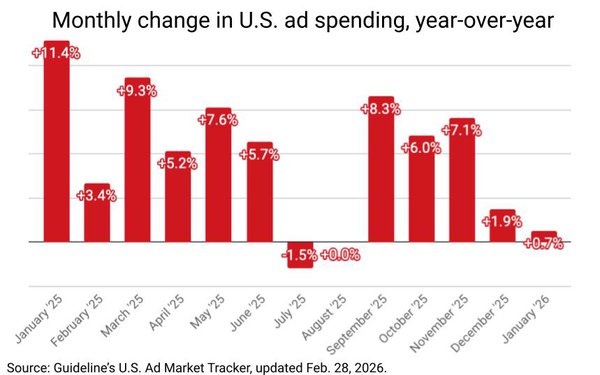
The U.S. ad economy entered 2026 on a tepid note, expanding less than a point over January 2025, according to Guideline's just-refreshed U.S. Ad Market Tracker.
January marks the second month of deceleration for the U.S. ad economy, which ended 2025 up 1.9% -- the worst monthly expansion in 2025 except for two year-over-year Olympic comps in July and August.
Netflix's WBD View: Nice to Have, But Not Necessary
A little of something to think about now that Paramount begins its ownership of Warner Brothers Discovery: Philip Jay LeNoble, Ph.D.
Commentary
Netflix's WBD View: Nice to Have, But Not Necessary
- by Wayne Friedman , Staff Writer, 8 hours ago

Early in the week when news broke that Paramount Skydance would be upping its bid for Warner Bros., Netflix stock responded in a way that some would consider surprising.
Shares for the leading premium streaming company rose around 10%.
The belief was that this was good news, as Netflix would not be encumbered with legacy issues that appear to be still plaguing old-school, big media companies.
Netflix did its best to financially hone its bid for Warner Bros Discovery to just studios and streaming -- and well as being financially disciplined in the bidding process when it came to debt needed.
What remains? For years, Netflix counted on legacy movie and TV studios when it came to their original content production needs -- including NBCUniversal, Warner Bros, Paramount or Sony Pictures. But more recently in building its in-house production infrastructure operations, they are less dependent on these partnerships.
Legacy movie and TV studios deal with Netflix when it comes to specific production services -- perhaps on a ‘frenemy” basis -- because that is still a moneymaking business.
Overall, Netflix is now 80% to 90% independent when it comes to producing and releasing original content. What remains is that it is 30%-40% dependent on production services from legacy studios.
The Paramount-Warner Bros Discovery merger may change the dynamic somewhat from a competitive position.
But for the newly merged Paramount-WBD company, major disruption is coming for the next few years.
The newly merged company will need to make massive layoffs across all levels of the company -- studios/streaming and its cable networks.
In addition, Paramount-WBD favor going forward will have taken on enormous debt -- over $60 billion, and possibly as high as $87 billion to $90 billion.
This is the same financial situation that WBD has been dealing with since it formed the company in a 2022 merger of WarnerMedia and Discovery Inc. -- now at around $30 billion to $37 billion.
In the interim, Netflix's strong marketplace position keeps growing, while trimming back on library product deals from studios. Some estimates are that Netflix could hit 90% exclusive content by the year of 2026, currently around 60%.
What about strength in streaming combinations? For sure, Paramount-WBD and their big streaming brands Paramount+ and HBO Max would be a force to reckon with.
But if you take a look at combined market share of viewing from Nielsen’s January 2026 Gauge for streaming, Netflix still is tops with a 8.8% share. A combined Paramount/WBD market share for all its streaming is 4.7% -- around half that of Netflix.
Paramount-WBD will need to deal with this as well as still highly dependent -- 70% of its cash flow -- from declining linear TV network businesses. Even then some regulatory issues might remain.
Overall from a marketplace perspective, this isn’t all that bad news from Netflix. From Netflix’s continuing perspective from the start is that WBD would have been “nice to have” but not “necessary to have.”
And that is why its stock has been up 20% over the week through mid-day Friday, on the news it might drop out of its WBD merger pursuit.
A different surprise ending to this dramatic, highly public -- and costly -- script.
Monday, February 23, 2026
EV Owners Report Being Happier Than Ever
Ever since electric vehicles hit the market, the future of this industry has been full of commentaries and, in this article the authors left out more of the consumer optional burgeoning preference of the Hybrid market. In my opinion, I can't wait 'till the countries around the world move away from fossil fuel transportation as climate change may be linked to ongoing fossil fuel environmental tragedies such as the severity of weather and disastrous fires! Philip Jay LeNoble, Ph.D.
Commentary
EV Owners Report Being Happier Than Ever
- by Tanya Gazdik , Staff Writer, 60 minutes ago

Despite volatility in electric vehicle sales, current owners report a new high in satisfaction.
That’s according to the JD Power 2026 U.S. Electric Vehicle Experience (EVX) Ownership Study.
Overall satisfaction among current battery electric vehicle (BEV) owners is at its highest level since the study’s inception in 2021. Notably, nearly all owners of new BEVs (96%) say they would consider purchasing or leasing another BEV for their next vehicle.
The Tesla Model 3 ranks the highest overall followed by the Tesla Model Y and BMW i4. The Ford Mustang Mach-E ranks highest among mass market brands followed by the Hyundai Ioniq 6 and Kia EV9.
EV market share declined sharply following the discontinuation of the federal tax credit program in September 2025.
“But that dip belies steadily growing customer satisfaction among owners of new EVs,” said Brent Gruber, executive director of the EV practice at JD Power in a release. ”What’s more, the vast majority of current EV owners say they will consider purchasing another EV for their next vehicle, regardless of whether they benefited from the now-expired federal tax credit.”
The availability of public charging is by far the most improved index factor in both premium and mass market BEV segments. Satisfaction among premium battery electric vehicle (BEV) owners is 652 (on a 1,000-point scale) and 511 among mass market owners, up 101 and 115 points, respectively, year over year.
The continued growth of publicly available chargers and the opening of the Tesla Supercharger network to non-Tesla models have notably improved satisfaction among mass market BEV owners during the past several years. Furthermore, satisfaction among Tesla owners is rebounding as they adapt to the expanded access of the charging network.
BEVs continue to have higher satisfaction than plug-in hybrid electric vehicles (PHEVs). Overall satisfaction continues to be higher among BEV owners in both the premium (786) and mass market (727) segments versus comparable PHEV owners, particularly when it comes to satisfaction with the cost of ownership.
Premium BEVs score 114 points higher than premium PHEVs in this area, while mass market BEVs outperform their PHEV counterparts by 117 points. Although PHEVs benefit from improved battery performance compared with traditional internal combustion engine (ICE) vehicles, they still carry the maintenance requirements of an internal combustion engine—cost and service needs that BEVs are able to avoid entirely.
The U.S. Electric Vehicle Experience (EVX) Ownership Study, now in its sixth year, focuses on the crucial first year of ownership.The 2026 study includes 10 factors (in alphabetical order): accuracy of stated battery range; availability of public charging stations; battery range; cost of ownership; driving enjoyment; ease of charging at home; interior and exterior styling; safety and technology features; service experience; and vehicle quality and reliability.
The study is conducted in collaboration with PlugShare, the leading EV driver app maker and research firm. This study sets the standard for benchmarking satisfaction with the critical attributes that affect the total or overall EV ownership experience for both BEV and PHEV vehicles.
Survey respondents for the 2026 study include 5,741 owners of 2025 and 2026 model-year BEVs and PHEVs. The study was fielded from August through December 2025.
The 3 A's of Marketing to The Gen Z Parent
Looking how best to market to the moms of Generation Z ? Here's some marketing tips for local-direct businesses you may want to share with how best to market their business to busy moms: Philip Jay LeNoble, Ph.D.
Commentary
The 3 A's of Marketing to The Gen Z Parent
- by Maria Bailey , Columnist, 2 hours ago
Gen Z parents are not shopping the way millennials did. They’re not starting with a brand website. They’re not relying on polished ads. And they’re definitely not trusting one sponsored Instagram post. Gen Z moms and dads are intentional and purposeful as they curate parenthood. They are discovering, validating, and deciding what to buy in entirely new ways.
If you want to win with Gen Z parents, you need to master the 3 A’s.
AI: Be Where Discovery Starts
Discovery no longer begins with a Google search bar. It begins inside AI tools. You may have seen this in your own online behavior. When was the last time you clicked on a blue link?
Parents are asking:
- What’s the best stroller for city living?
- Is this diaper brand worth the price?
- What baby wash is safest for sensitive skin?
And long language models are delivering answers from AI-driven environments like ChatGPT, Google AI Overviews, and search engines that summarize the web instead of sending traffic to it.
For brands trying to reach Gen Z moms and dads, it’s imperative to show up in AI search. If your product is not mentioned in trusted content across blogs, Reddit threads, YouTube transcripts, reviews, and retail listings, AI will not surface it.
AI does not invent authority. It pulls from it. Brands have to be smarter in the content they create and the strategy behind their influencer or content creator partnerships.
Brands must:
- Create content that answers real parenting questions
- Ensure product details are consistent across retail, blogs, and social whether you create it or someone posts about your products
- Show up in long-form, searchable formats not just short social posts, this means mom blogs count more than followers on a single Instagram post.
Discovery is now conversational. Your content needs to be, too.
Authenticity: Trust Is Built on Reddit, Not Ads
Gen Z parents are skeptical by default. They question brand claims. They know everything can be altered with technology.
When they want truth, they go to community. Platforms like Reddit have become modern word-of-mouth engines. A mom will search:
- “Is Brand X actually worth it?”
- “Has anyone tried this for eczema?”
She wants lived experience. Not marketing copy or perfectly curated sponsored monotone images on Instagram.
Reddit works because:
- Conversations feel unfiltered
- Real parents share long-form feedback
- Pros and cons are discussed openly
For brands, this changes the strategy. You cannot control Reddit. But you can influence what shows up there by encouraging real, authentic reviews, listening to comments online and create communities around your brand.
Authenticity isn’t a message. It’s proof that Gen Z parents demand proof before purchase.
Algorithms: Visibility Is Earned, Not Assumed
Even great content doesn’t matter if algorithms don’t serve it up to viewers. It’s important to know the ecosystem of each popular social platform even in its simplest form.
- TikTok prioritizes watch time and engagement
- Instagram rewards engagement- saves, shares, and consistency
- YouTube values retention and searchable titles
- Amazon ranks based on conversion rate, reviews, and sales history
What Brands Need to Do to Capture the Gen Z Parent’s Attention
The good news is that brands don’t need to throw out the baby with the bathwater and start over with Gen Z parents. Instead, brands need to be more strategic with the tactics many are currently doing.
- Search-optimized titles and descriptions in Influencer content
- Add FAQs to enrich product pages
- Ensure consistency across all channels including paid content
- Make sure Influencer content is indexed for AI
Brands that understand the 3 A’s stop thinking in campaigns and start thinking in systems. Gen Z parents grew up with systems, and they win for today’s moms and dads.