Tuesday, February 17, 2026

2026 TV Advertising Predictions: What to Expect

 Whilst the following was published back in November, it wasn't available for us to grab for you until today. Enjoy! Philip Jay LeNoble, Ph.D.


Adwave logo
InsightsInsights

November 28, 2025

2026 TV Advertising Predictions: What to Expect

Trends, technologies, and opportunities to watch in the coming year
The TV advertising landscape is changing faster than ever. What worked in 2024 looks different from 2025, and 2026 promises even more evolution.

For small businesses, these changes are largely good news. The trends reshaping TV advertising are making it more accessible, more measurable, and more effective for businesses of all sizes.

Here are seven predictions for TV advertising in 2026, and what they mean for your business.

Prediction 1: AI-Powered Creative Goes Mainstream

The biggest barrier to TV advertising has always been production cost. Professional commercials required expensive agencies, video production crews, and weeks of development.

That's changing fast.

In 2026, AI-generated commercials will become the norm, not the exception. Tools that can create professional-quality video ads from text prompts, website content, or simple inputs will mature significantly.

What this means for small businesses:

  • No production budget required to get started

  • Faster iteration on creative concepts

  • Personalized ads for different audiences become feasible

  • The playing field levels between small businesses and big brands
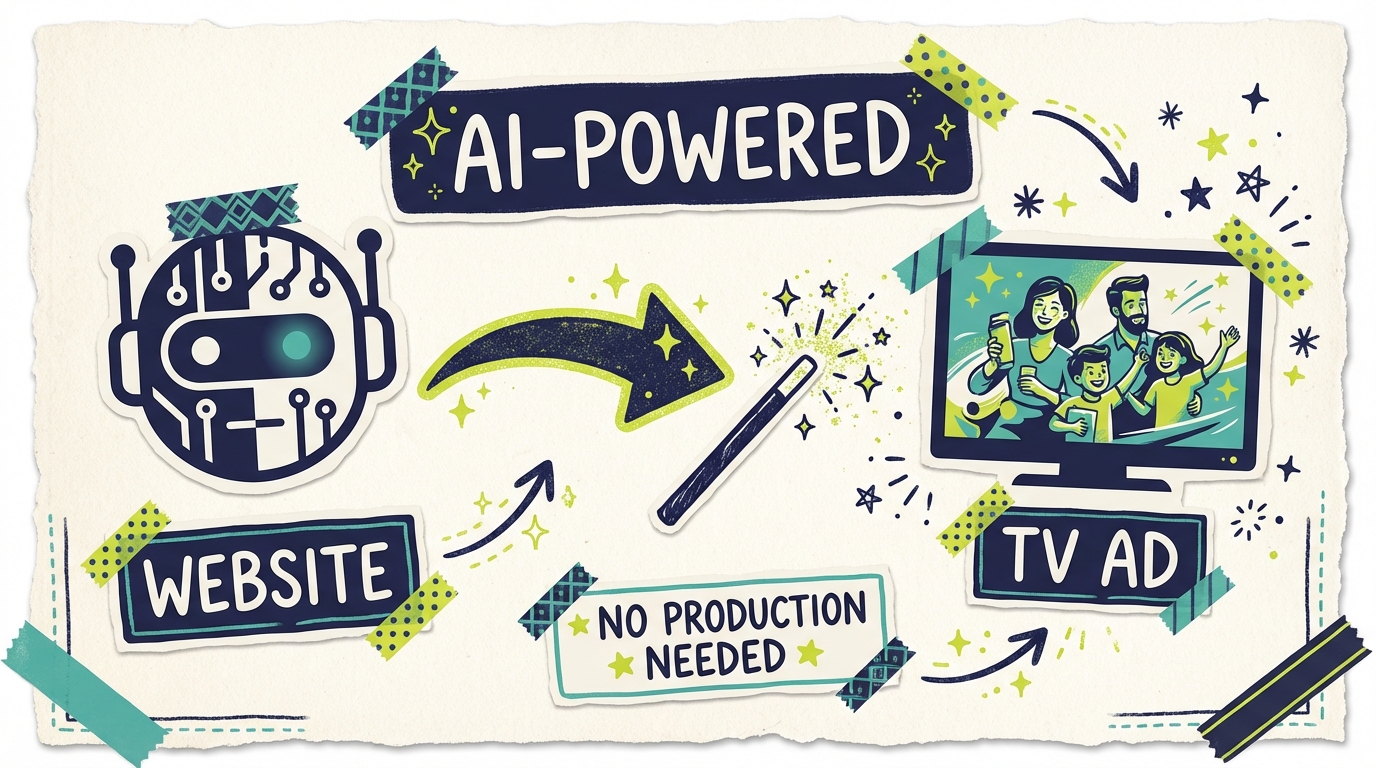
2026 TV Advertising Predictions - Ai Creative

Platforms like Adwave are already demonstrating this future. Provide a website URL, and AI generates a broadcast-ready commercial in minutes. By 2026, this will feel as normal as creating a social media post.

Prediction 2: FAST Channels Continue Explosive Growth

Free Ad-Supported Streaming TV (FAST) channels are booming. Services like Tubi, Pluto TV, and Freevee are attracting massive audiences who want free content with ads rather than paid subscriptions.

The numbers are dramatic:

  • FAST revenue is projected to exceed $12 billion by 2027

  • More than 80% of streaming households use at least one FAST service

  • Ad loads on FAST channels are typically lower than traditional TV

What this means for small businesses:

  • More premium inventory available at accessible prices

  • Audiences accustomed to ads during streaming content

  • New channels opening up for local targeting

  • CPMs remaining competitive as supply grows

In 2026, expect FAST to become a primary channel for CTV advertising, not just a secondary option.

Prediction 3: Attribution Gets Easier (and More Expected)

"Half my advertising is wasted. The trouble is, I don't know which half."

That classic quote is becoming less true every year. TV advertising attribution is improving rapidly, and 2026 will bring significant advances.

What's improving:

  • Cross-device tracking connecting TV views to digital actions

  • QR code scanning becoming more normalized

  • Brand lift studies becoming more accessible

  • Real-time dashboards showing campaign performance
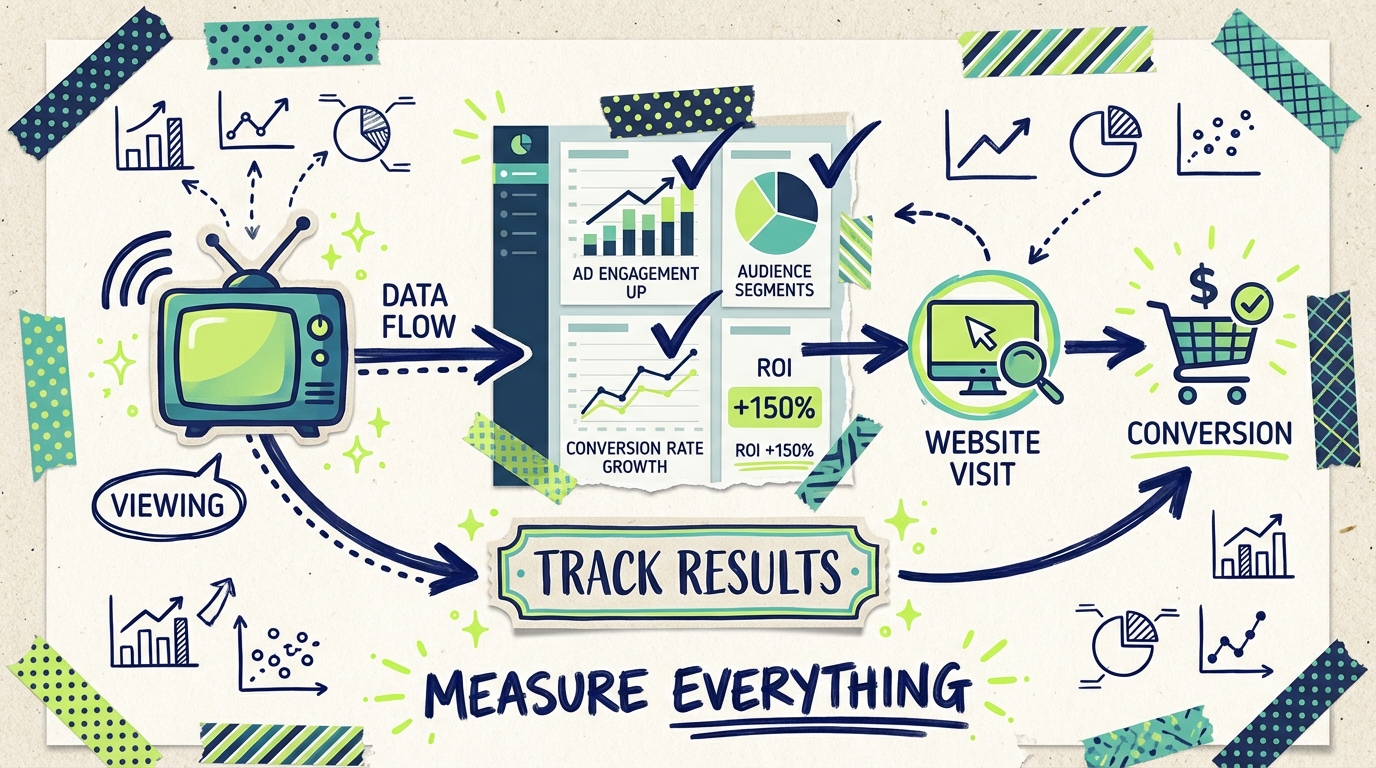
2026 TV Advertising Predictions - Attribution

What this means for small businesses:

  • Clearer picture of what's working

  • Better ability to optimize campaigns in real-time

  • Stronger case for TV in the marketing mix

  • Reduced "leap of faith" for first-time advertisers

Platforms like Adwave already provide dashboards showing impressions, reach, and audience geography. Expect these capabilities to expand significantly.

Prediction 4: Interactive TV Ads Become Standard

The passive TV ad experience is evolving. Interactive elements are becoming more common:

  • QR codes linking to websites, offers, or apps

  • Voice commands ("OK Google, learn more about...")

  • Click-to-action on smart TVs

  • Shoppable ads with direct purchase capabilities

What this means for small businesses:

  • Shorter path from impression to conversion

  • New creative possibilities

  • Better tracking through interactive engagement

  • More direct response capabilities from brand campaigns

In 2026, including a QR code in your TV ad won't be innovative. It will be expected.

Prediction 5: Local Advertising Gets More Programmatic

Local TV advertising has historically been messy: different systems for different markets, manual negotiations, limited targeting options.

That's changing as programmatic buying expands to local markets:

  • More inventory available through self-serve platforms

  • Better geographic targeting at the ZIP code level

  • Easier to run multi-market campaigns

  • Simplified pricing and buying processes

What this means for small businesses:

  • Easier access to local TV without agency relationships

  • More precise targeting around your locations

  • Ability to test in one market before expanding

  • Better budget control and flexibility

The technology making national programmatic CTV possible is trickling down to local markets, making small business TV advertising more accessible than ever.

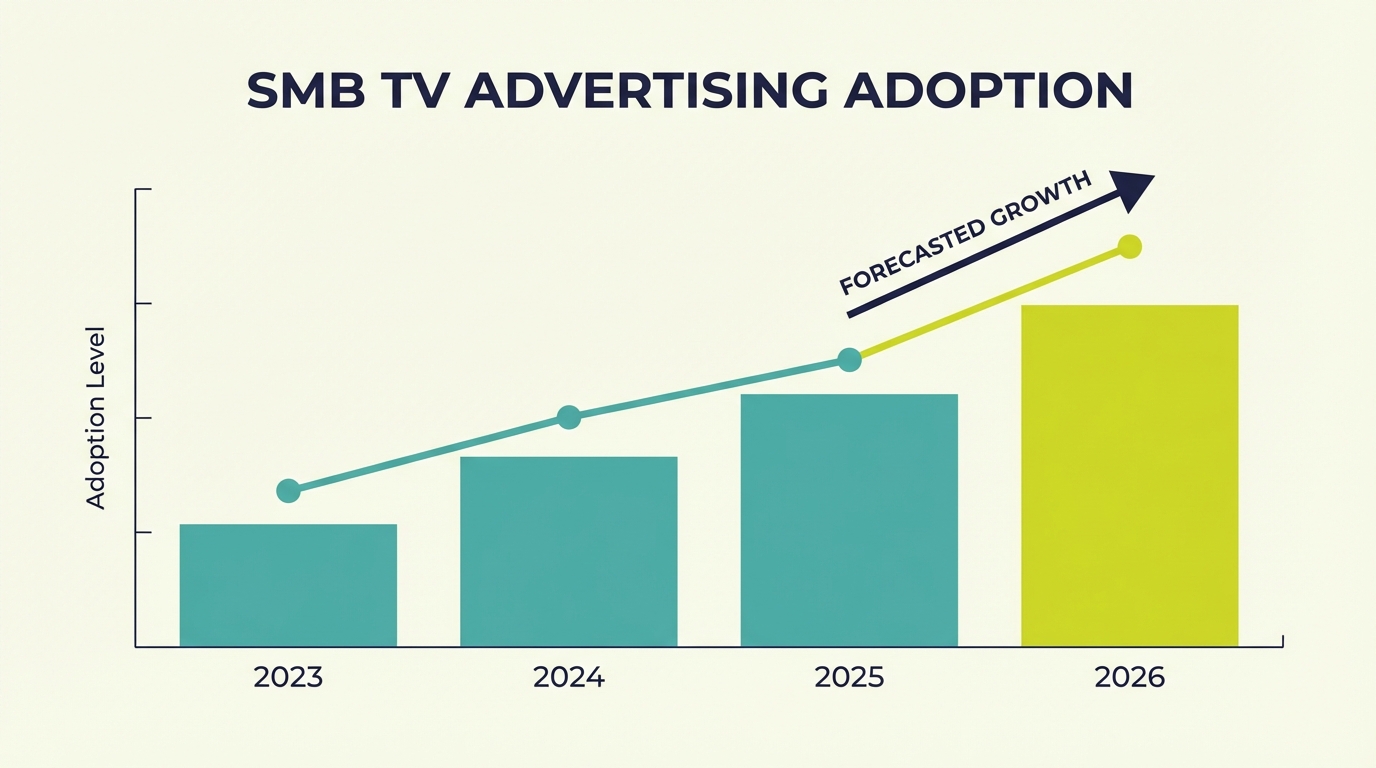
Prediction 6: SMB Adoption Accelerates

The biggest trend may be who's advertising, not how.

Small and medium businesses have historically avoided TV advertising, assuming it wasn't "for them." That assumption is breaking down:

  • Lower minimum budgets (starting at $50 on platforms like Adwave)

  • Simplified creative production through AI

  • Better targeting reaching relevant local audiences

  • Clearer ROI measurement

2026 TV Advertising Predictions - Smb Growth

What this means:

  • More businesses competing for attention (act now before it's crowded)

  • Platform improvements driven by SMB needs

  • More case studies and success stories from businesses like yours

  • TV advertising becoming a standard part of SMB marketing mix

If you've been waiting to try TV advertising, 2026 may be the year your competitors stop waiting.

Prediction 7: New Entrants Shake Up the Market

The TV advertising technology market is attracting significant investment and innovation. Expect:

  • New platforms making buying even simpler

  • Better creative tools for non-experts

  • More pricing competition benefiting advertisers

  • Innovative targeting and measurement capabilities

The dominance of traditional TV ad buying is eroding as new players prove there are better ways to serve small business advertisers.

How to Prepare Your Business for These Changes

These predictions aren't just interesting, they're actionable. Here's how to position your business:

Start Now, Not Later

The best way to understand TV advertising in 2026 is to have experience from 2025. Start with a small test campaign:

  • Learn how targeting works in your market

  • Understand your audience's response

  • Build baseline metrics to measure against

  • Get comfortable with the tools and processes

Plan for AI-First Creative

As AI creative improves, plan to take advantage:

  • Ensure your website and assets are high-quality (AI pulls from them)

  • Document your brand guidelines clearly

  • Build a library of images and messaging

  • Be ready to iterate quickly on creative concepts

Embrace Measurement

When attribution improves, you want to be ready:

  • Set up tracking on your website now

  • Train your team to ask "how did you hear about us?"

  • Define success metrics before you need them

  • Build the habit of reviewing performance data

Stay Informed

The landscape is evolving quickly. Stay current:

  • Follow industry publications

  • Connect with your advertising platforms

  • Watch what competitors are doing

  • Test new features as they launch

Make 2026 Your TV Advertising Year

The trends are clear: TV advertising is becoming more accessible, more measurable, and more effective for small businesses. The question isn't whether these changes are coming, it's whether you'll be ready for them.

Adwave is built for this future. AI-powered creative generation, low minimum budgets, simple self-serve buying, and clear performance dashboards. Everything that's coming mainstream in 2026 is available today.

Don't wait for the future to arrive. Create your first TV ad now and enter 2026 with experience, insights, and momentum.

Related Resources:

Key Sales and Sales Management Trends (As of 2/17/2026):


As of February 17, 2026, the broadcast television sales landscape is defined by an urgent, AI-driven shift from "experimentation" to "execution" in a "Total TV" (linear + streaming) model, aimed at maximizing reach and accountability in a landscape where streaming viewership has surpassed combined cable and broadcast, say reports.

Key Sales and Sales Management Trends (As of 2/17/2026):
  • "Total TV" Implementation: Broadcasters are breaking down silos between linear and digital teams to sell audiences, not just channels, treating streaming and linear as a unified inventory source.
  • AI-Driven Performance: Sales management is adopting AI to automate workflows, reduce production costs for SMBs, and enable real-time campaign optimization, moving away from "set-it-and-forget-it" models.
  • Speed as a Competitive Moat: Sales teams are accelerating internal workflows to meet advertiser demands for rapid, data-driven proofs. Delayed approvals are causing missed opportunities, with competitors winning on speed and personalization.
  • First-Party Data Necessity: Building and using direct viewer data is no longer optional but foundational to competitive, outcomes-based measurement.
  • Localism via Technology: Local ad sales are shifting to programmatic, allowing for ZIP-code level targeting, with high-stakes, local sports content on broadcast driving revenue, while political advertising continues to utilize digital/streaming tools.
  • Content and Commerce Convergence: Broadcasters are developing shoppable TV experiences (QR codes, interactive ads) to prove ROI, making TV a direct-response driver.
  • Industry Consolidation: Major networks (like Hearst) are actively exploring deals to build scale to compete with tech giants.
Technological and Operational Shifts:
  • IP-Native Infrastructure: The transition to IP-based workflows has moved from pilot projects to required, "essential" technology in 2026, allowing for more flexible, software-defined operations.
  • "Agentic" AI in Ad Ops: Sales ops teams are evolving from "doing" to "directing" by using AI agents to handle repetitive tasks, enabling human sales management to focus on higher-order strategy.
Key 2026 Media Events Driving Revenue:
  • Super Bowl LX (Feb 8, 2026): Reached $8–10 million for 30-second spots, with NBCUniversal selling out inventory across NBC, Peacock, and Telemundo.
  • Milan Cortina 2026 Winter Olympics & NBA All-Star Game: Managed via hybrid IP/digital infrastructures by partners like Comcast Business.

NFL, College Football Scores: Big January for Linear, Streaming


NFL, College Football Scores: Big January for Linear, Streaming

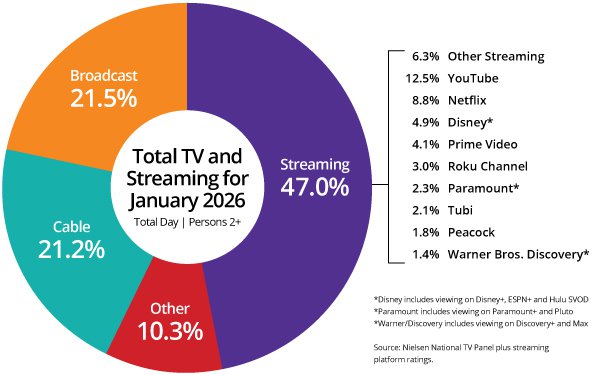
Backed by football -- both the NFL and college -- TV viewing of persons two years and older climbed to 12-month high in January 2026, according to Nielsen’s Total TV/Streaming Snapshot.

But live, legacy TV networks and streaming platforms continued their share trends of the market, respectively, of overall decline and ascending year-over-year.

Broadcast dipped one percentage point to 21.5% (from 22.5%), while cable was down 3.2 percentage points to 21.2% (from 24.4%). All the while streaming rose 4.4 percentage points to 47% share.

On a month-to-month basis (January 2026 to December 2025), both broadcast and cable rose with high-performing sports.

For broadcasts, the NFL accounted for the top 15 telecasts.

On the cable side, ESPN witnessed an increase of 82% in its sports programming, with news networks climbing 17% for Fox News Channel and CNN up by 29%.


Looking at ESPN and Fox News together, the two channels pulled in 21% of all cable TV viewing.

Streaming witnessed a 3% hike in total viewing from December, and 10% higher share versus January 2025.

A number of streamers showed year-over-year gains. YouTube remained in the top spot with 12.5% (vs. 10.8% in January 2025), while Netflix was next at 8.8% (versus 8.6%) and Disney, for all its platforms, came in at 4.9% (4.7%), while Prime Video had 4.1% (3.7%); Roku, 3.0% (2.1%), and Tubi, 2.1% (1.7%).

Apple Releases Dynamic Ad Insertions for Live Streaming Video Podcasts


Apple Releases Dynamic Ad Insertions for Live Streaming Video Podcasts

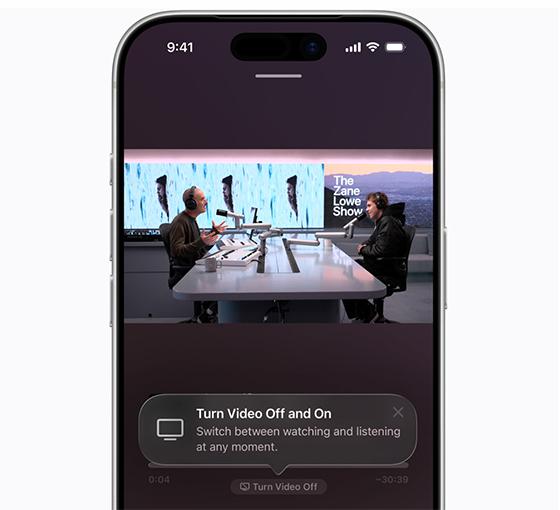
Apple made it possible to dynamically insert ads in live streaming video podcasts, allowing creators to control content and monetize the video stream using its HTTP Live Streaming (HLS) technology.

The change brings a YouTube-style monetization service to Apple's podcasting ecosystem. For advertisers, the move to HLS shifts video podcasts from static files to dynamic media assets.

Eddy Cue, Apple senior vice president of services, explains in a post that while it gives advertisers more choices, creators more options, and listeners and viewers a higher-quality experience.

Those using the podcast service can switch between watching and listening to shows. It makes discovery and viewability of video podcasts as easy as listening to audio.

Cue marked the day as a "milestone," noting that 20 years ago Apple created an audience for podcasting by integrating iTunes, which the company introduced in January 2001.


"By bringing a category-leading video experience to Apple Podcasts, we’re putting creators in full control of their content and how they build their businesses," he wrote in a blog post.

The theory is that increasing available ad supply in video podcasts will enable a more efficient programmatic media buy and lower costs.

The Trade Desk estimated in June 2025 that 46% of U.S. podcast listeners never miss an episode of their favorites.

While the introduction of HLS for video podcasts gives advertisers a broader video ad market to search for lower CPM rates, the company's announcement this week focused on the ability to dynamically add ads to serve video campaigns — including host-read video spots — that can be updated across a show's entire back catalog. 

The dynamic ad-insertion technology allows advertisers to replace or insert new video ads into each episode of a podcast simultaneously, rather than being placed in one file at the time of recording.

Video episodes will integrate with existing features like personalized recommendations and editorial curation on the “New” tab and in Category pages.

HLS video is available to test in beta versions, with functions coming to iPhone, iPad, and Apple Vision Pro users, as well as via Apple Podcasts on the web this spring.

Commentary: Is Roku's Growth Fostering A 'Switzerland' Of All Streaming Video?


Commentary

Is Roku's Growth Fostering A 'Switzerland' Of All Streaming Video?

It may still be amazing to some to witness Roku's growing strength in the streaming world.

Recent outperforming earnings results showed a 16% revenue increase to $1.39 billion and a return to profitability, and analysts are all thumbs up on the company.

In terms of controlling streaming hardware and operating system (OS), Roku has 50% market share. Perhaps even more significant is that this is substantially more than Amazon Fire TV, Google TV and Apple TV.

Those are some giant media competitors. But perhaps those big names have their focus elsewhere -- on other rapidly growing businesses.


Strategically, Roku has been able to squeeze into this niche and succeed.

Some say Roku’s performance is all about platform neutrality. Roku does not give specific weight to just one premium streaming service.

For example, Amazon focuses heavily on Prime Video, Google on YouTube and Apple on Apple TV. It does not necessarily play favorites even as it heavily promotes The Roku Channel.

For many, as a free ad-supported streaming service, this does not really compete directly with the bigger premium streamers.

All that means more easily working with TV set manufacturers that want to place the Roku OS without fear they are pushing one big-name streamer over another.

What about the downside? Going forward, that could be a Walmart-Vizio combination.

Walmart has been a major retailer for Roku -- a marketing partner of sorts to help foster that "neutrality," which consumers may have been looking for.

For many, Roku is now an accepted as a replacement -- or partial replacement -- for old-school "cable TV" distributors.

That's all the more reason why the likes of Comcast, Charter and other traditional cable TV-centric companies are trying to play catch-up by also distributing streaming services through video packages at the same time as their traditional TV networks.

Can Roku keep the "neutrality" thing going -- as well as huge media companies like Amazon, Google, and Apple?

Perhaps Roku needs to talk up its status more as the industry’s "Switzerland."

Super Bowl Sentiment: AI-Tainted Advertising


Commentary

Super Bowl Sentiment: AI-Tainted Advertising?

Super Bowl advertising is always a high-value affair for many brands -- but now increasingly critical. 

Does artificial intelligence (AI) have anything to do with it -- either from what was promoted or from customer sentiment around perceived AI -- creative advertising?

One survey, for example, says 50% of social media comments about Super Bowl AI-driven advertising were sharply negative, according to Meltwater Advertising. Audiences believed "automation" hurts the overall production standards for typical high-quality TV Super Bowl advertising.

That’s right. Consumers are looking more critically at Super Bowl commercials than at other times.


One report says 23% of Super Bowl commercials -- 15 out of the 66 ads -- featured AI.

Looking specifically, the Dunkin’ “Good Will Dunkin” ad took the brunt of this -- with 37% of AI-related mentions and 9% of engagement share.

Audiences were critical of the disjointed nature of Dunkin’ ad featuring AI-generated sitcom-style/celebrity integrated characters.

Meltwater defines "sentiment" as the tone of the conversation by volume of mentions versus "engagement sentiment" as the tone of the conversation by volume of reactions to those mentions.

What effect will any of this have on real financial and business outcomes for brands? So far we can see some early-round results.

The best result so far was from AI.com, a future personal AI assistant. The ad was so powerful that viewers immediately signed on to reserve a "handle" on the site. 

The spot was so popular that it crashed the company’s servers. TV advertising/data analytics company, EDO says the ad got 9.1 times as much engagement as the median Super Bowl LX  ad.

This ad nipped out the second-biggest ad in terms of engagement -- Universal Pictures’s upcoming theatrical movie "Minions & Monsters," which posted 9.09 times the engagement of other Super Bowl ads.

Other high-performing spots included ads from Lay’s, Netflix, Universal Pictures' "Disclosure Day," Cadillac, Budweiser, Invest America, and Wegovy. 

The bottom line is that brands believe consumer interest lies around AI-platforms consumer services, cryptocurrencies, sports wagering and weight-loss medications.

Will any of this be driving the economy in 2026?