Tuesday, February 17, 2026

NBA Team Valuations Spike, Driven by Rising TV Advertising


Commentary

NBA Team Valuations Spike, Driven By Rising TV Advertising


Valuations of NBA teams have been skyrocketing -- and TV revenue is a major reason why.

We can thank rising sports rights fees -- now at $75.9 billion over 11 years, up more than two-and-a-half times the previous contracts -- by way of major TV advertising and sponsorship revenue.

A collective $637 million in regular-season TV advertising for the 2024-25 NBA season was pulled in, according to EDO Ad EnGage, followed by $845 million for all post-season media buys.

The big three advertising categories include quick-service restaurants, automotive and insurance (auto and home).

The broader picture shows that for this season alone -- the 2025-26 season -- total league-wide revenue will grow 12% to $14.3 billion.

Higher rates and fees had a lot to do with it, stemming from rising ad revenue. This has given about $142 million to each team from those current TV partners: Walt Disney, NBCUniversal, and Amazon.


The average revenue for the previous season per team was at $416 million -- nearly 7% more than 2023-24.

This has pushed team valuations -- including new ownership deals for some teams -- to a level where three teams have valuations of more than $10 billion, according to CNBC.

This includes the Golden State Warriors ($10.8 billion), the New York Knicks ($10.1 billion), and the Los Angeles Lakers ($10.0 billion).

The biggest valuation change -- year-over-year -- was with the Lakers, due to a controlling interest purchase by Mark Walter, at nearly 20 times that of the team’s 2024-25 revenue of $565 million.

Early viewership for the 2025-2026 shows saw 18% improvement due to more games on over-the-air TV, ABC and NBC.

Overall local TV revenue from cable TV channels and/or streaming TV platforms for the biggest markets -- such as New York and Los Angeles -- are figuring in big-time. The Lakers and the Knicks grab the most -- around $185 million and $140 million respectively, according to Sports Business Journal.

Still, everyone is benefiting -- all 30 NBA teams. The average value of an NBA team is up 18% versus a year ago to $5.52 billion.

With regard to downside, that may be subscription fatigue on the streaming side -- Disney’s ESPN streamer, NBCU’s Peacock and Amazon Prime Video.

Another downside is that high sports-rights fees from regional sports cable TV networks have evaporated.

Much of what remains has shifted to over-the-air TV, with one new exception -- many teams now sell their local TV advertising.

In the future, it seems that teams may need assists from financial teammates to come to keep up the big scores.

Friday, February 13, 2026

National/Local TV Ad Silos Will Collapse Before Linear/Streaming Silos Do

 Local-direct media marketing will always top revenue opportunities going forward when compared to transactional media. Philip Jay LeNoble, Ph.D

Commentary

National/Local TV Ad Silos Will Collapse Before Linear/Streaming Silos Do

Many of us have been waiting many, many years for advertisers and agencies to view streaming and linear TV channels as a holistic premium video world, where planning, buying, selling and measurement can be truly done together in a fully integrated way.

Historical silos in organization products, planning, buying, workflows and metrics have prevented this from happening. Yes, I know that day in and day out folks in our industry take stages at events or give quotes to trade media that claim to be true silo-busters operating in a real cross-channel way. But we know that, all too often, our industry loves to embrace what people say without a lot of attention to what they actually do.

Managing cross-channel linear and streaming TV media is a great example of that.

We’re an industry that is quite accustomed to silos. It wasn't that long ago that most major buying and selling organizations were structured by daypart, distribution and strategy. Broadcast daytime buyers couldn't touch prime, nor could they touch cable. Direct-response broadcast sellers couldn’t sell broadcast sports, and broadcast sports sellers couldn’t sell entertainment. And don’t even think about what would happen if a USA Network seller tried to sell CNBC.


BISRetail-sp26-WorkPlay-640x480dbl.gif


Well, much of that world has changed. Shifts to streaming, increasing focus on audience-based approaches, and massive reductions in force across teams have finally broken the walls between many roles that had remained mysteriously disparate and siloed.

And national and local linear TV are next, even before linear and streaming come together. As national TV takes on more of an audience-based approach, with increasing focus on strategic target delivery and resulting outcomes, it’s only natural we will see local impressions optimized into national programs in a data-driven way to best meet advertisers’ goals.

Most advertisers had some geographic biases in where their target customers live, and where they can be found at scale cost-efficiently. We have had un-wired networks for a long time, but it was really hard to pull together truly integrated national and local activation and planning without tons of staffing to make it work. But predictive analytics, spot-level activation automation and integrated local and national measurement are changing that game.

Who knows, if Skydance/Paramount isn’t able to buy Warner Bros Discovery, why wouldn’t it buy a large local broadcast company, now that the government doesn’t seem to worry too much about the 40% coverage rule? If that’s the case, then the only way to maximize yield for the various national products and local programs and audiences need to be sold in a truly integrated way, not just sold in separate siloed buckets.

That future is coming fast, I think. What do you think?

Big Game, Bigger Laughs: The Ads That Understood Humor This Year


Big Game, Bigger Laughs: The Ads That Understood Humor This Year

The Super Bowl remains advertising’s biggest comedy stage: where nostalgia, celebrities, satire and sheer absurdity battle it out for cultural relevance and brand love. To cut through the noise, Peppercomm’s Laughing Matters Council weighed in on the ads that delivered genuine laughs, smart structure and memorable storytelling.

From nostalgic nods to perfectly timed punchlines, our experts share what stood out, and what fell flat, after the final whistle:

 Luvell Anderson, Professor, Head at University of Illinois, Urbana-Champaign

“Good Will Dunkin’’ tapped into ‘90s nostalgia and Dunkin’s domination of the Northeast. This chuckle-worthy send-up had me hankering for a Boston creme.

Similarly, Raisin Bran’s cheeky wordplay with Will Shatner provided lots of scatalogical fun: “Will Shat? Every darn day!”

Malcolm Frierson, Assistant Professor at Riverside City College

I’m among men with hair on their faces and other places, and the “Manscaped” commercial moved me to create a goodbye ritual for my heartbroken hairs after future shaves and trims. Novartis indeed relaxed my tight end with its hilarious and important message regarding finger-free prostate screenings. Finally, I gotta say I went to bed laughing at the Pringles “perfect man” driving a convertible with his hair (chips) flying away in the wind.


Clayton Fletcher, Peppercomm’s Chief Comedy Officer and Co-Author of The ROI of LOL

Emma Stone struck a chord with performing artists and business owners alike in her commercial for SquareSpace. In the ad, she is mortified to discover that her domain name, emmastone.com, is already taken. Reprising her role in “Bugonia,” Emma throws an unhinged fit over the horrifying news. This one really hit home for me because one day almost 20 years ago, I tried to create a Twitter account using my full name and it was already taken. On that day, I responded similarly as Ms. Stone and @claytoncomic was born.

David Horning, Chief Experience Officer at Water Cooler Comedy and Secret Society Comedy’s Executive Producer

AI was a big topic of conversation coming into 2026’s ads, and no one did it better than Anthropic’s Claude ads -- by calling out industry leader OpenAI’s adoption of ads IN ADS. Chef’s kiss on the meta jokes (no Zuckerberg) in these. In a year filled with grandiose, cameo-packed attempts at connection (cough Bud Light cough), these stood out for their simplicity and well-structured, tongue-in-cheek writing. Asking an unblinking manifestation of ChatGPT “How do I connect better with my mom?” to be met with two earnest answers followed by an ad to “find connection with other older women on Golden Encounters,” was perfect joke structure with an unexpected, yet logical punchline. Well played, Claude. (This ad recap was NOT written using AI).

 Liz Joynt Sandberg, Head of Comedy Arts, Assistant Professor at DePaul University

It’s rare to see satire at the Super Bowl (at least on purpose!), but Wegovy shot for it (no pun intended) this year. In a smart and thoughtful way, Wegovy shared whimsical examples of other things we might want to take a pill to help. These included things like parallel parking, and rescuing kittens with super-long paws. Their final example? How great it would be if we could take a pill to get rid of the judgment users face in adding GLP 1s to their weight loss routine. By showing us things that it would be ridiculous to judge someone for wanting to take a pill to help with (and making us laugh in the process), Wegovy responded to a common criticism by getting us to see that it’s a little ridiculous to judge its users as well. 

Whether through nostalgia, satire or expertly crafted joke structure, this year’s most effective Super Bowl ads reminded us that humor isn’t just entertainment -- it’s strategy. When brands respect the audience’s intelligence and understand comedic timing, the payoff goes far beyond a laugh. And as these insights show, the best jokes don’t just land in the moment -- they stick for a while.

U.S. Ad Growth Composite Rises On Bullish IAB Forecast


U.S. Ad Growth Composite Rises on Bullish IAB Forecast


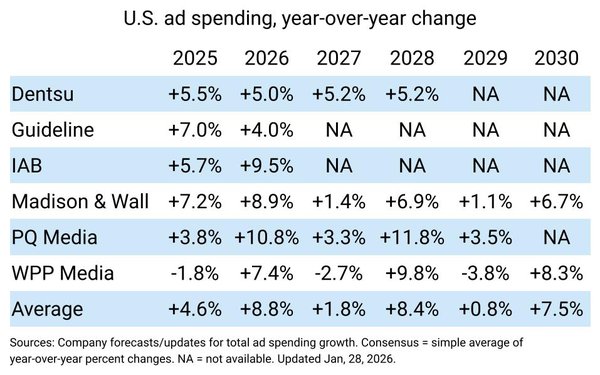
Following an updated ad forecast released this morning by the Interactive Advertising Bureau (IAB) -- and based on a survey of advertisers and agency media buyers late last year -- I also received updated long-term estimates for U.S. ad spending beyond 2026 from Madison and Wall. 

As a result, I'm updating MediaPost's recently rebooted industry forecast consensus tracker.

As you may recall, our old composite was an average of the major agency holding company ad forecast reports and updates, but following the demise of Interpublic's and Publicis Media's Zenith public reporting, we are now including other reputable ad industry forecast sources, including Madison and Wall, Guideline, PQ Media, etc.


The consensus for this year's U.S. ad growth rises 1.6 points to +8.8% from the previous composite.

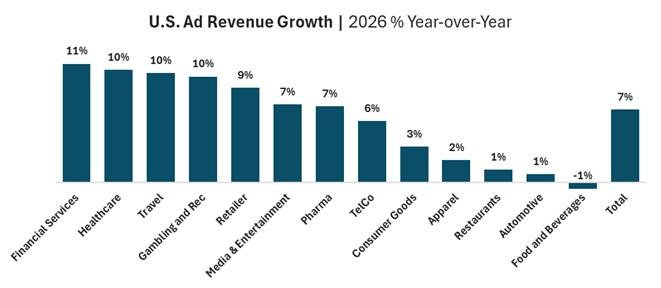
In related news, Madison and Wallthis morning began publishing ad category-level projections for both U.S. and Canadian ad spending (see U.S. category chart below).

Thursday, February 12, 2026

Super Bowl LX: Viewing Flat, Wagering Way Up


Commentary

Super Bowl LX: Viewing Flat, Wagering Way Up

Traditional Super Bowl TV-streaming viewing remained  basically the same as a year ago (down 2%) to 124.9 million Nielsen-measured viewers. 

But what about wagering and gambling? That was up 27% versus a year ago to $1.76 billion (from $1.39 billion), according to the American Gaming Association -- in surveying all “legal” channels.

Looking specifically at those hot, near "prediction markets," separate estimates show that another $1.5 billion was “traded” in the game. Kalshi placed nearly $1 billion and Polymarket (still not legal) got $1.2 billion in wagering, according to investment bank Piper Sandler analysts.

What took a hit? That would be Nevada-based casino gaming, according to a report in Bloomberg, down nearly 12% year-over-year -- the lowest in around 10 years.

Overall there was a lot of money growth in the game, with advertisers placing their bets as well (so to speak). 


Comcast's NBCUniversal platforms -- NBC Television Network, Peacock, Telemundo and NBC Digital -- pulled in an estimated $800 million in advertising in the game, pre-game, and post game programming. That is possibly a new record.

While early reports were that NFL-aligned online sports betting operations DraftKings and FanDuel also did well, analysts say results could have been better.

Those sportsbooks had the Seattle Seahawks favored to win the game against the New England Patriots -- and they did just that, with a score of 29-13.

Predictably, they also beat the point spread (-4.5) and the game total “over/under” bet (42 points), which was under the 45.5-point-spread set. 

Marketing and more wagering content could be key to the rise, as sports TV networks now offer regular programming content on wagering. 

ESPN has one called “Bad Beats” during Scott Van Pelt's prime-time “SportsCenter” show.

It shows dramatic/unbelievable conclusions of games and their effects on the wagering marketplace.

Does this mean even more dramatic gambling on games -- and higher wagering off all types -- to come?

Why Cheap Media Is Costing Us More Than We Think


Commentary

Why Cheap Media Is Costing Us More Than We Think

Digital advertising has become the fast food of marketing: cheap, convenient, scalable and engineered for short-term satisfaction, but ultimately low in nutritional value. And in a world of  autoplaying videos, reaction triggers and animated banners, most digital media doesn’t hold enough value to stand out — it’s as disposable as junk food.

Moreover, marketers are becoming increasingly disconnected from the process. We use algorithms that optimize for clicks, not connection, and when impressions and CPMs barely register as a rounding error on a budget spreadsheet, it’s easy to forget that behind each one is a real person.

The truth is, you can’t optimize your way to meaning.

Attention is not a commodity

Marketers say we want meaningful engagement, but in our relentless pursuit of efficiency, we’ve let programmatic algorithms prioritize cheap impressions over real connections to the point that we’ve forgotten there’s a person on the other side.

And principal-based media is making things worse. With the promise of “low-cost media,” “cheaper agency fees,” and effortless automation, it’s easy to become hooked on convenience. This approach sacrifices significance for scale at the risk of turning our budgets into self-perpetuating systems that favor empty reach over emotional resonance.

Attention is precious. With so many ads clogging up their screens, over half of consumers intentionally avoid them through adblocking software or ad-free subscriptions. It takes real effort to earn a person’s attention and more to earn their business, but the cost is worth it.

Faulty systems cost more than money

When media is bought purely on price, it often lands in places no brand would knowingly choose: content farms, piracy sites and misinformation peddlers, or worse — reports from the New York Times and CBS News about ads appearing beside racist videos are just the tip of the iceberg.

It’s usually not bad faith, just bad math. Advertising is exploitable when it’s cheap and paid less attention. Campaigns measured by volume allow bots to slip through the cracks. Fraudulent traffic can generate clicks and impressions that never involve a real person. Ironic that automating efficiency inadvertently pours resources into nonexistent audiences.

Malicious or not, the result remains: Dollars meant to build brands subsidize the disappearance of quality media content. Newsrooms are shuttered, investigative reporting is underfunded and public trust erodes. The very infrastructure of an informed society is undermined by numbers in a spreadsheet.

You can’t optimize on a broken system.

There’s no easy fix for a systemic problem, and optimization isn’t the answer. It’s time to demand better, to rethink media from the ground up. End the conflicts in the system, from principal-based trading to incentivizing bad actors from an over-dependence on “cheap” inventory. You can run a smart, efficient marketing machine at scale without sacrifice.

Marketing that connects and resonates is what really matters. It’s not just a math problem; it’s a human one.

If we end the desperate chase for cheap, we can escape from the world of disposable marketing, and get back to the fundamentals of successful media where the rarest thing you can offer is something worth remembering.

Is AI About to Have Its Netflix Moment?


Commentary

Is AI About to Have Its Netflix Moment?


For years, AI companies positioned themselves as tools that help professionals work faster, not competitors waiting in the wings. It's a comforting story. But industries often cling to comforting stories right up until the business model beneath them shifts.

If you want a glimpse of where this might be heading, you don't need a crystal ball. You just need to look at what happened in Hollywood.

From Distributor to Creator: The Netflix Roadmap

Netflix began by distributing other people's content. Then it improved discovery with data. Then it hired writers and directors. Then it became a full-scale studio. Today, it's no longer disrupting the entertainment industry. It is the entertainment industry.

AI is now where Netflix was in its early years, still in the distributor phase, ingesting massive amounts of content: books, articles, reports, expert work to train large models.

The next question is unavoidable: What happens when the platform that aggregates the world's expertise decides it can also produce its own?


Signals AI May Follow the Same Path

Look at what AI companies are doing, not what they're saying, and a familiar pattern appears.

They're hiring specialized talent -- not only engineers but economists, psychologists, legal scholars, clinicians, and policy strategists.

Netflix changed course when it hired creators. AI may change course when it hires experts.

AI companies are building vertical pro models for finance, law, software development, and marketing. The step from supporting professionals to substituting for them isn't a big one.

Enterprise clients want more than raw answers. They want interpretation, judgment, and strategic guidance: the same things consulting firms, agencies, and analysts are hired to deliver. If platforms can deliver even part of this at scale, the competitive landscape will look very different.

What This Means for Professional Services

Professional services differentiate themselves through expertise: original thinking, proven frameworks, the ability to read situations with nuance. Yet these are the very ingredients AI systems learn from.

The assets that make firms valuable may soon become the training data that powers their most significant competition.

This doesn't mean the sky is falling. It does mean the center of gravity in professional services is shifting. Winning firms will deliver fresh thinking rather than recycled best practices, develop a clear and original point of view, combine human judgment with AI scale, and protect the parts of their expertise that can't be flattened into data.

The Takeaway

Netflix never announced it was entering the studio business. It simply hired the talent it needed and let the model evolve.

AI companies are now hiring their talent.

The question is no longer whether AI will become more than a tool.

The question is whether professional service firms are preparing for the moment when the platform that learned from them begins to compete with them.

This post was previously published in an earlier edition of Marketing Insider