Wednesday, July 9, 2025

Miele Makes Its U.S. Ad Debut With 'Rumored for A Reason'

 A new and highly energetic retail company is emerging from Germany and coming to our country to challenge local- and national retailers. I gathered the information so you can help your local-direct clients prepare for Miele's entry: Philip Jay LeNoble, Ph.D.

appliances

Miele Makes Its U.S. Ad Debut With 'Rumored for A Reason'

In Germany, the 125-year-old Miele is a brand touted for engineering achievements, powering high-end dishwashers, ranges, and refrigerators. In the U.S., though, the name is barely known, except among vacuum-cleaner aficionados. To better make the acquaintance of the American public, the company is leaning into that “the best appliance brand you’ve never heard of” with the first-ever U.S. ad campaign: “Rumored for a reason."

The campaign aims to spark curiosity with the idea that while a good kitchen is nice, a great one gets people talking. “We talk about Miele as the best appliance you haven't heard of yet, as we look to expand our consumer base,” says Cathy Grayson Roper, Miele’s vice president of marketing for the U.S. and Mexico.

advertisement

advertisement

The company is tripling spending on brand-building year over year, Roper adds. “This is the first time we have a bespoke North America campaign, which is new in itself,” she says, different from the previous “One voice, one campaign” strategy the company has used in the past.

“We’re recognizing that we're in a different growth stage here in the U.S., and we needed to meet the consumer where they are.”

Roper tells Marketing Daily the company hopes to achieve more than a billion impressions, reaching about 85% of the core audience. 

The campaign includes a series of cinematic-style films, shot by Janicza Bravo, an American director best known for her work on the TV show “Atlanta" and the movie “Zola.”  With lines like "Miele's outlasts most marriages" and "increases property value"-- both of which are true, according to the brand -- the campaign looks to add wit, drama and a touch of cool-kid sheen.

Ads are running on TV, digital, social, and print platforms, targeting key markets such as Los Angeles, New York, Chicago, and Miami. The brand is also working with content partners and influencers and reaching out to architects and designers.

Roper describes the core audience as discerning and self-aware. “Miele is a brand people often graduate to [when] they've reached a point in their life and are done with compromising on what's best.”

They are also people who inherently love their kitchens, which is the most emotional place in the home, she says. “Whether or not you're a serious cook, it’s the place where people gather. It’s the place that signals your design style to other people.”

That emotional connection is also influencing how Miele approaches growth in the U.S., including new investments in manufacturing and leadership. For Roper, who joined the company last September from a similar role at MillerKnoll, the marketing effort has also been a lesson in cultural differences. Miele is based in Gütersloh, Germany, and she has already made multiple trips there. The company recently opened an assembly plant in Opelika, Alabama, where the company pairs German and Alabamian workers to assemble the products by hand.

Adds Roper: “I’ve worked for many global companies, but never seen anything quite like this.”

Looking For News Show Answers: Influencer Video on The Big Screen?


Commentary

Looking For News Show Answers: Influencer Video on The Big Screen?

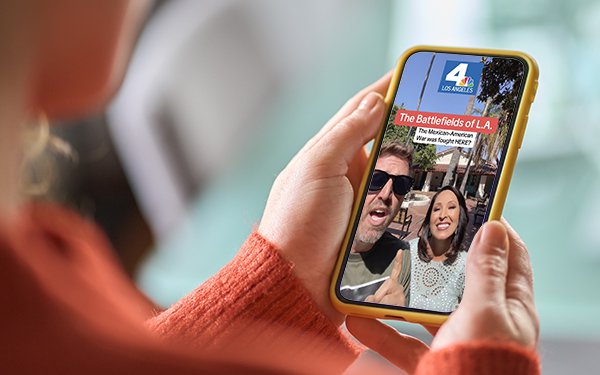
Can TV stations benefit from growing use of influencer-based short-form videos on their airwaves? Perhaps.

But who is willing to step up -- at least from the legacy TV side or things? And will the intended audience of young viewers find this content?

Quick video-editing techniques and causally delivered content can appeal to younger social media-focused users -- especially video on rising platforms like YouTube Shorts, TikTok and Facebook Reels.

Short-form video may be just a minute in length -- or even shorter, perhaps 30 seconds -- when it comes to almost any genre.

But there may be a long and rocky road to reach that goal.

In a TVNewsCheck article, the journalist interviewed a group of influencers and was taken aback when asked a question about possible future collaboration with a local TV news station.


The response from a young participant was: “[Can you give me an] example of a local TV news station?”

Well, that could be a problem right now. Viewers need to turn on their TV set, navigate their smart TV OD to find their DirecTV or other legacy pay TV channel tab, and then go to an over-the-air channel lineup -- identified by generally small numbers -- like "2" to "12." (I thought we needed to help define TV OD...so here goes: TVOD, which stands for Transactional Video on Demand, is a video monetization model where users pay a one-time fee to access specific content, such as a movie or TV show, either by renting or purchasing itIt's essentially a "pay-per-view" system for streaming services. Philip Jay LeNoble, Ph.D.)

Just the nuts and bolts of old technology may not be the only hurdle -- explaining why might be.

It's better to initially suggest to creators that a short video segment will appear on YouTube, Instagram, Snap, or other social media platforms.

In addition, and perhaps as a side benefit, it will also air on a “local TV station’s newscast” -- kind of a backward way of helping a traditional over-the-air longform platform.

This is not to say that name-checking “NBC” or “Warner Bros” doesn’t mean something to Gen Z-ers.

Even my daughter senses those companies are kind of a big deal, although she doesn’t know all the specific channels/platforms where stuff airs. That said, she does know how to access NBCU’s Peacock for any and all “Love Island” episodes.

Still, influencers know about what it’s like to have their content seen by a wider audience to have greater impact.

TV stations' bread and butter TV newscasts have seen declining usage and ever older audiences coming for a while.

Can they adapt? And better yet, how can they pull in new viewers, translating short form content into the bigger screen in Gen-Zers' parents' living room, specifically via a TV station’s local TV news show -- not just YouTube?

Young creators have no problem making more videos.

But convincing young audience members to watch on a specific over the air TV station? Hmm.. Good luck.

Nascar Viewing Down 9% To 2.98M, Formula 1 Up 7%


Nascar Viewing Down 9% To 2.98M, Formula 1 Up 7%

Top motorsports TV programs have seen diverging viewing results so far this season.

Average viewership for 20 Nascar races across all broadcast and cable TV networks so far (Fox Television Network, FS1, NBC, TNT and USA) is down 9% to a Nielsen-measured 2.8 million viewers.

Five races on broadcast networks Fox and NBC are higher -- up 14% to 4.5 million viewers. New entry Prime Video -- through four races -- is averaging 2.1 million.

Overall advertising revenue, according to EDO Ad EnGage estimates, is at $33.4 million -- compared to a year ago, when it was $51.9 million.

Fox Television Network commands the best advertising revenue results this year -- $17.5 million for a combination of Nascar Cup Series and Nascar Craftsman Truck series. A year ago, Fox was at $39.5 million. Fox has aired 4 races this year versus 12 a year ago.


By comparison, Formula 1 motor racing has seen rising viewership -- up 7% to 1.3 million viewers through 11 races this season -- on ESPN, ESPN2, and ABC. It is 17% higher than the full 2024 season average.

The recent British Grand Prix over the July 4 holiday weekend posted 19% higher results to 1.5 million.

ESPN says it has seen rising viewership for 18- to-49-year-old viewers -- 14% higher (511,000 viewers) season-to-date and 24% more over the full 2024 season average.

Gen Z's Dream Isn't Dead -- Even If It Echoes the Past


Commentary

Gen Z's Dream Isn't Dead -- Even If It Echoes the Past

Every generation reshapes the world in its image. But what happens when the generation expected to burn down the house ends up rebuilding it -- brick-by-brick, with familiar blueprints?

A recent study surveyed some 1,200 Gen Z-ers across the U.S. -- and a smaller comparison groups of boomers, Gen X and millennials -- to find out what the American dream meant to today’s young people. 

The result? A redefinition that’s less about reinvention and more about restoration. This generation isn’t rejecting the dream. They’re reclaiming it.

Not the Dream Researchers Were Expecting

The loudest narratives about Gen Z tend to focus on extremes: digital maximalists, anti-capitalists, crypto kids and chaos agents. But behind the noise is a quieter, more consistent truth.

The majority of Gen Z respondents (83%) said they valued monogamy; 65% prioritize homeownership, more so than millennials do by 20-plus points. And a majority of Gen Z want or already have children.


The suburban sprawl, once symbolic of Boomer aspirations, is making a comeback with Gen Z: 32% find it appealing—second only to boomers themselves.

A Generation Grounded in Reality

This isn’t nostalgia, it's a necessity. Gen Z grew up during a recession, came of age during a pandemic, and watched the world fracture in real time on their phones. They’re deeply aware of the volatility around them and in response, they’re choosing stability, practicality, and meaning.

Their career goals reflect this, too. Only 3% want to be influencers. Instead, they’re pursuing healthcare, creative industries, and entrepreneurship—fields where they can have impact, autonomy and a measure of security.

They’ve seen what hustle culture and hype cycles offer. They’re after something more sustainable.

What This Means for Brands

All too often, brands talk to Gen Z like they’re all the same: coastal, hyper-online, ironic, progressive. But the data tells a different story, one of nuance, tradition and quiet ambition.

Gen Z is asking: How do I build a life?


Marketers should be ready with real answers: How to buy a home. How to save money. How to find joy in structure—not just disruption.

The brands that succeed with Gen Z won’t just be cool. They’ll be useful, clear and grounded. They’ll treat adulthood not as a punchline, but as a journey—one Gen Z is serious about walking.

You Don't Know Dads: Marketers Keep Missing the Male Shopper


Commentary

You Don't Know Dads: Marketers Keep Missing the Male Shopper

Marketers have long portrayed men, especially dads, as dopey or incompetent in home life, boxing them into clichés like grill dads, sports guys, or as the comic relief. But that doesn’t reflect the full reality of who they are, how families function today, or how modern consumers behave.

Millennial fathers are far more involved in homemaking and caregiving than many marketers seem to think. These dads aren’t just providers -- they’re planners, influencers, creators, and decision-makers, playing an active, thoughtful role in how their families eat, spend, and live. Research confirms women also react more positively to ads that depict men as caring, capable fathers and partners.

Here are three essential ways to start deepening your connection with today’s dads:

Rethink the default shopper. Men are planning meals, buying groceries, and managing household routines. In fact, 28% more U.S. dads report grocery shopping now than in 2017, and 42% of men say they do most of the food shopping for their households. Half of dads now identify as “Shopping Cart Dads” -- regular, engaged food buyers -- while 80% of millennial dads prefer to shop with their kids, compared to 60% of millennial moms. In store, men prize efficiency rather than exploration.


Show real fatherhood. When brands reflect what modern fatherhood looks like, it resonates -- not just with dads, but with entire families. Partners, kids, relatives all live with real dads who don’t match the advertising characterizations. Give them portrayals they recognize, and they’ll tune in. For example, Hyundai’s “Internet Dad” depicts a father cooking his daughters breakfast while humorously trying to engage them using Gen Z slang. It taps into the playful, everyday ways that dads try to connect with their kids -- even if it's a shared appreciation for their capacity for cringe. 

Google Pixel’s “Dream Job” flips the typical narrative of dad as a side gig. Rather than starting from the expected framing of "parenting versus career," it tells the story of fatherhood as the ultimate preparation for everything else -- including a big job interview. And the Ad Council’s “Self Love” features a single father opening up about his vulnerability, emotional growth, and the importance of taking care of himself in order to better show up for his child.  

Involve Dadfluencers. Online, dads are telling their own stories of raising kids, grocery shopping, and a broad array of the challenges of family life. One giant step toward inclusive storytelling is to involve someone with a compelling narrative and committed following. There are plenty to choose from, and they appeal to both sexes (a lot of male followers are introduced by female partners). To start, familiarize yourself with #DadLife, which has over 26 million views on TikTok and averages 102 posts/hour on Instagram. Then look at Dadfluencers Tyler Moore (Tidy Dad) and Glen Henry (Beleaf in Fatherhood) on Instagram and Youtube.

As dads chart new territory, they open a huge branding and commerce channel. The opportunity is transformational for brands that can listen; they’ll outmaneuver competitors who are stuck in tired tropes.

Young/Old TV Consumers' Divergence: AVOD Vs. FAST


Commentary

Young/Old TV Consumers' Divergence: AVOD Vs. FAST

Young and older U.S. consumers continue to show diverging preferences when it comes to legacy and new TV-video platforms, according to ARF’s DASH, a syndicated study conducted in partnership with the National Opinion Research Center at the University of Chicago.

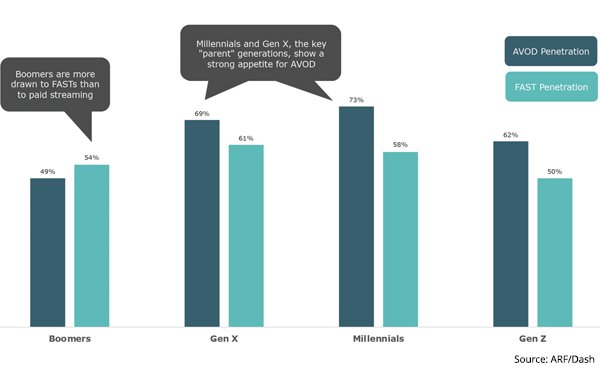
Platform penetration usage of TV “boomer” consumers -- those born in the late 1940s through late 1950s -- show this group was more drawn to FAST channels (54%) than to paid AVOD (49%).

FAST is (free ad-supported/streaming TV) channels, while AVOD are paid subscription/advertising-supported streaming platforms.

Authors of the report suggest that FAST are familiar channels for boomers, especially when it comes to channel-surfing of legacy TV. In addition, FAST channels feature a lot of library programming services they are accustomed to.

Other younger demographic groups all give higher performance to AVOD. But FAST also gets good results.


After boomers, the next-oldest generation -- Gen Xers, those born from around 1960 through 1980 -- have a 69% preference for AVOD, as well as a 61% affinity for FASTs. Younger millennials come in at 73% for AVOD, with 58% for FASTs.

Gen Z consumers -- who spend less time on TV than other groups -- have 62% AVOD platform penetration, compared to 50% for FAST.

By comparison, only 36% of Gen Zers watch two or more hours of TV sets per day, and 73% of boomers.

Watching TV shows on smart devices? Gen Z scores 34%, versus 7% for boomers.

“In short, younger generations aren’t just choosing new platforms,” write the authors of the study. “Their emphasis on flexibility, convenience, and personalization is reshaping how TV fits into their lives.”

This all suggests that younger generations -- while they are looking to avoid advertising -- will still use the platforms when “the value is clear" -- which means avoiding AVOD isn’t a good idea.

Brands in categories like consumer packaged goods (CPG), family entertainment and financial services will miss core consumers.

The most recent full-year DASH study in 2024, was conducted online, face-to-face and by phone among 10,122 U.S. adults.

Social Media Video: Daily Use Tops Broadcast, Streaming, Gaming


Commentary

Social Media Video: Daily Use Tops Broadcast, Streaming, Gaming


Global social media video content -- on TikTok, YouTube Shorts, and Instagram Reels, for example -- is now the most-used daily media content -- exceeding broadcast and streaming TV and gaming.

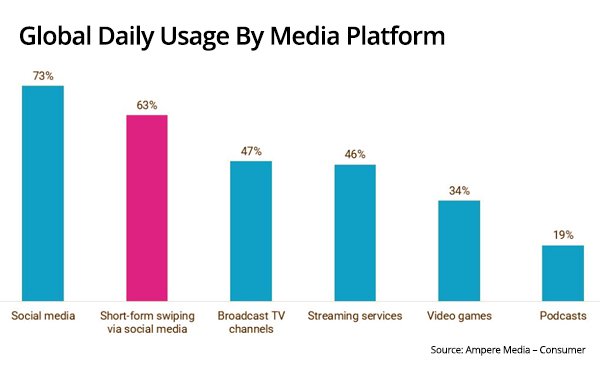
According to a June Ampere Analysis report, 63% of the global online population consumes social media video content on a daily basis.

“While broadcast television offers a range of choices for viewers, algorithmic social media knows what people are likely to want to watch before they do,” according to Sam Nursall, senior analyst, Ampere Analysis.

Ampere also says “swiping” -- finger-like actions by users, especially on mobile devices that enable users to move quickly onto other video content -- is a factor.

Broadcast and streaming daily usage are far behind -- with 47% and 46%, respectively, in daily use, followed by video games (34%) and podcasts (19%). Overall social media daily use, beyond video consumption, continues to have the highest daily usage at 73%.


Breaking down usage among key audience segments, Gen Zers' (18 to 24 years old) use of social form video continues to be the highest, at 73%.

On the other end of the audience spectrum -- 45- to-54-year-olds and 55- to 64-year-olds -- come in at 58% and 49%, respectively.

Although the average daily overall time use is higher for traditional TV and video platforms (with linear TV channels at one hour/nine minutes and subscription/streaming platforms  at 52 minutes) than social media video (45 minutes) --- "social media services are more frequently used on a daily basis, per the initial release," Ampere's Nursall tells Advanced TV Insider.

The most popular media platform for short-form video is YouTube Shorts (78%), followed by Instagram (41%), TikTok (39%), and Facebook (38%).

These results come from a study when respondents were asked whether they use the platform in the past week.

The territories with the highest usage of short-form video are Southeast Asia -- the Philippines at 83%, Thailand (83%), and Indonesia (82%).

The Ampere Analysis survey was produced from a consumer survey of 56,000 internet-using respondents across 30 markets fielded in February 2025.