Thursday, March 20, 2025

Women's Sports TV Ads More Than Double In 2024 - To $244M


Women's Sports TV Ads More Than Double In 2024 - To $244M

TV and media investment in ad spending for women’s sports more than doubled in 2024 (139%) versus the year before -- to $244 million, according to EDO Ad EnGage.

The media-measurement company says those live events boosted engagement for brands by 40% over the average prime-time commercial. In 2024, there were a total of 26 billion video impressions (up 131%) versus the year before, coming from 30,322 commercial airings (up 37%).

Major sports content featured the WNBA and NCAA Women’s Basketball Tournament. Ads during the 2024 WNBA playoffs were 24% more effective that the average prime-time spot, with the NCAA Tournament up 18% over prime time.

Other women’s sports including tennis, gymnastics, lacrosse and volleyball also fell into the same engagement range -- 18% to 25% more effective than prime time.

Top brand advertising fell into a similar top category with that of men live TV sports programming -- automotive ($27.2 million), pharmaceutical ($26.2 million), internet/telecom ($25.6 million), financial services ($24.5 million), insurance ($20.6 million), food/beverage ($20.5 million) and retail ($14.9 million).


Some of the brands with the best business outcome engagement versus low media spend were KFC, Starbucks, and Polestar. Those with high media engagement driven by high media investment include Pizza Hut, Zillow, and Airbnb.

On the flip side, those with more limited results coming from their high media spend included Jeep, Wendy’s and Instacart.

The biggest-spending individual brands overall included State Farm ($5.5 million), AT&T ($

Local TV's 'Muted' Political Growth - What Comes Next?


Local TV's 'Muted' Political Growth - What Comes Next?

Local TV advertising -- which for years has put much of its focus on those every-other-year gains of political ads -- did not perform all that well in 2024, according to Madison & Wall.

What happened? Much of it moved to digital-first owned local media.

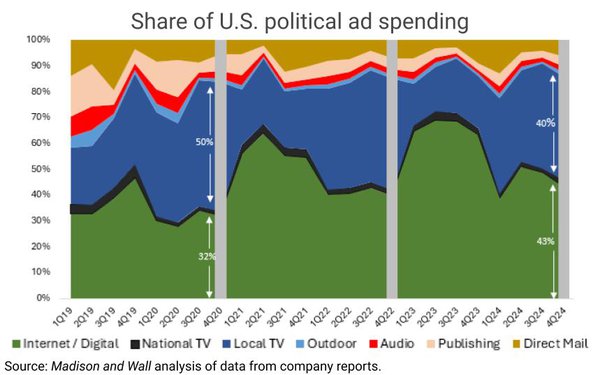
Brian Wieser, media analyst/founder of Madison & Wall, says digital media platforms posted a significant share gain of political advertising revenue -- 43%, up from a 32% share in the fourth quarter of 2020, the last Presidential election period.

All this pulled down local TV station’s share of political dollars -- to 40% in the fourth quarter of 2024, from 50% in the same quarter of 2020.

This happened even as total media-placed political advertising dollars rose by 13% during 2024 to $16 billion over the four-year Presidential cycle.


For the full year, political -- as a percentage of total media owner advertising revenues -- slipped to 4% from 5.5% in 2020.

For the big fourth-quarter period, political advertising share was 7.1% down from 9.6% in the fourth quarter of 2020.

There was one major local TV station group outlier -- E.W. Scripps, which witnessed 54% of its fourth-quarter advertising revenue coming from political.

Still, the overall political advertising market is seemingly seeing slower growth. Currently, Wieser points to a “relatively un-competitive primary environment (which led to limited growth in fund-raising in 2024 over 2020) and perhaps because of the very high plateaus realized in 2020 and 2022.”

So going forward, should local TV now worry that one of its key dominant ad business areas over digital media for years is fading?

It depends how much local TV owners, who are moving quickly into the local streaming video space, can amass in the next several years in packaged ad deals with their slow declining local linear TV platforms.

Add in this: Local TV efforts around owned digital content-based platforms -- which had been growing with modest growth pacing -- has stalled.

BIA is projecting that these local TV station digital businesses will slip 9% to $2.1 billion, from $2.3 billion in 2024.

From all this Wieser now says that -- as anticipated -- political advertising growth ended up somewhat “muted.”

In other words, nothing to shout about.

On Tariffs: What Is the TV Messaging for Brands?


Commentary

On Tariffs: What Is the TV Messaging for Brands?

Consumers already are feeling the pinch somewhat, or at least are on high alert that there could be major change in the economy as it pertains to potential volatile tariffs, including those against countries like China.

When will major brands start to address some of these concerns going forward -- perhaps in a slowdown-economy world compounded by the upward pull of high inflation?

Consumers may have been worried about the high price of eggs under the Biden Administration, with bird flu issues a major contributor. But now there seems to be more uncertainty.

What’s the messaging now -- if anything -- as this new wrench works its way through the U.S. advertising system?

A possible pullback or adjustment by brands on TV and elsewhere may be coming.

Currently the national TV scatter market has been soft, according to media executives -- and this came before all the tariff news. But going forward, consider this estimate from a PWC survey: Tariff cost effects on telecommunications, media, and technology companies (TMT) could rise to $139 billion from $13 billion.


What should we expect now as we move into the fall and winter period? Proponents of tariffs believe there needs to be a long-term re-adjustment to the U.S. economy -- including possible stagflation or even a recession -- if tariffs are widespread. But better days are ahead, they say: Some short-term pain before long-term progress.

If that isn’t enough, the marketplace keeps shifting the ground underneath everything.

Major Chinese electric vehicle manufacturer BYD, the company Elon Musk and Tesla have long been concerned about, now says it has the ability to charge up a car in five minutes.

Down the road, think of how U.S.-based EV car manufacturers will need to respond with that kind of news in terms of savvy marketing messaging. Forget about "drill baby drill" -- what some public officials now in charge believe we need to do in terms of oil production.

That said, we know that the message for many marketers during recessionary times -- especially from TV media sellers -- is: don’t stop advertising. That's because if you do, and we begin to come out of tough economic times, you don’t want to be left behind.

In this strange marketplace, with an unpredictable administration in charge, are we on more unstable ground? (Oh, and wait. What about that potential ban on pharmaceutical companies' advertising?)

Perhaps if President Trump offers up a schedule of his posts on TruthSocial -- as one CNBC commentator recommends, somewhat in jest -- we could have some rough plan of what is to come.

Even with that, the U.S. stock market and the economy will need to read other tea leaves. I’ll take mine black and strong.

How Brand and Performance Marketing Drive Mutual Success

 A little brand marketing education: Philip Jay LeNoble, Ph.D.

Commentary

How Brand and Performance Marketing Drive Mutual Success

Many marketers mistakenly see brand and performance marketing as separate, even opposing forces. Historically, brand marketing is associated with long-term value and awareness, while performance marketing is linked to immediate results and conversions.

It's time to argue for a more holistic perspective: These two approaches are deeply interconnected. A strong brand significantly enhances performance marketing, and at the same time, performance marketing contributes to brand growth, creating a synergistic relationship that drives overall business success.

Integrating Brand as a Performance Amplifier

When these two approaches are aligned, they amplify each other, driving both brand awareness and conversions. Brand marketing introduces the brand and its value, paving the way for performance marketing to target and convert customers, creating a full-funnel marketing strategy. Brand awareness and trust increase customer engagement and conversions, which lowers costs and boosts overall success.

System 21 Guarantees New Business Growth: Contact Michael Guld 804.356.7006 

Apple seamlessly integrates brand and performance marketing with iPhone launches. Brand marketing creates an emotional connection and highlights the iPhone's lifestyle appeal, while performance marketing drives sales through targeted ads and pre-order campaigns.

The combination of brand and performance marketing creates a powerful cycle. Brand marketing generates the desire, and performance marketing fulfills that desire, leading to measurable sales results. One without the other is less effective. If Apple only focused on emotional appeal, the company might have a lot of interested people but miss out on sales. If it only focused on performance tactics, those tactics might be less effective, because consumers wouldn't have the initial emotional connection to drive their purchase.

Measuring the Combined Impact

While traditional performance marketing metrics like conversion rates and cost per acquisition are valuable, it's also important to consider brand-centric metrics. Measuring ROI for brand and performance marketing provides insight into overall marketing effectiveness.

WARC’s recent Multiplier Effect Report indicates that this combined approach can boost advertising effectiveness and ROI by 25% to 100%, with an average increase of 90%. To achieve optimal results, it's recommended to allocate 40% to 60% of a marketing budget to brand while dedicating the remaining funds to performance advertising.

The success depends on being able to measure the impact throughout the consumer journey and attribute the proper credit to upper-funnel tactics that lead to conversions. We’ve executed insurance

campaigns featuring brand-focused CTV ads and successfully measured their direct impact on driving

incremental leads through search, leading to a more efficient ROAS when combining the investments. Early framework development ensures proper campaign structure and eliminates uncertainty.

The Dangers of Prioritizing One Over the Other

Prioritizing either brand or performance marketing exclusively can be detrimental. Overemphasizing performance for quick wins can weaken the brand, resulting in degradation, customer churn, and declining returns.

Conversely, focusing solely on brand building without a performance-driven approach may result in strong brand awareness but fail to generate sufficient conversions and revenue. Without performance marketing that leverages brand awareness, businesses risk missed sales, stunted growth, and lost market share.

By recognizing the symbiotic relationship between these two approaches, businesses can unlock significant growth potential and achieve greater marketing effectiveness.

Friday, March 14, 2025

Gen Z’s Podcast Habits Defy Trends: Audio-Only Still Rules

Another goody from another reliable resource: Philip Jay LeNoble, Ph.D.


Gen Z’s Podcast Habits Defy Trends: Audio-Only Still Rules

1

Despite concerns over the rise of video podcasts across digital platforms, audio remains king when it comes to deep engagement – and in reaching Gen Z. A new study shows the younger generation still favors audio-only formats over video when consuming podcasts.

A new Transistor.fm survey reveals that while YouTube dominates overall podcast consumption across all age groups, Gen Z listeners are charting a different path.

One of the most noteworthy findings is that Gen Z overwhelmingly prefers traditional audio-only podcasts. While video content is becoming more prominent in podcasting, 76% of surveyed Gen Z listeners said they primarily consume audio podcasts. Another 18% listen to a mix of audio and video, while just 6% primarily watch video podcasts.

Despite the industry’s push toward video podcasting, Spotify remains the go-to platform for Gen Z podcast listeners. According to the February 2025 survey, which polled over 100 podcast fans ages 13-29, 56% prefer Spotify, up from 47% in 2021. YouTube is used by 21%, an increase from 10% in 2021, but still well behind Spotify.

Apple Podcasts saw a decline, with only 10% of Gen Z choosing it as their primary listening app, down from 16% in 2021. These findings contradict the belief that younger listeners are driving YouTube’s podcast growth and highlight key trends shaping the next generation of audio consumption.

One point that radio might want to make note of: Gen Z’s audio consumption habits take place largely outside the car. A majority, 59%, listen to podcasts at home on their phone or tablet, making mobile devices the dominant platform for this demographic. Public transit accounts for 12% of their listening, while 10% engage with podcasts while walking or cycling.

Only 9% report listening in the car, a stark contrast to older age groups. Other settings make up 6% of their listening habits, while just 3% say they primarily use a TV at home for podcasts.

This suggests that the rush to video podcasting, driven by YouTube’s growth, may need to be observed much more closely – at least when it comes to capturing younger audiences. The full findings can be viewed via Transistor.fm.

Edison Research’s Latest Share of Ear Finds AM/FM Rules In-Car Listening.

 Here's a good article from Inside Radio to help you keep UpToDate on what's happening in other competitive media. Philip Jay LeNoble, Ph.D.


Edison Research’s Latest Share of Ear Finds AM/FM Rules In-Car Listening.

  •  
Kia Niro EV 2025

Edison Research’s Share of Ear for the fourth quarter of 2024 finds that AM/FM still dominates in-car listening.

Its in-car share of 86% reinforces AM/FM’s standing as the primary way to reach consumers on their path to purchase, Cumulus Media/Westwood One Chief Insights Officer Pierre Bouvard writes in a blog post, noting that the proportion of AM/FM radio in-car listening has surged, returning to pre-pandemic norms.

Those are among Bouvard’s key takeaways from the latest Share of Ear study, which surveys 4,000 each year to gauge daily reach and time spent with all forms of audio.

In terms of ad-supported audio, Edison’s Q4 2024 data also reveals that ad-supported digital audio reaches less than a third of the U.S., with AM/FM reaching two-thirds of the nation. When those are combined, ad-supported digital audio and AM/FM reach nearly three-quarters (74%) of the U.S. daily.

The research also shows that AM/FM radio also has a big advantage when it’s pitted against ad-supported versions of Spotify and Pandora. In total AM/FM radio and podcasts make up almost 90% of tuning minutes on the U.S. ad-supported audio clock.

“A media plan of music streaming and podcasts will miss two-thirds of Americans,” Bouvard writes. “The net reach of ad-supported Spotify, Pandora, and podcasts combined reaches less than one-third of the U.S. (29%). Versus, digital audio, AM/FM radio reach is double (61%)… The addition of AM/FM radio to digital audio causes reach to soar to 74% of the U.S. … An audio media plan can achieve true scale with the inclusion of AM/FM radio.”

The aforementioned numbers, Bouvard says, demonstrate that an audio investment that doesn’t include AM/FM radio misses a large portion of the audience. In a typical day among ad-supported media, 18% listen only to digital audio and not AM/FM radio; 22% listen to digital audio and AM/FM radio; and 61% only listen to AM/FM radio and not digital audio.

Edison also examined the daily reach of AM/FM radio and ad-supported Spotify and found that in a typical day 5% listen just to ad-supported Spotify and not AM/FM radio; 5% listen to both ad-supported Spotify and AM/FM radio; and 90% only listen to AM/FM radio and don’t listen to ad-supported Spotify.

“A buy that just has Spotify in the plan misses 95% of Americans,” Bouvard says. “Interestingly, an AM/FM radio buy reaches two-thirds of Spotify’s audience.”

It was a similar story when ad-supported Pandora was matched up against AM/FM radio in a typical day with 4% listening only to ad-supported Pandora and not AM/FM radio; 5% listening to both ad-supported Pandora and AM/FM radio; and 91% only listening to AM/FM radio and not listening to ad-supported Pandora. Again, a buy with only Pandora misses the overwhelming majority of Americans (96%), while an AM/FM buy reaches more than half (56%) of Pandora’s ad-supported audience.

Breaking down an hour’s worth of U.S. ad-supported audio consumption (determined by multiplying “Share of Ear” ad-supported audience shares by 60 minutes), AM/FM radio represents 41.2 minutes of listening. AM/FM is followed by podcasts (11.1 minutes); ad-supported Spotify (3 minutes); ad-supported SiriusXM (2.8 minutes); and ad-supported Pandora (1.9 minutes). In a typical hour, 87% of U.S. ad-supported audio consists of podcasts and AM/FM radio.

In terms of in-car ad-supported audio, the research shows that AM/FM radio represents the vast majority of tuning minutes. Here’s the breakdown: AM/FM radio (51.7 minutes of listening); podcasts (3.8 minutes of listening); ad-supported SiriusXM (2.1 minutes); ad-supported Spotify (1.2 minutes); and ad-supported Pandora (1.3 minutes).

Overall, AM/FM radio has a dominant 69% share of ad-supported audio. Podcasts are second (19%), followed by ad-supported Pandora (5%), ad-supported Spotify (5%), and ad-supported Sirius XM (3%).

Local TV's 'Muted' Political Growth - What Comes Next?


Local TV's 'Muted' Political Growth - What Comes Next?

Local TV advertising -- which for years has put much of its focus on those every-other-year gains of political ads -- did not perform all that well in 2024, according to Madison & Wall.

What happened? Much of it moved to digital-first owned local media.

Brian Wieser, media analyst/founder of Madison & Wall, says digital media platforms posted a significant share gain of political advertising revenue -- 43%, up from a 32% share in the fourth quarter of 2020, the last Presidential election period.

All this pulled down local TV station’s share of political dollars -- to 40% in the fourth quarter of 2024, from 50% in the same quarter of 2020.

This happened even as total media-placed political advertising dollars rose by 13% during 2024 to $16 billion over the four-year Presidential cycle.


For the full year, political -- as a percentage of total media owner advertising revenues -- slipped to 4% from 5.5% in 2020.

For the big fourth-quarter period, political advertising share was 7.1% down from 9.6% in the fourth quarter of 2020.

There was one major local TV station group outlier -- E.W. Scripps, which witnessed 54% of its fourth-quarter advertising revenue coming from political.

Still, the overall political advertising market is seemingly seeing slower growth. Currently, Wieser points to a “relatively un-competitive primary environment (which led to limited growth in fund-raising in 2024 over 2020) and perhaps because of the very high plateaus realized in 2020 and 2022.”

So going forward, should local TV now worry that one of its key dominant ad business areas over digital media for years is fading?

It depends how much local TV owners, who are moving quickly into the local streaming video space, can amass in the next several years in packaged ad deals with their slow declining local linear TV platforms.

Add in this: Local TV efforts around owned digital content-based platforms -- which had been growing with modest growth pacing -- has stalled.

BIA is projecting that these local TV station digital businesses will slip 9% to $2.1 billion, from $2.3 billion in 2024.

From all this Wieser now says that -- as anticipated -- political advertising growth ended up somewhat “muted.”

In other words, nothing to shout about.