Wednesday, March 12, 2025

Automotive TV Spending Nearly Flat in February


automotive

Automotive TV Spending Nearly Flat in February

Automakers spent just slightly more in February on estimated national TV vs. a year ago with year-to-date nearly even with the same period a year ago. 

February 2025 estimated national TV spending was $152 million up 1.0% from $150.5 million a year ago, per iSpot.tv. 

Year-to-date national TV spending tallied $485.1 million, up 0.2% from $484.2 million in the first two months of 2024. 

Household TV Ad Impressions were 17 billion in February were down 13.6% year over year from 19.7 billion. Year-to-date impressions were 36.4 billion, down 11.7% from 41.2 billion for February 2024, per iSpot.tv.

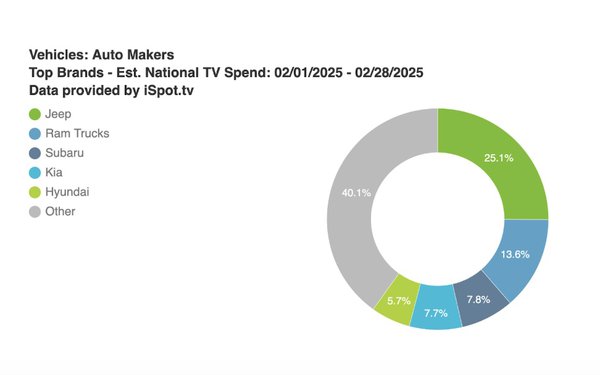
The top five brands by estimated national TV ad spending in  February were Jeep ($38.1 million), Ram Trucks ($20.7 million), Subaru ($11.8 million), Kia ($11.7 million) and Hyundai ($8.7 million). 

advertisement

advertisement

Sports-related programming accounted for over 60% of total industry spend in February. Jeep and Ram Trucks outspent other automakers in February by notable margins, due largely to Stellantis being the only automaker that aired ads during Super Bowl LIX. 

Despite skipping the Super Bowl, automakers were still very active advertisers this February while taking advantage of holiday sales opportunities, says Stuart Schwartzapfel, executive vice president,, media partnerships at iSpot.tv. 

“And in this increasingly shifting TV landscape, we’re seeing interesting developments from auto brands, taking new approaches across both streaming and linear ads in an effort to maximize messaging opportunities with prospective buyers,” Schwartzapfel tells Marketing Daily.  

All of the top five automakers invested, to varying extents, in men’s college basketball, and all except Subaru also activated around NBA games. 

Of the top five, Kia leaned into the NBA the most, allocating over 31% of its total February outlay to games, while the NBA captured nearly 23% of Hyundai’s spend for the month. Meanwhile, Subaru was the only automaker that activated around the Puppy Bowl (nearly 18% of its total monthly spend), per iSpot.tv.

The top five brands by share of automaker household TV ad impressions in February were Hyundai (9.95%), Toyota (8.61%), Lexus (8.17%), Nissan (7.23%) and Subaru (6.98%).

The top five brands by share of voice on streaming were Jeep (11.99%), Hyundai (10.57%), Ram Trucks (7.21%), Toyota (6.60%) and Lexus (6.03%).

Hyundai, Toyota and Lexus were among the top five automakers on both streaming and national linear. Meanwhile, Ram Trucks put a great emphasis on streaming over national linear from an ad reach SOV standpoint, ranking No. 15 for linear SOV but third for streaming, according to iSpot.tv.  

The most-seen automaker ads by share of household TV ad impressions in February were Volkswagen: A Life Half-Full (2.93%); Jeep: Official Vehicles of Winter (2.89%); Kia: Elevated By the Dark (2.70%); Audi: The Road is Calling (2.65%); and Hyundai: Lay Low (2.64%).

The top automaker ads by likeability among the top 20 most-seen ads in February 2025 were  Lexus: Baby on Board (+10.6% more likeable than February automotive norm);  Audi: The Road is Calling (+9.6%); Jeep: Official Vehicles of Winter (+6.7%); Lexus: Free (+4.6%); and GMC: Another Choice (+4.3%).

The top automaker ads by positive purchase intent among the top 20 most-seen ads were  Audi: The Road is Calling (62% positive purchase intent); Lexus: Baby on Board (60%); GMC: Another Choice (55%)' Jeep: Official Vehicles of Winter (51%); andGMC: Let It Snow (51%).

Audi’s “The Road Is Calling” was not only the fourth most-seen auto ad in February, it was also among the top five for likeability and positive purchase intent. 

The spot forgoes any type of traditional voiceover or speaking role, instead focusing on the visuals — the fully-electric Q6 e-tron zooming along a winding mountain road — a tactic that seemed to resonate with surveyed viewers, as 32% cited the visual scenes to be the “single best thing” about the ad, according to iSpot.tv.

Women's Sports TV Ads More Than Double In 2024 - To $244M


Commentary

Women's Sports TV Ads More Than Double In 2024 - To $244M

TV and media investment in ad spending for women’s sports more than doubled in 2024 (139%) versus the year before -- to $244 million, according to EDO Ad EnGage.

The media-measurement company says those live events boosted engagement for brands by 40% over the average prime-time commercial. In 2024, there were a total of 26 billion video impressions (up 131%) versus the year before, coming from 30,322 commercial airings (up 37%).

Major sports content featured the WNBA and NCAA Women’s Basketball Tournament. Ads during the 2024 WNBA playoffs were 24% more effective that the average prime-time spot, with the NCAA Tournament up 18% over prime time.

Other women’s sports including tennis, gymnastics, lacrosse and volleyball also fell into the same engagement range -- 18% to 25% more effective than prime time.

Top brand advertising fell into a similar top category with that of men live TV sports programming -- automotive ($27.2 million), pharmaceutical ($26.2 million), internet/telecom ($25.6 million), financial services ($24.5 million), insurance ($20.6 million), food/beverage ($20.5 million) and retail ($14.9 million).


Some of the brands with the best business outcome engagement versus low media spend were KFC, Starbucks, and Polestar. Those with high media engagement driven by high media investment include Pizza Hut, Zillow, and Airbnb.

On the flip side, those with more limited results coming from their high media spend included Jeep, Wendy’s and Instacart.

The biggest-spending individual brands overall included State Farm ($5.5 million), AT&T ($5.5 million), Allstate ($4.5 million), Nike ($4.4 million) and Skyrizi ($3.9 million).

Streaming Vs. Theaters: More Competition for Movie Screen Time?


Commentary

Streaming Vs. Theaters: More Competition for Movie Screen Time?

Are consumers still going to movie theaters to see films -- even as streaming platforms continuing to dig into entertainment behavior more broadly?

Of course, and possibly for the near term.

One key measurement is attendance days after a movie’s initial weekend opening -- which, on average, for regular wide-release movies isn’t that bad over recent years -- at least according to one major theater owner's chief executive.

“We haven’t seen a steeper decay of a film’s trajectory through its life cycle after it’s released into theaters,” said Sean Gamble, CEO of Cinemark, speaking at a Morgan Stanley investor event recently.

“That’s held pretty consistent with pre-pandemic patterns. And even when it enters the home like a PVOD [pay per view video-on-demand] service, we haven’t seen a steeper decline at that point, so that’s encouraging.”


Still, a maturing streaming market might see a different kind of behavior -- especially if there is more of a gradual shortening of theatrical windows for all movies.

“As consumers become more aware of these short windows, does that ultimately lead to some form of reduction in attendance overall? I think that’s something that’s still to be determined over time.”

Overall theatrical attendance has declined over the past few years -- but that has more to do with the number of releases by studios that have been pulling back -- first with the pandemic disruption, and more recently due to actors' and writers' strikes.

There were 823 million tickets sold in 2024, down 24% from the pre-pandemic 2019 period, and down 3% from 2023.

Gamble says the good news for theater owners is that new, digital-first companies now producing and distributing theatrical movies -- Amazon MGM and Apple -- could be ramping up the number of releases. Amazon will go from around five a year to 16 wide releases. Gamble also believes Apple will add more releases.

What does this all mean for streamers? Well, they are not going away. One recent survey from MX8 Labs says 46% of U.S. adults prefer to stream flicks at home, with only 15% saying they favor theaters.

No doubt more of those big franchise expensive adventure, fantasy, computer-generated content-based movies for the summer or the end-of-the year holiday periods will still be the major drivers.

The two biggest U.S. domestic movies in terms of box-office revenue in 2024, per IMDb’s Box Office Mojo, were Walt Disney’s “Inside Out 2” ($653 million) and “Deadpool & Wolverine” ($636.7 million).

That leaves more of the off-holiday, mid-level movies for the summer period -- especially older, adult-focused films -- which may find less interest in theaters.

Concert films? Special big-screen events, such as gaming competitions and the like? Movie theater operators have talked up content like this before in attempts to spike attendance in off periods.

Other remedies will be needed in the coming years. Big screens will always need high-quality, hit-them-over-the-head visually compelling content.

Tesla Troubles and Remedy: Its First Ever Large TV Ad Campaign?

 Perhaps there's some local money for dealers to use to boost their brand to consumers who may be shying away from Tesla as a result of the recent political problems Elon Musk may have caused: Philip Jay LeNoble, Ph.D. 

Tesla Troubles and Remedy: Its First Ever Large TV Ad Campaign?

Walking out of my local Trader Joe's, I quickly eye a round, red-and-white sticker on the back of a car with the name “Elon” --a sticker designed with his name heavily crossed out amid a thick white line.

I’m focusing on it so heavily as I walk by that I don’t realize this car just isn’t any car. It’s a Tesla.

Mixed messaging? Or some tongue-in-cheek brand loyalty gone wild?

No matter. The now infamous EV (electric vehicle) car brand needs much more.

Maybe it’s time -- well past the time actually -- for Tesla to start a real, significant large-scale TV advertising campaign. You know, like most car companies.

Why now? One major sign is the cratering of the company’s stock, which in the early part of this week was down 15%. Tesla stock price is now at a five-year low.


Now analysts are calling the company a “meme” stock. For many investors, it means Tesla is not traded on foundational financial metrics but on the whims, observations, social media comments of users or other followers of the company.

For sure, market dynamics have changed for the company as well. EV competition in the space has been heating up among all U.S. and among globally based car companies, including cars made in China.

And now the long-time EV leader is suffering from boycotts, protests and other disturbances at Tesla locations and showrooms -- all because of Elon Musk’s high-profile, controversial association with the Trump Administration and Musk's efforts to foster more "governmental efficiency."

This has resulted in massive Federal employee layoffs everywhere -- even among existing workload-strapped agencies when it comes to staffing. Those affected have included both Republican and Democrat-leaning federal workers.

For years, Tesla didn’t need TV advertising. Word-of mouth and cool messaging worked well and the slick looking and now very identifiable vehicles meant plenty of out-of-home advertising/promotion for the company, which was slowly building a devoted clientele.

Perhaps Tesla could jump-start a TV campaign by doing selective media schedules on must-have connected TV -- Netflix, Prime Video, Max, Hulu -- via special live events (sports, awards shows, or otherwise) or top-of-mind streaming TV shows like “The Bear,” “The White Lotus” or “Only Murders in the Building.”

Maybe Apple TV+'s “Severance”? (There's a hint for you!)

Hey, the President is already helping out -- in a way. Trump continues to support Musk, and even just bought a Tesla, as well as saying the boycotts against Tesla are “illegal.”

Then again, if you're driving a Tesla with some contrarian stickers on it, maybe you are just rolling around, getting comfortable in a new world order mix of provocative messaging. Might that sell some cars?

Can’t wait to see a TV spot featuring those real-world Tesla haters -- and lovers -- speaking out of both sides of their mouths. Finally some long-lasting, less gaseous brand engagement!

This story has been updated.

Commentary How to Optimize GenAI Strategy For 4 Key Consumer Mindsets


Commentary

How To Optimize GenAI Strategy For 4 Key Consumer Mindsets

In just a handful of years, GenAI has emerged as a transformative force in marketing, promising to revolutionize how brands interact with consumers. With 74% of B2C marketing leaders anticipating a positive impact from GenAI, the technology is poised to dramatically enhance time and cost efficiency.

However, as brands increasingly integrate GenAI into their strategies, they face a complex landscape of consumer sentiment. While some consumers are eager to embrace the advancements GenAI offers, others remain deeply skeptical, with 58% expressing concerns that the risks of artificial intelligence outweigh its benefits. Moreover, an equal percentage of consumers prefer to engage with brands that refrain from using GenAI in their messaging and communications.

How can CMOs harness the benefits of GenAI without alienating a substantial portion of their audience? The answer lies in recognizing the diversity of consumer perspectives and tailoring strategies to meet these varied expectations.

advertisement

advertisement

To navigate this complex terrain, CMOs must first understand that consumers are not monolithic when it comes to GenAI. Gartner research has identified four distinct consumer mindsets—Enthusiasts, Pragmatists, Passives, and Rejectors—each with unique attitudes and concerns regarding the technology. By developing targeted GenAI strategies that address these specific mindsets, brands can optimize their approach, ensuring that their use of AI resonates positively with their audience and mitigates the risk of backlash.

GenAI Enthusiasts embrace the personal and societal benefits of GenAI, with demographics skewing younger, male, educated, and high-income. They represent one fifth of consumers. Brands targeting this group can boldly embrace GenAI, as these consumers are open to AI-driven content creation. Connect with Enthusiasts by emphasizing and demonstrating your organization’s commitment to innovation in creative and messaging.

GenAI Pragmatists are ambivalent, but recognize GenAI's utility for work and productivity. This group, representing a plurality of consumers -- nearly 40% -- has a more even gender split and needs to see personal benefits to fully embrace GenAI. Connect with Pragmatists by emphasizing individual productivity gains and demonstrating the way your organization’s use of the technology benefits employees and customers (rather than just the company’s bottom line) in creative and messaging.

GenAI Passives represent one fifth of consumers, often older women, who are skeptical about GenAI's value and its personal impact. In addition, they typically do not use GenAI at work. Because Passives are uneasy about GenAI, to engage this group, brands should employ reassuring creative and messaging that demonstrates how GenAI supports customers without putting jobs at risk.

GenAI Rejectors deeply distrust the technology. Representing less than 15% of consumers, they are more likely to be older men and are unlikely to change their negative view of GenAI. Therefore, brands that must connect with these consumers, but also need to incorporate GenAI into business processes, have a delicate balance to strike. Acknowledge and respect Rejectors’ skepticism. Prioritize GenAI initiatives that optimize internal processes over consumer-facing applications. Emphasize the importance your organization places on humans over tech.

By identifying and understanding these four consumer mindsets, brands can tailor their GenAI strategies to align with their target audiences' values and concerns. This approach not only mitigates the risk of consumer pushback but also enhances brand reputation and loyalty.

Broken Promises: How DEI Rollbacks Are Deepening the Brand Trust Crisis


diversity

Broken Promises: How DEI Rollbacks Are Deepening the Brand Trust Crisis

  
Target's Black History Month items sparked outraged comments on social media, criticizing what many consumers see as brand hypocrisy.


A new study reveals that consumer trust in brands is eroding, with diversity rollbacks becoming a key flashpoint in an already widening gap.

Some 80% of those in Collage Group’s latest wave of data say inclusive marketing is equally or more important to them today than in 2020, and 39% say they’ve purchased from a brand expressly because that company’s ads represent diverse people in ways that seem authentic.

Since President Donald Trump’s re-election, many companies -- including Target, Walmart, McDonald’s, and Toyota -- have rolled back DEI initiatives. As a result, 30% of consumers (about 86 million people) plan to cut back spending on these brands

System 21 guarantees a minimum of $300,000 in the first 6 months of licensure or your money back! Call Michael Guld 804-356-7006

That meshes with other research, including a recent Harris Poll published in the Guardian, which found that by mid-February -- even before boycott and Economic Blackout plans solidified on social media -- 24% of consumers said they’d already stopped shopping at their favorite stores.

And while there’s no conclusive data available yet that these efforts, including the recent Economic Blackout Day, are hurting sales, preliminary indications show these consumer-led boycott groups could hurt financial performance.

The uproar reflects problems that go much deeper than a single issue. “Many brands have been spiraling down a reactionary cycle for years,” the report says. Brands start with grand promises, retreat to moderate promises, then degenerate into empty promises. For consumers, that’s led to a parallel downward cycle of disappointment and backlash.

The result is a gaping trust gap: While 80% of consumers say brand trust is essential when making a purchase, only 40% believe brands and companies are trustworthy.

DEI isn’t the only measure of trust, or even a large one. A personal positive experience with the product or service is the essential way brands build trust, named by 61% of respondents, followed by friends and family recommendations (47%), timely and personal customer service outreach (39%), transparent business practices (37%), and fair treatment of staff (32%.)

A stated commitment to diversity was named by just 25%, with support for “social causes I care about” mentioned by 24%.

Before their DEI pullbacks, Walmart and Target had high trust levels compared to other retailers, with 83% of consumers saying they trusted Walmart and 82% saying they trusted Target, according to Collage.

In the weeks following announcements from both companies saying they would no longer support efforts promoting internal diversity and inclusion, Walmart has somehow managed to maintain more of that trust, with Collage’s measure of brand momentum among multicultural consumers up nine percentage points, and increasing by six percentage points among white shoppers.

Consumers believe Walmart is holding up its primary and highly transactional promise: everyday low prices.

For Target, the reverse is true. Consumers read the DEI retreat as an abandonment of core promises. Momentum among multicultural shoppers fell three percentage points and dropped seven percentage points among white shoppers.

“Target is stuck in a repeated, reactionary cycle of dramatic reversals,” the report notes, “with the latest policy changes, misaligned with established brand values, continuing the downward spiral. The brand is now extremely vulnerable to double backlash and accusations of performative allyship.”

Early in February, Target launched a Black History Month collection, drawing widespread hisses and boos on social media. “Did you think we forgot???” posted one critic. “Babes Babes it hasn’t even been a month.” Added another: “Anyways, y’all need anything from Costco?”

Collage says the findings underscore messages for all marketers, no matter where their corporate parent lands on the political spectrum. For those at companies that are standing by DEI policies, a list that includes Costco, Apple, Delta Airlines and E.L.F., it’s vital to do more than just stay the course. Collage says stepping up core brand value propositions, and increasing transparency efforts to reach out to multicultural growth segments, will all increase trust.

For those working at brands that have eliminated or watered down efforts, marketers need to “chart a new course.” That likely entails increasing efforts to track consumer sentiment, developing proactive response playbooks, and building new relationships with diverse creators.

Tuesday, March 4, 2025

Consumers Are Logging Off: Where to Shift Your TOFU Efforts Now

 Times are changing when it comes to media marketing in terms of what businesses should consider in the new world of what is value to today's consuming public. A local business's Top of Funnel idea is modifying its communications to potential consumers, whether a legal ad, automotive, furniture, jewelry store or physician's medical practice. So, the first thing we should do is redefine TOFU....Top of Funnel. Top-of-funnel (TOFattracting and engaging potential customersIt aims to educate or inform the audience about a general topic related to their interests, without directly promoting a specific product or service.  . So now you may help effect the success of your direct client's media marketing by helping them learn some of the tools of the trade. Philip jay LeNoble, Ph.D


Commentary 

Consumers Are Logging Off: Where to Shift Your TOFU Efforts Now

After 17 years, I finally deleted Facebook and Instagram. Being constantly bombarded with news, ads, and content that is at best, a waste of time and at worst, harmful misinformation, is overwhelming. The shift from seeing posts from friends and family to algorithm-driven content from strangers, combined with privacy concerns, made it an easy decision to step away.

And I’m not alone in my social media fatigue. A Gartner survey found that 53% of consumers believe social media has deteriorated due to misinformation, toxic communities, and bots. Gartner predicts 50% will significantly reduce or abandon social media this year.

Rather than relying on social media for awareness and relationship-building, brands must diversify their top-of-funnel (TOFU) efforts to meet consumers where they’re shifting their attention. Here’s where to invest next:

Owned content. Traditional social media may be fading, but content remains king. Investing in a well-optimized website, engaging email newsletters, and timely blogs creates a sustainable, long-term marketing foundation that isn’t subject to shifting algorithms or rising ad costs.

If social media reach declines, PPC costs skyrocket, or influencers lose their following, owned content ensures your brand’s visibility and credibility remain intact. By prioritizing content that you control, you build an audience that can keep coming back—regardless of external platform changes.

Even as AI reshapes search, engines will still prioritize trusted, in-depth content. Especially for B2B brands with long sales cycles, expert-driven content and branded search remain key for visibility and conversions.

Trade media. A Broadsheet survey reported that 82% of respondents found trade media coverage has a material impact on sales. Earned media coverage, or bylines in trade publications, allows you to reach a highly engaged, niche audience without competing with the 24/7 news cycle of mainstream media.

With trust in social media declining, third-party validation is more powerful than ever. Plus, with many consumers shifting their attention away from social media, some may turn to the trade publications they’ve relied on for decades to fill the information gap. Trade media coverage can be repurposed across marketing channels, extending its impact far beyond the initial publication.

Advertising on podcasts, TV, and traditional media. Podcast advertising is booming, with 500-plus million listeners worldwide, set to reach 650 million by 2027. Host-read ads feel like trusted recommendations, driving 60% of listeners to consider purchases. Similarly, use of CTV and streaming ads is rising as cable declines.

While digital marketing took center stage in recent years, many marketers are seeing success in bringing traditional tactics back into the fold. As consumers grow numb to digital ads in an always online world, strategic traditional media campaigns -- including billboards, print, and direct mail -- leave a lasting impression on potential customers.

Diversifying your TOFU marketing tactics beyond social platforms gives your brand more opportunity to reach consumers in moments of real engagement rather than mid-doomscroll. As always, don’t put all your eggs in one basket, and be ready to pivot your marketing efforts to other channels as they gain popularity.