Blogging By Dr. Philip Jay LeNoble discusses the sales and sales management structure of media marketing and advertising including principles, practices and behaviorial theory. After 15 years of publishing Retail In$ights and serving as CEO of Executive Decision Systems, Inc., the author is led to provide a continuum of solutions for businesses.
Holiday shoppers are spending more time streaming, and are increasingly apt to engage with interactive ads and look up brand or product reviews after seeing streamed ads, according to Roku’s 2022 fifth annual holiday consumer shopping study.
The survey of nearly 2,000 U.S. adults who plan to purchase holiday gifts, conducted for Roku by The Harris Poll, also found shoppers planning to shop earlier and increase their spending.
Holiday shoppers now report spending an average of 10.7 hours per week watching streaming TV, versus 10.5 in 2021, 9.5 in 2020, 8 in 2019; and 4.7 in 2018.
Nearly nine in 10 (89%) of respondents overall report having streamed in the past three months — up from 86% in 2021 and 85% in 2020. Among Gen Z shoppers, 98% have streamed in the past three months.
Among shoppers who subscribe to a streaming service, 21% subscribe to more than four (up from 13% in 2021, 8% in 2020 and 2% in 2019).
This year, 39% of shoppers report having looked up brand or product reviews on a search engine after seeing a brand or product advertised on a streaming service or device — up from 32% last year.
Nearly one in three (29%) report having engaged with an interactive ad experience while streaming a TV show or other video content.
Shoppers plan to spend an average of $993 on holiday gifts—up 6% versus last year’s $938 average.
Those who stream plan to spend 18% more than non-streamers ($1011 vs. $855, respectively).
More than half (56%) of shoppers overall, and 70% of millennials, said that they have either started or will start saving earlier this year to prepare for the holiday season.
One-quarter reported having already begun their holiday shopping, versus 21% per cent last year.
Don't count on the NFL to try to carry the load for national TV advertising -- in terms of ever higher revenue or overall gains in 30-second unit pricing.
Like anything in sports and in winning national TV advertising business, you need a team.
While national TV advertising will recover somewhat in the fourth quarter of this year -- up 2%, due to continued strong linear TV NFL programming -- there will be a 5% decline for all of 2023, according to estimates from MoffettNathanson Research.
Apart from playoffs and the Super Bowl in January-February next year, the league doesn't get going again until September. And there are no Olympics scheduled next year.
MoffettNathanson, a media-focused stock market analyst group, said it is “concerned with how the economic backdrop will impact 2023 national TV advertising after football season finishes and forecast 5% declines (down 4% ex-Winter Olympics compares) in 2023.”
It added that a “full recession” could decrease its estimates by "at least an additional 10%." In particular, it is concerned over new, highly touted advertising-supported options from Netflix and Disney+ that are set to launch by the end of this year.
“We expect the majority of these ad dollars will come at the expense of cable networks although we remain concerned that some smaller share will shift away from the pure AVOD services.”
In an earlier estimate from the company, MoffettNathanson disclosed that domestic advertising video-on-demand (AVOD) services from four major providers -- Hulu, Roku, Pluto TV, and Tubi -- would see much smaller growth in the fourth quarter of 6% to $1.7 billion -- versus a 35% gain the first quarter of 2022.
For all of 2022 -- sans 2021 Olympic advertising-included comparisons -- total national TV advertising is projected to slip 2% to around $84 billion.
Even with expectations that AVOD/FAST streaming services will continue to climb -- albeit slowly -- it will not lift all boats amidst a recessionary economy. Just consider that tiny 6% bump for those four AVOD services.
Nor will big-time sports.
TV business analysts will keep talking up how sports are ready to make ever bigger contributions to streaming platforms -- especially to premium live national TV advertising unit pricing.
At the same time, there will be sports TV references, excuses, and/or explanations with regard to overall national TV advertising results.
Better have a new game plan. Many big touchdowns will be tougher to come by.
NFL in-game advertising for the first week of the new 2022 season grew 8%, totaling $240.4 million across all national TV networks from Thursday through Monday, according to EDO Ad EnGage.
EDO says there was an increase to 637 total airings -- up 67 airings over 2021 (575) and 152 more than in 2020 (485).
Automotive was the biggest ad category -- at $30.3 million, followed by insurance ($28 million) and consumer packaged goods ($25.5 million).
Total online search engagements for those brands’ NFL media schedules amounted to 12.3 million -- lower than the previous year, when they totaled 15.4 million -- but higher than in 2020, when the total was 11.4 million.
EDO measures TV ads via search-engine volume, which quantifies ad engagement five to ten minutes after an ad airs.
The best-performing individual brands for the week were entertainment TV and movie brands.
20th Century Studios had 1.05 million searches, wth $2.45 million in total ad spending, followed by Apple iPhone with 900,00 searches at $6.91 million; Disney+ with 740,000 searches at $5.4 million and Netflix with 675,000 searches on $1.34 million.
Among individual entertainment brands, the highest total searches were for Warner Bros. “The Matrix Resurrections” (799,631); Paramount+, “Mayor of Kingstown” (620,438); and 20th Century Studios’, “The Last Duel” (594,463).
Looking at all NFL-related linear TV programming over that period, the first week posted $413.0 million in advertising revenue -- 3% higher than the total of $401.3 million in 2021, according to iSpot.tv estimates.
NBC came in at $125.6 million, followed by CBS at $83.2 million; Fox at $77.4 million; ABC at $53.9 million; ESPN at $36.9 million; ESPN2 at $9.2 million; NFL Network at $1.2 million; NBCUniversal’s Universo at $18.1 million; and ESPN Deportes at $7.5 million.
With inflation continuing to hover near 40-year highs, consumers seek out savings wherever they can find them -- except for one surprising segment.
Most categories saw carnage in Q2. Retailers that stocked up on athleisure apparel, home furnishings and consumer electronics are now drowning in inventory, priced for clearance. Bed Bath & Beyond stock trades for less than a third of what it did in late August, and Kohl’s shares have fallen more than 50% from early May. In July, The Gap parted ways with its celebrated CEO, Sonia Syngal. Its stock remains stuck around $10.
CPG brands aren’t faring much better. P&G’s dominant Tide competes in a detergent market where sales for premium brands fell 3% year-over-year in the four weeks ending Aug 7, while sales of mainstream, value and private-label brands remained flat or increased. Campbell Soup Company reported an earnings decline of about two-thirds year-over-year, due in part to consumers trading down to private-label brands. And according to IRI data reported in the Wall Street Journal, private label is gaining ground in utilitarian categories including oatmeal, pickles, coffee and snack bars.
Which brands are succeeding? For starters, in a shaky stock market, Coca-Cola is up about 5%, thanks to its ability to pass on price increases to its customers. Starbucks has also been surprisingly resilient, with its stock rebounding from a mid-June nadir of $70 to about $84 today, due to strong Q2 earnings. McDonald’s shares have held steady, thanks to higher menu prices and consumers trading down from sit-down and fast-casual restaurants. And Hershey, Mondelez, Kellogg’s, General Mills and Kraft Heinz are also doing just fine.
What do these winners have in common? Consumers will trade down for their commodities, but they pay up for their sugar, caffeine or cholesterol fix. They’re going without new clothes or furniture, and buying the cheapest pantry staples, to free scarce funds for a daily indulgence. Starbucks lattes aren’t bankrupting young adults -- it’s their crushing student loans. And at a time when consumers face skyrocketing costs for energy, housing, education and medical care, they find that a $5 Big Mac, Frappuccino, or six pack of Coca-Cola is an easy way to “treat yo self.”
How can brands convince consumers that they offer daily essentials in a difficult economy?
“You’re worth it.” One of the most iconic McDonald’s campaigns is “You deserve a break today,” and in 2022, consumers need that break more than ever. Create permission for consumers to take a much-needed time-out from their stressful day, and demonstrate how your brand can give them 10 minutes of bliss before they get back to the grind.
“Accept no substitute.” Another legendary campaign is Coca-Cola’s “Can’t beat the real thing,” and winning brands emphasize that they’re in a category all their own. There’s only one Coke, Big Mac or Hershey’s, and any attempt to trade down is futile, potentially turning a regular indulgence into a one-and-done nightmare. Remind consumers that your brand has no real competitors, only pale imitators, and if they’re budgeting time, money and calories, they shouldn’t risk making a mistake.
“Take a trip down memory lane.” During trying times, consumers like the comfort of brands that represent fond memories of happier, more innocent times. The time their grandma took them to McDonald’s. The time they shared a Coke with a friend. The time they met a hiring manager at Starbucks and got the job. Remind consumers of their joyful brand experiences, and provide them with a way to relive those memories (and make new ones).
Today’s stretched consumers seek a $5 vacation; brands that provide it will win market share, and keep private label at bay.
Let’s think of management as the art, science, and craft to get work done. As most of us perform some kind of work, and most work requires more than one individual to complete, we need to care about management. It touches everyone, everywhere, anytime.
Typically, when it comes to performance, discussion centers around employees, context and the culture needed to perform at peak. This attitude reflects traditional management: everybody else, who do the work need to be more efficient, be higher performing – not me.
It’s time we inwardly reflect on the performance of management. But management is like taste. One only notices it when its gone. Nobody wants superior management if everything went well. Superior management is a given. Equally, poor management is always attributed to a poor manager. It’s personalized. That why it makes sense to think about the performance of management itself – the science, the art, the craft.
We know from diagnosing hundreds of organizations world-wide that the problem is not usually with managers. It’s with management. The evidence is mounting that in today’s hyper-dynamic and disruptive business environment, traditional management based on control, change, projects, and engagement has seen better days.
Two trends – digitalization and the changing nature of work – fundamentally alter the way we manage people and organizations. New external challenges and more knowledge with people at the client front expedite the trend. Traditional management cannot cope with a digital context. That opens the conversation about better management as a competitive advantage. Traditional competitive advantages vanish fast in the digital economy. What is left in organizations is management – how work is being done. That leaves organizations with a huge opportunity to turn their management into a competitive advantage.
Competitive advantage has long been the yardstick for success and the performance of management. The diagnostic data from 400 companies of all kinds from around the globe clearly shows a strong relationship between management and outcomes. Better-managed organizations make a difference. They are considerably more agile, people-centric, and ready for a dynamic market environment. And they are better off competing with 21% higher performance, 25% higher innovation, and 28% higher growth.
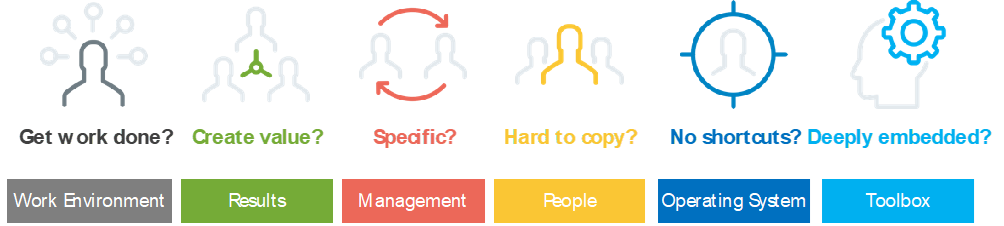
To be a true differentiator, management needs to fulfil the criteria of a competitive advantage. In line with strategic management professor Jay B Barney’s resource-based view of the firm and the VRIN criteria for competitive advantage (valuable, rare, inimitable and non-substitutable), our research has identified a model with six features to signal whether management qualifies as a competitive advantage. The standards represent steps with increasing demands, greater impact, and higher sustainability:
A viruses-free, collaborative, connected, and purposeful work environment for people to get work done.
A strategy with agile capabilities that safeguards performance, innovation, and growth for the organization to create value in a dynamic context.
People-centric management with principles for self-responsible people who make the client offering specific.
People who play the inner game to experience flow, which makes performance hard to copy.
An operating system with dynamic capabilities that prevent short cuts.
A toolbox with diagnostic systems for interactive leadership that is deeply embedded in culture.
Six questions offer the measurement of management as a competitive advantage:
Does the work environment enable people to get work done? Culture, purpose, relationships, and collaboration size up the work environment. An engaging work environment is a competitive advantage because it enables people to get work done.
Does your organization keep promises and create value? Performance, innovation, growth, and success determines organizational outcomes and reveal whether management creates value. Keeping promises is a competitive advantage because it establishes trust with clients, which is of greatest value.
Does your management create unique value? Review whether management applies a control-based (traditional management) or an enabling-based (people-centric management) approach to leading people. A people-centric management approach is a competitive advantage because it mobilizes resources in ways that make the client offering specific.
Do people use their talent to exceed expectations? Awareness, trust, choice, and focus of attention are the means for people to experience flow, perform at their peak and learn. Achieving flow more often – the state of high performance – is a competitive advantage that is hard to copy.
Is your operating system read for VUCA? Review the operating system to evaluate whether it is designed for a traditional or a dynamic environment. A dynamic operating system is a competitive advantage, as it prevents shortcuts.
Is your toolbox deeply embedded in culture? Do systems and leadership have interactive and diagnostic features? Their usage tells us whether the toolbox is rooted in the culture and is a competitive advantage.
What can you do to reach the standards?
Work environment: Remove the interference and offer the opportunity.
Strategy and results: Develop agile capabilities and clear expectations.
Management: Engage in people-centric principles for people to mobilize their resources.
People: Enable people to play the inner game for them to unfold their potential.
Operating System: Insist on dynamic features in support of people to master higher challenges.
Toolbox: Maintain a diagnostic toolbox for people to capture new opportunities and grow.
With these six features, management turns into a competitive advantage. Companies that have established agile, people-centric and dynamic capabilities outperform others by a huge margin. And, once developed, these capabilities permeate the entire organization – deeply embedded into the culture of the organization. They are a true competitive advantage that is hard to copy. That’s why every manager needs to worry about management.
About the Author:
Lukas Michel is the founder and CEO of Management Insights AG, Switzerland (management-insights.ch). He is the author of The Performance Triangle, Management Design, People-Centric Management, Agile by Choice, Diagnostic Mentoring and his newest book, Better Management.
If a picture is worth a thousand words, one included in a report being released this morning by the Interactive Advertising Bureau (IAB) should send shivers up and down Madison Avenue. The picture -- a chart delineating the status of various state consumer privacy legislation, is part of a report arguing that the biggest threat to that ad industry's "signal loss" isn't moves by Apple and Google to deprecate cookies and identity trackers, but the multitude of legislation.
“While Google’s decision to postpone the deprecation of third-party cookies until 2024 may feel like a reprieve, the industry is far from off the hook,” IAB CEO says in a statement included with an early look at the IAB's "State of Data 2022" report being released to the industry this morning.
The report, the sixth installment of a tracking study initiated by the IAB five years ago, estimates the U.S. ad industry already has lost "approximately 50% to 60% of the signal fidelity from third-party identifiers" due to steps taken by Apple and Firefox's browser, even before Google's deprecation of web browser cookies in 2024.
"This, coupled with impending changes to the regulatory landscape and potential actions by the Federal Trade Commission, demands an immediate re-evaluation of the ecosystem," the report asserts, noting that "the biggest immediate threat to the industry is inconsistent and poorly crafted state-level privacy legislation."
Specifically citing new laws or updates to preexisting ones poised to take effect in 2023, as well as various new international regulations, the report indicates most advertisers, agencies and publishers are not prepared to adapt.
Asked to to rate on a scale of one to five (with four/five representing "highly prepared"), advertisers scored themselves a 3.6, agencies a 3.8 and publishers a 3.6.
“I think preparation is really subjective right now," says an anonymous executive representing a "large brand" marketer quoted in the report. "We've been working on a variety of approaches to a strategy that continues to evolve because we haven't reached maturity for some of the things we consider viable for the future. I would say, despite all the progress we've made, it's irresponsible and premature of us to be anything further than that. I think we'll continue to be a 3 to 4 for another few years.”
"Consumers need transparency and control," concludes the IAB's Cohen, adding, "We need addressability and measurement solutions that are privacy-by-design and fully compliant with state, federal, and international standards.”
There are the Emmys — the awards — and there are the Emmy Awards. The first is a trophy; the second is a television show. The trophy, awarded to whatever and whomever a plurality of voters happened to watch and like or remembered liking before, almost always rewards good work, and it is nice when people or programs one admires are celebrated. But given a wealth of possibilities, it’s meaningless in terms of absolute quality — though on behalf of their favorites, many viewers will consider not winning a slap in the face. Those tweets will already be coursing through the cybersphere by the time you read this.
The Emmy Awards — “The 74th Primetime Emmy Awards” to give it this year’s full royal title — is just a television show, this year hosted by Kenan Thompson, to be enjoyed or hate-watched or looked at just to see what everybody’s wearing or completely ignored. And one can say in advance, as one inevitably says in retrospect, that it will be too long and fall somewhere on a scale between Not Completely Horrible and Surprisingly Good. Which, once again, it did, if a little closer to the former than the latter.
Along with a number of questions that maintain from year to year, one wondered beforehand whether the broadcast would address more timely industrial concerns and world events. Would “Abbott Elementary” win anything, striking a blow for broadcast television? (Yes! Sheryl Lee Ralph for acting in it and creator Quinta Brunson for writing it.) Would anyone mention the queen? (No, but “Succession” creator Jesse Armstrong threw some shade at the British succession and the new king: “Evidently, a little more voting involved in our winning than Prince Charles.”) Trump the hoarder? (Yes: Martin Short to audience: “I wish I could box you up and take you home like classified White House documents.”) Will Smith slapping Chris Rock at the last big awards show? Yes, but vague. Thompson to Oscar host Regina Hall: “Surprised she’s at another award show — girl, you brave.”



 Posted by