Tuesday, September 13, 2022

Sales Quotas: The Harm of the Annual Start-Over


                                                                                         Sales&Marketing Management


Sales Quotas: The Harm of the Annual Start-Over

Imagine the following: You’re given a job to build something and paid a set amount to do it. Your job is to keep building, and you’re paid for each one you complete.

Scenario #1: After each thing is built, you’re paid. The completed thing is then put on a shelf for all to see. You’re provided with another one to build. This repeats itself.

Scenario #2: After each thing is built, you’re paid. The completed thing is then disassembled in front of you and put back into its box. The box is then handed back to you and you’re required to build it again. This repeats itself.

In each scenario, it’s the exact same job and the exact same pay. But in which scenario are you more likely to remain engaged, motivated, and excited?

A similar scenario was explored in a research study using Lego models. Participants in Scenario #2 gave up much sooner than those in Scenario #1.

Sales Leadership and Quotas

In sales leadership, you tend to create a Scenario #2 environment for your reps after each deal, and especially after every year, right?

Your sales team is tasked with uncovering, cultivating and closing deals. For each one they close, they’re paid a commission. But without even speaking a word, you send them the message, “You’re only as good as your current (month/quarter/year).” They’re on to build their next deal. What they built is disassembled and forgotten. As the year ends, their attainment resets to zero along with all their peers, as though what they produced never happened. It’s time for them to rebuild.

In the process of starting everyone over each year at zero, the ironic thing is this: You’re actually penalizing your top performers and rewarding your bottom performers. Your top performers are no longer your top performers, and your bottom performers are no longer your bottom performers when everyone is back to the starting line at zero. What’s past is past.

Is that really what you want?

Rethink the Annual “Starting Over at Zero” Approach

As a selling professional, or really any human being, we do our best work when the aim of our work means more than just quota attainment. We do our best work when we can see the fruits of our labor, when we can make an impact beyond just the numbers.

You’d like to keep your top performers optimally inspired, right? Consider these ideas for inspiring your sales team members:

  1. Allow carryover credit. Is there a way for their quota to start based on their impact on the business long-term? Assumedly your top performers are paid higher than others already. Is there way for those team members to feel recognized for the work they’ve already done?
  2. Create a customer wall. One sales team has a wall in their office with all of their customer logos on it. You can take this further by including the rep’s headshot next to logo. Or, build pyramids of logos by the reps who’ve brought in the customers over their tenure. As companies and reps come and go, let the wall reflect that. It will create a source of pride for the reps who’ve helped build the company over the years. And selling deals with companies that stay long term can become another symbol on the wall.
  3. Give out achievement bonuses or titles. In my last role, I periodically ran a report that showed “lifetime achievement by rep,” and talked about the results in sales meetings. While that was well received, it was by no means enough. If it’s possible, provide accelerating bonuses or else titles to individuals based on their overall impact on the business.

I’m confident there are many other ways to reward top performers and grow the inspiration of your team. Importantly, establish practices that lead to high performance, low turnover, and more advocacy amongst the reps for you and your company.

  • Check out System 21© TV nation's oldest and most reliable and guaranteed sales training curriculum. 
  • For more information contact Michael
     Guld President System 21 804-356-7006.


Brand Extensions Are All the Rage in Fall Network Lineups

 A good idea for local-direct businesses to be shown the importance of being on air during these TV program extensions with maybe 1-2 commercials with the balance of the branding campaign in more affordable dayparts throughout the week-weekend.  Philip Jay LeNoble, PhD.

COMMENTARY

Brand Extensions Are All The Rage In Fall Network Lineups

Legacy networks are relying more and more on brand extensions of shows whose brand names are already familiar to their audiences.

The brand-extension trend has been around for years. But this fall, the number of new examples are piling up even more.

Out of the 95 hours of network prime time this fall -- ABC, CBS and NBC with 22 hours each, Fox with 15 and the CW with 14 -- the TV Blog estimates that 20 of those hours will be devoted to brand-name shows and their spinoffs.

Those 20 hours will be distributed over four of the above networks, with Fox the lone exception this fall.

A look at the fall TV schedules shows at least four brand-extension triple threats -- two on NBC and two on CBS.

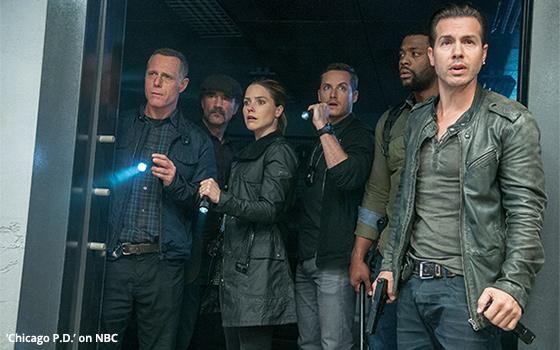
The two on NBC are the three “Chicago” dramas (pictured above) and three “Law & Orders.”

“Chicago Med,” “Chicago Fire” and “Chicago P.D.” (in order of time period) start their new seasons on Wednesday, September 21. They are starting their eighth, 11th and 10th seasons, respectively.

The three “Law & Order” shows start their new seasons the following evening -- Thursday, September 22: (in order of time period) “Law & Order,” “Law & Order: SVU” and “Law & Order: Organized Crime.”

Starting its third season, “Law & Order: Organized Crime” is the youngest of the three. “Law & Order” will be starting its 22nd season and “L&O: SVU” is starting its 24th.

All six shows are from executive producer Dick Wolf. He also happens to be the executive producer of one of the triple threats on CBS too -- the “FBI” franchise -- giving him control of at least nine hours of network prime time.

The “FBI” shows all have their season premieres on Tuesday, September 20. In order of time period, they are “FBI” (starting its fifth season), “FBI: International” (second season) and “FBI: Most Wanted” (fourth season).

CBS’s other franchise trio consists of “NCIS” (starting its 20th season) and “NCIS: Hawaii (second season) -- both premiering at 9 p.m. and 10 p.m. Eastern, respectively, on Monday, September 19. 

The “NCIS” shows are the only group of the brand-extension trios to be split up over two evenings. The third one, “NCIS: Los Angeles” starts its 14th season on Sunday, October 9, at 10 p.m. Eastern.

But those franchises are well-established. New to the brand-extension game this fall are “The Rookie” on ABC and “Walker” on CW. Both are extending their brands this season for the first time.

“The Rookie,” starring Nathan Fillion, premieres for its fifth season on Sunday, September 25, at 10 p.m. Eastern. Two nights later, on Tuesday, September 27, the new “Rookie” show -- “The Rookie: Feds” -- premieres at 10 p.m. Eastern.

Like “The Rookie,” in which Fillion plays a middle-aged man who joined the LAPD as its youngest rookie, “The Rookie: Feds” has a middle-aged woman (played by Niecy Nash-Betts) joining the FBI as the oldest rookie at the FBI Academy.

The “FBI” character was introduced on “The Rookie” at the end of last season. Unlike the other franchises on NBC and CBS, the two “Rookie” shows will not be seen on the same night, at least not now.

On the CW, it took only two seasons for “Walker” to spawn “Walker: Independence.” “Walker” is a modern-day reboot of the old Chuck Norris series “Walker, Texas Ranger.” It starts its third season on Thursday, October 6, at 8 p.m. Eastern.

The new “Walker: Independence” is being paired with “Walker” this season. The new one premieres on the same evening at 9 p.m. Eastern.

The new show is a prequel to “Walker” set in the late 1800s. In this one, a pioneering woman from Boston named Abby Walker encounters tragedy on the way west and settles in a small town in Texas called Independence.

On ABC, two new prime-time quiz shows can be categorized with the other brand-extensions shows -- “Celebrity Jeopardy!” and “Celebrity Wheel of Fortune” -- both stemming from the famed, long-running syndicated shows.

Both shows are premiering as regularly scheduled series this fall for the first time. The hour-long “Celebrity Wheel of Fortune” premieres on Sunday, September 25, at 9 p.m. Eastern, preceded by the one-hour “Celebrity Jeopardy!” premiere.

It's Time to Reset Your Facebook Ad Strategy


COMMENTARY

It's Time to Reset Your Facebook Ad Strategy

The following was previously published in an earlier edition of Marketing Insider.

Prime-time digital marketing is getting harder for middle-market companies. They’ve relied principally on Facebook to give them provable audiences, conversions, and metrics in exchange for an annual brief, a budget, and a credit card. With acquisition costs rising and engagement less transparent, Facebook isn’t a set-and-forget panacea anymore.

Marketers need to recalibrate to keep getting the most out of this essential channel. The key is shifting from trial and acquisition to retention and targeted customer development.

To do it, marshal the first-party data you’re already collecting from loyalty programs, sweepstakes, and direct sales online. Rather than simply analyzing the number of customers, amounts of sales, and average order value, use first-party data to profile demographics and tight customer segments. Then find more on Facebook by targeting interest groups and lookalike audiences.

Then take a page from traditional media and look at sales results.

The simplest way is to compare five or six markets where you focus Facebook ads versus those you don’t. You’ll see how you’re performing, and it will likely be better than you expected.

Considering overlaying Google Analytics and platforms like Triple Whale that filter Facebook and your website data to track conversions. These secondary pixels can reveal significantly more sales.

As costs increase, it gets relatively cheaper to court existing and past customers than to acquire new ones. Think engagement, not just conversion, especially for higher-priced products. A Facebook connection can become an email subscriber to nurture and convert directly over time.

Because Facebook changes so fast, best practices have become a moving target. It’s impossible to predict changes months in advance. What worked in January isn’t working today. Flexibility is everything now, so being prepared to react equals prepared to win.

So, incorporate these shifts into a monthly review and refresh on strategy. You’ll take a giant step toward future-proofing your investment.

Bottom line, Facebook still works for the marketing majority that depends on it. The platform’s reporting has diminished, but the audience is more active and valuable than ever. And the extra work required to realize the full value reopens the door to competitive advantage in what has become a level playing field. Separating yourself from set-and-forget competitors just got easier.

Too Many Political Ads This Season? It Could Mean TV Stations Cashing In


COMMENTARY

Too Many Political Ads This Season? It Could Mean TV Stations Cashing In

Too many TV commercials on TV? Well, that depends on your specific side of the equation.

Just talk to TV advertising executives. They want a lot more.

Kantar estimates local TV could get to $5.5 billion -- another new record. AdImpact says connected TV platforms will add another $1.4 billion.

Political advertising is a key part of any local TV station ad growth picture. But as you know, average citizens don't like it as much. YouGov, in a recent poll, asked if there were too many political ads on TV and got an obvious and predictable response: 64% said there were too many.

But the more revealing data showed that 5% said there were too few. Of course, we could assume those respondents were just a bunch of cheeky people, looking to get a rise.

Another 16% said their response was “about right” when it came to the number of TV political ads.

Even then, you wonder -- how do we define what is “about right,” please? Four per hour? Ten per hour? Thirty?

This type of survey makes you look for other wrinkles. Here’s one crease:

Which statement comes closer to your own view, even if neither is exactly right?

When someone gives $1 million to a super PAC…

-79% answered: “They want something big in return from the candidates they are trying to elect.”

- 21% answered: “They are simply supporting candidates with whom they agree, which is their right.”

So there’s skepticism? Well, that's good. Political polling has a lot of mystery attached to the process for many of us.

Some analysts feel Republican-inclined voters can shy away from pollsters, who perhaps should not be trusted -- while Democratic-inclined voters, on the other hand, are more happy to offer up their insights, and as a result, their data.

Social media has been further clouding up all these issues. Hard-liners will just call it mistrust and misinformation.

So whatever poll you see on television -- along with those TV commercials -- take it with a grain of salt. Or maybe a shakerful.

Perhaps a salt mine.

NFL TV Advertising Won't Save National TV Ad Revenue in Recessionary Economy


COMMENTARY

NFL TV Advertising Won't Save National TV Ad Revenue In Recessionary Economy

Don't count on the NFL to try to carry the load for national TV advertising -- in terms of ever higher revenue or overall gains in 30-second unit pricing.

Like anything in sports and in winning national TV advertising business, you need a team.

While national TV advertising will recover somewhat in the fourth quarter of this year -- up 2%, due to continued strong linear TV NFL programming -- there will be a 5% decline for all of 2023, according to estimates from MoffettNathanson Research.

Apart from playoffs and the Super Bowl in January-February next year, the league doesn't get going again until September. And there are no Olympics scheduled next year.

MoffettNathanson, a media-focused stock market analyst group, said it is “concerned with how the economic backdrop will impact 2023 national TV advertising after football season finishes and forecast 5% declines (down 4% ex-Winter Olympics compares) in 2023.”

It added that a “full recession” could decrease its estimates by "at least an additional 10%." In particular, it is concerned over new, highly touted advertising-supported options from Netflix and Disney+ that are set to launch by the end of this year.

“We expect the majority of these ad dollars will come at the expense of cable networks although we remain concerned that some smaller share will shift away from the pure AVOD services.”

In an earlier estimate from the company, MoffettNathanson disclosed that domestic advertising video-on-demand (AVOD) services from four major providers -- Hulu, Roku, Pluto TV, and Tubi -- would see much smaller growth in the fourth quarter of 6% to $1.7 billion -- versus a 35% gain the first quarter of 2022.

For all of 2022 -- sans 2021 Olympic advertising-included comparisons -- total national TV advertising is projected to slip 2% to around $84 billion.

Even with expectations that AVOD/FAST streaming services will continue to climb -- albeit slowly -- it will not lift all boats amidst a recessionary economy. Just consider that tiny 6% bump for those four AVOD services.

Nor will big-time sports.

TV business analysts will keep talking up how sports are ready to make ever bigger contributions to streaming platforms -- especially to premium live national TV advertising unit pricing.

At the same time, there will be sports TV references, excuses, and/or explanations with regard to overall national TV advertising results.

Better have a new game plan. Many big touchdowns will be tougher to come by.

Tuesday, August 30, 2022

New Multitasking Conundrum: Watching 4 TV Live Streams, Spots At The Same Time


COMMENTARY

New Multitasking Conundrum: Watching 4 TV Live Streams, Spots At The Same Time

Modern TV viewing has always been a complicated operation, with multitasking of other media and other device distractions.

Now, YouTube TV will test the boundaries of media attention. Viewers to the virtual pay TV service will soon be able to watch four live streams simultaneously in a feature called “Mosaic Mode.”

This isn't so revolutionary. Other pay TV providers have had this for years -- including DirecTV which offers HD Sports Mix where it shows six network transmissions at the same time on a channel, where you can click on one of the six to access that network.

To an extent this is a subset of DirecTV's overall TV program guide where you can select and/or record TV episodes. The downside: Only one audio of those six channels is available on HD Sports Mix. (Hey, that makes sense -- I already have my wireless earbuds in while listening to Apple Music on my phone!).

Another new feature for YouTube TV includes an adaptation for YouTube Shorts -- the company's TikTok-style short-form video service -- when viewed on large screens. (YouTube Shorts was originally intended for mobile devices).

Many of these new features for YouTube TV are intended to do more to keep virtual pay TV subscribers around longer -- and perhaps not flee to a world of exclusive premium streaming apps/platforms. And the “Mosaic Mode” most likely would also be used as a promotional tool.

But can this actually be used to increase advertising revenue? Indirectly. Near-term, I am just wondering exactly what kind of real-time engagement marketers might expect getting when their commercials run opposite some -- or all -- other TV messaging.

Talk about your TV ad clutter!

I am guessing that now the IAB will need to consider lowering its viewability standards of digital advertising. Currently, that's when 50% of the ad's pixels are visible in the browser window for a continuous one second.

I think a nano-second duration might work here.

Streaming - No Big Deal? Look At What NBC Is Considering


COMMENTARY

Streaming - No Big Deal? Look At What NBC Is Considering

If you are shrugging over the news that streaming now has the leading share of TV viewing -- a bit higher than cable, and considerably more than broadcast's share -- the news of NBC considering a cutback in prime-time programming should make you sit up and take notice.

NBC could be giving back the 10 p.m. to 11 p.m. hour to its affiliate stations to program. That would leave NBC effectively airing just 8 p.m. to 10 p.m. time periods -- just as the Fox Television Network has done since its inception in 1986.

For years -- even before the rise of streaming -- TV executives complained that the 10 p.m. hour was a place for time-shifted programming -- mostly due to home DVR activity.

Now, this trend has expanded greatly and virtually all TV network's prime-time lineups can be "time-shifted" --- through streaming platforms, many of which are owned by the same companies operating linear TV networks.

So it is no longer just competition for linear TV  -- it's cannibalization. And that’s the rub.

This follows the news that NBC is making all linear TV prime-time episodes available the next day to air on NBCU's Peacock. This is not completely a ground-breaking move, as other TV networks-based media is also doing this.

This makes sense when considering the soaring demand that now exists for streaming platforms from consumers.

For all the shock the NBC prime-time news brings, the downside is that Peacock as a still nascent streamer will continue to post major losses for some time, now over $2.5 billion on an annualized basis.

All the while, NBC Television Network is still profitable. But now with less prime-time content, this would also mean lower distribution fees for NBC, as well as lower advertising revenue for its traditional channels

At the same time, NBC continues to spend heavily on linear TV prime-time content -- in other areas: Sports, most recently making a deal to carry Big Ten college football at an estimated $350 million a year in sports rights fees. This follows a $2 billion-plus-a-year deal that NBC made in 2021 for “Sunday Night Football.”

What's left? What Fox had anticipated in scaling back its entertainment prime-time content over the last few years: Mostly sports.

The question is: What will marketers pay to keep their lower entertainment linear TV program association, five or ten years from now?