Tuesday, August 23, 2022

Crossing The TV 'Rubicon': Cable TV July Viewing Sinks 19% -- Down 32% Over 2 Years


Crossing The TV 'Rubicon': Cable TV July Viewing Sinks 19% -- Down 32% Over 2 Years

While streaming and cord-cutting continue to sink all legacy TV, cable TV networks in particular have been taking the brunt of that activity -- down 19% in total day 18-49 July viewership versus a year ago, according to media research company MoffettNathanson Research.

Over a two-year period, the picture is worse. MoffettNathanson, analyzing Nielsen results, says cable TV networks have declined 32%.

Broadcast has not been spared either -- it was down 39% this past July, due to comparisons to July 2021, which included one week of the Tokyo Summer Olympics and late post-season NBA and NHL games.

Looking over a two-year period, broadcast is down 18% in July.

“More troubling to us is the fact that broadcast's loss of key events wasn't cable network’s gain, as viewers did not return to cable,” writes Michael Nathanson, senior research analyst of MoffettNathanson Research.

All this points to continued trouble for big cable TV network groups -- such as NBCUniversal and Warner Bros. Discovery, down 29% and 24% respectively for the month. This followed similar declines in June of this year -- a 29% sinking for NBCU, and 32% for Warner Bros. Discovery.

This follows the recent news from Nielsen's The Gauge report for July -- which shows streaming platforms now leading for the first time -- cable TV in terms of share of total day persons two plus viewing with a 34.8% share to cable’s 34.4%. Broadcast was at 21.6%.

Looking at this dramatic result, Nathanson notes: “The Rubicon has been crossed.”

He adds: “These significant linear cable network ratings challenges should put further pressure on the ad dollars each media company relies on. Add in a potentially deteriorating macro environment and it becomes hard to find cause for optimism for many legacy cable network owners.”

Sales Outcomes and Product Marketing Are Interconnected


Why the success of sales relies on a return to core product marketing practices


In a rapidly changing business and economic environment, companies face even more urgent pressure to boost sales, strengthen customer engagement, and diversify opportunities. This “all-hands-on-deck” moment requires close collaboration between sales and marketing teams to ensure that limited resources are leveraged properly to drive sales outcomes.

Simply put, without alignment between sales and marketing, businesses cannot be successful as priority misalignment, poor lead quality, and infighting reduce organizational effectiveness.

Economic Downturns Exacerbate Inefficiencies and Misalignments

Economic disruption exposes inefficiencies and missed opportunities. As the sardonic expression goes, “when the tide goes down, you find out who is swimming without clothes on.”

In other words, inefficiencies and misalignments that were covered when business was booming are exposed when things slow down. This includes:

Misalignment between marketing goals and sales realities. There must be parity between the solution and vision being marketed by the marketing team and the ones that sales feels they can realistically sell. This requires effective communication and agreement between the executive team and the product, marketing, and sales teams to ensure the business is successful.

Misalignment between messaging and target audience. Product marketing teams must collaborate with the sales team and even customers to get feedback to ensure they are crafting the best possible message. For instance, if marketing messaging targets company CEOs but the sales team is most successful selling to mid-level decision-makers, the organization will have difficulties driving new business. Companies need to clarify their market segment and target audience so marketing and sales teams can work together to support critical outcomes.

Misalignment between lead generation and sales initiatives. Poor lead quality can negatively impact pipeline and revenue potential. If marketing and sales are not aligned, marketing leaders are more likely to miss the mark in securing the right leads, ultimately diminishing sales potential.

As businesses grapple with shifting operational realities, it’s especially important to align marketing and sales initiatives, proliferating growth through unified investment and resource deployment.

Product Marketing Drives Sales Results

​​Product marketing is essential to the success of a business. Unfortunately, product marketing teams are chronically understaffed, something that is even more apparent as companies contend with persistent hiring challenges in a tight labor market.

According to a recent survey of senior decision-makers, 67 percent of product marketing teams say they need to add personnel or reduce projects to sufficiently support sales enablement goals.

Most importantly, this reduces their capacity to develop a solid Go-to-Market (GTM) plan, which should include:

  • Determining market segments
  • Crafting an ideal customer profile (ICP)
  • Identifying buyer personas and pain points
  • Assessing value propositions and messaging
  • Analyzing competitive differentiation
  • Producing a marketing execution plan

If product marketing isn’t fully staffed, an organization will find it immensely or even prohibitively difficult to achieve its business objectives.

In response, nearly 90% of surveyed product marketing leaders say they plan to leverage external expertise and strategic partnerships to support product marketing initiatives. This is especially important when companies have a fast-approaching product launch or campaign, requiring sales teams and channel partners to be fully trained and ready to drive sales.

Launching a new product to the market has critical components, including a product launch plan and strategy to ensure its overall success. These efforts produce messaging/positioning for the product, understanding of the target buyers, SWOT analysis, competitive intelligence, and program management of the launch. Without product marketing, it will be difficult to have an effective product launch. It is a similar issue with campaigns, where product marketing helps the marketing team target the right buyers with relevant messaging and content which help generate quality leads.

Ultimately, when product marketing teams have the right personnel and financial resources, they are best positioned to support sales enablement and content marketing. Sales enablement ensures that sales teams understand the product, target audience, personas, value proposition, objection handling, competitors, and more.

With a looming economic downturn, it’s even more important than ever to have sales and marketing in sync for optimal outcomes.

Working Together to Promote Sustainability

Product marketing is one of the main functions within marketing that helps salespeople succeed. As companies battle shifting economic realities and novel operational challenges, aligning sales and marketing teams can be a competitive differentiator, separating agile companies ready to meet the moment from those left vulnerable by misalignment and poor prioritization.

Simply put, sales and marketing are two sides of the same coin. Discerning leaders will ensure that both are well-resourced and closely connected to help their business thrive in any environment.

Friday, August 19, 2022

Political Ad Records This Season? More Coming In 2024


COMMENTARY

Political Ad Records This Season? More Coming In 2024

Rising midterm political advertising looks to easily outpace 2018 midterm revenue this year -- up to $9.7 billion, according to an AdImpact estimate. But it doesn't stop there.

At that level, it will also easily pass the 2020 Presidential record total of $9.0 billion. In recent history, these levels were unheard of for midterm election years. (The 2018 midterms totaled $3.96 billion).

Local TV station owners -- big beneficiaries of the every-other-year spike in political advertising -- are now licking their lips in anticipation.

But let's look further -- to the 2024 Presidential election season. All that could mean even higher results.

TV stations might have little to no room for all kinds of marketers -- from those high-priced automotive marketers to rising sports betting services, as well as regular pharmaceuticals or finance/insurance advertisers.

Imagine if Donald Trump makes another attempt to run again, with the history looking like this: Losing the popular vote by nearly 2.9 million in 2016 to Hillary Clinton, and then, in 2020, losing the popular vote by 7 million to Joe Biden. What if two years from now, he could lose by 10 million?

All this brings up advertising. Can the GOP do what it has virtually always done through the year -- raise more political ad commitments than their Democrat opponents?

Now think about "earned media." Facebook and Twitter still maintain permanent suspensions of Trump accounts due to his January 6 insurrections posts/activity. Recently, Facebook said to Politico that it won't speed up a decision on whether to reinstate his account.

That means he needs to find another way to post many more social missives. Think his Truth Social is going to be enough? What about big TV news coverage? The Fox News Channel seems to be cutting back on Trump coverage.

To overcome all of this there will need a lot of political messaging -- paid, earned media, or otherwise.

TV stations need to accommodate political advertising, per FCC requirements. The collateral damage is that high-priced automotive marketers, regular pharmaceuticals or finance/insurance advertisers and sports betting services, may get pushed aside.

No problem. Down to the wire -- in crunch time -- political big dollars seeking a needed share of voice will find happy and ever-hungry TV stations -- and TV news channels -- ready to accommodate.

Wednesday, August 17, 2022

THE ECONOMIC CASE FOR TV ADVERTISING DURING A RECESSION


SPONSOR CONTENT FROM Marketing Architects

THE ECONOMIC CASE FOR TV ADVERTISING DURING A RECESSION

    If there’s a silver lining when recession storm clouds gather, it’s that certain advertising opportunities provide brands a chance to get ahead.

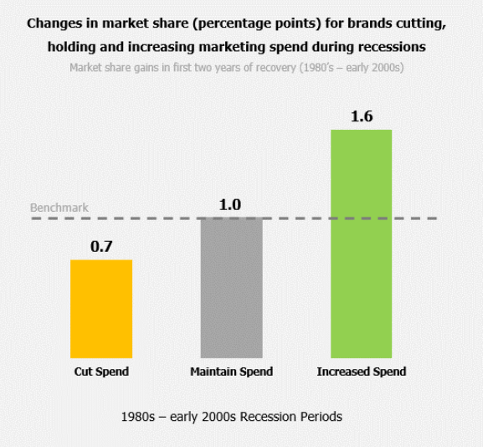
    Advertising during an economic downturn has well-proven benefits, including staying top-of-mind for purchase decisions, rebounding quickly, and even gaining market share. And because many large-scale advertisers pull back during downturns, brands that continue to spend see their ads grow even more efficient. There’s less competition for both media and consumer attention.

    So why is marketing typically the first budget cut when analysts predict trouble on the horizon? Marketing principles don’t change just because the environment does. And historical examples show advertising grows in value during downturns. When times are good, advertising is important. In times of uncertainty, it’s crucial.


    When times are good, advertising is important. In times of uncertainty, it’s crucial.


    So cutting spend isn’t the right move. But deciding how to allocate that spend may require a new strategy. Brands rightly prioritize performance, focusing on the most efficient marketing channels. In practice, however, this tends to mean shuffling budget away from traditional channels toward digital. It’s understandable. Digital is easily measured. Its inherent accountability is reassuring for those worried about making every dollar count. But digital on its own isn't necessarily the best use of ad dollars.

    Traditional channels, especially TV advertising, are ideally suited for driving business outcomes during an economic downturn. This statement may seem counterintuitive, but here’s why it’s true:

    1)     Consumers trust traditional channels.

    When uncertainty is high, trust matters even more for brands. And consumers still trust traditional channels far more than digital or social. 80% of customers trust TV advertising to inform purchase decisions. That's compared to just 61% trusting paid search ads and only 25% for online display. Double the number of people say TV advertising leaves a positive impression than those that say the same of digital. When establishing relationships with customers, TV gives brands an inherent advantage.

    It's no surprise, then, that traditional ad spend is on the rise for the first time in a decade. More brands are prioritizing the built-in credibility of traditional media. Plus, traditional channels can help brands stand out in competitive categories and diversify marketing mixes overly reliant on digital.

    2)    Awareness is key for getting the most from your ads.

    Part of the rationale behind recession advertising is that you’re more able to drive awareness because there’s less competition. But digital channels alone don’t create the same top-of-funnel awareness as TV. So when brands continue spending but don't consider awareness, they fail to make the most of that spend.

    TV advertising is still the best channel for brand building. But even more importantly, TV can successfully drive awareness for your brand without sacrificing performance. TV also increases the effectiveness of other channels—its “halo effect” can dramatically boost digital performance.

    3)    Efficient media rates increase the likelihood of success on TV.

    Many brands avoid TV because of the high costs. But as large-scale advertisers cut back their spend and drop buys, that inventory becomes available at highly efficient rates. Based on predictions of an upcoming recession, such openings are possible in the second half of 2022, even as general media prices increase.

    The challenge, however, is finding these opportunities as they arise. Brands should leverage a media partner using artificial intelligence and automation to identify, and capitalize on, newly available inventory. Because as media efficiencies increase, so does a brand’s chances of achieving success with TV advertising.


    As media efficiencies increase, so does a brand’s chances of achieving success with TV advertising.


    It may seem odd to think about a recession being the right time to launch TV, especially for brands new to the channel. But successfully launching a TV campaign can mean gaining an invaluable growth driver for your business.

    Although this is an opportunity with a time limit, testing TV when there's a built-in advantage can help brands prove the value of the channel while identifying what works for them. These learnings can then drive awareness and performance on the channel long-term. Because TV is a channel capable of future-proofing your brand, whatever comes next.

    July Posts Worst Ad Decline In Two Years, Big Categories Lead Contraction

     National and local transactional revenue dips are further examples of why local-direct businesses are key to revenue growth going forward. Philip Jay LeNoble, PhD.

    July Posts Worst Ad Decline In Two Years, Big Categories Lead Contraction


    The U.S. advertising marketplace contracted 12.7% in July versus the same month a year ago, marking its first double-digit rate of decline since July 2020, according to a MediaPost analysis of data from Standard Media Index's U.S. Ad Market Tracker.

    Compared with July 2020, which was the tail-end of the COVID-19 ad recession, the U.S. ad market was up 29.7%.

    Smaller ad categories continue to be sustaining ad spending better than the largest ones. While the top 10 ad categories declined 14% in year-over-year ad spending in July, all other categories contracted only 11%.

    According to SMI's analysis of its core data, specific categories showed mixed results for July, but overwhelmingly contracting ones.

    Other than travel (+28%), apparel (+4%), and retail (+1%), the other categories were all in decline, although consumer packaged goods slid only 0.1%.

    The 23% decline in entertainment and media category spending in July is noteworthy, given that it is Hollywood's big theatrical season and conventional wisdom is that its theatrical business has been rebounding. Media also is surprising, given the supposed streaming category marketing war.

    Noting that July was the second consecutive month that the major categories reduced their ad spending, SMI's analysts commented:

    "The number of growing sectors continued to dwindle, reaching four this month, compared to five last month, and ten in the first quarter 2022 months.

    "Travel, apparel & accessories, retail and CPG category groups expanded and sat at peak levels for the month, representing an opportunity for media companies.

    "Travel represented the strongest lift year-over-year, a position held every month from April 2021 onward. Travel expenditures have quadrupled vs. 2020 pandemic levels."


    Linear TV Ad Spending Fell 1% in June: SMI Reports

    Broadcasting & Cable 

    Linear TV Ad Spending Fell 1% in June: SMI Reports

    A pile of money
    (Image credit: Chris Clor via Getty Images)

    Advertising spending on national linear TV fell 1% in June to $3.138 billion, according to new figures from Standard Media Index.

    Spending on cable TV dropped 12% to $1.946 billion, while broadcast increased 23% to $1.05 billion, SMI said. Syndication grew 33% to 142.2 million.

    The June performance left linear TV spending for the second quarter down 1% at $9.617 billion. Cable was down 1%, broadcast was down 2% and syndication was up 6%.

    For the quarter spending on sports was up a whopping 21%, mostly because the NBA Finals were played in June this year versus July last year. Entertainment programming was down 5% and news was down 7%.

    Spending resulting from last years strong upfront generated a 3% increase in the quarter, while scatter was down 15%. Direct response spending was down 4%.

    Media Co. Share of Market June SMI

    (Image credit: Standard Media Index)

    The drop in cable spending meant that Warner Bros. Discovery’s share of the maret fell 18% in June from a year ago to 21%, still leading all media companies. The Walt Disney Co. was up 11% to 19%. Comcast was down 7% to 18%, Paramount was up 7% to 16% and Fox was up 18$ to 5%.

    Top spending ad categories in June were consumer packaged goods, down 13% year over year, pharmaceuticals up 0.2%, general business, up 13%, financial services, down 22% and tech, down 7%. Entertainment and media was up 34% and autos were up 7%.  ■

    Sinclair's Bally Sports+ Streamer to Launch in September

     Television News Daily

    Sinclair's Bally Sports+ Streamer To Launch In September

    With the coming NBA and NFL season, Sinclair Broadcast Group Bally Sports+ streaming services will launch its long-anticipated Bally Sports+ streaming service next month for $19.99 a month, across all 19 Bally Sports-brand regional sport networks on September 26.

    Subscribers will have access to live, local NBA and NHL broadcasts, pre- and post-game shows, regional college football and basketball and high school sports, among other content.

    In an SEC filing a year ago, Sinclair predicted Bally Sports+ could eventually attract about 4.4 million subscribers and bring around $2 billion in annual revenue.

    The service will be distributed on mobile and tablet devices operating on iOS or Android, Android TV, TvOS, and BallySports.com.

    This follows the June pre-launch of Bally Sports+ in five regional markets -- Bally Sports Detroit, Bally Sports Kansas City, Bally Sports Florida, Bally Sports Sun and Bally Sports Wisconsin.

    In May, Diamond Sports Group -- the regional sports network (RSN) unit under Sinclair -- hired Michael Schneider, a senior Hulu marketing executive, to be the chief operating officer and general manager of Bally Sports+, its new direct-to-consumer (D2C) sports division.

    Diamond Sports Group has been working for a few years to solve problems among traditional pay TV providers, some of whom have backed out RSN carriage-- due to weak profit margins.

    This includes a number of virtual pay TV providers that dropped Bally Sports RSNs -- including Hulu + Live TV and YouTube TV.

    For its second-quarter period, Sinclair's overall advertising revenues sank 25% to $366 million, primarily due to lower results from Sinclair' Diamond Sports Group. Distribution revenue was also impacted, sinking to $430 million -- less than half the total of $1.1 billion it reported a year ago.

    Better news for Diamond Sports in April was Sinclair's company-wide renewal of the retransmission carriage deal for its TV stations with Charter Communications service. This included carriage of Bally Sports RSNs.