Monday, July 25, 2022

Marketing Signals the End of Times -- Or Maybe It's Just Pubic Hair


COMMENTARY

Marketing Signals The End Of Times -- Or Maybe It's Just Pubic Hair

According to some, we are in the last throws of the Western democratic industrial model. Plagues, crumbling economies, migration, inequality of access to food, shelter, income and healthcare, as well as climate change, are all indicators of the beginning of the end, say doomsday believers.

Some people like to add that the end must be near, because we are living in a decadent society which is losing touch with its morals and basic believes. And I am almost ready to believe them when I take the following, totally subjective and self-observed occurrences, into consideration.

First proof point: since going off cable, and full-time on streaming, my family is now being held hostage by the power of poorly functioning ad serving algorithms. During the live evening news, watched via the app of our local news station, we sometimes get served the same Chevy Equinox or Chevy Truck Month ad seven times, back-to-back. In three or more consecutive breaks. I do not know if Chevy has tested this tactic as successful, but I hate Chevy for it, along with its media agency and my local news station. This is what you get from a crappy programmatic algorithm, a lazy agency and station, and a non-capped reach and frequency incentivized media plan. It demonstrates a pure lack of media plan management morals.

Second proof point: ads on TV for stuff I did not know needed ads on TV for. Or needed mentioning at all. There is Pete Davidson selling a product called “Manscape." It is a shaver you are supposed to use for all your body hair. Everywhere.

At the same time, P&G is singing the praises of pubic hair in a catchy tune for Gillette, wanting to “unshame” the having of body hair. I think we can agree the end of times are near if we both promote the having of, and the not having of bodily hair, in TV ads, in one ad break.

Third proof point: spending money on celebrities and then giving them splashy marketing titles, as if the sponsorship deal really is some kind of employment agreement. The latest I saw reported on Bloomberg: “Kate Moss has been appointed creative director of Diet Coke as the brand celebrates its 40th year. The catwalk star, 48, will partner with some of the world's leading fashion houses as part of a new campaign to promote the drink using the slogan "Love What You Love."

To use a British description: what a load of bollocks. What really happened here is “we paid Kate Moss to appear in our ads and some of our events." Diet Coke is trying to pretend something that isn’t what it is. Surely another sign, right?

Marketers continue to feel overwhelmed. Mediapost reported on that this week: “Marketers are overwhelmed by their workloads. For one thing, they have far too many sources to wade through to get the information they need, according to Marketing Trends Report, a study from Airtable.” And they continue to be fired and replaced faster than you can say “integrated marketing strategy”.

I hope that the examples mentioned here are merely a proof point of stressed-out marketing leaders who got lost wading through far too many sources for data and insights, and that it is not the beginning of the end of marketing and Western Civilization as we know it.

And that is a positive, right?

Tuesday, July 19, 2022

Strong Correlation Between TV Viewers' Attention, Marketers' Brand Gains: Survey


Strong Correlation Between TV Viewers' Attention, Marketers' Brand Gains: Survey

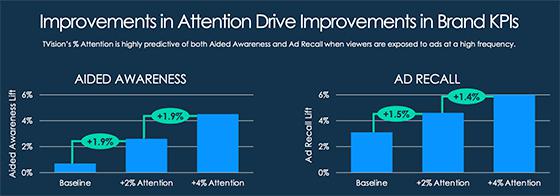
There is a direct “one to one” correlation between TV commercials' "attention" score and marketers' all-important "brand lift" measure, according to a survey from TVision, a TV measurement company and Upwave, an advertising-tech brand-measurement company.


“We found proof of strong correlations,” said the companies, “between the percent of attention... and lift in aided awareness and ad recall,” TVision measures second-by-second, person-level data about how people watch TV using “eyes on the screen” technology.

"Aided awareness'" is the percentage of respondents aware of a marketer's product, brand, or advertising when asked.

For example, if a campaign reaches 100 million people, which gets a 38% score in “attention” -- instead of 34% -- that means an extra 4 million people recognizing one's brand.

Digging deeper, the research also notes that “attention” can vary greatly between high and low placements depending on daypart, network, and program. For example, programming can show a 43% difference, while networks can show a difference of 23%: and dayparts, 9%.

TVision and Upwave research comes from linear regression analysis of more than 40 national campaigns between the fourth quarter of 2019 and the first quarter of 2022.

Campaigns from ad categories include those in finance, consumer packaged goods, fast food, automotive, retail, telecommunications, and pharmaceutical.

When U.S. Economy Gets Rough, Moms Still Spend


COMMENTARY

When U.S. Economy Gets Rough, Moms Still Spend

In 1992, Bill Clinton was elected President. The media was quick to attribute the success of his campaign to capturing the votes of “Soccer Moms.” 

It was the first time the media had focused on women with children as a collective powerhouse of voters, consumers and decision makers. Never before had so much media attention shined on moms until 2022 -- the year of formula shortages, angry school board meetings and professional women who hold positions as first responders and educators.

As someone who has written about the power of moms since 1999, I’d like to say the attention they’re garnering today is a long time coming.  It’s unfortunate that it took a pandemic, formula recall, $5/gallon gas and rising prices at the grocery store to do it.

Nonetheless, as a marketer, congratulations to the brands who have decided to put their advertising dollars focused on tapping into the $3.1 trillion moms spend collectively in the U.S. economy each year. 

I’m not accusing brands of ignoring moms as purchasers. I believe that companies such as Proctor & Gamble, Kimberly Clark and Kellogg’s have long known that moms are their main target as buyers.

However recently I’ve seen traditional television ads focused on marketing to moms by the likes of Bank of America, Swarovski, Carhartt, and Google.   I can’t help believing that recent headlines highlighting the innovative ways moms are coming together to source formula or moms developing less expensive solutions to every day consumables have contributed to the awakening of marketing departments across Fortune 500 global brands toward moms as consumers.

If your company is still sitting on the sideline trying to figure out how to better tap into the buying power of moms, here’s a few tips.

Start by listening to your customer. It’s so easy to do this in today’s world of social media.  Search hashtags related to your product and find out what moms are saying about you and your competitors. Resist the urge to jump into the social conversation with comments, likes or shares until you clearly understand the mom's point of view.

Establish a long-term relationship with mom consumers. Executing a one-off campaign won’t work. Moms want to have a relationship with the brands, products and companies they do business with. This can be following them on social or serving as an ambassador in their local market.

Create content that’s relevant and timely. Sending a back-to-school coupon is great, but sending it out in September misses the target. Moms begin preparing for back to school in July, because most schools south of the Mason Dixon line return to the classroom in August.  Unfortunately agencies and media based in New York City recognize back to school as the day after Labor Day, when their local students return to the classroom.  Point is, good content delivered at the right time is a great way to establish a relationship with moms.

Use influencers wisely. Seek out mom influencers with high engagement rather than large numbers of followers. The power of word-of-mouth marketing among moms is their interactions with each other. Don’t be fooled by influencers or agencies that sell you on impressions.  If no one is listening, it doesn’t matter how many moms on their feed.

As consumers begin to tighten their spending, it’s a good time to target moms, who control America’s household spending.

Local OTT Advertising To Hit $2B, Doubling 2020 Total


Local OTT Advertising To Hit $2B, Doubling 2020 Total

Local over-the-top (OTT) TV advertising is estimated to sharply climb to $2 billion in revenues by the end of this year -- up from $1 billion in 2020, according to a new study.

The research comes from BIA Advisory Services, a local media consultancy, and is sponsored by Vevo, the digital music video network.

The authors say the average compounded annual growth rate (CAGR) over the past two years for OTT was 43% -- which makes it the fastest-growing local media.

After local TV OTT comes local digital radio, with an annual growth rate of 24.3% over the last two years, followed by local mobile at 20.8%, local digital magazines at 17% and local PC/laptop advertising at 16.6%

The top advertising local OTT category for 2022 is projected to be general services, at $337.2 million. This includes legal/law firm businesses, as well as plumbers, HVAC contractors, utilities, and funeral home operators, to name a few.

The second-biggest local OTT category is automotive, at $273.2 million, followed by restaurants ($203.4 million); health ($202.8 million); and finance/insurance ($182.8 million).

Looking at six U.S. regions, the biggest growth was in Mid-Atlantic markets, with 53% CAGR, and the lowest was the Pacific Southwest, 39% Other regions were as follows: Northeast (47%), Southeast (40%); Midwest (42%) and Pacific

The Expansion Is Over: Ad Economy Recedes For First Time In 16 Months


The Expansion Is Over: Ad Economy Recedes For First Time In 16 Months

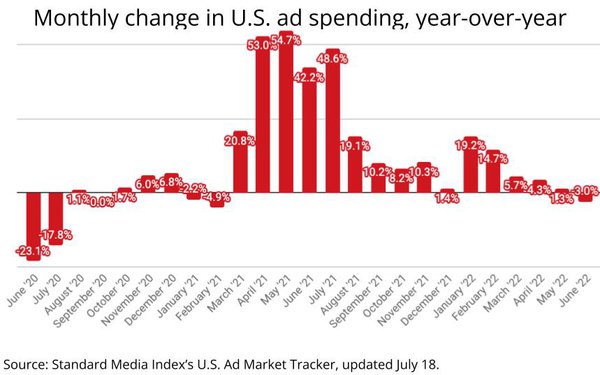
The U.S. ad market contracted 3% in June, marking the first decline since February 2021, according to a MediaPost analysis of data from Standard Media Index's U.S. Ad Market Tracker.

The contraction follows a steady deceleration of the U.S. ad market's expansion coming out of the COVID-19-related advertising recession.

Relative to June 2020, which fell 23.1%, June 2022's ad market index actually expanded 36.6%.

Most of the June 2022 contraction was due to reductions by the nation’s largest advertising categories. Spending by the top 10 categories fell 5.2% in June, while all other categories actually expanded 1.2%.

Most of June’s erosion occurred among traditional media spending.

Among media, the erosion was mostly among traditional media, which contracted 16.6% from June 2021, while digital expanded 8.6%.

Digital’s share of all media spending rose to six points to 62% in June

Wednesday, July 13, 2022

Gen Z Wants Video and Personalization, But Is Less Interested in Email


Gen Z Wants Video And Personalization, But Is Less Interested In Email

Email is the preferred communication channel of consumers: 52% choose it, versus a distant 17% for text and 14% for online accounts.

But young people are not as fond of it as their elders, according to the 2022 Digital Communications Market Study, a new report from Idomoo. 

The rate of email preference varies greatly by age cohort: 

  • Generation Z — 29%
  • Millennials — 40% 
  • GenerationX — 58%
  • Baby Boomers — 64%
  • Silent Generation — 67%

Despite all that, the study seems  more focused on showing the growing popularity of video.  

Of those polled, 62% want more video, but 74% rarely or never receive it. 

The study also found that video is the preferred medium for brand communications, especially among Gen Z and high-income earners.  

For instance, 40% of Gen Z and 61% of the high earners, who presumably are older, are most likely to want personalized video.  

In addition, 59% of Gen Z and 47% of high earners are most likely to desire video interactivity. And 69% of Gen Z and 33% of high earners want videos they can customize. 

The similarity is also seen in trust in brands. 

Overall, 55% of consumers trust brands to keep their data secure, versus 16% who don’t trust them, 26% who are neutral and 4% who don’t know. And 72% will share data in return for personalization. 

Gen Z and millennials are 20% more likely to share information, and high earners are 25% more likely. 

It could be that Gen Z and the high earners feel more free to let their imaginations wander. 

When do people expect a brand to understand their needs and interests and tailor content for them? They say: 

  • Before I have a relationship with them — 13% 
  • When I first sign up/create an account — 34%
  • During onboarding — 33%
  • After a few months or years of being a customer — 40%
  • Once I’ve opted in for a rewards or loyalty program — 24%
  • When I cancel or stop being a customer — 7%

And how should brands show they understand customers? They expect to be recognized by: 

  • Name — 51% 
  • Past purchase behavior — 44%
  • Interests — 35% 
  • Location — 22%
  • Device — 22%
  • Future goals — 15%

Meanwhile, 71% more people saw an increase in personalized brand communications since the pandemic began, versus those who said they did not see an increase. Americans were 20% more likely to note an increase.  

Continuing the country comparison, 30% of UK consumers don’t feel valued by brands, compared to 20% in the U.S.

Can this be the reason? Only 13% of UK consumers have ever received a personalized video, compared to 22% in the U.S.

On behalf of Idomoo, Arlington Research surveyed 2,000 consumers in the U.S. and UK in January 2022. These respondents have a relationship with a brand. High earners are defined as those with $150,000+ annual income in the U.S., and £75,000 in the UK. 

Senators Press Meta Over 'Censorship' Of Abortion Posts


Senators Press Meta Over 'Censorship' Of Abortion Posts

Two Senate Democrats are questioning Facebook and Instagram over reports that the platforms have been removing posts related to abortion.

It's now “more important than ever that social media platforms not censor truthful posts about abortion, particularly as people across the country turn to online communities to discuss and find information about reproductive rights,” Senators Amy Klobuchar (D-Minnesota) and Elizabeth Warren (D-Massachusetts) say in a letter to Facebook CEO Mark Zuckerberg and Instagram head Adam Mosseri.

The lawmakers say the Supreme Court's recent decision in Dobbs v. Jackson Women’s Health Org., which cleared the way for states to outlaw abortion, led to a spike in social media posts about abortion.

“Many took to social media to share stories about the impact of the decision, let others know how to legally obtain abortion services, and to discuss their personal experiences,” Klobuchar and Warren wrote.

The pair added that reports indicate that Facebook and Instagram removed “multiple posts providing accurate information about how to legally access abortion services,” and tagged other posts with warnings.

Meta spokesperson Andy Stone said late last month that the company doesn't allow any posts offering to sell or donate pharmaceuticals.

He added that the company had “discovered some instances of incorrect enforcement and are correcting these.”

Klobuchar and Warren are now asking Meta for detailed information about their content-moderation policies regarding abortion related posts, including how many such posts have been removed since June 24 -- the date of the Dobbs decision.