What happens to an ad and the company in the minds of the consumer when frequency outdoes itself?
Philip Jay LeNoble, Ph.D.

Commentary
Omnicom Launches Frequency Probe, Finds 'Negative Reach'
- by Joe Mandese , April 20, 2026
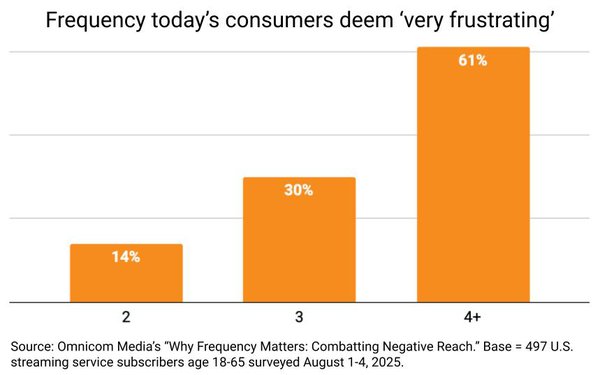
As part of a longer-term research project to understand what constitutes optimum ad frequency in today's multimedia, multimodal world, Omnicom's OM Intelligence unit this morning published the first in a series of reports finding that excessive frequency actually produces "negative reach," a phenomenon that happens "when a consumer has seen your ad so many times that it become egregious, beginning to create negative brand recognition."
The report, "Why Frequency Matters," also finds that there no longer are industry rules of thumb for determining when ad frequency generates positive or negative reach, and that it all comes down to the nature of the campaign, the consumer and the media environment, as well as the creative rotation.
Or, as Chief Intelligence Officer Joanna O'Connell puts it, "it depends."
In a preview of the report's findings, O'Connell said the initial study combined a proprietary consumer research study fielded by OM Intelligence in August 2025, as well as some quantitative research utilizing VideoAmp's ACR data, and programmatic bid stream data from The Trade Desk.
The main initial takeaway is that "negative reach" can occur among some viewers with just two ad exposures of the same ad, but that it occurs among nearly two-thirds of viewers when it approaches frequencies of 4+.
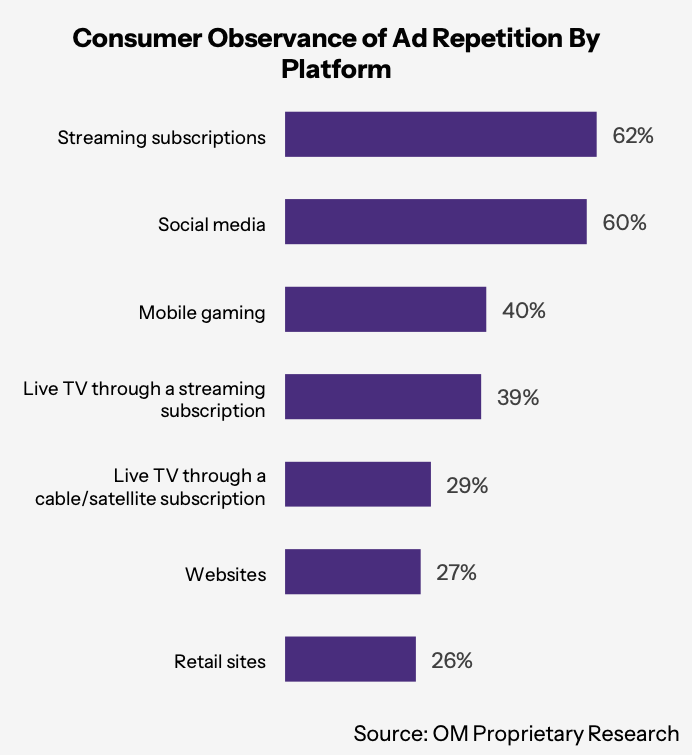
Not surprisingly, the study also found that consumers perceive "negative reach" levels most when seeing excessive ad frequency on streaming platforms, as well as social media platforms -- but interestingly have much more positive reach perceptions when seeing ad frequencies on linear TV, websites and retail sites (see data below).


No comments:
Post a Comment