Friday, April 3, 2026

Commentary An Agentic Upfront: What About Transparency?

 Agentic AI, or autonomous AI, is a type of artificial intelligence that runs independently to design, execute, and optimize workflows – allowing enterprises to more effectively make decisions and get work done. AI agents can make decisions, plan, and adapt to achieve predefined goals - with little human intervention or completely autonomously

Philip Jay LeNoble, Ph.D.


Commentary

An Agentic Upfront: What About Transparency?

What happens when linear TV ad sales become near full-scale programmatic -- and move deeper into agentic AI media planning and buying?

There would be fewer sales personnel for TV stations, networks, and streamers, for sure.

This process has been going on for some time. Over the last ten years, the number of advertising sales positions has plummeted.

And yet marketplaces like the upfront keep going. Top-of-the-funnel value remains at linear TV -- especially for live events -- with sports programming in particular, but also big live events such as "The Oscars" and other award shows.

Consider the idea that in the future an agentic AI agent can offer up micro-parameters that can survey content for new guideposts.

Perhaps the first position in the last two-minute pod of the Super Bowl is best -- but only if it is a close game -- for example, within three points.


Perhaps agents can sense that a viewer has only tuned in to half of the advertising message -- but will offer up the other half at another time.

And even if live TV seems to now be a desirable programming genre for a brand, perhaps an AI agent could detect whether a specific live program -- for example, a live golf event -- is not driving the expected sales.

It could then shift messaging or some of its remaining parts of its budget to a different program -- maybe scripted, or unscripted or onto a CTV platform.

Some analysts might call this "dynamic re-allocation."

Taking this further, imagine the standard commercial break going away. Digital media -- especially YouTube -- is already doing this, to an extent -- mixing up regular-looking commercials with short form QR code messaging and short, display-like interactive advertising content.

And speaking of greater flexibility, fourth-quarter TV network upfront deals could disappear altogether.

For media sellers, all is not lost. Many could adjust their parameters around limited flexibility -- with their own agentic AI selling agents.

So while some platforms might make losses, they could make gains with other brands.

Will buying and selling AI agents really talk with each other... or will they do battle? On the buying side, all that would shrink transaction costs. But at what cost?

The bad news? Some dark, movie-like drama story arcs from futurists may wonder about hundreds of millions of dollars quickly shifting-- with little notice -- to Walt Disney from NBCUniversal.

Transparency? Perhaps those agents will calm some fears and give us a few crumbs to consider.

2030 Forecast: Ad-Supported Video Soars 75% To $540B


2030 Forecast: Ad-Supported Video Soars 75% To $540B

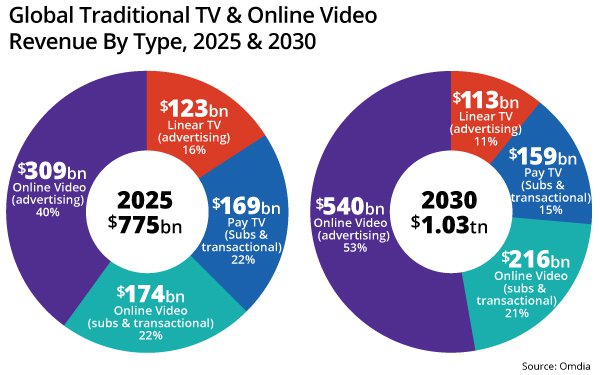
Global advertising-supported video -- especially social media-enabled video -- will continue to soar over the next five years, rising 75% to $540 billion by 2030, according to Omdia.

“Social video advertising is becoming the dominant force, reshaping how content is consumed and monetized,” says Maria Rua Aguete, senior research director of Omdia, a research company. “Meanwhile, traditional models such as linear TV and pay TV are in structural decline.”

At the same time, linear TV content supported by advertising will sink 8% to $113 million.

Online video -- social media, connected TV, website and other digital -- will command a 54% share of all global video revenues (versus 40% in 2025) -- including ad-supported, subscriptions and individual transactions.


Omdia projects that total revenues from global video businesses will rise 33% to $1.03 billion in 2030 -- with ad-supported online video at 53%, online video from subscriptions/transactions at 21%, pay TV (subscriptions/transactions) at 15%, and linear TV (advertising) at 11%.

Worldwide-cord cutting of traditional retail video revenue businesses continues to sink, but at a slower rate than gains made by online/digital video -- down 6% to $159 billion.

Sharply rising ad-supported video of all types will also cut into gains from subscription/transaction revenues from online video, growing 24% to $216 billion. That revenue will sink to a 21% share (in 2030) -- down from 22% in 2025.

How Modern Moms Discover, Trust, And Buy


Commentary

How Modern Moms Discover, Trust, And Buy

The most effective way to market to moms is through trusted peer influence, real-world validation, and content that supports a longer purchase journey. Data shows that moms rely far more on recommendations from other moms, reviews, and real-life experiences than traditional advertising.

This shift is redefining how brands win with Gen Z moms, millennial mothers, and the grandparents who make up Gen X and boomer moms. Some of the shifts in marketing tactics are being fueled by the emergence of artificial intelligence and AEO search. The discovery phase in a mom’s purchasing journey has shortened and requires brand managers to become AEO specialists.

Who is the modern mom in today’s market?

The modern mom is primarily a millennial woman, most often between ages 35–44, raising two or more children and living in suburban communities. Gen Z moms are emerging as well as the consumer group within the mom market.  They are intentional in the narrative they are writing around motherhood, and they are purposeful in their purchases. As with all moms, time is a scarcity.


The modern mom is:

  • Balancing work and home life
  • Digitally connected but selective about what she trusts
  • Focused on efficiency, value, and emotional reassurance in her purchases

What this really means is, she’s not just a buyer. She is a decision engine for the household and often for her broader network. She buys for herself, her family, and often her business.

What are moms’ biggest daily challenges?

Modern moms are not short on options. They are short on time and often willing to buy products that save time.  Their lack of time creates decision fatigue, so brands who make it easy for them to make a decision often win their business.

The biggest daily pain points include:

  • 69% struggle with home organization
  • 56% struggle to find time for themselves
  • 52% struggle with meal planning
  • 52% struggle with time management

These are not just lifestyle insights. They are product positioning opportunities. Brands that win here solve friction, not just sell features. Social media messaging should focus on solutions and solutions-based products.  Moms are not buying features; they are buying convenience and ways to gain peace in their world.

What actually drives moms to buy?

Word-of-mouth is the single most powerful driver of purchase behavior among moms.

  • 76% rely on recommendations from friends and family
  • 63% are influenced by in-store sampling
  • 62% trust online reviews
  • 61% respond to discounts and coupons
  • Only 8% trust paid ads

Moms don’t want to be marketed to. They want to be reassured. This is why an integrated approach works best for connecting with modern moms. That’s why influencer marketing works when it feels like a recommendation, not a promotion.  Moms want social validation for the research she does online.

Where do moms discover products?

Discovery is split between search, retail, and social. It is so important for brands to have an active AEO program that puts their brands in the conversation as she is searching with AI.

  • 78%  of moms use Google to search for products
  • 72%  of mothers rely on Amazon reviews
  • 81% of moms are active on Facebook
  • 78% of mothers are active on Instagram

The most engaging formats for mom consumers:

  • Facebook posts
  • Instagram Reels

What this really means is, discovery is not happening in one place. It is happening across a layered ecosystem where search, social, and retail all reinforce each other.

Brands who earn mom’s trust have the opportunity to win the loyalty of today’s modern’s mom. 

From Ads to Answers, AI Is Rewiring Marketing's Growth Engine

  A welcome educational piece to share with local-direct clients for their media marketing objectives: Philip Jay LeNoble, Ph.D.

Commentary

From Ads to Answers, AI Is Rewiring Marketing's Growth Engine

Attention is no longer the gatekeeper.

For two decades, digital marketing has been engineered around one dominant design: the ad unit. Paid search. Pre-roll. Display. We optimized bids, refined audiences, and scaled reach with precision. Marketing became a predictable, capital-efficient growth engine.

That engine still works, but the interface that governs decision-making is changing, and that changes what drives performance. Marketing is shifting from a system optimized to win attention to one optimized to win recommendation. As AI increasingly shapes what consumers see and choose, competitive advantage depends less on distribution scale alone, and more on credibility and eligibility.

The shift is measurable: 53% of consumers are now either experimenting with or regularly using generative AI tools, up from 38% in 2024. Google’s AI Overviews are expanding across commercial queries, and ChatGPT surpassed 100 million weekly active users within a year. The behavioral shift is clear: consumers are moving from browsing options to asking for conclusions.


“What’s the best electric SUV?”

“Which CDP should I implement?”

“What’s the safest sunscreen for my kids?”

These are not keyword queries. They are decision prompts. Instead of scanning links or comparing ads, consumers receive synthesized recommendations. Reviews, expert commentary, sentiment signals, structured data, and historical consistency are aggregated into a conclusion. The consideration set narrows, sometimes to one.

When consideration compresses, distribution scale alone cannot compensate. If your brand is not included in the recommendation layer, you are invisible at the moment of decision.

For executives, this is not a media trend, it is an operating model shift. If growth now depends on being selected, not just seen, marketing must evolve from a campaign engine into a coordinated system designed to earn trust, strengthen signals, and increase selection probability.

The Operating Model of Selection

Performance marketing long depended on a predictable sequence: search, browse, compare, convert. Scale could compensate for weaker brand signals. In the answer era, weak signals reduce eligibility altogether, and marginal position losses now have disproportionate impact.

When consumers ask AI systems “what’s best,” those systems synthesize reviews, authority, sentiment, product attributes, and consistency to produce a shortlist. Analysis from Bain & Company suggests that brands included in recommendation outputs can see conversion efficiency improve 2–3× compared to brands simply present in the category.

Marketing is no longer just reach and frequency; it is the ecosystem of signals that influence recommendation. If the old model was built around distribution efficiency, the new one is shaped by credibility, integration, and measurable trust.

A New Scorecard for the AI Era

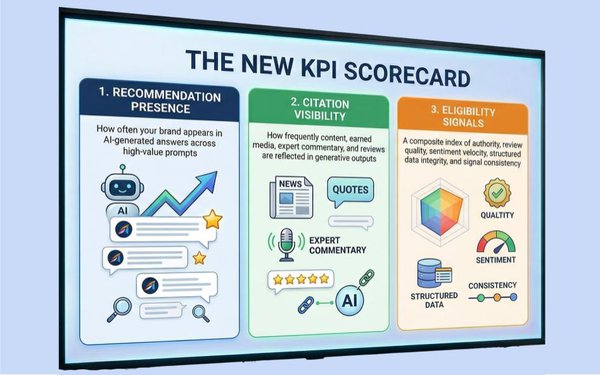
A new class of indicators is emerging:

  • Recommendation Presence: how often your brand appears in AI-generated answers across high-value prompts

  • Citation Visibility: how frequently content, earned media, expert commentary, and reviews are reflected in generative outputs

  • Eligibility Signals: a composite index of authority, review quality, sentiment velocity, structured data integrity, and signal consistency

These metrics are increasingly measurable through prompt tracking, AI visibility audits, and sentiment monitoring tools. Over time, they may become leading indicators upstream of CPA and ROAS.

Interconnected Levers

Five interconnected levers form the foundation of this new operating model, each driving the signals and systems that determine whether a brand is recommended in an AI-mediated marketplace.

  • Power Source: Authority as Stored Energy – Influencers shape how categories are understood. Signals ripple into search results, Reddit threads, YouTube reviews, and earned media, becoming part of the corpus AI systems retrieve and synthesize. Authority compounds and increases selection probability.

  • Traction: UGC and Social Signals as Demand Infrastructure – Review health and community sentiment are structural growth inputs. Social listening is an early-warning radar, while traction amplifies media efficiency.

  • Navigation: From Search to Selection – SEO remains foundational, but Answer Engine Optimization (AEO) and Generative Engine Optimization (GEO) shift focus from visibility to inclusion in synthesis. The objective is to be recommended.

  • Drivetrain: Data Integration Converts Power into Performance – First-party data strategies, CDPs, clean rooms, and interoperable analytics systems ensure media, analytics, product, and CX operate as a coordinated system.

  • Dashboard: Measurement When the Click Disappears – Attribution explains transactions; modeling explains contribution. Incrementality testing and advanced MMM illuminate what strengthens eligibility even when clicks vanish.

What This Means for Executive Leadership

Growth will no longer be driven by how efficiently you buy attention alone, but by how consistently you earn recommendation. Competitive advantage will increasingly be defined by credibility density, and the cumulative signals that make a brand trusted and recommendable across AI systems. Investments once labeled “brand” or “upper funnel” are now structural efficiency drivers.

The brands that win will not be the most aggressive bidders; showing up is table stakes. In the answer era, winners will be defined by the strength of their demand infrastructure, building the signals and systems that ensure AI, and the consumers who rely on it, consistently select them. The growth engine is not disappearing. It is being rebuilt in real time.


Wednesday, March 25, 2026

Millennial Parents Set To Push Easter Spending To New Record


retail

Millennial Parents Set To Push Easter Spending To New Record


Economic concerns may be top of mind for many American families, but don't tell the Easter Bunny. Two new reports indicate that this spring, people are in the mood to shop, from new outfits for the kids for Easter and Passover, gifts, entertaining and travel.

The National Retail Federation says it expects Easter spending to reach a record $24.9 billion, passing the 2023 record of $24 billion. On a per-person basis, it anticipates $196, also a record, up from the previous record of $192 in 2023.

"While economic uncertainty remains on the minds of many, consumers are still focused on holiday celebrations like Easter," NRF chief economist and executive director of research Mark Mathews said in the announcement.

In its survey of more than 7,800 consumers, 80% plan to celebrate Easter this year.

While candy is a given, purchased by 92%, spending on clothing (with 51% buying some form of apparel) will amount to $3.7 billion. Spending on gifts, chosen by 64%, will top $3.9 billion. Food continues to be the largest category, purchased by 90% of celebrants, with the category expected to generate $7.5 billion in spending. About 56% say they'll cook a holiday meal.

But even those who don't celebrate regard the season as a good time for deals, with 54% of non-celebrants planning to shop Easter-related sales.

Prosper Insights & Analytics conducted the research for the NRF.

Consulting giant PwC also released fresh data on spring holidays, finding that the biggest spenders are millennial parents, who are likely to spend as much as $1,900 celebrating the season — roughly four times more than childless millennials. That includes an average of $500 on travel.

Social media is shaping many of those purchases. Consumers who use social media for spring holiday inspiration spend nearly three times more than those who don't — roughly $1,517 versus $583. For millennials, the gap is even more striking: social media users in that generation spend an average of $2,190, compared to $761 for millennials who don't use social platforms for product discovery. Roughly 50% of Gen Z now say they use social media to learn about spring holiday products or ideas, up from 43% in PwC's most recent winter holiday research, while 44% of millennials do the same, up from 42%.

And the way consumers discover products is shifting in another notable direction: AI-assisted gift and product discovery has roughly doubled since PwC's last holiday survey, rising from about 15% to 30% among Gen Z, and from 16% to 29% among millennials — a signal that agentic commerce is moving from novelty to mainstream faster than many retailers may have anticipated.

Federal Pressure On TV News: Hard To Do, But Threats Persist


Federal Pressure On TV News: Hard To Do, But Threats Persist

Broadcast stations get to renew their individual FCC licenses every eight years.

But taking away licenses? In reality, that is a very difficult task. 

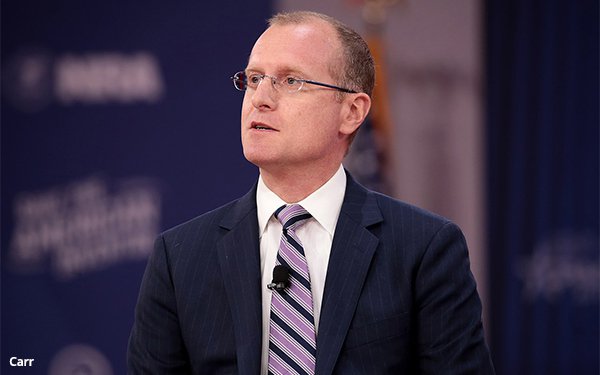
Recently, there have been perceived threats from Federal Communications Commissioner Brendan Carr, with regard to issues over news distortion and hints of license removals.

The problem is in proving any of this. Producing evidence of attempts to falsify the new reports and stories requires whistleblowers, memos, and on-the-record executive with knowledge of efforts telling journalists to deliberately distort news.

But this doesn’t mean the Trump Administration and FCC don't have other means of influence -- such as when it considers approval of business merger deals or other potential agreements.

We have seen this recently as Nexstar Media Group, the largest owner of U.S. TV stations, completed a $6.2 billion deal to buy major TV station owner Tegna. The deal received approval last week from the FCC.

This came despite the FCC's own limitation on U.S. station ownership with a maximum 39% reach of the U.S. TV households. The FCC issued a waiver of that rule for Nexstar-Tegna.

On the flip side, the FCC and the Department of Justice’s Antitrust unit could pressure other deals. 

The Trump Administration, according to many analysts, had favored Paramount Skydance buying Warner Bros. Discovery, but was less favorable toward a Netflix deal to buy WBD.

At the center of this was CNN, owned by WBD. The Trump Administration has been critical of CNN news reports. 

CNN doesn’t need a license to operate. But there are other ways to influence executives as well as other news organizations. 

The Trump Administration sued both the parent companies of ABC News and CBS News for what it perceived as mid-leading reports of “news distortion.” Those suits were settled with $15 million and $16 million settlements respectively.

So while broadcast license removals may not come to pass, there are other tools the Trump Administration may use to influence news organizations.

Meta Found Liable For Violating New Mexico Consumer Protection Law


Meta Found Liable For Violating New Mexico Consumer Protection Law

A jury in New Mexico on Tuesday found Meta Platforms liable for violating a state consumer protection law, and ordered the company to pay $375 million in fines.

The verdict, reached after a six-week trial, came in a lawsuit brought in 2023 by state Attorney General Raúl Torrez. He alleged in a sprawling 228-page complaint that the company "knowingly exposes children to the twin dangers of sexual exploitation and mental health harm."

Meta spokesperson Andy Stone tweeted Tuesday evening that the company disagrees with the verdict and will appeal.

"We work hard to keep people safe on our platforms and are clear about the challenges of identifying and removing bad actors or harmful content," Stone tweeted. "We will continue to defend ourselves vigorously, and we remain confident in our record of protecting teens online.”

Torrez alleged in the original complaint that Facebook and Instagram "are a breeding ground for predators who target children for human trafficking, the distribution of sexual images, grooming, and solicitation."

He added that Meta allows adults to groom underage users by giving adults "unfettered access" to children.

Meta also used design features such as automatically playing videos even though the company supposedly "knew that design features fostered addiction, anxiety, depression, self-harm, and suicide among teens and preteens," the complaint alleged.

He claimed Meta violated the state's Unfair Practices Act for several reasons, including that it allegedly misrepresented the safety of its apps.

The verdict against Meta came as a jury in Los Angeles continued to deliberate whether Meta and YouTube are liable for injuries suffered by a 20-year-old woman who alleged that she became addicted to social media as a child.

Meta, YouTube, TikTok and other platforms are currently facing numerous complaints in federal and state courts over allegations that they addict young users and then serve them with harmful content.

The tech companies have typically argued that they are protected by the Section 230 of the Communications Decency Act -- which provides that web companies aren't responsible for harmful content posted by users -- as well as the First Amendment, which protects companies' ability to publish lawful speech.

Plaintiffs and attorneys general have countered that many of their claims focus on design features such as algorithmic recommendations and automatically playing videos -- not the content itself.

The Supreme Court hasn't yet weighed in on whether Section 230 protects publishers' choices about recommendations to users and other design features, and lower court judge have reached seemingly contradictory rulings.

For instance, Los Angeles Superior Court Judge Carolyn Kuhl, who is presiding over the ongoing case involving Meta and YouTube in that city, ruled in 2023 that Section 230 did not immunize tech companies from liability over design features aimed at maximizing the amount of time people spend on social media.

But U.S. District Court Judge Yvonne Gonzalez Rogers, who presides over the federal litigation against social platforms, ruled that Section 230 protected the platforms from some claims about allegedly addictive features, but not from claims that the platforms failed to warn users about potential harms.