Friday, April 3, 2026

Commentary An Agentic Upfront: What About Transparency?

 Agentic AI, or autonomous AI, is a type of artificial intelligence that runs independently to design, execute, and optimize workflows – allowing enterprises to more effectively make decisions and get work done. AI agents can make decisions, plan, and adapt to achieve predefined goals - with little human intervention or completely autonomously

Philip Jay LeNoble, Ph.D.


Commentary

An Agentic Upfront: What About Transparency?

What happens when linear TV ad sales become near full-scale programmatic -- and move deeper into agentic AI media planning and buying?

There would be fewer sales personnel for TV stations, networks, and streamers, for sure.

This process has been going on for some time. Over the last ten years, the number of advertising sales positions has plummeted.

And yet marketplaces like the upfront keep going. Top-of-the-funnel value remains at linear TV -- especially for live events -- with sports programming in particular, but also big live events such as "The Oscars" and other award shows.

Consider the idea that in the future an agentic AI agent can offer up micro-parameters that can survey content for new guideposts.

Perhaps the first position in the last two-minute pod of the Super Bowl is best -- but only if it is a close game -- for example, within three points.


Perhaps agents can sense that a viewer has only tuned in to half of the advertising message -- but will offer up the other half at another time.

And even if live TV seems to now be a desirable programming genre for a brand, perhaps an AI agent could detect whether a specific live program -- for example, a live golf event -- is not driving the expected sales.

It could then shift messaging or some of its remaining parts of its budget to a different program -- maybe scripted, or unscripted or onto a CTV platform.

Some analysts might call this "dynamic re-allocation."

Taking this further, imagine the standard commercial break going away. Digital media -- especially YouTube -- is already doing this, to an extent -- mixing up regular-looking commercials with short form QR code messaging and short, display-like interactive advertising content.

And speaking of greater flexibility, fourth-quarter TV network upfront deals could disappear altogether.

For media sellers, all is not lost. Many could adjust their parameters around limited flexibility -- with their own agentic AI selling agents.

So while some platforms might make losses, they could make gains with other brands.

Will buying and selling AI agents really talk with each other... or will they do battle? On the buying side, all that would shrink transaction costs. But at what cost?

The bad news? Some dark, movie-like drama story arcs from futurists may wonder about hundreds of millions of dollars quickly shifting-- with little notice -- to Walt Disney from NBCUniversal.

Transparency? Perhaps those agents will calm some fears and give us a few crumbs to consider.

2030 Forecast: Ad-Supported Video Soars 75% To $540B


2030 Forecast: Ad-Supported Video Soars 75% To $540B

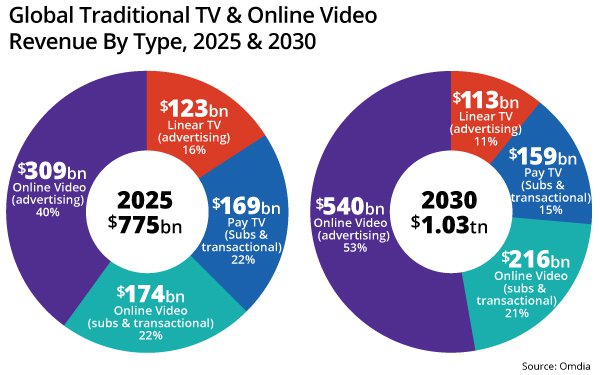
Global advertising-supported video -- especially social media-enabled video -- will continue to soar over the next five years, rising 75% to $540 billion by 2030, according to Omdia.

“Social video advertising is becoming the dominant force, reshaping how content is consumed and monetized,” says Maria Rua Aguete, senior research director of Omdia, a research company. “Meanwhile, traditional models such as linear TV and pay TV are in structural decline.”

At the same time, linear TV content supported by advertising will sink 8% to $113 million.

Online video -- social media, connected TV, website and other digital -- will command a 54% share of all global video revenues (versus 40% in 2025) -- including ad-supported, subscriptions and individual transactions.


Omdia projects that total revenues from global video businesses will rise 33% to $1.03 billion in 2030 -- with ad-supported online video at 53%, online video from subscriptions/transactions at 21%, pay TV (subscriptions/transactions) at 15%, and linear TV (advertising) at 11%.

Worldwide-cord cutting of traditional retail video revenue businesses continues to sink, but at a slower rate than gains made by online/digital video -- down 6% to $159 billion.

Sharply rising ad-supported video of all types will also cut into gains from subscription/transaction revenues from online video, growing 24% to $216 billion. That revenue will sink to a 21% share (in 2030) -- down from 22% in 2025.

How Modern Moms Discover, Trust, And Buy


Commentary

How Modern Moms Discover, Trust, And Buy

The most effective way to market to moms is through trusted peer influence, real-world validation, and content that supports a longer purchase journey. Data shows that moms rely far more on recommendations from other moms, reviews, and real-life experiences than traditional advertising.

This shift is redefining how brands win with Gen Z moms, millennial mothers, and the grandparents who make up Gen X and boomer moms. Some of the shifts in marketing tactics are being fueled by the emergence of artificial intelligence and AEO search. The discovery phase in a mom’s purchasing journey has shortened and requires brand managers to become AEO specialists.

Who is the modern mom in today’s market?

The modern mom is primarily a millennial woman, most often between ages 35–44, raising two or more children and living in suburban communities. Gen Z moms are emerging as well as the consumer group within the mom market.  They are intentional in the narrative they are writing around motherhood, and they are purposeful in their purchases. As with all moms, time is a scarcity.


The modern mom is:

  • Balancing work and home life
  • Digitally connected but selective about what she trusts
  • Focused on efficiency, value, and emotional reassurance in her purchases

What this really means is, she’s not just a buyer. She is a decision engine for the household and often for her broader network. She buys for herself, her family, and often her business.

What are moms’ biggest daily challenges?

Modern moms are not short on options. They are short on time and often willing to buy products that save time.  Their lack of time creates decision fatigue, so brands who make it easy for them to make a decision often win their business.

The biggest daily pain points include:

  • 69% struggle with home organization
  • 56% struggle to find time for themselves
  • 52% struggle with meal planning
  • 52% struggle with time management

These are not just lifestyle insights. They are product positioning opportunities. Brands that win here solve friction, not just sell features. Social media messaging should focus on solutions and solutions-based products.  Moms are not buying features; they are buying convenience and ways to gain peace in their world.

What actually drives moms to buy?

Word-of-mouth is the single most powerful driver of purchase behavior among moms.

  • 76% rely on recommendations from friends and family
  • 63% are influenced by in-store sampling
  • 62% trust online reviews
  • 61% respond to discounts and coupons
  • Only 8% trust paid ads

Moms don’t want to be marketed to. They want to be reassured. This is why an integrated approach works best for connecting with modern moms. That’s why influencer marketing works when it feels like a recommendation, not a promotion.  Moms want social validation for the research she does online.

Where do moms discover products?

Discovery is split between search, retail, and social. It is so important for brands to have an active AEO program that puts their brands in the conversation as she is searching with AI.

  • 78%  of moms use Google to search for products
  • 72%  of mothers rely on Amazon reviews
  • 81% of moms are active on Facebook
  • 78% of mothers are active on Instagram

The most engaging formats for mom consumers:

  • Facebook posts
  • Instagram Reels

What this really means is, discovery is not happening in one place. It is happening across a layered ecosystem where search, social, and retail all reinforce each other.

Brands who earn mom’s trust have the opportunity to win the loyalty of today’s modern’s mom. 

From Ads to Answers, AI Is Rewiring Marketing's Growth Engine

  A welcome educational piece to share with local-direct clients for their media marketing objectives: Philip Jay LeNoble, Ph.D.

Commentary

From Ads to Answers, AI Is Rewiring Marketing's Growth Engine

Attention is no longer the gatekeeper.

For two decades, digital marketing has been engineered around one dominant design: the ad unit. Paid search. Pre-roll. Display. We optimized bids, refined audiences, and scaled reach with precision. Marketing became a predictable, capital-efficient growth engine.

That engine still works, but the interface that governs decision-making is changing, and that changes what drives performance. Marketing is shifting from a system optimized to win attention to one optimized to win recommendation. As AI increasingly shapes what consumers see and choose, competitive advantage depends less on distribution scale alone, and more on credibility and eligibility.

The shift is measurable: 53% of consumers are now either experimenting with or regularly using generative AI tools, up from 38% in 2024. Google’s AI Overviews are expanding across commercial queries, and ChatGPT surpassed 100 million weekly active users within a year. The behavioral shift is clear: consumers are moving from browsing options to asking for conclusions.


“What’s the best electric SUV?”

“Which CDP should I implement?”

“What’s the safest sunscreen for my kids?”

These are not keyword queries. They are decision prompts. Instead of scanning links or comparing ads, consumers receive synthesized recommendations. Reviews, expert commentary, sentiment signals, structured data, and historical consistency are aggregated into a conclusion. The consideration set narrows, sometimes to one.

When consideration compresses, distribution scale alone cannot compensate. If your brand is not included in the recommendation layer, you are invisible at the moment of decision.

For executives, this is not a media trend, it is an operating model shift. If growth now depends on being selected, not just seen, marketing must evolve from a campaign engine into a coordinated system designed to earn trust, strengthen signals, and increase selection probability.

The Operating Model of Selection

Performance marketing long depended on a predictable sequence: search, browse, compare, convert. Scale could compensate for weaker brand signals. In the answer era, weak signals reduce eligibility altogether, and marginal position losses now have disproportionate impact.

When consumers ask AI systems “what’s best,” those systems synthesize reviews, authority, sentiment, product attributes, and consistency to produce a shortlist. Analysis from Bain & Company suggests that brands included in recommendation outputs can see conversion efficiency improve 2–3× compared to brands simply present in the category.

Marketing is no longer just reach and frequency; it is the ecosystem of signals that influence recommendation. If the old model was built around distribution efficiency, the new one is shaped by credibility, integration, and measurable trust.

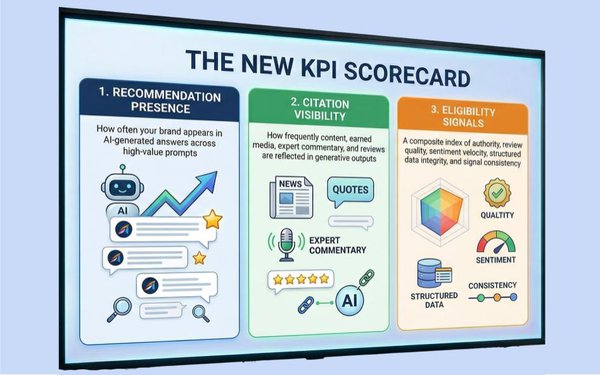
A New Scorecard for the AI Era

A new class of indicators is emerging:

  • Recommendation Presence: how often your brand appears in AI-generated answers across high-value prompts

  • Citation Visibility: how frequently content, earned media, expert commentary, and reviews are reflected in generative outputs

  • Eligibility Signals: a composite index of authority, review quality, sentiment velocity, structured data integrity, and signal consistency

These metrics are increasingly measurable through prompt tracking, AI visibility audits, and sentiment monitoring tools. Over time, they may become leading indicators upstream of CPA and ROAS.

Interconnected Levers

Five interconnected levers form the foundation of this new operating model, each driving the signals and systems that determine whether a brand is recommended in an AI-mediated marketplace.

  • Power Source: Authority as Stored Energy – Influencers shape how categories are understood. Signals ripple into search results, Reddit threads, YouTube reviews, and earned media, becoming part of the corpus AI systems retrieve and synthesize. Authority compounds and increases selection probability.

  • Traction: UGC and Social Signals as Demand Infrastructure – Review health and community sentiment are structural growth inputs. Social listening is an early-warning radar, while traction amplifies media efficiency.

  • Navigation: From Search to Selection – SEO remains foundational, but Answer Engine Optimization (AEO) and Generative Engine Optimization (GEO) shift focus from visibility to inclusion in synthesis. The objective is to be recommended.

  • Drivetrain: Data Integration Converts Power into Performance – First-party data strategies, CDPs, clean rooms, and interoperable analytics systems ensure media, analytics, product, and CX operate as a coordinated system.

  • Dashboard: Measurement When the Click Disappears – Attribution explains transactions; modeling explains contribution. Incrementality testing and advanced MMM illuminate what strengthens eligibility even when clicks vanish.

What This Means for Executive Leadership

Growth will no longer be driven by how efficiently you buy attention alone, but by how consistently you earn recommendation. Competitive advantage will increasingly be defined by credibility density, and the cumulative signals that make a brand trusted and recommendable across AI systems. Investments once labeled “brand” or “upper funnel” are now structural efficiency drivers.

The brands that win will not be the most aggressive bidders; showing up is table stakes. In the answer era, winners will be defined by the strength of their demand infrastructure, building the signals and systems that ensure AI, and the consumers who rely on it, consistently select them. The growth engine is not disappearing. It is being rebuilt in real time.