A welcome educational piece to share with local-direct clients for their media marketing objectives: Philip Jay LeNoble, Ph.D.

Commentary
From Ads to Answers, AI Is Rewiring Marketing's Growth Engine
- by Jesse Rosenschein , Op-Ed Contributor, 55 minutes ago
Attention is no longer the gatekeeper.
For two decades, digital marketing has been engineered around one dominant design: the ad unit. Paid search. Pre-roll. Display. We optimized bids, refined audiences, and scaled reach with precision. Marketing became a predictable, capital-efficient growth engine.
That engine still works, but the interface that governs decision-making is changing, and that changes what drives performance. Marketing is shifting from a system optimized to win attention to one optimized to win recommendation. As AI increasingly shapes what consumers see and choose, competitive advantage depends less on distribution scale alone, and more on credibility and eligibility.
The shift is measurable: 53% of consumers are now either experimenting with or regularly using generative AI tools, up from 38% in 2024. Google’s AI Overviews are expanding across commercial queries, and ChatGPT surpassed 100 million weekly active users within a year. The behavioral shift is clear: consumers are moving from browsing options to asking for conclusions.
“What’s the best electric SUV?”
“Which CDP should I implement?”
“What’s the safest sunscreen for my kids?”
These are not keyword queries. They are decision prompts. Instead of scanning links or comparing ads, consumers receive synthesized recommendations. Reviews, expert commentary, sentiment signals, structured data, and historical consistency are aggregated into a conclusion. The consideration set narrows, sometimes to one.
When consideration compresses, distribution scale alone cannot compensate. If your brand is not included in the recommendation layer, you are invisible at the moment of decision.
For executives, this is not a media trend, it is an operating model shift. If growth now depends on being selected, not just seen, marketing must evolve from a campaign engine into a coordinated system designed to earn trust, strengthen signals, and increase selection probability.
The Operating Model of Selection
Performance marketing long depended on a predictable sequence: search, browse, compare, convert. Scale could compensate for weaker brand signals. In the answer era, weak signals reduce eligibility altogether, and marginal position losses now have disproportionate impact.
When consumers ask AI systems “what’s best,” those systems synthesize reviews, authority, sentiment, product attributes, and consistency to produce a shortlist. Analysis from Bain & Company suggests that brands included in recommendation outputs can see conversion efficiency improve 2–3× compared to brands simply present in the category.
Marketing is no longer just reach and frequency; it is the ecosystem of signals that influence recommendation. If the old model was built around distribution efficiency, the new one is shaped by credibility, integration, and measurable trust.
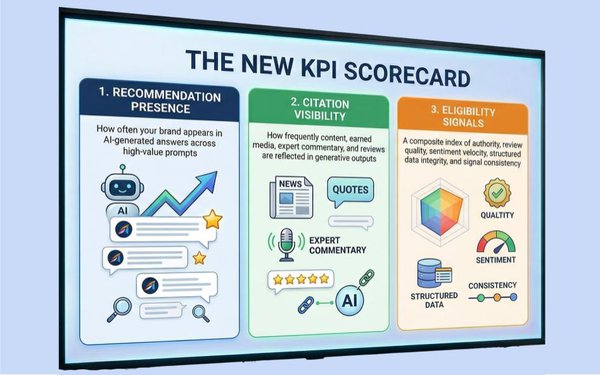
A New Scorecard for the AI Era
A new class of indicators is emerging:
Recommendation Presence: how often your brand appears in AI-generated answers across high-value prompts
Citation Visibility: how frequently content, earned media, expert commentary, and reviews are reflected in generative outputs
Eligibility Signals: a composite index of authority, review quality, sentiment velocity, structured data integrity, and signal consistency
These metrics are increasingly measurable through prompt tracking, AI visibility audits, and sentiment monitoring tools. Over time, they may become leading indicators upstream of CPA and ROAS.
Interconnected Levers
Five interconnected levers form the foundation of this new operating model, each driving the signals and systems that determine whether a brand is recommended in an AI-mediated marketplace.
Power Source: Authority as Stored Energy – Influencers shape how categories are understood. Signals ripple into search results, Reddit threads, YouTube reviews, and earned media, becoming part of the corpus AI systems retrieve and synthesize. Authority compounds and increases selection probability.
Traction: UGC and Social Signals as Demand Infrastructure – Review health and community sentiment are structural growth inputs. Social listening is an early-warning radar, while traction amplifies media efficiency.
Navigation: From Search to Selection – SEO remains foundational, but Answer Engine Optimization (AEO) and Generative Engine Optimization (GEO) shift focus from visibility to inclusion in synthesis. The objective is to be recommended.
Drivetrain: Data Integration Converts Power into Performance – First-party data strategies, CDPs, clean rooms, and interoperable analytics systems ensure media, analytics, product, and CX operate as a coordinated system.
Dashboard: Measurement When the Click Disappears – Attribution explains transactions; modeling explains contribution. Incrementality testing and advanced MMM illuminate what strengthens eligibility even when clicks vanish.
What This Means for Executive Leadership
Growth will no longer be driven by how efficiently you buy attention alone, but by how consistently you earn recommendation. Competitive advantage will increasingly be defined by credibility density, and the cumulative signals that make a brand trusted and recommendable across AI systems. Investments once labeled “brand” or “upper funnel” are now structural efficiency drivers.
The brands that win will not be the most aggressive bidders; showing up is table stakes. In the answer era, winners will be defined by the strength of their demand infrastructure, building the signals and systems that ensure AI, and the consumers who rely on it, consistently select them. The growth engine is not disappearing. It is being rebuilt in real time.
No comments:
Post a Comment