Tuesday, December 9, 2025

Your Shoppers Don't Want Content -- They Want Connection

 Thinking how those who are on social media more than they are with their real friends, colleagues or family members, the real loneliness factor growing for those who have little time to get off their phones

Here's an article about Generation Z and Gen Alpha consumers today who are craving real experiences not found on their phone!  Now...lets understand that Generation Alpha are the youngest consumer group who may be dependent on their parents as consumers as those born more closely to now, are not yet int eh marketplace...as you can see by the dates born I have provide, preceding the articel: Philip Jay LeNoble, Ph.D. 

Generation Z generally includes those born between the mid-to-late 1990s (around 1997) and the early 2010s (around 2012), while Generation Alpha starts in the early 2010s (around 2010 or 2012) and continues until the mid-2020s (around 2024 or 2025), with specific start/end years varying slightly by source. Gen Z are the older siblings, raised with early social media, while Gen Alpha are the first truly digital-native generation, born entirely in the 21st century, shaped by AI and smart devices. 

  • Key Defining Factor: Born entirely in the 21st century, after the launch of the iPad and Instagram. 

Commentary

Your Shoppers Don't Want Content -- They Want Connection

Technology was supposed to make life easier—and in many ways, it has. But what about the repercussions from the infusion of technology into every aspect of our daily lives?

While our lives have gotten “easier,” we’ve started to lose sight of authenticity and vulnerability, presence and connection. It’s getting harder and harder to be fully present when we’re rarely without a smartphone in hand, and so many moments are photographed instead of truly lived.

As the rise of technology and AI continues, Gen Z and Gen Alpha are craving human experiences. The question now is: How do we bring humanity back into technology and marketing?

Though social media promises connection, it often delivers isolation, sending users into a spiral of screentime and vanity metrics. A recent study suggests the negative impacts of online activities like doom-scrolling, with 61% of Gen Z respondents saying they are lonelier today than they were 10 years ago. Even though theoretically, we have 24/7 access to other people, this doesn’t always feel the way it should, and it’s easy to get lost in comparison.


Today, younger generations are craving the analog in an attempt to escape that spiral. The recent resurgence of disposable cameras, vinyl records, and even flip phones is all evidence of the desire for something tangible.

But how does all this relate to brands? Well, we marketers and brands contributed to this rapid growth and emphasis on the digital; maybe we can be the ones to help recalibrate it.

There’s an opportunity emerging in 2026 to reshape the way consumers experience brands, and to make that experience even more human, and build real, authentic relationships with shoppers. Because if younger shoppers are craving what’s real and physical, they’re going to want the brands they buy from to reflect those qualities as well.

The goal isn’t to abandon technology, but to use it with vision, intention, and means. That means defining a purpose beyond just clicks, creating with empathy rather than algorithms, and building real experiences that connect people offline and online.

To start, we can focus on bringing back a renewed emphasis on brand stories and anchoring those brand stories in true purpose. What would it look like to approach our marketing with a perspective that centered questions like who are we creating this for, and what do we want it to do? There’s a chance to move away from simply creating content to fill up a feed or please an algorithm, and instead create content that speaks to the true pain points and desires of our audience.

Honest storytelling is resonating with Gen Z and Gen Alpha audiences. Fifty nine percent of Gen Z-ers are more likely to support brands that show vulnerability over perfection.The more we can demonstrate that our brands truly understand and empathize with our audience’s pain points, the more successful—and more human—we’ll be.

Additionally, since much of the world exists in a digital space, we’re seeing a re-emergence of curated in-person experiences and physical events. There’s been a noticeable shift away from mass-scale experiences and instead towards experiences that aren’t just curated for Instagram and TikTok, but are built from a desire to actually create something authentic. Brands are seeing success when they bring people face-to-face in real life instead of only on a screen.

I’m not proposing the complete abandonment of technology. I’m simply calling for brands and marketers to remember that behind each click, like, and share is a real person looking to connect with other real people. The more we can remember that, the more successful we’ll be at reaching younger audiences and bringing true authenticity to our marketing.

Consumer Trends Sports Marketers Should Jump on in 2026

 Got a local golf shop or sports apparel retailer in your marketplace for golf, tennis etc? Philip Jay LeNoble, Ph.D.

Commentary

Consumer Trends Sports Marketers Should Jump on in 2026

We all remember learning about marketing’s “four Ps.”  Looking at recent research with sports fans, I found four significant themes for sports marketers looking to hit the ground running in the year ahead.  I call them “the four Es”:

Emotional connection: Is it just me, or does it seem like every article, sales pitch or seminar presentation has the letters AI in it?  I never cease to be simultaneously entertained and disgusted by the incessant pursuit of the next "big thing/easy button.” If we believed everything we heard, we’d just let automation take care of everything. 

At the end of the day, effective marketing is about personal relationships, contextual empathy, and channeling Wayne Gretzky's great line about anticipating where the puck is going next. All that is beyond the capacity of any large language model. 

Sports fans seek connection, and our data shows that nearly half feel “very lonely.” Automation can create back-office efficiencies, but we’re seeing a huge dichotomy between those consumers seeking frictionless high tech and interpersonal high touch.  I see an inevitable bursting of the bubble and those properties and brands that can reconnect with their targets on a more personal level, can win the year ahead.


Experiences: The percentage of sports fans who strongly agree that “It’s important for my life to include a number of unique experiences” is at its highest since August 2023.  Concurrently, we are seeing a 10-point year-over-year uptick in the percentage of fans who believe attending a live sports event is a good value.  Nearly two-thirds plan to allocate more time to leisure activities in 2026 than they did this year. This is particularly important as economic trepidation is growing.

Eagerness:  Two thirds of sports fans strongly agree that their life philosophy is more about living for today than tomorrow.  That’s up +9 points from November 2024. As consumer confidence is muted about the medium to long term, research is showing a certain impetuousness, satisfied by permission to spend on what consumers most covet while they still can.

Entitlement:  It’s not just the younger generations. Data shows that across the board, sports fans and participants see getting what they want as a just reward for enduring difficult times. Couple this with some six in ten who strongly believe that people today are more “in it for themselves” than they were 20 years ago, and a similar percentage who see people today as more selfish than in their parents’ generation. So the ability to provide those rewards is a super power that sports marketers can bestow upon their target market.

Why Ad Spending Grew, Not Stalled During Government Shutdown - For Now

 Here's another pre-published research piece that during the government shutdown, businesses that didn't reduce their advertising actually invested more to their advantage: Philip Jay LeNoble, Ph.D.

Commentary

Why Ad Spending Grew, Not Stalled During Government Shutdown - For Now

As we approach the early December period when some of the big agency holding companies -- well, at least one this year -- update their annual ad-spending forecasts for the year ahead, we can all take some solace in the fact that the U.S. federal government shutdown did not slow the expansion of the advertising marketplace.

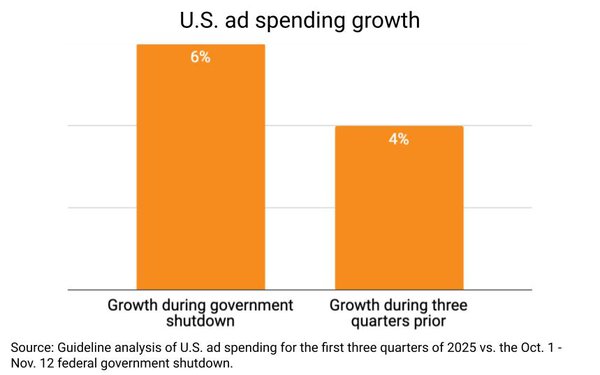
According to a new analysis from Guideline, U.S. advertisers spent half again as much during the October 1 - November 12 shutdown as they did during the previous three quarters of 2025.

That said, there undoubtedly may be seasonal or even cyclical reasons for the upward expansion so far this quarter, but at least at this point, it does not look like 2025 is ending on a downward note.

As for the not-too-distant future beyond that, it is still unclear how much of a lag effect the protracted shutdown had on specific advertising categories with the greatest exposure to it.

advertisement

PMIS-fa25-WorkPlay-640x480dbl.gif

advertisement

“While it is impossible to understand what long-term impact the government shutdown will have on the broader economy, we feel confident that the ad market will begin to show that impact long before the economic data will, especially in the pharma and travel sectors, which will feel more immediate effects," says Guideline Chief Insights & Analytics Officer Sean Wright.

That said, Wright currently is predicting the U.S. ad market will weaken during the first half of 2026 "as consequences of the shutdown begin to make their way through the market." Specifically, related to disruptions in the travel and pharmaceutical categories.

Based on Guideline's analysis of "forward bookings" of media buys, airline ad spending is expected to remain elevated through year-end, but beyond the holidays, it remains uncertain what will happen to airline, rental car and cruise line ad spending as a result of the shutdown.

The impact on pharma is a little more clear, as the shutdown is estimated to have pushed approval for 10 to 20 novel new prescription drugs into 2026, which is expected to see category declines during the first half of the year.

When I asked Wright how the disruption in ad spending compares with previous government shutdowns, he said that's difficult to discern.

"It's hard to say how the longer-term effects will compare," he explained, adding: "One thing that is complicating matters is the additional efforts that were made to furlough or fire existing federal workers. We think that will have a profound impact in the longer term both on the economy and the ad market but it's too early to say how or where."

Meanwhile, stay tuned until mid-December when the holdcos start releasing their new year outlooks.

Marketing Turns Ideas into Business

 This article published earlier, I extracted and thought the concepts are well worth establishing

 as not letting your good ideas escape. The use of ChatGPT may help save time and may help bring different perspectives into the light but what helped top media executives become leaders or small business owner become big businesses with greater sustainable profitability is the theory differential advantage! I found the theory vital in separating the goods and services of one business to another in the same marketplace is what solution they offer as a different acknowledged benefit to consumers than the competition. Additionally, let's review the basis of the theory so you may be able to provide a greater service to your local-direct direct business client: The theory of differential advantage explains how a company achieves competitive superiority by offering unique, valuable product/service attributes (quality, features, brand) that competitors lack, allowing them to charge premium prices and attract specific customers who perceive this uniqueness as superior value, distinct from just being cheaper (comparative advantage). It's about differentiation through innovation, strong R&D, branding, and superior customer service, making the offering more desirable than others. Philip Jay LeNoble, Ph.D.

Commentary

Marketing Turns Ideas into Business

From all my years in research and consulting, I think I’ve learned a thing or two about marketing worth sharing. Enduring fundamentals, mostly—yet often overlooked. So, over the course of my biweekly column this year, I want to share some snippets for your consideration. I hope they’re helpful.

This week’s thought: Marketing turns ideas into business.

Ideas are the heart and soul of marketing. It’s all about intangibles -- lightbulb moments of inventive strategic inspiration. It’s a lot of brain work, and thus marketing is easily mocked. We know the tropes—the shadowy huddle behind one-way mirrors, sticky notes papering walls, quirky creatives, Madison Avenue extravaganzas and more. Yet, this brain work is hard work, which dead-ends more often than it takes off. When marketing clicks, though, it is a commercial alchemy unlike any other, turning ideas, the most immaterial of things, into business, perhaps the most material thing of all.


The imperative that follows is easy to see but hard to stick to: Intangibles come first. Ideas are essential but ideas are a sensitive crop. Try too hard or bear down too much and ideas dry up. While too much indulgence and excess will produce inbred ideas and leaden results.

Companies tend to swing between high-flying periods of effortless success that often smother good new ideas and demanding periods of weakening performance that choke off investment in ideas and innovation. Sustaining the right balance of support and pressure takes good leadership and patient oversight, which, understandably, is often hard to do. But without it, it is difficult for marketing to stay true to its purpose for turning ideas into business.

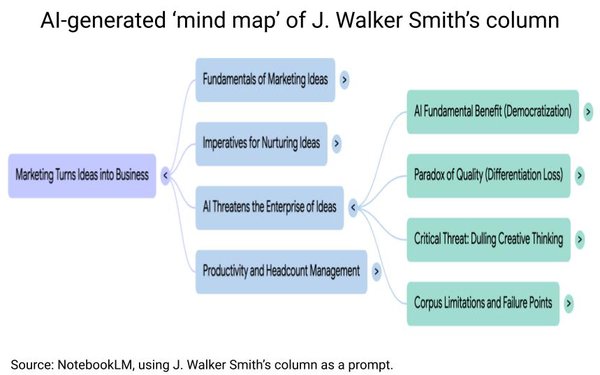
When it comes to ideas, marketing is facing its biggest challenge yet. AI threatens the enterprise of ideas. Mind you, these perils are not intractable problems. Marketers can address them, but first marketers must rouse themselves from the spell of hyperbole that always goes hand-in-hand with big technological advances.

The fundamental benefit of gen AI is that it makes make extant knowledge about virtually anything available in seconds to anyone with a good prompt. What this means for marketing is the democratization of the best ideas. No longer will costs or staff or infrastructure provide market-leading companies with an entrenched monopoly of insights and information about the secrets to success. Every company will have the ability to learn what works best and then put it into action. The overall quality of marketing will rise but at the expense of differentiation.

This paradox of quality has been playing out even before the explosion of gen AI in November 2022 with the introduction of ChatGPT. Many observers have commented on the sea of sameness in which brands operate these days. In survey after survey, the vast majority of consumers report that they find it hard to tell the difference between brands. Not because brands are getting worse. Rather, because brands are getting better.

Over the course of many decades, brands have experimented with all kinds of innovations, out of which the best solutions have been found. All brands copy the best. Every brand moves in the direction of a breakthrough idea. No brand concedes advantage to competition. So, brands are better than ever yet more similar as well.

AI will make it harder to do something unique. The old secrets are secrets no longer, and new advances will mainstream more quickly.

Of course, such impact assumes that AI delivers knowledge in an accurate and helpful manner. The problems of AI hallucination, social bias, cultural-centricity, over-compliance and conformity are well-known. But the critical threat to ideas is one of dulling the edge of sharp, creative thinking.

People use gen AI for summaries so that they don’t have to read and interpret the material themselves. In effect, they rely on gen AI in the way that senior executives have historically relied on junior staff. Gen AI is essentially a junior analyst pulling everything together, presenting options and making recommendations. Senior executives have typically been junior staff themselves, which is part of their background and experience that (hopefully) enables them to be sophisticated consumers of staff reports. But gen AI short-circuits this process.

Gen AI makes a senior executive out of everyone, if you will, and presents summary information in a way that presumes the user to be a sophisticated reader. Which, of course, is simply not true. Expertise comes the hard way. AI summarization risks dumbing down expertise, and if this gets too superficial, ideas will wind up being superficial as well, if not worse.

Ideas are better when people invest time with the data and the details. People learn how knowledge is generated, analyzed and verified. And more importantly, how information can sometimes deceive. Skipping this step by using gen AI to do that work means that people will never acquire the savvy that comes from the experience of actually working with the data, reading the original sources, and figuring out how to sort the wheat from the chaff.

Gen AI is being deployed intentionally nowadays to free people from spending time with data and details. And that sort of deployment misses the point when it comes to nurturing good ideas.

Related to this is the corpus of original material on which AI is trained and utilized. The worse the corpus, the worse the AI results. AI is good only when the underlying corpus of knowledge is good. AI offers competitive advantage only when the underlying corpus of knowledge is proprietary. AI works seamlessly only when all users are connected to the same underlying corpus of knowledge. These are all too typical points of failure.

Beyond these questions of how gen AI is used is another question of greater importance about how time is spent. The benefits of gen AI are discussed in terms of productivity. To wit: people will be able to free themselves from mindless work to spend more time on mindful work. But time saved does not automatically mean greater productivity.

Productivity comes from what is done with the time saved by gen AI. If people use the time saved to scroll their Instagram accounts or catch up on expense reports, then overall productivity is probably less, not more. Productivity goes up only when people use the time saved to do equally or more productive other tasks. 

One more productive task is thinking mindfully about the business. But not everyone can do that. Indeed, very few people. So, most of the time saved will be for people who lack the ability to add value with new insights or better ideas. And the people who able to do that are doing so now, meaning that their incremental increase in ideas—quality or number—is likely to be small.

Now, obviously, these are hypotheses that will be put to the test over time. Perhaps there will be a boon in creativity and ideation. But if not, then companies will certainly move to monetize productivity gains in the only other way possible, which is to reduce headcount. If better ideas are not forthcoming, then it will be the same ideas with fewer people.

This is the bigger threat. Ideas flourish in collaborative environments that reward originality and risk-taking. A sustained wave of downsizing across the marketing profession could compromise what makes marketing work best. Marketing will still work, but not at its best. If gen AI is not facilitating better ideas, thus leading to force reductions, then marketers are sure to respond by trying too hard or bearing down too much, which always makes it harder to generate good ideas. So, the key is to make sure that AI is used properly, not in ways that dry up the ideas that marketing turns into business.

Friday, December 5, 2025

Aging Cable First Steps: Rebrand, New Digital Businesses - Is That All?


Commentary

Aging Cable First Steps: Rebrand, New Digital Businesses - Is That All?

MS NOW (formerly MSNBC) is being pushed to the side as a business -- being spun out of Comcast, along with other cable networks.

There is a plan. And we can assume that other aging cable TV networks have a similar approach.

It seems there is a plan to dramatically ramp up the business for the still highly viewed 24/7 cable news TV network. 

MS NOW will have a new direct-to-consumer (D2C) offering next summer under the new brand name.

As MSNBC, the network has had its own mobile app for a while now -- as well as its sister network CNBC.

But the new business plan looks to make this D2C effort much bigger than its previous iteration.

The new service intends to offer up podcasts and YouTube-centric long- and short-form video as well as interactive content and features.


Reports suggest that MS NOW President Rebecca Kutler, under its new Versant corporate company, is opening the spigot in a push for more digital business extension going forward.

Versant becomes a publicly traded company on January 2, 2026.

Looking at the bigger picture, now we can see a different spin on what the broad spectrum of legacy and declining cable TV businesses may be doing to resurrect themselves as more independent businesses.

This would give hope to what some companies may envision for the future -- for the most part what Paramount Skydance’s future plans are to keep and revamp its cable TV networks.

This is a somewhat different approach to that of Comcast Corp. and Warner Bros. Discovery, which are both currently in the process of spinning off their respective cable TV networks as separate companies.

The goal is that operating as a smaller company, these networks will in theory have better flexibility to make more aggressive, entrepreneurial, real-time changes to their operations.

Pushing more digital, social media, AI-focused business that adapts to modern media consumers makes sense.

Execution of that plan, of course, is the final judge and jury.

You can now wonder why changing its longtime seemingly valuable brand name -- MSNBC -- to MS NOW might make more sense.

Rebranding cable TV networks with new business extensions? Guessing we are only at stage one of those plans.

Netflix To Buy WBD's Studio, Streaming In $82.7B Deal


Netflix To Buy WBD's Studio, Streaming In $82.7B Deal

Moving swiftly, Netflix will buy Warner Bros. Discovery's key studio and streaming operations for $82.7 billion -- securing the legendary movie studio/TV company and beating out legacy media companies Paramount Skydance and Comcast Corp.

The deal is for $27.50 per WBD share in cash and stock -- totaling $82.7 billion, with $72.0 billion coming from cash ($23.25 in cash/$4.50 Netflix shares). Early Friday morning trading of WBD stock was up 4% to $25.46. Netflix was down 3% to $100.24.

As expected, Netflix only wanted to buy the studio and streaming operations. Netflix says the deal is estimated to close after WBD's planned separation of the company.

Discovery Global will be a newly publicly traded company that will contain all the company’s global cable networks including CNN, TNT, TBS, Discovery Channel, Food Network, and HGTV, among many others.


Previously, WBD also planned to spin out its studio/streaming operations as a separate publicly traded company.

Analysts expect Netflix to see heavy analysis from the antitrust division of the Department of Justice due to its dominance in the streaming market. The Trump administration may also weigh into the deal, considering its long-time battle and criticism over CNN, the longtime cable TV news network.

Early in the week, warnings came from Paramount about the lack of transparency and the “fairness and adequacy” of the sales process that Warner Bros. Discovery was undertaking in the deal.

Analysts say those warnings and criticisms came as a prelude that the deal was going the way of Netflix. WBD was to decide on the winning bid next week.

Paramount implored WBD to appoint an independent committee of “disinterested members of its board to consider any potential transaction.”

The deal includes HBO Max, cable TV network HBO, entire movie and the film libraries of Warner Bros.

Netflix says the deal creates “more opportunities for the creative community... the company will create greater value for talent — offering more opportunities to work with beloved intellectual property, tell new stories and connect with a wider audience than ever before.”

Wednesday, December 3, 2025

Record Traffic Masks a More Calculated Holiday Shopper


shopping

Record Traffic Masks a More Calculated Holiday Shopper


The National Retail Federation reports that a record 202.9 million people shopped between Thanksgiving and Cyber Monday this year, easily topping last year’s 197 million and beating NRF’s own forecast by about 16 million. The trade group says the blowout weekend keeps spending on track for holiday sales growth of 3.7% to 4.2% over 2024, crossing the $1 trillion mark for the first time.

It’s not that there aren’t pressures on people, trade group execs said. It’s just that shoppers build a “moat” around December spending, even if they cut back in other areas. “Holiday spending and holiday shopping is an essential part of the budget,” NRF president and CEO Matthew Shay said on a press call, calling the five-day stretch “a very, very solid beginning to the holiday season.”


The survey-based tally shows 129.5 million consumers shopped in stores, up 3% from last year, and 134.9 million shopped online, up 9%. Almost all weekend shoppers bought holiday-related items, spending an average of $338 — up from $316 a year ago and the highest since 2019. About two-thirds of that spending went to gifts.

Other data sets tell a similarly upbeat — if heavily promo-driven — story. Adobe Analytics says Cyber Monday generated $14.25 billion in online sales, up 7.1% year over year, with Cyber Week reaching $44.2 billion, up 7.7%. Steep discounts in electronics, toys and apparel did much of the work. Buy now/pay later usage hit a record $1.03 billion on Cyber Monday, up 4.2%, as more shoppers spread payments over time.

Mastercard SpendingPulse estimates Black Friday retail sales rose 4.1% from last year, with ecommerce up 10.4% and in-store sales up 1.7%. “Consumers are showing incredible savviness this season,” said Michelle Meyer, chief economist at the Mastercard Economics Institute, in the announcement. “They’re navigating an uncertain environment by shopping early, leveraging promotions, and investing in wish-list items.”

The NRF's top destinations for gift shopping? Supermarkets, at 47%, followed by online at 45%.

NRF chief economist Mark Matthews said consumers are “very, very promotional, very sales-focused,” and more attuned to price comparisons than ever. For retailers, the record traffic and mid-single-digit sales gains are welcome. But with much of that strength tied to discounts and BNPL, the holiday surge looks more like a protected splurge than proof that broader consumer jitters have melted away.


Luxury Isn't Collapsing -- It's Recalibrating Downward


Luxury Isn't Collapsing -- It's Recalibrating Downward


Luxury marketers like to boast that their customers are resilient, but the latest numbers tell a more brittle story. Bain’s newest benchmark pegs global luxury spending at €1.44 trillion — flat at best — as the consumer base contracts, active shoppers fall sharply, and profit margins sink back to levels last seen in 2009. Beneath that surface stability is a structural reset: Consumers are prioritizing experiences over goods, and brands are losing both aspirational shoppers and margin power.

The Bain–Altagamma study describes “tectonic shifts” as consumers redirect spending toward cruises, fine dining, travel adventures, safaris, and elite sports. These categories are redefining exclusivity, while anything that signals conspicuous consumption — cars, handbags, and shoes — is struggling. Even beauty, typically a bright spot, stalled and ended the year flat.


The demand problem is real. Active luxury shoppers now make up just 40% to 45% of the addressable customer base, down from roughly 60% last year. The total number of luxury consumers has fallen from 400 million in 2022 to about 340 million in 2025, and new customer acquisition slipped 5% between 2024 and 2025.

Personal luxury goods, which excludes categories like travel, automotive, and furniture, are expected to finish the year down about 2%. Apparel is likely to edge down, and both leather goods and footwear are forecast to fall 5% to 7%. Growth is limited to jewelry (up 4% to 6%) and eyewear (up 2% to 4%).

Spending patterns are also diverging by income tier. Ultra-wealthy buyers have trimmed purchases slightly, with the high-end segment (about 40% of the market) contracting by 1% to 3%, even as they spend more on cars, hospitality, fine wines and spirits, and gourmet dining. Yachts and private jets remain strong sellers. The accessible segment was flat to slightly negative, but gained share within personal luxury goods, powered by Gen Z and value-conscious shoppers.

“After the shopping spree era, experiences and emotions have become the true engine of luxury growth,” writes lead author Claudia D’Arpizio, Bain & Company senior partner in fashion and luxury. “The market remains resilient but not immune to macroeconomic complexities, navigating a fragile global balance.”

Retail behavior is shifting, too. Outlet stores are outperforming as consumers hunt for value. Online spending is stable, but physical retail footprints are shrinking sharply, with declines across monobrand stores and U.S. department stores.

Profitability is deteriorating, with margins expected to fall 15%–16%, matching the lows of 2009.

D’Arpizio calls this a crossroads, shaped by uneven regional growth paths, pricing pressure, and fragmented consumer personas. “Creativity is progressively coming back, but a broken price–value equation calls for integrity and renewed trust,” she adds. “This is luxury’s moment of truth… The winners will balance profit with purpose, creativity and conscience, turning recalibration into reinvention.”

Bain expects a modest recovery in 2026, forecasting growth of 3% to 5%. Deutsche Bank is slightly more optimistic, predicting 6% growth next year — up from its estimate of 2% for 2025 — while cautioning that the sector is unlikely to return to its prepandemic trajectory. The firm names LVMH, Burberry, and Richemont as its most preferred stocks, and lists Kering and Moncler among its least preferred.

Record Traffic Masks a More Calculated Holiday Shopper


shopping

Record Traffic Masks a More Calculated Holiday Shopper


The National Retail Federation reports that a record 202.9 million people shopped between Thanksgiving and Cyber Monday this year, easily topping last year’s 197 million and beating NRF’s own forecast by about 16 million. The trade group says the blowout weekend keeps spending on track for holiday sales growth of 3.7% to 4.2% over 2024, crossing the $1 trillion mark for the first time.

It’s not that there aren’t pressures on people, trade group execs said. It’s just that shoppers build a “moat” around December spending, even if they cut back in other areas. “Holiday spending and holiday shopping is an essential part of the budget,” NRF president and CEO Matthew Shay said on a press call, calling the five-day stretch “a very, very solid beginning to the holiday season.”


The survey-based tally shows 129.5 million consumers shopped in stores, up 3% from last year, and 134.9 million shopped online, up 9%. Almost all weekend shoppers bought holiday-related items, spending an average of $338 — up from $316 a year ago and the highest since 2019. About two-thirds of that spending went to gifts.

Other data sets tell a similarly upbeat — if heavily promo-driven — story. Adobe Analytics says Cyber Monday generated $14.25 billion in online sales, up 7.1% year over year, with Cyber Week reaching $44.2 billion, up 7.7%. Steep discounts in electronics, toys and apparel did much of the work. Buy now/pay later usage hit a record $1.03 billion on Cyber Monday, up 4.2%, as more shoppers spread payments over time.

Mastercard SpendingPulse estimates Black Friday retail sales rose 4.1% from last year, with ecommerce up 10.4% and in-store sales up 1.7%. “Consumers are showing incredible savviness this season,” said Michelle Meyer, chief economist at the Mastercard Economics Institute, in the announcement. “They’re navigating an uncertain environment by shopping early, leveraging promotions, and investing in wish-list items.”

The NRF's top destinations for gift shopping? Supermarkets, at 47%, followed by online at 45%.

NRF chief economist Mark Matthews said consumers are “very, very promotional, very sales-focused,” and more attuned to price comparisons than ever. For retailers, the record traffic and mid-single-digit sales gains are welcome. But with much of that strength tied to discounts and BNPL, the holiday surge looks more like a protected splurge than proof that broader consumer jitters have melted away.

Radio’s Festive Flippers See Early 40% Audience Gain Across US

 Just thought you might want to know where some of the ad dollars are going this holiday season.

and remember the importance of local-direct: Philip Jay LeNoble, Ph.D.

Radio’s Festive Flippers See Early 40% Audience Gain Across US

0

As Thanksgiving officially kicked off the holiday season last week, it was radio that enjoyed the feast as sleigh bells brought listeners back in force. Stations from Biloxi to LA that flipped to all-Holiday formats saw huge in-car audience spikes across 15 US markets.

The measurement, which tracked more than 1.3 million connected vehicles through Xperi’s DTS AutoStage Broadcaster Portal between November 25-30, showed a 40.4% average increase in audience share for holiday music stations, with consistent gains in every market measured, demonstrating the widespread seasonal lift tied to format switches.

Portland’s KKCW posted the largest share increase at 68.4%, followed by Washington, DC’s WASH (61.7%) and Cincinnati’s WRRM (56.2%). San Francisco’s KOIT and Boston’s WMJX rounded out the top five at 55.0% and 53.6%, respectively.

Other major markets mirrored the trend. Philadelphia’s WBEB rose 46.8%, Chicago’s WLIT climbed 42.1%, and Dallas’s KDGE increased 40.3%. Even smaller markets showed measurable gains: Biloxi’s WMJY up 34.0%, Salt Lake City’s KSFI up 31.5%, and Lexington’s WMXL up 22.4%.

The AutoStage dataset captured listener movement in real time as audience share rose steadily from Thanksgiving Day through the weekend. Top-performing stations saw their share nearly double by November 30. KKCW in Portland grew from 9.3% to 15.6%, while WASH in Washington, DC, increased from 3.9% to 6.3% over the same period.

All metrics came following enhancements to the DTS AutoStage Broadcaster Portal in November, which now provides audience analytics to 250 US markets.

These results even outperform Katz Media Group’s 2024 review of 102 PPM-measured stations, which found that switching to all-holiday formats drove 34.4% growth in Average Quarter-Hour listening and 17.7% gains in cumulative audience.

The best news for advertisers? That festive boom directly translates to seasonal commerce. Critical Mass Media and iHeartMedia found that 98% of holiday music listeners say Christmas radio gets them into the holiday spirit, while 90% say it makes them more excited to shop, and 83% say it signals time to start shopping. Three-quarters are more likely to purchase from companies advertised on holiday stations.

Social Media Is Organic -- Why Isn't Your Content?


Commentary

Social Media Is Organic -- Why Isn't Your Content?

Today, consumers head to TikTok before Google, and word-of-mouth often starts with content creators. Yet most social media campaigns are cut downs and crops of existing creative campaigns.

That’s a critical missed opportunity. Social offers a platform for different, and especially meaningful, content ideas and applications -- if you’re willing to start from it.

Put social teams in upfront strategy sessions. Social teams have valuable insight into what moves your consumers to move their friends. Using them as social “extensions” once copywriters and designers have developed the big idea wastes this resource (and deprives the brand of priority intel). When you put social pros at the creative table from the start, you get core ideas that can inspire a community.

Get chronically online. Younger hires often worry they’ll be judged if they appear to be on their phones too much. Flip that script. You want everyone working on content to stay on top of the dialogue and trends happening across platforms, so they can master the nuances of each. That’s what makes the work relevant. Someone who doesn’t speak French cannot prepare anyone for a trip to Paris.


Let creators create. Good creators are brand architects, not just media channels. They understand how to build a brand, they understand their audience, and they’re masters at connecting the two.

Grouping influencer marketing and creator relations into paid media fails to recognize or unleash the organic power creators provide. If you put them at the forefront of creative, they will produce ideas and meaningful content their communities will propel. Give them the autonomy to recommend real-time adjustments, and they’ll keep the brand on board with tastes and trends as they take off.

Recognize social’s big idea power. As an industry, we’re stuck in the rut of envisioning ideas in 30-second spots and heavily designed OOH campaigns. Social yields deeper clues into how communities see and express themselves; building from them produces breakthrough content. For example, Workday’s campaign for LinkedIn leans into the overuse of the phrase “rockstar” on the platform by partnering with an actual rockstar, Billy Idol, to disrupt feeds while simultaneously promoting its services. The campaign was specific to conversations taking place on LinkedIn and how the platform is uniquely used. It wins because Workday understands the culture of that space and lets natives develop an authentic language.

Social builds on connections that spread. That starts with letting insiders take the lead.

Too Fast for FAST TV? Buckle Your Seatbelts


Commentary

Too Fast for FAST TV? Buckle Your Seatbelts

Worried about the latest data showing the entire connected TV (CTV) ecosystem is seeing more maturation?

What does this mean for businesses that are seemingly defying that trend -- FAST networks? Very little, apparently.

With consumer pricing for all products continuing to rise -- as well as premium subscription-based streaming platforms seeing nonstop price hikes -- will we see more TV subscribers flocking to Tubi, Roku Channel, Pluto TV and scores of other free, ad-supported/streaming platforms?

Even if you are a legacy TV company, you don’t want to leave any missing advertising dollars on the floor in this marketplace.

FAST is almost solely dependent on the ad business. And this comes as some big media holding companies have trimmed their advertising forecasts in 2025.

From a consumer experience perspective, maturity is still a ways off. Perhaps too much advertising on FAST platforms would result in a poor user experience and could cap viewing. Analysts worry that cost per unit (CPM) pricing would then suffer some declines.


And then there is the measurement issue. Standardizing viewing metrics seems far off for brands that want to analyze comparisons for proposed media campaigns.

Until then, no worries. Why? Double-digit percentage growth in all key areas is still on track to come in 2026 and well beyond with more viewers, channel count expansion and rising ad dollars.

Mordor Intelligence estimates that the global FAST market will have compounded average growth of over 17% through the next five years, rising to $27.14 billion. This year is estimated to hit $12.26 billion.

Right now there are 1,850 active FAST channels globally, up 14% since the first quarter of this year, and over 70% higher since 2023, according to Nielsen’s Gracenote.

Viewing is much on the same trend line. Next year, hours are likely to grow 30-50% over 2025 in the U.S. in many markets, according to eMarketer.

So, if FAST continues to get top speed, start placing your bets on who could be running out of gas. Soon?

TV, Movie Discovery Continue to Benefit from Social Media


Commentary

TV, Movie Discovery Continue to Benefit from Social Media

Legacy TV and movie discovery continue to see many benefits from social media -- in terms of marketing and content discovery.

At the same time, social media does much to serve its own content in terms of getting popular appeal and usage.

New research from S&P Global Market Intelligence finds young media consumers are served very well. Seventy-three percent of Gen Zers say they get better recommendations for TV and movies from social media than the broader online video-services platforms -- which can include those owned by legacy media companies.

Overall, 76% of Gen Zers also say “social media services create more content that is personalized for me than TV/video services.”

As expected, older boomers and seniors have a different behavior track -- although the trend is improving. Twenty-four percent say they get better recommendations on TV and movies from social media than other services and 32% get more personalized video content from social media than anywhere else.


In terms of daily time spent on social media, activity is still rising -- especially among Gen Zers, who spent 5.1 hours per day in the third quarter this year -- up from 4.5 hours in the first quarter of 2023.

At the other end of those audience demographics are boomers and seniors at 1.5 hours a day -- at nearly the same level (1.6 hours) in the first quarter of 2023.

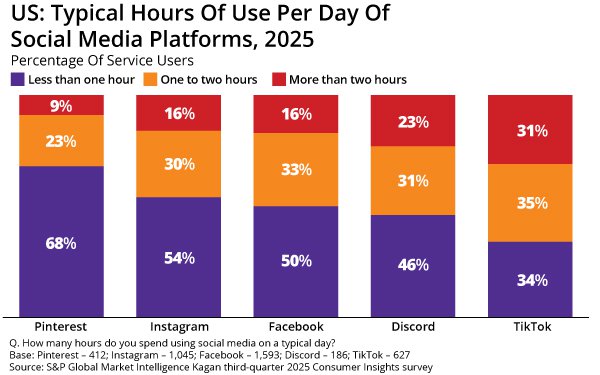
Looking specifically at the percentage of social-media users and their different levels of time spent on services, 31% of TikTok users can spend more than two hours a day on the service -- higher than users on Facebook, Instagram, Discord and Pinterest.

By comparison, 16% of Facebook users spend two or more hours on services, compared to 9% with Pinterest. Roughly 50% of users spend less than an hour a day on non-TikTok social media.

S&P research comes from 2,500 respondents via a survey done in the third quarter of this year. For the individual social media research, 627 respondents were surveyed for TikTok compared to 1,593 for Facebook, 196 for Discord, 1,045 for Instagram and 412 for Pinterest.